WELVERT, EAntiquariat.de
Postcolonial Disillusionment and Migration in African Literature
2026rif. x-1041285434Routledge 2026. Hardcover. New. 262 pages. 9.18x6.12x9.45 inches. Routledge hardcover

Revaluation Books · Regno Unito270,29 £≈ 321,67 €
1708 risultati
1900rif. 3135802Paris, Calman-Lévy, (etwa 1900). 62, 398 S. Halbleder der Zeit.
1987rif. 3461452Paris, Aubier, 1987. 404 S. OKart.
1912rif. 3316476Leipzig, 1912. 80 S. OBroschur.
1924rif. 3460560München, Müller, 1924. 227 S. OKart. (Name auf Vorsatz).
1991rif. 3464981Frankfurt, Lang, 1991. 182 S. OKart.
1963rif. 3358891London, Routledge and Kegan Paul, 1963. VIII, 278 S. OLwd (mit OUmschlag).
1887rif. 3463453Paris, Picard-Bernheim, (1887). XIII, 459 S. Roter Halblederband der Zeit.
1992rif. 3461240Bonn, Bouvier, 1992. VIII, 576 S. OPpbd.
1940rif. 3013156Paris, Presses Universitaires de France, 1940. 162 S. Kart.
1889rif. 3465267Paris, Guillaumin, 1889. XII, 416 S. Mit Porträt. Kart.
1919rif. 811372Berlin, Ullstein, (1919). M. Portr. 227 S. OPp. Einbd. etwas fleckig. St. a. Tit.
1900rif. 703668Bielefeld, Velhagen & Klasing, 1900. 4°. M. 1 Faks., 4 (1 doppelbl. gr.) Taf. u. 93 Abb. 128 S. OLwd. M. Kopfgoldschn. Anmerk. a. Tit. (Monogr. z. Weltgesch. XIII).
1920rif. 127419Paris, Librairie Hachette, 1920. M. einigen Abb. 324 S. OBr. Rücken etwas angerissen. Umschl. teils fleckig. (Figures du passé).
2026rif. x-1041285434Routledge 2026. Hardcover. New. 262 pages. 9.18x6.12x9.45 inches. Routledge hardcover
1788rif. ZB1326673A Londres 1788. 7 vols. in eight; frontis. portrait of Frederic in the first volume; contemporary marbled boards & leather backstrips however now lacking all of the leather spine coverings; masonic book plate to the front paste down and small hand stamp to the title page of each volume occasional foxing else internally clean and tight. - If you are reading this this item is actually physically in our stock and ready for shipment once ordered. We are not bookjackers. Buyer is responsible for any additional duties taxes or fees required by recipient's country. Photos available upon request. A Londres hardcover
1788rif. ZB1314872A Londres Paris: Lejay 1788. 2 vols. quarto measuring 10 x 8 inches; xliv 522 566 pp. frontis. portrait of Frederic in the first volume; uniformly bound in contemporary full leather bindings dry and very worn hand stamp to each title page else internally clean and tight. - If you are reading this this item is actually physically in our stock and ready for shipment once ordered. We are not bookjackers. Buyer is responsible for any additional duties taxes or fees required by recipient's country. A Londres Paris: Lejay hardcover
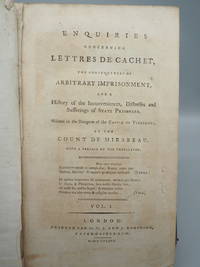
1787rif. C181678London: G. G. J. and J. Robinson 1787. Hardcover Hardcover. Very Good. Vol. 1. only. Bound in full contemporary leather worn with front board detached otherwise very good. G. G. J. and J. Robinson, hardcover
1900rif. 63439ca. 1900. Le Monde Intellectuel. - La France Contemporaine. - Berlin-Charlottenburg Adolf Eckstein Editeur o.J. ca.1900 300 x 460 mm; beigelegt 1 pp. Biographie von Albert de Ricaudy. Sibylle Aimée Marie-Antoinette Gabrielle de Riquetti de Mirabeau Gräfin de Martel de Janville 1849-1932 war eine französische Schriftstellerin die ihre Werke unter dem Pseudonym "Gyp" veröffentlichte. Ihren Salon in Neuilly-sur-Seine besuchten u. a. Robert de Montesquiou Marcel Proust Edgar Degas Maurice Barrès Anatole France Paul Valéry Alphonse Daudet und Jean-Louis Forain. unknown
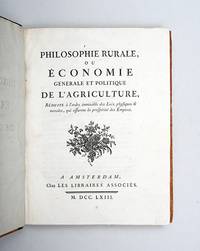
1763rif. 153616Amsterdam: Chez les Libraires Associés 1763. The new science of economics Rare first edition presenting "perhaps the most complete and magisterial account of the views of the Physiocratic school" Higgs. "Quesnay collaborated very substantially in preparing this last major work contributing the final chapter with further explanations and manipulations of his Tableau Économique analysis" The New Palgrave. Schumpeter calls the work "the first of the four textbooks of physiocrat orthodoxy" p. 225. It contains for the first time Quesnay's masterful explanation of his Tableau Économique "one of those works in the history of economics which have often been regarded as an anticipation of modern theories" Schumpeter p. 242. Originally printed as a pamphlet of 16 pages in 1758 in a minute number of copies Quesnay's Tableau Économique was first revealed to the public as the final part of Mirabeau's L'Ami des Hommes in 1760. In the Philosophie rurale Quesnay for the first time gives a full explanation of his system. The Tableau économique is credited as the "first precise formulation" of interdependent systems in economics and the origin of the theory of the multiplier in economics. An analogous table is used in the theory of money creation under fractional-reserve banking by relending of deposits leading to the money multiplier. In a letter to Mirabeau written late in 1758 Quesnay remarks "J'ai taché de faire un tableau fondamental de l'ordre économique pour y représenter les dépenses et les produits sous un aspect facile à saisir et pour juger clairment des arrangemens et des dérangemens que le gouvernement peut y causer" translated: "I have tried to make a fundamental table of the economic order in order to represent the expenses and the products in an aspect easy to grasp and to judge clearly of the arrangements and disturbances that the government can cause there". "A most remarkable analysis of the economic condition of his country" Palgrave the Tableau économique "is the most important and famous work of Physiocracy and has often been regarded as a summary of the entire corpus of Physiocratic economics. The Tableau has also been regarded as the analytical synthesis of the logical structure of Quesnay's economics or at least as its most relevant aspect. The Tableau économique is one of those works in the history of economics which have often been regarded as an anticipation of modern theories. The Tableau has been considered a first rough presentation of Keynes's multiplier and as a sort of general equilibrium system of a Walrasian type. For others the Tableau is an input-output table. Because of the Tableau Quesnay has been regarded as an early econometrician. The Tableau has also been interpreted as the first classical system of price determination thus anticipating Marx's reproduction schemes and Sraffa's price system" Giovanni Vaggi in The New Palgrave. Quarto 260 x 192 mm. With 3 engraved plates including the Tableau économique. Contemporary quarter marbled sheep orange paste paper sides light blue endpapers. Housed in a black cloth flat-back box by the Chelsea Bindery. Neatly restored at extremities insect abrasion to spine slight cockling to paste paper sides contents clean and fresh. A very good copy. Goldsmiths' 9836; Higgs 2881; INED 3204; Kress 6120; Mattioli 2435. hardcover
rif. 181865Paris EDHIS Éditions d'Histoire Sociale. 1968. Original publisher's sewn gray paperback black lettering spine and frontcover 8vo: I. Sur Moses Mendelssohn sur la réforme politique des Juifs 1787: lxxij 130pp. 2pp. II. Dissertation sur cette question: est il des moyens de rendre les Juifs plus heureux et plus utiles en France 1788x 105pp. 9pp. III. Essai sur la régénération physique morale et politique des Juifs 1789: xij 262pp. 4pp. IV. 4: Apologie des Juifs en réponse a la question: est il des moyens de rendre les Juifs plus heureux et plus utiles en France 1789: iv 90pp. 6pp. V. Adresses Mémoires et Pétitions des Juifs 1789-1794: iv ca. 350pp. ij 18 contributions. VI. La commune et les districts de Paris: discours lettres et rapports 1790-1791: vi ca. 135pp. ij. VII. L'Assemblee Nationale Constituante: motions discours et rapports les legislation nouvelle 1789-1791: iv xvi ca. 150pp. ij. VIII. Lettres memoires et publications diverses 1787-1806: vi ca. 250pp. ij. Untrimmed - unopened. Very fine copies - as new. Facsimile of the original edition. Each volume printed in 750 numbered copies. Paris, EDHIS [Éditions d'Histoire Sociale]. 1968 paperback
1760rif. 83935No place: no printer 1760. First edition of a spirited and able attack upon the financial administration of France and especially upon the "fermiers généraux" whom Mirabeau regarded as parasites preying upon the vitals of the nation. The work highlights the problems and injustices of the French system of taxation and added fuel to the fire of the coming revolution. The king disapproved of the work; Mirabeau was imprisoned on 16 December 1760 but through the efforts of Madame de Pompadour and others was released on Christmas Eve under orders to leave Paris for his estate at Bignon. The work proposes a reorganization of financial administrative machinery the abolition of the "Fermes" a reduction in the taxation upon salt with the object of increasing the total yield and a special tax upon tobacco farms. The domaine the post and the mint were to be further sources of revenue. The author ranks as one of the earliest important writers on taxation. Higgs notes that the book is "of real importance in the history of financial theory" The Physiocrats p. 57. Quarto 257 x 192 mm. Additional engraved frontispiece portrait of the author. Contemporary sprinkled calf spine ruled and decorated gilt in compartments red morocco label sprinkled edges. Spine ends and corners skilfully repaired. Manuscript note to title-page "par Mr Mirabeau père" with a short verse "helas dans le Siècle ou nous sommes / pour avoir dit la vérité / Mirabeau cet ami des hommes vient de perdre la liberté" in a neat calligraphic hand. Occasional light foxing. A very good copy. Goldsmiths' 9836; Higgs 2881; INED 3204; Kress 6120. unknown
1782rif. 28912AB1782. 2 Teile in 1 Bd. Hamburg o. Vlg. 1782. 8°. XIV 2 366 1 S.; 237 S. 1 Bl. Halblederbd. d. Zt. mit Rückenvergoldung u. goldgepr. Rückentitel bestossen. Graesse 535. - Holzmann/Bohatta 53. - Das anonym erschienene Werk Mirabeaus entstand während der durch seinen Vater veranlassten Inhaftierung und ist wie "Essai sur le despotisme 1775" gegen die despotisch ausgeübte Staatsgewalt mit ihrer Unterdrückung gerichtet. In seinen staatsphilosophischen Werken plädiert er für Freiheit und Volksbildung als Grundvoraussetzung jeder sozialen Harmonie. - Vorsätze leicht stockfleckig. Durchgehnd gebräunt. Gelenke am Kopf des Einbandes über 4 cm geplatzt. Rücken mit mehreren kl. Wurmlöchern. unknown
1789rif. 57115Paris Chez Baudouin Imprimeur de l'Assamblée Nationale 1789. 8vo. Bound in an exquisite later red half morocco with gilt spine. Top edge gilt. 1 f. title-page 8 pp. "Déclaration des droits de l'Homme en société" 6 pp. "Articles de Constitution" 1 f. "Réponse du Roi" 1 f. blank. Woodcut head-pieces. Title-page slightly bowned otherwise in excellent condition. A truly excellent copy. The exceedingly scarce true first printing in an incredibly rare form of off-print/separate printing of one of the most important and influential documents in the history of mankind namely the French Human Rights Declaration containing also the articles for the first French Constitution. This groundbreaking publication constitutes a monumental change in the structure of the human world providing all citizens with individual rights that we now take for granted. This monument of humanist thought appeared in the "Procès verbal de l'Assemblée Nationale" copies of which are also very difficult to obtain. There however the two parts appeared without a title-page and without the final blank which together constitute a form of wrappers for this off-print/separate printing of which only five or six other copies are known and which is present in merely one or two libraries world-wide. As far as we now only one other copy has been on the private market and that did not have the blank back wrapper. This exceedingly rare separate printing of the Human Rights Declaration with the Constitution was intended for the inner circle of those participating in its creation and was limited to a very restricted number of copies - all of which will have been owned by the creators of the Declaration. This epochal document is just as important today as it was when it was formulated during the French Revolution in 1789 and since 2003 the Declaration has been listed in the UNESCO Memory of World Register - "This fundamental legacy of the French Revolution formed the basis of the United Nations Declaration of 1948 and is of universal value". Few other documents in the history of mankind has done as much to determine the way we live and think the way Western societies are structured and governed and few other documents have had such a direct impact upon our constitutional rights and the way we view ourselves and others in society. It is here that we find the formulation of liberty and equality upon which so much of Western political and moral thought is based - that all "men are born and remain free and equal in rights" Article 1 which were specified as the rights of liberty private property the inviolability of the person and resistance to oppression Article 2; that all citizens were equal before the law and were to have the right to participate in legislation directly or indirectly Article 6; no one was to be arrested without a judicial order Article 7; Freedom of religion Article 10 and freedom of speech Article 11 were safeguarded within the bounds of public "order" and "law" etc. etc.The content of the document that were to change the Western world for good emerged largely from the ideals of the Enlightenment. "The sources of the Declaration included the major thinkers of the French Enlightenment such as Montesquieu who had urged the separation of powers and Jean-Jacques Rousseau who wrote of general will-the concept that the state represents the general will of the citizens. The idea that the individual must be safeguarded against arbitrary police or judicial action was anticipated by the 18th-century parlements as well as by writers such as Voltaire. French jurists and economists such as the physiocrats had insisted on the inviolability of private property." Encycl. Britt.The key drafts were prepared by Lafayette working at times with Thomas Jefferson. In August 1789 Honoré Mirabeau played a central role in conceptualizing and drafting the Declaration. On August 26 1789 in the midst of The French Revolution the last article of the Declaration was adopted by the National Constituent Assembly as the first step towards a constitution for France. "In 1789 the people of France brought about the abolishment of the absolute monarchy and set the stage for the establishment of the first French Republic. Just six weeks after the storming of the Bastille and barely three weeks after the abolition of feudalism the Declaration of the Rights of Man and of the Citizen French: La Déclaration des Droits de l'Homme et du Citoyen was adopted by the National Constituent Assembly as the first step toward writing a constitution for the Republic of France.The Declaration proclaims that all citizens are to be guaranteed the rights of "liberty property security and resistance to oppression." It argues that the need for law derives from the fact that ".the exercise of the natural rights of each man has only those borders which assure other members of the society the enjoyment of these same rights." Thus the Declaration sees law as an "expression of the general will" intended to promote this equality of rights and to forbid "only actions harmful to the society." www.humanrights.com. This sensational document became the crowning achievement of the French Revolution; it came to accelerate the overthrow of the "Ancien Régime" and sowed the seed of an extremely radical re-ordering of society. The Declaration interchanged the pre-revolutionary division of society -in the clergy the aristocracy and the common people- with a general equality - "All the citizens being equal in the eyes of the law are equally admissible to all public dignities places and employments according to their capacity and without distinction other than that of their virtues and of their talents" From Article VI upon which today's society is still based. It is hard to imagine a work that is more important to the foundation of the society that we live in today. unknown
1789rif. 54453Kiøbenhavn Hegelunds Forlag 1789. Samtidigt helldrbd. i flammet kalv med overdådig rygforgyldning. Rygtitel fornyet forgyldt. 4460 pp. Trykt på skrivepapir. Første danske udgave unknown
1989rif. BN257386Frankfurt am Main : Insel-Verl. 1989. 1989. Mirabeau - "Der Redner der Revolution" : Reden Briefe Schriften. hrsg. u. übers. von Horst Günther Mirabeau - "Der Redner der Revolution" : Reden Briefe Schriften. hrsg. u. übers. von Horst Günther Mirabeau Honoré-Gabriel de Riquetti de und Horst Günther Frankfurt am Main : Insel-Verl. unknown