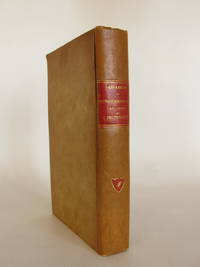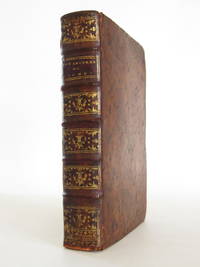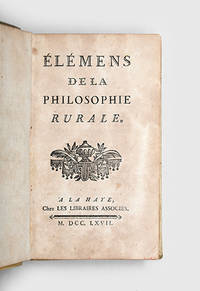
1767ref. 164209The Hague: chez les Libraires associés 1767. Handbook of Physiocracy including the Tableau économique First edition of Mirabeau's own abridgement of his and Quesnay's Philosophie rurale 1763 the first textbook of the physiocratic school. The Philosophie rurale presented "perhaps the most complete and magisterial account of the views of the Physiocratic school" Higgs p. 57. The Eléméns condenses the work into a more manageable textbook format aiming at a broader dissemination and understanding of the system. Importantly the Eléméns contains as a folding plate the Tableau économique first published in 1758 in a minute number of copies and reproduced in Mirabeau's L'Ami des hommes in 1760 and in the Philosophie rurale. The Tableau économique is cited as the earliest attempt to visualize a comprehensive model of the economic system illustrating the flow of goods and money and the interdependence of the agricultural manufacturing and commercial sectors. It is credited as "the most important and famous work of Physiocracy and has often been regarded as a summary of the entire corpus of Physiocratic economics" New Palgrave IV p. 23. Provenance: 19th-century bookplate of Isaac Iselin to the front pastedown; 20th-century note of authorship to front free endpaper; half-title with 20th-century library stamps of the Basel section of Schweiz Vereinigung für Sozialpolitik noted as bequeathed by the Austrian labour economist Stephan Bauer 1865-1934 and of the political science seminar of the University of Basel. Duodecimo 162 x 89 mm. Engraved folding Tableau économique at rear. Contemporary vellum spine lettered in gilt red sprinkled edges. Slight browning half-title loosening a little short closed tear to inner margin of table. A very good copy. Einaudi 3948; Goldsmiths' 10275; Higgs 3977; INED 3197; Kress 6477. Henry Higgs The Physiocrats 1963. hardcover
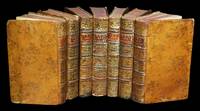
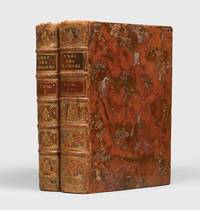
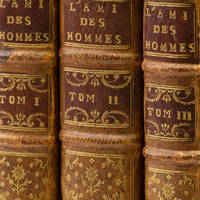
1760ref. 304661760. A Hambourg chez Chrtien Hrold 1760 - S.l. s.. 1761. 8 parties relies en 7 vol. au format in-12 168 x 102 mm de 2 ff. n.fol. 308 pp. et 1 f. n.fol. ; 2 ff. n.fol. 426 pp. et 1 f. n.fol. ; 422 pp. et 1 f. n.fol. ; 2 ff. n.fol. et 336 pp. ; 2 ff. n.fol. vi - 281 pp. 2 ff. n.fol. et 1 f. bl. ; 2 ff. n.fol. et 205 pp. ; 2 ff. n.fol. 192 pp. et 2 ff. n.fol. ; 2 ff. n.fol. et 104 pp. ; viii - 422 pp. Reliures uniformes de l'poque de pleine basane glace et marbre blonde filet gras vertical froid port sur chacun des plats dos nerfs orns de filets gras froid caissons d'encadrement dors important dcor fleuronn dor piÂces de titre de maroquin vieux-rouge titre dor tomaison dore palette dore en tÂte et queue jeu de petits filets obliques dors sur les coupes tranches saumon. Ensemble complet de ses 8 parties ; ici relies en 7 volumes. A la fin du dernier a t reli - sans page de titre - La Thorie de l'impt de Mirabeau. Ouvrage en outre complet de ses 6 tableaux dpliants. Primitivement paru en un volume Avignon en 1759 les derniÂres cinq autres parties qui composent cet ensemble parurent de 1758 1760. En effet lorsque Mirabeau publia le prsent ouvrage il ne connaissait pas encore Quesnay. Ce dernier fut vivement impressionn par L'Ami des hommes et trÂs rapidement de leur rencontre naquit l'cole Physiocratique et les trois autres parties de l'Ami des Hommes seront le rsultat de la collaboration des deux hommes. Principal propagateur des doctrines conomiques en France Riquetti propose ici un trait fondamental pour la physiocratie alors naissante en partie inspir de FranÂois Quesnay. On y trouve ici noncs des principes comme le primat de lÕagriculture et la condamnation de la finance du luxe et de la Ç cupidit È dans un monde sous la conduite de propritaires et dÕun ÇÊroi pasteurÊÈ. Aussi d'aprÂs l'auteur ''la vraie richesse ne consiste que dans la population. Or la population dpend de sa subsistance et la subsistance ne se tire que de l'agriculture. Ainsi pour ce physiocrate convaincu tout dpend de l'agriculture : elle reste le premier des arts. Mirabeau se rangera derriÂre l'ide que Ç Plus vous faites rapporter la terre et plus vous la peuplez È''. Riquetti comprit avec quelques autres la vritable nature du paysan franÂais sa dvotion la terre et sa persvrance endurer un travail dur et reintant pour en obtenir une parcelle.Ê Le paysan nՎtait pas pauvre par paresse mais parce que le dcouragement de ne jamais rien obtenir le conduisait baisser les bras au milieu de beaucoup de contraintes. Il travaillerait toujours dur pour son propre intrÂt. Il fallait donc lui faciliter lÕaccÂs la proprit rurale en supprimant les causes de son dcouragement.Ê En outre Mirabeau souligna le besoin dÕun traitement rural de lÕassistance publique convaincu quÕil tait de la supriorit de lÕagriculture sur toutes les autres formes de richesse. Les villes lui paraissaient comme des excroissances conomiques sources de luxe qui rpandait son pouvoir de corruption sur les campagnes environnantes. Barbier I Dictionnaire des ouvrages anonymes 133 - Brunet III Manuel du libraire et de l'amateur de livres 1739 - Cioranescu II Bibliographie de la littrature franÂaise du XVIIIÂme siÂcle 45626 - Tchmerzine VIII Bibliographie d'ditions d'auteurs franÂais 283 - Qurard VI La France littraire p. 154. Angles lims. Quelques abrasions ou petits manques superficiels affectant les plats. Quelques coiffes arases. Dos prsentant un clat lgÂrement altr. Quelques rousseurs et feuillets parfois oxyds. Petite dchirure en marge d'une page de titre. Du reste bonne condition. b42961 unknown
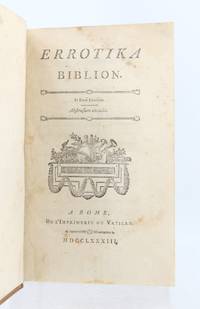
1783ref. 85830Rome Neuchâtel Neuchâtel: De l'imprimerie du Vatican 1783. Fine. De l'imprimerie du Vatican Rome Neuchâtel Neuchâtel 1783 13 x 20.70 cm relié First edition. Bound with Reymond La Bataille d'Austerlitz poème dramatique en cinq actes Riom 1806; Huvier des Fontenelles La Targétade comédie un peu burlesque parodie d'Athalie de Racine de Racine 1791; de Bonnay La Prise des Annonciades n.p. n.d.; Abbé de Vermond La Cour plénière Héroï-tragi-comédie Paris 1788; Aymé Déportation et naufrage de J.J. Aymé Paris n.d.; Jourgniac de Saint-Médard Mon agonie de trente-huit heures Paris 1806. Contemporary beige half calf binding ochre paper boards smooth spine deep green morocco title-piece gilt title gilt stamped motifs. Some chafing to the boards scattered foxing. A few brown spots on the title page of La Prise des annonciades. Illustrated with a vignette on the title page of Errotika. Collection written by Mirabeau imprisoned in Vincennes at the same time as the Marquis de Sade. Various curiosities are culled from ancient writings relating to sexual practices such as onanism tribalism sodomy nymphomania etc. : ""The author in addition to the talent of perfectly mastering ancient languages writes very well in his own joking lightly and often drawing on Voltaire's style: in the very dirty pictures he sometimes presents he always uses honest or technical expressions: besides he seems well versed in the art of voluptuousness"" contemporary 18th century review quoted in Gay-Lem. II 151. According to the legend the book was relentlessly censored by the authorities and only fourteen copies of the first edition had survived - an estimate which seems to be quite inaccurate. After a second edition in 1792 the book was prohibited and included in the papal index. Another edition was destroyed in 1826 by the Royal Court of Paris and two further prosecutions were brought in 1856 and 1868 for ""outrage à la morale publique et aux bonnes murs"". The text was notably published by Guillaume Apollinaire along with other writings by Mirabeau in his 1910 edition in the Bibliothèque des Curieux series. De l'imprimerie du Vatican hardcover
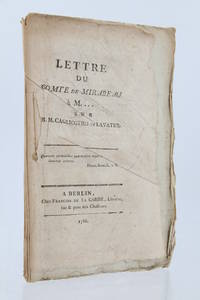
1786ref. 81145Paris: François de La Garde 1786. Fine. François de La Garde Paris 1786 14.50 x 22 cm broché First edition of this work addressed to the new King of Prussia Friedrich Wilhelm against the three great impostors of the time: Cagliostro Lavater and Mesmer. First page creased title page some light foxing. Rare work in original stitching. François de La Garde unknown
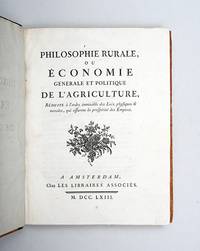
1763ref. 153616Amsterdam: Chez les Libraires Associés 1763. The new science of economics Rare first edition presenting "perhaps the most complete and magisterial account of the views of the Physiocratic school" Higgs. "Quesnay collaborated very substantially in preparing this last major work contributing the final chapter with further explanations and manipulations of his Tableau Économique analysis" The New Palgrave. Schumpeter calls the work "the first of the four textbooks of physiocrat orthodoxy" p. 225. It contains for the first time Quesnay's masterful explanation of his Tableau Économique "one of those works in the history of economics which have often been regarded as an anticipation of modern theories" Schumpeter p. 242. Originally printed as a pamphlet of 16 pages in 1758 in a minute number of copies Quesnay's Tableau Économique was first revealed to the public as the final part of Mirabeau's L'Ami des Hommes in 1760. In the Philosophie rurale Quesnay for the first time gives a full explanation of his system. The Tableau économique is credited as the "first precise formulation" of interdependent systems in economics and the origin of the theory of the multiplier in economics. An analogous table is used in the theory of money creation under fractional-reserve banking by relending of deposits leading to the money multiplier. In a letter to Mirabeau written late in 1758 Quesnay remarks "J'ai taché de faire un tableau fondamental de l'ordre économique pour y représenter les dépenses et les produits sous un aspect facile à saisir et pour juger clairment des arrangemens et des dérangemens que le gouvernement peut y causer" translated: "I have tried to make a fundamental table of the economic order in order to represent the expenses and the products in an aspect easy to grasp and to judge clearly of the arrangements and disturbances that the government can cause there". "A most remarkable analysis of the economic condition of his country" Palgrave the Tableau économique "is the most important and famous work of Physiocracy and has often been regarded as a summary of the entire corpus of Physiocratic economics. The Tableau has also been regarded as the analytical synthesis of the logical structure of Quesnay's economics or at least as its most relevant aspect. The Tableau économique is one of those works in the history of economics which have often been regarded as an anticipation of modern theories. The Tableau has been considered a first rough presentation of Keynes's multiplier and as a sort of general equilibrium system of a Walrasian type. For others the Tableau is an input-output table. Because of the Tableau Quesnay has been regarded as an early econometrician. The Tableau has also been interpreted as the first classical system of price determination thus anticipating Marx's reproduction schemes and Sraffa's price system" Giovanni Vaggi in The New Palgrave. Quarto 260 x 192 mm. With 3 engraved plates including the Tableau économique. Contemporary quarter marbled sheep orange paste paper sides light blue endpapers. Housed in a black cloth flat-back box by the Chelsea Bindery. Neatly restored at extremities insect abrasion to spine slight cockling to paste paper sides contents clean and fresh. A very good copy. Goldsmiths' 9836; Higgs 2881; INED 3204; Kress 6120; Mattioli 2435. hardcover
1788ref. 260481788. A Londres s.. Lejay 1788. Un fort vol. au format in-folio 433 x 277 mm de 3 ff. n.fol. 10 cartes graves sur double-page 93 planches graves tableaux et 1 f. bl. Ne subsiste plus de la reliure que le carton des plats. Important atlas au format in-4 comportant 10 sur 10 grandes cartes graves sur double-page dresses par Mentelle Pays-Bas autrichiens Tyrol BohÂme-Moravie Etats entre la BaviÂre et la BohÂme Carte gnrale d'Allemagne Monarchie prussienne l'orient de Weser Possessions du roi de Prusse l'ouest du Weser Carte de la Haute-Saxe et de la Lusace Haut et Bas-Rhin BaviÂre. L'ouvrage recÂle en outre 93 sur 93 planches graves dont double-pages ainsi que de nombreux tableaux dont dpliants. ''La parution de cet ouvrage fit faire banqueroute au libraire Lejay''. in Qurard. Qurard VI La France littraire p. 158. Petit travail de ver affectant les fonds de cahiers des feuillets liminaires ainsi que plus lgÂrement des cartes. L'une prsente des plissures une autre un petit manque angulaire ; une derniÂre des rousseurs. Chacune une discrÂte cerne marginale. Deux tableaux manquants. Plusieurs feuillets dsolidariss. Quelques petites altrations parses dans le corps d'ouvrage. Du reste belle condition. b42961 unknown
1758ref. 153197Avignon: no publisher 1758-60. The first public appearance of Quesnay's Tableau Économique First complete edition of all six parts containing the first public appearance of Quesnay's Tableau Économique; a superb copy in contemporary French red morocco very uncommon thus. The first to follow Quesnay in the foundation of the Physiocratic circle Mirabeau was familiar with and influenced by Cantillon's theories. As well as fully articulating the principles that were to mark the school of physiocrats and expounding their implications regarding population agriculture and commerce the Ami de l'Homme contained a reproduction of Quesnay's Tableau Économique vol. 6 previously published separately in very small numbers in 1758 and 1759. Mirabeau's reproduction made the essay obtainable thus bringing the founding document of the school of physiocrats to the attention of a wide public. "This remarkable treatise created the greatest sensation throughout the whole of Europe. It is said to have gone through forty editions and was translated into several languages. Its anonymous author soon discovered became the idol of the day and was generally referred to by the soubriquet which he had chosen for the title of his book" Palgrave II p. 775. Following the publication of the first three parts Mirabeau made the acquaintance of Quesnay who had been greatly impressed by his book. "Mirabeau now became the fervent admirer of Quesnay and between them they founded the school of the Physiocrats" ibid. With this new edition of the first three parts a fourth part was published in 1758 in which Quesnay's influence is clearly visible. The remaining two parts were published in 1760. The final part is of particular importance as it contains the first obtainable appearance of Quesnay's Tableau Économique which was previously published separately in tiny numbers in 1758 and 1759. An English translation was first published in 1766. 6 parts in 3 vols quarto 252 x 195 mm. Engraved frontispiece in part I engraved head- and tailpieces initials. Contemporary French red morocco spines elaborately decorated gilt in compartments twin green morocco labels raised bands triple gilt rule border to sides gilt inner dentelles marbled endpapers gilt edges green silk ribbon bookmarkers. Authorship attribution to first title in ink in an early hand. Bar a few trivial marks to sides the binding in beautiful condition corners a touch rubbed; vast majority of contents bright crisp and clean with very occasional spotting third volume with some light browning and foxing; loss to lower corners of leaves vol. 1 Hh2 and vol. 3 Aa3 not affecting text; patch of dampstain to last two leaves and final blank of vol. 2. A near-fine set. Einaudi 3941; Goldsmiths' 9317; Higgs 1628 1631; INED 3194; Kress 5735 & 5736; Mattioli 2427 2428 2429 & 2430. hardcover
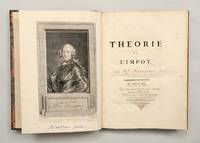
1760ref. 83935No place: no printer 1760. First edition of a spirited and able attack upon the financial administration of France and especially upon the "fermiers généraux" whom Mirabeau regarded as parasites preying upon the vitals of the nation. The work highlights the problems and injustices of the French system of taxation and added fuel to the fire of the coming revolution. The king disapproved of the work; Mirabeau was imprisoned on 16 December 1760 but through the efforts of Madame de Pompadour and others was released on Christmas Eve under orders to leave Paris for his estate at Bignon. The work proposes a reorganization of financial administrative machinery the abolition of the "Fermes" a reduction in the taxation upon salt with the object of increasing the total yield and a special tax upon tobacco farms. The domaine the post and the mint were to be further sources of revenue. The author ranks as one of the earliest important writers on taxation. Higgs notes that the book is "of real importance in the history of financial theory" The Physiocrats p. 57. Quarto 257 x 192 mm. Additional engraved frontispiece portrait of the author. Contemporary sprinkled calf spine ruled and decorated gilt in compartments red morocco label sprinkled edges. Spine ends and corners skilfully repaired. Manuscript note to title-page "par Mr Mirabeau père" with a short verse "helas dans le Siècle ou nous sommes / pour avoir dit la vérité / Mirabeau cet ami des hommes vient de perdre la liberté" in a neat calligraphic hand. Occasional light foxing. A very good copy. Goldsmiths' 9836; Higgs 2881; INED 3204; Kress 6120. unknown
1756ref. 131625Avignon: n.p. 1756-60. The first public appearance of Quesnay's Tableau économique First edition of all six parts containing the first public appearance of Quesnay's Tableau économique. The first to follow Quesnay in the foundation of the Physiocratic circle Mirabeau was familiar with and influenced by Cantillon's theories. As well as fully articulating the principles that were to mark the school of physiocrats and expounding their implications regarding population agriculture and commerce the Ami des Hommes contained a reproduction of Quesnay's Tableau économique vol. VI previously published separately in very small numbers in 1758 and 1759. Mirabeau's reproduction made the essay obtainable thus bringing the founding document of the school of physiocrats to the attention of a wide public. "This remarkable treatise created the greatest sensation throughout the whole of Europe. It is said to have gone through forty editions and was translated into several languages. Its anonymous author soon discovered became the idol of the day and was generally referred to by the soubriquet which he had chosen for the title of his book" Palgrave II p. 775. Following the publication of the first three parts Mirabeau made the acquaintance of Quesnay who had been greatly impressed by his book. "Mirabeau now became the fervent admirer of Quesnay and between them they founded the school of the Physiocrats" ibid. In 1758 a fourth part was published in which Quesnay's influence is clearly visible. The remaining two parts were published in 1760. The final part is of particular importance as it contains the first obtainable appearance of Quesnay's Tableau économique which was previously published separately in tiny numbers in 1758 and 1759. An English translation was first published in 1766. 6 parts in 2 vols quarto 246 x 188 mm. Contemporary French mottled calf spines ruled and decorated gilt in compartments all edges red. Joints and extremities expertly restored scattered foxing to contents; a handsome copy. Einaudi 3941; Goldsmiths' 9092; Higgs 1143 1631 & 2160; INED 3194; Kress 5543 & 5736; Mattioli 2426 2428 & 2429. unknown
1789ref. 57115Paris Chez Baudouin Imprimeur de l'Assamblée Nationale 1789. 8vo. Bound in an exquisite later red half morocco with gilt spine. Top edge gilt. 1 f. title-page 8 pp. "Déclaration des droits de l'Homme en société" 6 pp. "Articles de Constitution" 1 f. "Réponse du Roi" 1 f. blank. Woodcut head-pieces. Title-page slightly bowned otherwise in excellent condition. A truly excellent copy. The exceedingly scarce true first printing in an incredibly rare form of off-print/separate printing of one of the most important and influential documents in the history of mankind namely the French Human Rights Declaration containing also the articles for the first French Constitution. This groundbreaking publication constitutes a monumental change in the structure of the human world providing all citizens with individual rights that we now take for granted. This monument of humanist thought appeared in the "Procès verbal de l'Assemblée Nationale" copies of which are also very difficult to obtain. There however the two parts appeared without a title-page and without the final blank which together constitute a form of wrappers for this off-print/separate printing of which only five or six other copies are known and which is present in merely one or two libraries world-wide. As far as we now only one other copy has been on the private market and that did not have the blank back wrapper. This exceedingly rare separate printing of the Human Rights Declaration with the Constitution was intended for the inner circle of those participating in its creation and was limited to a very restricted number of copies - all of which will have been owned by the creators of the Declaration. This epochal document is just as important today as it was when it was formulated during the French Revolution in 1789 and since 2003 the Declaration has been listed in the UNESCO Memory of World Register - "This fundamental legacy of the French Revolution formed the basis of the United Nations Declaration of 1948 and is of universal value". Few other documents in the history of mankind has done as much to determine the way we live and think the way Western societies are structured and governed and few other documents have had such a direct impact upon our constitutional rights and the way we view ourselves and others in society. It is here that we find the formulation of liberty and equality upon which so much of Western political and moral thought is based - that all "men are born and remain free and equal in rights" Article 1 which were specified as the rights of liberty private property the inviolability of the person and resistance to oppression Article 2; that all citizens were equal before the law and were to have the right to participate in legislation directly or indirectly Article 6; no one was to be arrested without a judicial order Article 7; Freedom of religion Article 10 and freedom of speech Article 11 were safeguarded within the bounds of public "order" and "law" etc. etc.The content of the document that were to change the Western world for good emerged largely from the ideals of the Enlightenment. "The sources of the Declaration included the major thinkers of the French Enlightenment such as Montesquieu who had urged the separation of powers and Jean-Jacques Rousseau who wrote of general will-the concept that the state represents the general will of the citizens. The idea that the individual must be safeguarded against arbitrary police or judicial action was anticipated by the 18th-century parlements as well as by writers such as Voltaire. French jurists and economists such as the physiocrats had insisted on the inviolability of private property." Encycl. Britt.The key drafts were prepared by Lafayette working at times with Thomas Jefferson. In August 1789 Honoré Mirabeau played a central role in conceptualizing and drafting the Declaration. On August 26 1789 in the midst of The French Revolution the last article of the Declaration was adopted by the National Constituent Assembly as the first step towards a constitution for France. "In 1789 the people of France brought about the abolishment of the absolute monarchy and set the stage for the establishment of the first French Republic. Just six weeks after the storming of the Bastille and barely three weeks after the abolition of feudalism the Declaration of the Rights of Man and of the Citizen French: La Déclaration des Droits de l'Homme et du Citoyen was adopted by the National Constituent Assembly as the first step toward writing a constitution for the Republic of France.The Declaration proclaims that all citizens are to be guaranteed the rights of "liberty property security and resistance to oppression." It argues that the need for law derives from the fact that ".the exercise of the natural rights of each man has only those borders which assure other members of the society the enjoyment of these same rights." Thus the Declaration sees law as an "expression of the general will" intended to promote this equality of rights and to forbid "only actions harmful to the society." www.humanrights.com. This sensational document became the crowning achievement of the French Revolution; it came to accelerate the overthrow of the "Ancien Régime" and sowed the seed of an extremely radical re-ordering of society. The Declaration interchanged the pre-revolutionary division of society -in the clergy the aristocracy and the common people- with a general equality - "All the citizens being equal in the eyes of the law are equally admissible to all public dignities places and employments according to their capacity and without distinction other than that of their virtues and of their talents" From Article VI upon which today's society is still based. It is hard to imagine a work that is more important to the foundation of the society that we live in today. unknown
1788ref. 65686à Londres London: Chez J. Johnson 1788. Fine. Chez J. Johnson à Londres London 1788 - relié First edition second issue. The first of 1784 contains only 212pp. against 403 for this one which has been expanded with the translation of Price's work: ""Observations on the Importance of the American Revolution"". Turgot's letter and Price's book benefit from a half-title. Later modern binding. Pastiche blonde cardboard Bradel binding. Smooth spine with pink sheep title and volume labels. Spine lightly darkened. Rubbing. Uncut copy bound directly from the original wrappers. The first 2 leaves browned. Scattered browning. Last leaf with lack to lower right corner. The Order of Cincinnati a modern order of chivalry was instituted by Washington to reward the French and Americans at the end of the War of Independence. The creation of this order was initially criticized in the United States itself as contrary to the democratic principles of equality. Mirabeau's work then residing in England takes up these criticisms and extends them to all noble heredities. The translation of Richard Price's work major in the history of American democratic ideas was requested by Benjamin Franklin. A letter from Turgot attached to the whole asks Americans to be more scrupulous in the future regarding democratic principles. Chez J. Johnson unknown
1782ref. 65195A Hambourg Hamburg: S. n. 1782. Fine. S. n. A Hambourg Hamburg 1782 12 x 20 cm In-8 relié First edition. The second part is regarded as rare since Prussia ordered the manuscript to be seized and the copies burned although in fact the second part is found in many sets. Contemporary full mottled brown calf binding. Spine with raised bands richly gilt. Red morocco lettering-piece. Lower headcap partly torn. Abrasion to the lower cover with loss along the joint. Two corners rubbed. A brown stain in the upper margin of p. 49 about 2 cm. Loss in the margin at the corner of p. 144 not affecting the text. Marbled endpaper with a cut along the outer margin. Some gatherings browned. A good copy. The work written during and after Mirabeaus arrest and imprisonment at Vincennes is both a plea and an indictment against arbitrary justice and power. « J'entreprends de parler des emprisonnements arbitraires et des prisons d'état. » The volume contains numerous historical commentaries and substantial documentation on arbitrary authority and judicial practice. In the second part Mirabeau deals more specifically with prison life and incarceration. He also reflects on the English constitution and argues that our own history condemns the use of lettres de cachet just as it makes kings the sole representatives of the people. A rich source of material on prisons and imprisonment. S. n. hardcover
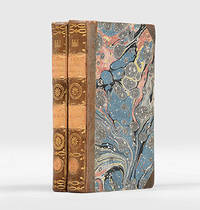
1769ref. 126597Amsterdam et se trouve à Paris: Lacombe 1769. Scarce complete thus attractively bound First duodecimo edition of Mirabeau's Les économiques also printed in a single quarto volume format the same year. A further volume was published in 1771 also in both quarto and 2-volume duodecimo formats. Complete sets are very scarce. Mirabeau who seems to have taken the title of this work from the Économiques of Xenophon here gives various methods of economic instruction for the various levels of society; he also suggests the method of approach in the instruction of heads of government. 2 vols duodecimo 162 x 95 mm. Engraved head- and tailpieces. Near-contemporary half calf twin morocco labels spine elaborately tooled in gilt red morocco onlay roundels with vol. numbers to foot of spine marbled paper boards. Ownership signature to title pages of both vols of one H. Wrangel possibly a descendant of the Swedish Governor General Hermann Wrangel 1584-1653 whose crest incorporates a turret as stamped at the head of each spine. Extremities lightly rubbed two neat paper repairs to title leaf of volume 1 else a very good set attractively bound. Einaudi 3943; Higgs 4568; INED 3196; Mattioli 2432 hardcover
1789ref. 54453Kiøbenhavn Hegelunds Forlag 1789. Samtidigt helldrbd. i flammet kalv med overdådig rygforgyldning. Rygtitel fornyet forgyldt. 4460 pp. Trykt på skrivepapir. Første danske udgave unknown
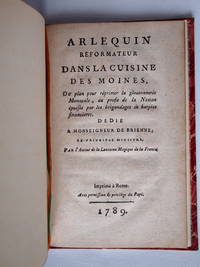
1789ref. 56166Imprimé à Rome Rome: S. n. 1789. Fine. S. n. Imprimé à Rome Rome 1789 13 x 19 cm relié The rare first edition probably printed in Paris anonymously by Mirabeau according to the Bibliothèque Nationale de France. Half morocco binding in faded red with long grain from the late 19th century signed L. Lemardeley with a tool at head and tail gilt title rubbing the binding bears the title: Stephan Bordese - Blanc et bleu which indicates that the work has been rebound. Handsome copy. Avis charitable aux moines so that they enrich the state and population by ceasing their gluttony at the expense of the people. The author promises the different monastic orders a monument to their glory if they comply with his prayers. Anticlerical libel violently attacking the monks. Armorial bookplate: Rose. S. n. unknown
1760ref. 84111No place: no printer 1760 & 1761. OF REAL IMPORTANCE IN THE HISTORY OF FINANCIAL THEORY" - a BEAUTIFUL COPY First edition of both works pairing Mirabeau's Théorie de l'Impôt his spirited and able attack upon the financial administration of France especially the "fermiers généraux" whom Mirabeau regarded as parasites preying upon the vitals of the nation with Pesselier's counterattack notable for its terse affirmation of the characteristically Physiocratic doctrine that agriculture holds a privileged place in the economic system. Mirabeau's work highlights the problems and injustices of the French system of taxation and added fuel to the coming fire of the revolution. The king disapproved of the work; Mirabeau was imprisoned on 16 December 1760 but was released on Christmas Eve through the efforts of Madame de Pompadour and others under orders to leave Paris for his estate at Bignon. The work proposes a reorganization of financial administrative machinery the abolition of the "fermes" a reduction in the taxation upon salt with the object of increasing the total yield and a special tax upon tobacco farms. The domaine the post and the mint were to be further sources of revenue. Mirabeau ranks as one of the earliest important writers on taxation. Higgs notes that the book is "of real importance in the history of financial theory" The Physiocrats p. 57. Pesselier was one of the most forceful critics of the physiocrats. Of the products of the soil Pesselier here writes "Elles procurent un profit net et durable puisqu'elles sont à l'abri de l'imitation" "They provide a net and lasting profit since they are safe from imitation". Two works bound in a single vol. quarto 255 x 193 mm. Contemporary French mottled calf spine decorated gilt in compartments red morocco label marbled endpapers. Housed in a brown morocco-backed book-form case. Engraved armorial bookplate to front pastedown. Lower edge a little rubbed with corners worn very occasional spotting; very good copies. Mirabeau: Einaudi 3946; Goldsmiths' 9602; Higgs 2297; INED 3209; Kress 5883. Pesselier: Brunet I 1118; Einaudi 4409; Goldsmiths' 9695; Higgs 2534; INED 3524; Kress 5964. unknown
1790ref. 32925Paris: Bureau de la collection historique des Mémoires relatifs au règne de Louis XV. 1790. Fine. Bureau de la collection historique des Mémoires relatifs au règne de Louis XV. Paris 1790 12.50 x 21 cm relié First edition. Posthumous publication by Soulavie. Contemporary full sheep binding. Smooth spine decorated with double gilt fillets title-labels headcaps worn joints rubbed numerous scuffs corners slightly bumped. Emmanuel Armand de Vignerot du Plessis de Richelieu duc d'Aiguillon was appointed governor of Brittany in 1753; until 1770 he was in open war with the Parliament of Brittany appointed by the king in a regional state that desired above all to preserve its privileges. Louis XV had to intervene several times in agreement with the duc d'Aiguillon. The memoirs record the numerous intrigues at court to destroy the duc d'Aiguillon. A final memoir concerns Louis XV's beautification projects in Nantes and Paris. Bureau de la collection historique des Mémoires relatifs au règne de Louis XV. unknown
1789ref. 30088s. l. Paris ou Londres London: S. n. 1789. Fine. S. n. s. l. Paris ou Londres London 1789 13.50 x 21.50 cm broché Reprint of the first edition also published in 1789. A second volume of these portraits would appear a little later. In original wrappers. Title page margins worn. The work is a series of portraits with a key at the end of the book to identify them; it includes Necker Guillotin Sieyès. Luchet also participated in writing some of these portraits. S. n. unknown
1881ref. 352135Brussels: Gay et Doucé 1881. No. 113 of 500 hand-numbered copies on Van Gelder Hollande. Engraved frontispiece by Chauvet portrait and facsiimile letter. Title page printed in red and black. xxix 267 5 pp. 1 vols. 8vo. Quarter blue morocco spine gilt preserving printed front wrapper. Signed and dated by G. Legman 1957. No. 113 of 500 hand-numbered copies on Van Gelder Hollande. Engraved frontispiece by Chauvet portrait and facsiimile letter. Title page printed in red and black. xxix 267 5 pp. 1 vols. 8vo. Pia 416; Kearney Biblio. of Jules & Jean Gay 3092; Private Case 1197; Gay-Lemonnyer II 150 Gay et Doucé unknown
1900ref. 63439ca. 1900. Le Monde Intellectuel. - La France Contemporaine. - Berlin-Charlottenburg Adolf Eckstein Editeur o.J. ca.1900 300 x 460 mm; beigelegt 1 pp. Biographie von Albert de Ricaudy. Sibylle Aimée Marie-Antoinette Gabrielle de Riquetti de Mirabeau Gräfin de Martel de Janville 1849-1932 war eine französische Schriftstellerin die ihre Werke unter dem Pseudonym "Gyp" veröffentlichte. Ihren Salon in Neuilly-sur-Seine besuchten u. a. Robert de Montesquiou Marcel Proust Edgar Degas Maurice Barrès Anatole France Paul Valéry Alphonse Daudet und Jean-Louis Forain. unknown
ref. 2558Paris Nilsson 1897 245p orné de cent tills obtenues par la photographie d'après nature dont dix planches sur texte demi-toile Photos: Paul Sescau - unknown
1760ref. 322182Paris 1760. First complete edition. Frontispiece. 192; 266 4; 6 263 1; 6 1-278; 80; viii 1-167 1; 279 5pp. Six parts in three volumes. 3 vols. 4to. Contemporary mottled french calf gilt spines red edges. Some wear at edges and joints. First complete edition. Frontispiece. 192; 266 4; 6 263 1; 6 1-278; 80; viii 1-167 1; 279 5pp. Six parts in three volumes. 3 vols. 4to. The first three parts constituting L'Ami des Hommes were first published by Mirabeau in 1756 before his meeting with Quesnay and his conversion to the physiocratic theses. In 1758 the work was reissued as a new edition with a fourth part added and in 1760 the fifth and sixth parts. Thus the present edition is the first complete one. Notably the final volume of the work includes Quesnay's Tableau Economique the first work attempting to describe the workings of the economy in an analytical way. Portions of Quesnay's work had been privately printed in a few copies only at the palace at Versailles in 1758 and 1759 but is here more widely and fully published. An important work on economic thought and political theory. Higgs 1628; Goldsmiths 9317; Kress 5735 unknown
ref. 2625Paris/Lyon Buisson/Bruyset 1792 392p en XI livres broché non-coupé plats carton taches de mouillures sur les 7 premières pp autrement bon état - publication posthume par Jean-Louis Giraud Soulavie unknown
1901ref. B4152New York & Ohio : St. Dunstan Society c. 1901. A fine and handsome set. Top edges gilt front and bottom edges uncut. . Binding: Rebacked tastefully to match the orginial boards tooled gilt rules and elaborate design on front covers blind tooled elaborate design on back matching pasted and free end papers. Notes: Honoré Gabriel Riqueti comte de Mirabeau 9 March 1749 – 2 April 1791 was a French revolutionary as well as a writer diplomat freemason journalist and French politician at the same time. He was a popular orator and statesman. During the French Revolution he was a moderate favoring a constitutional monarchy built on the model of Great Britain. He unsuccessfully conducted secret negotiations with the French monarchy in an effort to reconcile it with the Revolution. In the years leading up to the Revolution he communicated with Benjamin Franklin and Thomas Jefferson—who served successively as United States Ministers to France in that period—and used materials provided directly by each of them in several of his pre-Revolution publications. After a preliminary trip to Berlin in early 1786 he was dispatched that July on a mission to the royal court of Prussia; returning in January Mirabeau published a full account in his Secret History of the Court of Berlin 1787.10 This account denounced the Prussian court as scandalous and corrupt described the King of Prussia as weak and overly emotional and labeled Prince Henry of Prussia brother of Frederick the Great and a guest of the French court as narrow-minded and incompetent. The resulting uproar was an extreme embarrassment for the French government which quickly censored the book but could not prevent its widespread notoriety. Mirabeau's episode provided inspiration to many more radical publishers who came to regard Mirabeau as a leader of the coming revolution.11 Size: 4to: 160mm x 230mm Illustration: Illustrated with a color frontispiece. Category: Book Europe Germany;Book History St. Dunstan Society hardcover
1833ref. biblio1034712443EXTRA ILLUSTRATED RECOLLECTIONS OF MIRABEAU AND OF THE TWO FIRST LEGISLATIVE ASSEMBLIES OF FRANCE. Honoré Gabriel Riqueti comte de Mirabeau. Published by Philadelphia PA: Carey & Lea Henry Carey and Isaac Lea 1833. Dumont Etienne 1st American Edition the first English was 1832. Pierre Etienne Louis Dumont - Stephen Dumont 1759-1829. Honore Gabriel Riqueti comte de Mirabeau 1749-1791. 399 pages 27 extra illustrated plates Bound in Full Red Morocco Bound by "Taffin" signed by the binder in the lower inside front board Bookbinder Taffin-Lefort amongst others "Trautz-Bauzonnet Lortic Chambolle-Duru and Gruel" were some of the best bookbinders in the 18th and 19th centuries to imitate earlier styles of bindings. In the 19th century the demand of antiquarian book collectors for retrospective bindings was so great that there was a concerted effort on the part of bookbinders to copy earlier styles. Many of these binders produced outstanding designs of earlier years ofttimes surpassing their models in the precision and brilliance of their tooling. The vogue for such lavish bindings continued well into the 20th century. Making this a first American edition bound in France as an extra illustrated copy with a total 27 added plates. In the summer of 1789 Dumont went to Paris. The object of the journey was to obtain through Jacques Necker who had just returned to office an unrestricted restoration of Genevese liberty by cancelling the treaty of guarantee between France and Switzerland which prevented the republic from enacting new laws without the consent of the parties to this treaty. The proceedings and negotiations to which this mission gave rise necessarily brought Dumont into connection with most of the leading men in the Constituent Assembly and made him an interested spectator sometimes even a participator indirectly in the events of the French Revolution. The same cause also led him to renew his acquaintance with Mirabeau whom he found occupied with his duties as a deputy and with the composition of his journal the Courrier de Provence. For a time Dumont took an active and very efficient part in the conduct of this journal supplying it with reports as well as original articles and also furnishing Mirabeau with speeches to be delivered or rather read in the assembly as related in his highly instructive and interesting posthumous work entitled Souvenirs sur Mirabeau 1832. In fact his friend George Wilson used to relate that one day when they were dining together at a table d'hôte at Versailles he saw Dumont engaged in writing the most celebrated paragraph of Mirabeau's address to the king for the removal of the troops. He also reported such of Mirabeau's speeches as he did not write embellishing them from his own stores which were inexhaustible. But this co-operation soon came to an end; for being attacked in pamphlets as one of Mirabeau's writers he felt hurt at the notoriety thus given to his name in connection with a man occupying Mirabeau's peculiar position and returned to England in 1791. In 1791 Dumont along with the Marquis de Condorcet Thomas Paine and Jacques-Pierre Brissot published a brief newspaper promoting republicanism. hardcover