1 698 résultats
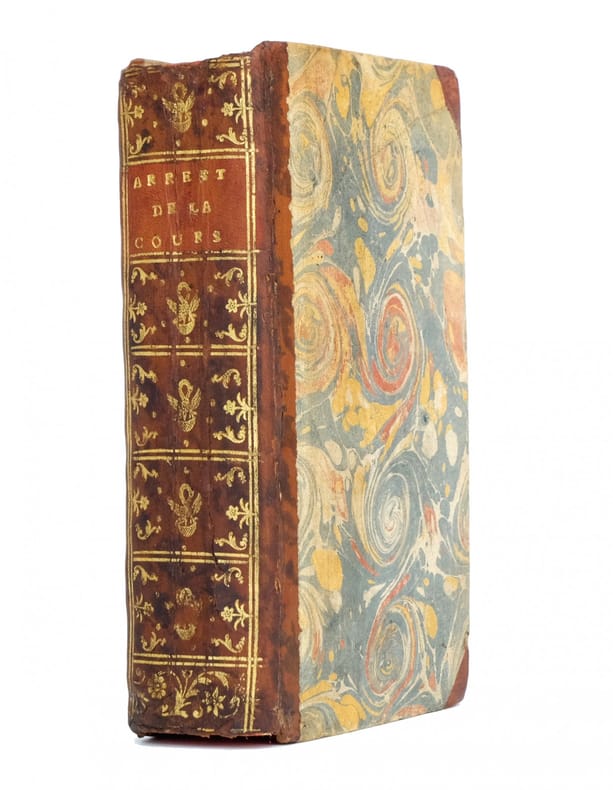
1789réf. 57115Paris Chez Baudouin Imprimeur de l'Assamblée Nationale 1789. 8vo. Bound in an exquisite later red half morocco with gilt spine. Top edge gilt. 1 f. title-page 8 pp. "Déclaration des droits de l'Homme en société" 6 pp. "Articles de Constitution" 1 f. "Réponse du Roi" 1 f. blank. Woodcut head-pieces. Title-page slightly bowned otherwise in excellent condition. A truly excellent copy. The exceedingly scarce true first printing in an incredibly rare form of off-print/separate printing of one of the most important and influential documents in the history of mankind namely the French Human Rights Declaration containing also the articles for the first French Constitution. This groundbreaking publication constitutes a monumental change in the structure of the human world providing all citizens with individual rights that we now take for granted. This monument of humanist thought appeared in the "Procès verbal de l'Assemblée Nationale" copies of which are also very difficult to obtain. There however the two parts appeared without a title-page and without the final blank which together constitute a form of wrappers for this off-print/separate printing of which only five or six other copies are known and which is present in merely one or two libraries world-wide. As far as we now only one other copy has been on the private market and that did not have the blank back wrapper. This exceedingly rare separate printing of the Human Rights Declaration with the Constitution was intended for the inner circle of those participating in its creation and was limited to a very restricted number of copies - all of which will have been owned by the creators of the Declaration. This epochal document is just as important today as it was when it was formulated during the French Revolution in 1789 and since 2003 the Declaration has been listed in the UNESCO Memory of World Register - "This fundamental legacy of the French Revolution formed the basis of the United Nations Declaration of 1948 and is of universal value". Few other documents in the history of mankind has done as much to determine the way we live and think the way Western societies are structured and governed and few other documents have had such a direct impact upon our constitutional rights and the way we view ourselves and others in society. It is here that we find the formulation of liberty and equality upon which so much of Western political and moral thought is based - that all "men are born and remain free and equal in rights" Article 1 which were specified as the rights of liberty private property the inviolability of the person and resistance to oppression Article 2; that all citizens were equal before the law and were to have the right to participate in legislation directly or indirectly Article 6; no one was to be arrested without a judicial order Article 7; Freedom of religion Article 10 and freedom of speech Article 11 were safeguarded within the bounds of public "order" and "law" etc. etc.The content of the document that were to change the Western world for good emerged largely from the ideals of the Enlightenment. "The sources of the Declaration included the major thinkers of the French Enlightenment such as Montesquieu who had urged the separation of powers and Jean-Jacques Rousseau who wrote of general will-the concept that the state represents the general will of the citizens. The idea that the individual must be safeguarded against arbitrary police or judicial action was anticipated by the 18th-century parlements as well as by writers such as Voltaire. French jurists and economists such as the physiocrats had insisted on the inviolability of private property." Encycl. Britt.The key drafts were prepared by Lafayette working at times with Thomas Jefferson. In August 1789 Honoré Mirabeau played a central role in conceptualizing and drafting the Declaration. On August 26 1789 in the midst of The French Revolution the last article of the Declaration was adopted by the National Constituent Assembly as the first step towards a constitution for France. "In 1789 the people of France brought about the abolishment of the absolute monarchy and set the stage for the establishment of the first French Republic. Just six weeks after the storming of the Bastille and barely three weeks after the abolition of feudalism the Declaration of the Rights of Man and of the Citizen French: La Déclaration des Droits de l'Homme et du Citoyen was adopted by the National Constituent Assembly as the first step toward writing a constitution for the Republic of France.The Declaration proclaims that all citizens are to be guaranteed the rights of "liberty property security and resistance to oppression." It argues that the need for law derives from the fact that ".the exercise of the natural rights of each man has only those borders which assure other members of the society the enjoyment of these same rights." Thus the Declaration sees law as an "expression of the general will" intended to promote this equality of rights and to forbid "only actions harmful to the society." www.humanrights.com. This sensational document became the crowning achievement of the French Revolution; it came to accelerate the overthrow of the "Ancien Régime" and sowed the seed of an extremely radical re-ordering of society. The Declaration interchanged the pre-revolutionary division of society -in the clergy the aristocracy and the common people- with a general equality - "All the citizens being equal in the eyes of the law are equally admissible to all public dignities places and employments according to their capacity and without distinction other than that of their virtues and of their talents" From Article VI upon which today's society is still based. It is hard to imagine a work that is more important to the foundation of the society that we live in today. unknown
réf. 226631Paris, Chez Gattey, 1790 in-8, 23 pp., dérelié.
réf. 1558Aix ; Rome [fausse adresse] ; s. l. ; Berlin [Paris] ; Nancy ; s. l. ; s. l. ; Amsterdam [Paris] : chez la veuve J. David, & E. David, imprimeurs ; apud Laurentem Carabioni, in via Sancta [fausse adresse] ; s. n. ; aux dépens de la compagnie ; chez les héritiers de N. Baltazard, imprimeur-librairie du Collège ; s. n. ; s. n. ; chez Abraham Root, 1765 ; 1750 ; 1755 ; 1751 ; s. d. ; 1716 ; s. d. (1764) ; 1765. TRÈS HUMBLES REMONTRANCES AU ROI ET À VOLTAIRE
réf. 205270Bruxelles, 1787 in-8, 20 pp., broché.
réf. 239261Bruxelles, 1787 in-8, 20 pp., broché, couv. papier bleu moderne.
1851réf. GF206571851 Lithographie en noir et bistre - Format 18,5 x 12 cm environ sur une feuille de papier fort de 25,5 x 16 cm - Paris vers 1850 -
réf. GF20730Eau-forte originale en couleurs (coloris d'époque) - Format 26 x 17 cm environ - vers 1845 - petites mouillures anciennes en marge - Avec une Notice biographique de 16 pages (en feuilles) par Alfred NETTEMENT -
réf. GF14749Eau-forte sur chine appliquée sur papier blanc - XIXéme siècle - format 22,5 x 16 cm pour le papier de chine - rousseurs sur les marges de papier blanc -
réf. GF15791Notice biographique de 4 pages in folio et portrait lithographié par Néraudeau Alexandre, peintre de portrait et lithographe - (format 38 x 26 cm marges comprises) - Ensemble extrait du "Panthéon Républicain" publié à Paris chez Fayard en 1874 - (quelques rousseurs) -
réf. 239078Paris, Lavillette, 1791 21 livraisons en un vol; in-8, viij pp. (faux-titre, titre & prospectus), pp. ix-xxviij [réimpression des deux numéros du périodique États-Généraux], 516 pp., un f. n. ch. de table, demi-basane blonde, dos lisse orné de pointillés et chaînettes dorés, pièce de titre crème, tranches jaunes (reliure de l'époque).
réf. 239236Paris, Lavillette, 1791 21 livraisons en un vol; in-8, viij pp. (faux-titre, titre & prospectus), pp. ix-xxviij [réimpression des deux numéros du périodique États-Généraux], 516 pp., un f. n. ch. de table, veau vert marbré, dos lisse orné, filets dorés en encadrement sur les plats, tranches citron (reliure de l'époque).
réf. 22325Paris, Impr. de Bure l'aîné, 1789. 19 ouvrages réunis en un volume in-8. Demi-veau fauve, dos plat orné de filets et de fers en forme d'urne typique du style Directoire, bon état.
1789réf. 845551789 Sans lieu ni nom, 1789, in 8° relié demi-basane marron moderne, dos lisse orné, VIII-130 pages et un feuillet non chiffré ("Clé des noms") ; rousseurs et taches, les premières pages ont été renforcées marginalement ; la page de titre est fanée.
réf. 103495À Paris, Chez Baudouin, 1789 in-8, 25 pp., dérelié.
1788réf. 260481788. A Londres s.. Lejay 1788. Un fort vol. au format in-folio 433 x 277 mm de 3 ff. n.fol. 10 cartes graves sur double-page 93 planches graves tableaux et 1 f. bl. Ne subsiste plus de la reliure que le carton des plats. Important atlas au format in-4 comportant 10 sur 10 grandes cartes graves sur double-page dresses par Mentelle Pays-Bas autrichiens Tyrol BohÂme-Moravie Etats entre la BaviÂre et la BohÂme Carte gnrale d'Allemagne Monarchie prussienne l'orient de Weser Possessions du roi de Prusse l'ouest du Weser Carte de la Haute-Saxe et de la Lusace Haut et Bas-Rhin BaviÂre. L'ouvrage recÂle en outre 93 sur 93 planches graves dont double-pages ainsi que de nombreux tableaux dont dpliants. ''La parution de cet ouvrage fit faire banqueroute au libraire Lejay''. in Qurard. Qurard VI La France littraire p. 158. Petit travail de ver affectant les fonds de cahiers des feuillets liminaires ainsi que plus lgÂrement des cartes. L'une prsente des plissures une autre un petit manque angulaire ; une derniÂre des rousseurs. Chacune une discrÂte cerne marginale. Deux tableaux manquants. Plusieurs feuillets dsolidariss. Quelques petites altrations parses dans le corps d'ouvrage. Du reste belle condition. b42961 unknown
1788réf. 26048A Londres, s.é. [Lejay], 1788. Un fort vol. au format in-folio (433 x 277 mm) de 3 ff. n.fol., [10] cartes gravées sur double-page,, 93 planches gravées + tableaux et 1 f. bl. Ne subsiste plus de la reliure que le carton des plats.
réf. 482697P., de l'Imprimerie nationale, [1791]. In-8 en feuilles, 19 pp.
réf. 0332486206.Ghardcover. Good. Access codes and supplements are not guaranteed with used items. May be an ex-library book. hardcover
1994Mm 170x240 Brossura cucita di pp. 126, tavole in bianco e nero. A cura dell'Università degli studi di Perugia. Opera in ottime condizioni. SPEDIZIONE IN 24 ORE DALLA CONFERMA DELL'ORDINE.
2026réf. x-1041285434Routledge 2026. Hardcover. New. 262 pages. 9.18x6.12x9.45 inches. Routledge hardcover
1792réf. 2968A PARIS. CHEZ F. BUISSON, LIBRAIRE. ET A LYON. CHEZ LES FRERES BRUYSET, IMPRIMEURS-LIBRAIRES. 1792. IN-8 BROCHE (13,5 X 21 X 4 CENTIMETRES ENVIRON) DE (4) + 392 PAGES, SOUS COUVERTURE D’ORIGINE PAPIER BLEU MARBRE, TITRE IMPRIME SUR ETIQUETTE PAPIER COLLEE AU DOS. MEMOIRES REDIGES PAR LE COMTE DE MIRABEAU, ET PUBLIES PAR J.-L. GIRAUD SOULAVIE L’AINE, D’APRES BARBIER (III. 219). LE DUC D’AIGUILLON FUT NOMME GOUVERNEUR DE BRETAGNE EN 1753, POSTE QU’IL CONSERVA JUSQU’EN 1770. CET OUVRAGE COUVRE LA PERIODE 1764-1770. BON EXEMPLAIRE, «DANS SON JUS» TEL QUE PARU AU XVIII°.
1828réf. 3263613Paris, Ponthieu, 1828/38. Halblederbände der Zeit mit Rückenschildern (leicht berieben, Stempel auf Titel).
réf. 0282138005.Gpaperback. Good. Access codes and supplements are not guaranteed with used items. May be an ex-library book. paperback
réf. 0666568472.Ghardcover. Good. Access codes and supplements are not guaranteed with used items. May be an ex-library book. hardcover
réf. 0428680240.Ghardcover. Good. Access codes and supplements are not guaranteed with used items. May be an ex-library book. hardcover