Mirabeau, Victor De RiquetiBiblio.com

1 709 résultats
réf. 1169792251.Ghardcover. Good. Access codes and supplements are not guaranteed with used items. May be an ex-library book. hardcover
réf. 0331683369.Ghardcover. Good. Access codes and supplements are not guaranteed with used items. May be an ex-library book. hardcover
réf. 112001879X.Gpaperback. Good. Access codes and supplements are not guaranteed with used items. May be an ex-library book. paperback
réf. 1166328457.Gpaperback. Good. Access codes and supplements are not guaranteed with used items. May be an ex-library book. paperback
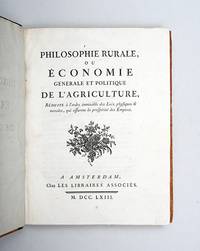
1763réf. 153616Amsterdam: Chez les Libraires Associés 1763. The new science of economics Rare first edition presenting "perhaps the most complete and magisterial account of the views of the Physiocratic school" Higgs. "Quesnay collaborated very substantially in preparing this last major work contributing the final chapter with further explanations and manipulations of his Tableau Économique analysis" The New Palgrave. Schumpeter calls the work "the first of the four textbooks of physiocrat orthodoxy" p. 225. It contains for the first time Quesnay's masterful explanation of his Tableau Économique "one of those works in the history of economics which have often been regarded as an anticipation of modern theories" Schumpeter p. 242. Originally printed as a pamphlet of 16 pages in 1758 in a minute number of copies Quesnay's Tableau Économique was first revealed to the public as the final part of Mirabeau's L'Ami des Hommes in 1760. In the Philosophie rurale Quesnay for the first time gives a full explanation of his system. The Tableau économique is credited as the "first precise formulation" of interdependent systems in economics and the origin of the theory of the multiplier in economics. An analogous table is used in the theory of money creation under fractional-reserve banking by relending of deposits leading to the money multiplier. In a letter to Mirabeau written late in 1758 Quesnay remarks "J'ai taché de faire un tableau fondamental de l'ordre économique pour y représenter les dépenses et les produits sous un aspect facile à saisir et pour juger clairment des arrangemens et des dérangemens que le gouvernement peut y causer" translated: "I have tried to make a fundamental table of the economic order in order to represent the expenses and the products in an aspect easy to grasp and to judge clearly of the arrangements and disturbances that the government can cause there". "A most remarkable analysis of the economic condition of his country" Palgrave the Tableau économique "is the most important and famous work of Physiocracy and has often been regarded as a summary of the entire corpus of Physiocratic economics. The Tableau has also been regarded as the analytical synthesis of the logical structure of Quesnay's economics or at least as its most relevant aspect. The Tableau économique is one of those works in the history of economics which have often been regarded as an anticipation of modern theories. The Tableau has been considered a first rough presentation of Keynes's multiplier and as a sort of general equilibrium system of a Walrasian type. For others the Tableau is an input-output table. Because of the Tableau Quesnay has been regarded as an early econometrician. The Tableau has also been interpreted as the first classical system of price determination thus anticipating Marx's reproduction schemes and Sraffa's price system" Giovanni Vaggi in The New Palgrave. Quarto 260 x 192 mm. With 3 engraved plates including the Tableau économique. Contemporary quarter marbled sheep orange paste paper sides light blue endpapers. Housed in a black cloth flat-back box by the Chelsea Bindery. Neatly restored at extremities insect abrasion to spine slight cockling to paste paper sides contents clean and fresh. A very good copy. Goldsmiths' 9836; Higgs 2881; INED 3204; Kress 6120; Mattioli 2435. hardcover
réf. A9781166328450New. unknown
réf. 028225997X.Gpaperback. Good. Access codes and supplements are not guaranteed with used items. May be an ex-library book. paperback
réf. 0666659133.Ghardcover. Good. Access codes and supplements are not guaranteed with used items. May be an ex-library book. hardcover
réf. 0666383510.Ghardcover. Good. Access codes and supplements are not guaranteed with used items. May be an ex-library book. hardcover
réf. B9781166328450New. unknown
réf. 0282286578.Gpaperback. Good. Access codes and supplements are not guaranteed with used items. May be an ex-library book. paperback
2002réf. 0035469Dusseldorf: Verlag Wirtschaft und Finanzen 2002. Facsimile Edition. Hardcover Hardcover. Fine Condition. 25.5cm x 19cm. viii xxvi 412 pages 1 table. Full leather gilt lettering and compartments blind rule all edges red marbled endpapers. Text is in French. The one hundredth and last edition of the facsimile edition of Classics of National Economic produced from the first edition published in Amsterdam in 1763. Limited to 200 numbered copies of which this is hors commerce. Text is in French. Category: Politics Government & Economics; 21st Century: 2000-2009; French Language; Inventory No: 0035469. BZDB407 Politics Government & Economics; 21st Century: 2000-2009; French Language; Unbranded Victor Riquetti Mirabeau; Francois Quesnay Philosophie Rurale ou Economie Generale et Politique de l'Agriculture Verlag Wirtschaft und Finanzen hardcover
réf. 1333257813.Gpaperback. Good. Access codes and supplements are not guaranteed with used items. May be an ex-library book. paperback
1764réf. RO80074491CHEZ LES LIBRAIRES ASSOCIES. 1764. In-12. Broché. Etat d'usage, Couv. légèrement passée, Dos satisfaisant, Quelques rousseurs. 420 pages. Un tableau dépliant en fin d'ouvrage. Relié plein veau marbré. Tranches rouges. Titre et caissons dorés sur le dos à 5 nerfs. Léger manque de cuir en coiffes.. . . . Classification Dewey : 630-Agriculture et techniques connexes
réf. 110892aafA Amsterdam Chez Les Libraires Associés, M. DCC. LXIV, 1764, collation in-12vo, (in-8° -16.5x10 cm), XLVIII + 420 p. + 4 ff. / 2 ff. + 378 P. + 3 ff., ms. ‘Ad usum Joannis Bartholomei Produit, Leytronensij 1798’, reliure en parchemin ms. (réutilisation) d’époque.
réf. 214698A Amsterdam, Chez les libraires associés, 1764 3 vol. in-12, tableau replié, veau fauve, dos à nerfs orné, encadrement d'un double filet doré sur les plats, tranches rouges (rel. de l'époque). Coiffes restaurées.
réf. 015115Honoré-Gabriel Riqueti de Mirabeau (1749-1791), écrivain, grand orateur de la révolution française. P.A., 16 juin [1781], 1/2p in-12. « Je prie monsieur de [nom illisible] de m'envoyer la note précise de ce que je lui dois. Ce 16 juin ». Une note indique « Ecriture de Mirabeau (16 juin 1781) ». Sympathique document alors que Mirabeau avait de gros problèmes d'argent et avait fui Paris pour fuir ses créanciers. [370]
réf. 103495À Paris, Chez Baudouin, 1789 in-8, 25 pp., dérelié.
réf. 16898In-8, broché, couverture papier marbré moderne, (2), 25 p. Paris, Baudouin, 1789.
1789réf. 44726Paris, Baudouin, 1789. In-8 broché de 25 pp. couverture de papier saumon, pièce de titre manuscrite à l'encre du temps.
réf. 239238Paris, Baudouin, 1789 in-8, [2]-25 pp., broché, couv. papier bleu moderne.
réf. GF20730Eau-forte originale en couleurs (coloris d'époque) - Format 26 x 17 cm environ - vers 1845 - petites mouillures anciennes en marge - Avec une Notice biographique de 16 pages (en feuilles) par Alfred NETTEMENT -
réf. GF6702Gravure à l'eau-forte - Format 16 x 11 cm environ sur une feuille de papier fort de 26,5 x 16 cm - Paris vers 1840 -
1851réf. GF206571851 Lithographie en noir et bistre - Format 18,5 x 12 cm environ sur une feuille de papier fort de 25,5 x 16 cm - Paris vers 1850 -