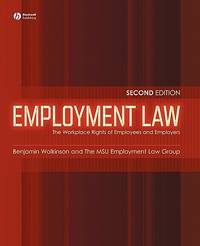
Employment Law – The Workplace Rights of Employees and Employers 2e
2008ref. x-1405134089Blackwell Pub 2008. Paperback. New. 2nd edition. 449 pages. 9.25x7.50x0.75 inches. Blackwell Pub paperback
Revaluation Books · Reino Unido94,74 GBP≈ 113,15 €
1025 resultados
ref. DADAX0415818818New unknown
ref. SONG1641433280Used: Good unknown
ref. DADAX0415875935New unknown
ref. DADAX1624176860New unknown
ref. DADAX1848440685New unknown
2008ref. x-1405134089Blackwell Pub 2008. Paperback. New. 2nd edition. 449 pages. 9.25x7.50x0.75 inches. Blackwell Pub paperback
ref. DADAX1543826210New unknown
ref. DADAX0415622522New unknown
ref. DADAX0367585022New unknown
ref. DADAX0367024942New unknown
ref. DADAX1138486256New unknown
ref. DADAX1138647489New unknown
ref. DADAX1771123168New unknown
ref. 1933043504-11-1Center for Education & Employm. 11th. Very Good. It's a well-cared-for item that has seen limited use. The item may show minor signs of wear. All the text is legible with all pages included. It may have slight markings and/or highlighting. Center for Education & Employm unknown
ref. SONG1683287320Used: Good unknown
ref. DADAX0415714729New unknown
1873ref. 165671873. Kinnear John Boyd. The Right of Women to Labour 1873 argues against restrictions on women's employment and examines the economic consequences of industrialization for women who depended upon paid work. Kinnear a Scottish lawyer writer and later Liberal politician rejects occupational exclusion based on sex writing "there are other things which women can do at least as well as men.Then why should women not do it" His argument extends beyond access to employment to the conditions under which women worked including their difficulty in "forming effective trade unions to secure their rights." The pamphlet thus addresses both women's right to enter occupations and their limited power to protect themselves collectively once employed. Kinnear John Boyd. The Right of Women to Labour. Being Portions of an Essay Re-printed by Permission from "Woman's Work and Woman's Culture." London: Printed by Frederick Bell & Co. Chelsea S.W. 1873. First edition. 14 pages. The text reprints portions of Kinnear's contribution to Josephine Butler's Woman's Work and Woman's Culture first published in 1869 a collection addressing women's education employment legal status suffrage and professional opportunities. Kinnear argues that mechanization and the movement of production from households into factories had eliminated forms of work traditionally performed by women while exposing those who remained in industrial employment to increased competition. He answers these changes by demanding access to work according to ability rather than sex and by identifying workers' collective organization as a means of defending wages and employment rights. Published amid nineteenth-century campaigns to expand women's access to education professions property rights and political participation Kinnear's pamphlet concentrates specifically on economic independence and the organization of women workers. One pamphlet 14 pages in original paper wrappers measuring 8 x 5 1/4 inches. Very good condition. Its discussion of occupational exclusion mechanization and trade union organization records an early argument that women's economic rights required both access to paid employment and the ability to defend their position within the labor market. unknown
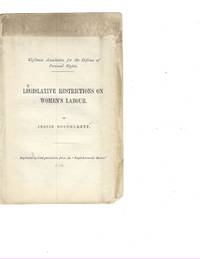
1873ref. 165771873. Boucherett Jessie. Legislative Restrictions on Women's Labour 1873 challenges proposed factory legislation limiting the hours and conditions under which women including mothers of young children could work arguing that such measures deprived adult women of authority over their own employment while providing no substitute for lost wages. Boucherett identifies the principle underlying the legislation as itself objectionable: "Another objection is that the Bill confirms the principle that women are not capable of deciding for themselves." Her opposition arose from the practical circumstances of women whose earnings supported themselves and their children placing employment restrictions within a larger debate over women's legal independence wages and control of their own labor. Boucherett Jessie. Legislative Restrictions on Women's Labour. London: Frederick Bell & Co. 1873. First edition. Reprinted by kind permission from the Englishwoman Review for the Vigilance Association for the Defence of Personal Rights. 12 pages. Original paper wrappers. 8 x 5 inches. Boucherett acknowledges the protective rationale behind the proposed measures writing "It has caused some surprise that Bills framed for so benevolent a purpose should have met with opposition from an unexpected quarter" before detailing their possible consequences for working women. She argues that reducing women's access to factory employment without guaranteeing family maintenance could produce "much suffering and some crime" since "it would always be difficult and sometimes impossible for a woman to provide sufficient food for herself and four or five little children." Her argument therefore distinguishes between women with independent means and wage-earning women for whom statutory restrictions could immediately reduce the household's supply of food and other necessities. Boucherett had founded the Society for Promoting the Employment of Women in 1859 and spent much of her career seeking expanded training and occupations for women; this pamphlet applies the same concern for economic independence to parliamentary attempts to regulate female industrial labor. Its publication also formed part of a contemporary controversy over proposals associated with Alexander Mundella and John Lubbock to extend restrictions governing women's factory employment. Rather than opposing regulation solely in the name of laissez-faire principles Boucherett bases her case on women's need to earn wages their responsibility for dependent children and their right to make employment decisions for themselves. Toning to front wrapper with a few chips and losses along the right edge. Good condition. unknown
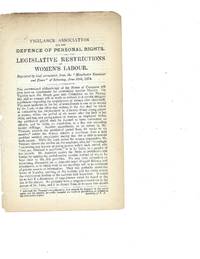
1874ref. 165761874. Vigilance Association for the Defence of Personal Rights. Legislative Restrictions on Women's Labour 1874 opposes proposed factory legislation that would prevent women from returning to industrial employment for six months after childbirth. The Association argues that a measure presented as protection would fall most heavily on women whose families depended upon their wages asking "Who in thousands of cases where there is no helper will assure them and their children bread" Its objections connect employment restrictions to married women's precarious legal and economic position particularly women deserted or unsupported by husbands and left without an enforceable claim upon their husbands' earnings. Vigilance Association for the Defence of Personal Rights. Legislative Restrictions on Women's Labour. Extract reprinted by kind permission from the Manchester Examiner and Times of Saturday June 20th 1874. London: Vigilance Association for the Defence of Personal Rights 1874. First edition extract. 4 pages. Original paper wrappers. 8 1/2 x 5 inches. The pamphlet challenges legislation directed specifically at working women while leaving wealthier women free from comparable interference. Addressing married workers it notes that there are ".many married women deserted or uncared for by their husbands" and argues that "no marriage law secures to the wife a share in the earnings of the father of her children." The text consequently treats freedom to work not as an abstract principle but as an immediate question of food wages and support for women and children and calls upon women themselves to oppose the proposed restriction. The pamphlet belongs to the Vigilance Association's campaign against statutory limitations imposed specifically upon adult women's labor during the parliamentary debates surrounding the Factory Acts in 1874. Its argument exposes a central conflict in nineteenth-century labor reform: legislation intended to protect women workers could also restrict their access to wages without providing an alternative means of family support. At the time this description was prepared no copies were located in American institutions through the OCLC search consulted; institutional records are subject to revision and should be reconfirmed. Condition information was not supplied. The four-page tract records an organized women's-rights response to factory regulation that linked employment freedom directly to marriage law household income and women's economic dependence. unknown
1859ref. 165681859. Parkes Bessie Rayner. The Market for Educated Female Labor 1859 argues that girls and young women should receive education or vocational training sufficient to support themselves rather than being prepared exclusively for marriage. Parkes wrote amid organized efforts to expand employment opportunities for middle-class women and in the same year that the Society for Promoting the Employment of Women was established. She rejects the assumption that marriage guaranteed lifelong financial support observing "The daughter may marry but her husband may die.or be too poor to support her and her children; let her at least be trained beforehand to some possible way of getting her bread." Her argument treats women's preparation for paid work as an ordinary parental responsibility rather than an emergency measure reserved for poverty. Parkes Bessie Rayner. The Market for Educated Female Labor. 1859. First edition. 6 pages present of an original 8 lacking the final two pages. Unbound measuring 8 1/4 x 5 inches. The text was delivered as a paper at the 1859 Bradford meeting of the Association for the Promotion of Social Science. Parkes states "We lay it down as a primary social law conceded by all political economists that a father ought to provide for all his children or give them the means of providing for themselves." She further counters the idea that paid employment among middle-class women was exceptional: "Probably every person present has a female relative or intimate friend whom trade-failure the exigencies of a numerous household or the early death of husband or father has compelled to this course; it is the experience of every family." The surviving text consequently links women's education to specific economic contingencies including business failure large households widowhood and the death of a father or husband. Parkes was then a central figure in the Langham Place circle and a founding editor of the English Woman's Journal established in 1858 to address women's employment education legal disabilities and related reforms. Her paper appeared as these activists were moving from publication and debate toward practical employment initiatives; the Society for Promoting the Employment of Women was founded in 1859 to train women and open additional occupations to them. At the time this description was prepared no copies were recorded in American institutional holdings consulted; OCLC search results remain subject to cataloging changes and should be reconfirmed. Repairs to the upper right corner and right edge of page 1 and a small repair to the left edge of page 6. Lacking the final two pages; good condition. The surviving six pages preserve Parkes's direct argument that women's education should provide the means for economic self-support in circumstances she described as common within middle-class families. unknown
1873ref. 165661873. Taylor Whately Cooke. The Employment of Married Women in Manufacture 1874. First edition of a paper delivered at the Social Science Congress in Norwich in October 1873 opposing proposed legislation that would restrict or prohibit married women's employment in British manufacturing. Taylor challenges the argument that married women should be excluded from factory labor because of their maternal and domestic responsibilities emphasizing the financial consequences for working-class families dependent upon women's earnings. He condemns the inconsistency of restricting married women's industrial employment while permitting women in agriculture and domestic service to continue working without comparable legal limitations. His argument addresses a central dispute in Victorian labor reform: whether legislation intended to protect women from industrial exploitation could instead deprive them of economic independence and impose unequal restrictions upon their employment. Taylor Whately Cooke. The Employment of Married Women in Manufacture. A Paper Read at the Social Science Congress Held at Norwich October 1873. London: Frederick Bell & Co. Steam Printers King's Rd. Chelsea 1874. First edition. 12 pages. Original paper wrappers measuring 8 x 5¼ inches. Reprinted for the Vigilance Association for the Defence of Personal Rights the pamphlet develops an economic and legal argument against restricting married women's factory employment. Taylor writes: "It is at first sign a very humane sentiment no doubt to assert that married women should be relieved from all hard work because of the duties which maternity casts upon them; but when as that the same time you relieve them of some fifteen shillings a-week without providing any substitute you must not be surprised if they themselves do not view your condescension in the same light." His reference to fifteen shillings a week places the loss of wages rather than the stated benevolence of protective legislation at the center of his objection. The pamphlet appeared during parliamentary debates preceding the Factory Act of 1874 which further regulated the working hours of women and young persons in textile factories. The Vigilance Association for the Defence of Personal Rights opposed legislation that restricted adult women's freedom to contract for employment particularly when comparable restrictions did not apply to men. Taylor's comparison of factory workers with women employed in agriculture and domestic service exposes the unequal treatment of female occupations under proposed labor regulations. His paper documents opposition to sex-specific industrial legislation within the nineteenth-century movement for women's legal and economic rights. Very good condition. unknown
1874ref. 165741874. Women Employment Lucy Wilson. "Women and Legislation." Vigilance Association for the Defence of Personal Rights. June 20 1874. Original paper wrappers. 4 pages. First edition. 8 1/2 x 5 in. A Letter addressed to the Editors of the Leeds Mercury. "These measures all point to one conclusion that motherhood is a crime. The woman who is guilty of it unless.she is rich and independent shall not eat bread for six months thereafter or twelve as the House may determine." In this open letter Wilson decries legislation which would forbid new mothers from working yet fails to provide any public assistance for them to care for their families. "No Act has been passed decreeing that such women shall not suffer cold or hunger or to 'deem that they commit an offence' if they are hungry." Vigilance Association for the Defence of Personal Rights was a British organization dedicated to watching restraining and influencing legislation especially in matters affecting the interests of women and the personal rights and liberties of the people. Small losses along spine. Very good condition. unknown
ref. DADAX0917463358New unknown
ref. DADAX0198268300New unknown
ref. DADAX0792391055New unknown