Women's Labor & EmploymentBiblio.com
910 resultados
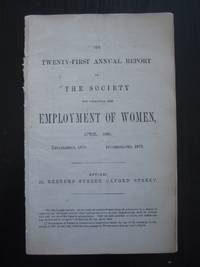
1880ref. 165711880. Society for Promoting the Employment of Women. The Twenty-First Annual Report of the Society for Promoting the Employment of Women 1880 documents an organization established to expand women's access to vocational training and paid employment in occupations beyond the limited fields conventionally open to them in nineteenth-century Britain. Founded in 1859 through the work of women's rights reformers including Jessie Boucherett Barbara Bodichon and Adelaide Anne Procter the Society connected demands for women's economic independence with practical programs for training and placement. Its purpose is stated directly in the report: "The Society is formed for promoting the Training of Women and their employment in industrial pursuits." Society for Promoting the Employment of Women. The Twenty-First Annual Report of the Society for Promoting the Employment of Women April 1880. London: Printed by John Bale & Sons 1880. First edition. The thirty-page report records the Society's work in preparing women for specific occupations and discusses the training required to enter fields including wood carving hospital nursing and hairdressing among others. Rather than arguing only for women's abstract right to employment the report records the practical means by which the Society attempted to open occupations through instruction and professional preparation. Its annual accounting of such programs shows how an organization founded by members of the mid-century women's rights movement addressed the economic restrictions confronting women through vocational initiatives maintained over more than two decades. The report appeared twenty-one years after the Society's establishment and shortly after its incorporation in 1879 when campaigns for women's property rights education professional access and suffrage were expanding the legal and economic questions surrounding women's independence. The Society's emphasis on training addressed one concrete barrier to entry into skilled occupations: women could not compete for work from which they had also been excluded from acquiring the necessary preparation. 30 pages. Original paper wrappers measuring 8 x 5 inches. Light pencil marks in the margins; otherwise very good condition. At the time this description was prepared no copies were recorded in American institutions in the OCLC search consulted; institutional holdings and OCLC records remain subject to revision. unknown
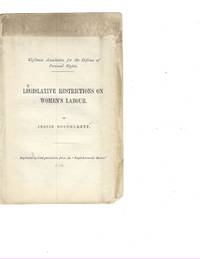
1873ref. 165771873. Boucherett Jessie. Legislative Restrictions on Women's Labour 1873 challenges proposed factory legislation limiting the hours and conditions under which women including mothers of young children could work arguing that such measures deprived adult women of authority over their own employment while providing no substitute for lost wages. Boucherett identifies the principle underlying the legislation as itself objectionable: "Another objection is that the Bill confirms the principle that women are not capable of deciding for themselves." Her opposition arose from the practical circumstances of women whose earnings supported themselves and their children placing employment restrictions within a larger debate over women's legal independence wages and control of their own labor. Boucherett Jessie. Legislative Restrictions on Women's Labour. London: Frederick Bell & Co. 1873. First edition. Reprinted by kind permission from the Englishwoman Review for the Vigilance Association for the Defence of Personal Rights. 12 pages. Original paper wrappers. 8 x 5 inches. Boucherett acknowledges the protective rationale behind the proposed measures writing "It has caused some surprise that Bills framed for so benevolent a purpose should have met with opposition from an unexpected quarter" before detailing their possible consequences for working women. She argues that reducing women's access to factory employment without guaranteeing family maintenance could produce "much suffering and some crime" since "it would always be difficult and sometimes impossible for a woman to provide sufficient food for herself and four or five little children." Her argument therefore distinguishes between women with independent means and wage-earning women for whom statutory restrictions could immediately reduce the household's supply of food and other necessities. Boucherett had founded the Society for Promoting the Employment of Women in 1859 and spent much of her career seeking expanded training and occupations for women; this pamphlet applies the same concern for economic independence to parliamentary attempts to regulate female industrial labor. Its publication also formed part of a contemporary controversy over proposals associated with Alexander Mundella and John Lubbock to extend restrictions governing women's factory employment. Rather than opposing regulation solely in the name of laissez-faire principles Boucherett bases her case on women's need to earn wages their responsibility for dependent children and their right to make employment decisions for themselves. Toning to front wrapper with a few chips and losses along the right edge. Good condition. unknown
1847ref. 162581847. Goddard Emily L. Archive of thirteen letters of recommendation and certification 1847-1853 documents a woman teacher establishing her professional qualifications across the common schools of western Massachusetts. Written by school officials and other individuals in Barre Wilbraham New Salem Athol Petersham and surrounding communities the letters certify Goddard's eligibility to teach in particular districts or attest to her general qualifications for common-school instruction. Spanning six years the correspondence records the repeated process by which a woman teacher obtained written approval and recommendations as she sought successive teaching positions in antebellum New England. Thirteen manuscript letters 1847-1853 concerning Emily L. Goddard's qualifications and employment as a teacher in western Massachusetts. The documents originate from multiple towns including Barre Wilbraham New Salem Athol and Petersham and consist principally of certifications and recommendations addressing Goddard's ability to teach a common school. The individual letters preserve the assessments she carried between districts as evidence of her preparation and prior work. Their geographic range and successive dates trace a professional record extending beyond a single appointment or school and show how recommendations from local authorities could accompany a teacher seeking employment elsewhere. Goddard's papers date from the expansion of the Massachusetts common-school movement when public education reform increased demand for teachers and teaching became an increasingly important occupation for women. Women's employment in common schools expanded substantially during the nineteenth century although hiring certification salaries and continued employment remained subject to local school authorities. This archive records those practices through one teacher's surviving credentials: thirteen documents produced over six years as Goddard accumulated certifications and endorsements in several Massachusetts communities. Fold lines and creases with very little foxing; handwriting remains clear and legible throughout. All thirteen letters in very good condition. A sustained documentary record of a woman building a teaching career within the local certification and recommendation practices of antebellum Massachusetts. unknown books
1847ref. 162581847. Goddard Emily L. Archive of thirteen letters of recommendation and certification 1847-1853 documents a woman teacher establishing her professional qualifications across the common schools of western Massachusetts. Written by school officials and other individuals in Barre Wilbraham New Salem Athol Petersham and surrounding communities the letters certify Goddard's eligibility to teach in particular districts or attest to her general qualifications for common-school instruction. Spanning six years the correspondence records the repeated process by which a woman teacher obtained written approval and recommendations as she sought successive teaching positions in antebellum New England. Thirteen manuscript letters 1847-1853 concerning Emily L. Goddard's qualifications and employment as a teacher in western Massachusetts. The documents originate from multiple towns including Barre Wilbraham New Salem Athol and Petersham and consist principally of certifications and recommendations addressing Goddard's ability to teach a common school. The individual letters preserve the assessments she carried between districts as evidence of her preparation and prior work. Their geographic range and successive dates trace a professional record extending beyond a single appointment or school and show how recommendations from local authorities could accompany a teacher seeking employment elsewhere. Goddard's papers date from the expansion of the Massachusetts common-school movement when public education reform increased demand for teachers and teaching became an increasingly important occupation for women. Women's employment in common schools expanded substantially during the nineteenth century although hiring certification salaries and continued employment remained subject to local school authorities. This archive records those practices through one teacher's surviving credentials: thirteen documents produced over six years as Goddard accumulated certifications and endorsements in several Massachusetts communities. Fold lines and creases with very little foxing; handwriting remains clear and legible throughout. All thirteen letters in very good condition. A sustained documentary record of a woman building a teaching career within the local certification and recommendation practices of antebellum Massachusetts. unknown
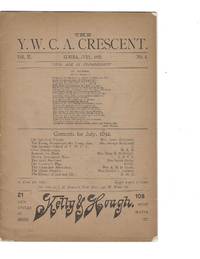
1892ref. 164651892. Young Women's Christian Association. The Y.W.C.A. Crescent July 1892 an early organizational newsletter carrying the motto "Our Aim is Progress" and documenting the public identity of the Young Women's Christian Association during the late nineteenth-century expansion of women's religious educational employment and associational activity. The emphatic language of "progress" places the publication within a culture of organized female self-improvement and collective advancement providing contemporary evidence of how a women-led Christian association presented its aims to members and readers. Without further description of the issue's internal articles its strongest interpretive value lies in this representation of YWCA community identity and the language through which women's organized activity was framed in the 1890s. The Y.W.C.A. Crescent. Vol. 2 No. 4. Young Women's Christian Association July 1892. Newsletter bearing the slogan "Our Aim is Progress." Pagination place of publication dimensions and specific internal contents are not supplied. As the fourth number of the publication's second volume the issue demonstrates an established serial publishing effort by the Association and provides material evidence of the periodical culture through which women's voluntary organizations maintained a recognizable institutional voice. An exact surviving example is independently cataloged under this title volume number and date. The issue belongs to the broader history of women's associational print culture at the close of the nineteenth century when newsletters and organizational periodicals helped sustain communities formed around religious fellowship education employment assistance and women's social development. The phrase "Our Aim is Progress" is particularly evocative of the aspirational vocabulary used by women's organizations seeking to define expanded roles for women within modern urban and professional life although the specific contents of this issue should not be inferred without examination. Covers loose or separated from the body of the newsletter; otherwise no specific defects supplied; overall very good. An early YWCA periodical useful for the study of women's organizational culture institutional publishing and the rhetoric of female advancement in the 1890s. unknown books
1892ref. 164651892. Young Women's Christian Association. The Y.W.C.A. Crescent July 1892 an early organizational newsletter carrying the motto "Our Aim is Progress" and documenting the public identity of the Young Women's Christian Association during the late nineteenth-century expansion of women's religious educational employment and associational activity. The emphatic language of "progress" places the publication within a culture of organized female self-improvement and collective advancement providing contemporary evidence of how a women-led Christian association presented its aims to members and readers. Without further description of the issue's internal articles its strongest interpretive value lies in this representation of YWCA community identity and the language through which women's organized activity was framed in the 1890s. The Y.W.C.A. Crescent. Vol. 2 No. 4. Young Women's Christian Association July 1892. Newsletter bearing the slogan "Our Aim is Progress." Pagination place of publication dimensions and specific internal contents are not supplied. As the fourth number of the publication's second volume the issue demonstrates an established serial publishing effort by the Association and provides material evidence of the periodical culture through which women's voluntary organizations maintained a recognizable institutional voice. An exact surviving example is independently cataloged under this title volume number and date. The issue belongs to the broader history of women's associational print culture at the close of the nineteenth century when newsletters and organizational periodicals helped sustain communities formed around religious fellowship education employment assistance and women's social development. The phrase "Our Aim is Progress" is particularly evocative of the aspirational vocabulary used by women's organizations seeking to define expanded roles for women within modern urban and professional life although the specific contents of this issue should not be inferred without examination. Covers loose or separated from the body of the newsletter; otherwise no specific defects supplied; overall very good. An early YWCA periodical useful for the study of women's organizational culture institutional publishing and the rhetoric of female advancement in the 1890s. unknown
1905ref. 190541905. Women Employment Albumen photograph of two women and a male supervisor working in a textile factory 1905. Measures 6" x 8.5". The photographer captures two women in modest long day dresses leaning upon a large table filled with various textiles and cloths. Beside them a man in a large black top hat stands stoically as his hands rest behind his back. In the background piles of cloth and textiles lay upon large tables and large pipes connect on the ceiling. During the second half of the 19th and early 20th century women began to work in textile clothing factories workshops coal mines tin mines commerce and on farms. Many women were employed in small industries including shirt creation nail making chain production and shoe stitching. Consequently these were known as "sweated industries" as the working hours were lengthy with low pay. Factories organized work along the lines of gender--with men performing the supervisory roles and work which was categorized as "skilled". The edges are minorly worn and the bottom right edge is cut not affecting the image. In very good condition. unknown books
1905ref. 190541905. Women Employment Albumen photograph of two women and a male supervisor working in a textile factory 1905. Measures 6" x 8.5". The photographer captures two women in modest long day dresses leaning upon a large table filled with various textiles and cloths. Beside them a man in a large black top hat stands stoically as his hands rest behind his back. In the background piles of cloth and textiles lay upon large tables and large pipes connect on the ceiling. During the second half of the 19th and early 20th century women began to work in textile clothing factories workshops coal mines tin mines commerce and on farms. Many women were employed in small industries including shirt creation nail making chain production and shoe stitching. Consequently these were known as "sweated industries" as the working hours were lengthy with low pay. Factories organized work along the lines of gender--with men performing the supervisory roles and work which was categorized as "skilled". The edges are minorly worn and the bottom right edge is cut not affecting the image. In very good condition. unknown
1935ref. 189931935. Women's Employment World-War II McConnell Dorothy. Women War and Fascism. New York: The American League Against War and Fascism 1935. 18 pages. Bound in brown cardstock wrappers. Measuring 5.5" x 8". McConnell presents a "protest against the use of women as cheap labor in factories and offices in the U.S. as well as in the fascist states" asserting that "Munitions plants employ women at dangerous tasks with long hours and low wages. Discriminatory laws against women should be defeated and women's wages made equal with men's for equal work". Wrappers are vibrant and unworn. Small penciled inscription on the title page not affecting text. An interesting pamphlet promoting the fight for women's labor safety and equal pay during WWII. Very clean and bright pages in very good condition. unknown books
1935ref. 189931935. Women's Employment World-War II McConnell Dorothy. Women War and Fascism. New York: The American League Against War and Fascism 1935. 18 pages. Bound in brown cardstock wrappers. Measuring 5.5" x 8". McConnell presents a "protest against the use of women as cheap labor in factories and offices in the U.S. as well as in the fascist states" asserting that "Munitions plants employ women at dangerous tasks with long hours and low wages. Discriminatory laws against women should be defeated and women's wages made equal with men's for equal work". Wrappers are vibrant and unworn. Small penciled inscription on the title page not affecting text. An interesting pamphlet promoting the fight for women's labor safety and equal pay during WWII. Very clean and bright pages in very good condition. unknown
ref. 16260Broadside calling on women to join a mass demonstration against reductions to the WPA 1937 documents organized opposition to cutbacks in one of the New Deal's principal employment programs during the continuing economic instability of the Great Depression. Addressing women specifically the broadside argues that WPA reductions threatened not only workers directly employed by the program but wage standards more broadly warning that increased unemployment would place downward pressure on earnings. Its appeal places women within contemporary campaigns over public employment wages and federal responsibility for economic relief. Broadside calling women to protest WPA cuts. Issuer not identified. 1937. 8.5 × 11 inches. The text urges women to participate in a mass demonstration protesting cuts to WPA funding and asks them to consider both their direct relationship to federal work programs and the wider consequences of rising unemployment. By connecting reduced WPA employment with falling wages the broadside frames the demonstration as a labor issue extending beyond current relief workers and calls upon women to participate in organized political action against the reductions. Very fragile with small tears and chips along the top and right edges; overall Good Condition. The broadside preserves direct evidence of women being recruited into Depression-era labor protest and of arguments linking New Deal employment programs to wage conditions across the broader workforce. unknown books
ref. 16260Broadside calling on women to join a mass demonstration against reductions to the WPA 1937 documents organized opposition to cutbacks in one of the New Deal's principal employment programs during the continuing economic instability of the Great Depression. Addressing women specifically the broadside argues that WPA reductions threatened not only workers directly employed by the program but wage standards more broadly warning that increased unemployment would place downward pressure on earnings. Its appeal places women within contemporary campaigns over public employment wages and federal responsibility for economic relief. Broadside calling women to protest WPA cuts. Issuer not identified. 1937. 8.5 × 11 inches. The text urges women to participate in a mass demonstration protesting cuts to WPA funding and asks them to consider both their direct relationship to federal work programs and the wider consequences of rising unemployment. By connecting reduced WPA employment with falling wages the broadside frames the demonstration as a labor issue extending beyond current relief workers and calls upon women to participate in organized political action against the reductions. Very fragile with small tears and chips along the top and right edges; overall Good Condition. The broadside preserves direct evidence of women being recruited into Depression-era labor protest and of arguments linking New Deal employment programs to wage conditions across the broader workforce. unknown
1990No marks or inscriptions. No creasing to covers. A very clean very tight copy with bright unmarked boards and no bumping to corners. 48pp. Advice and Information for Women Wishing to Return to Work.
1942ref. 154741942. Royal Medical College of Romania. 1942 license to practice medicine issued to a woman documenting the formal admission of a female physician to professional medical practice in wartime Romania. The license records the institutional process by which medical credentials were recognized and permission to practice was conferred placing an individual woman within Romania's developing twentieth-century medical profession. Romanian women had entered medical education before the First World War but female physicians remained a minority within the country's medical establishment during the interwar period. Royal Medical College of Romania. License to Practice Medicine. Romania 1942. The document formally licenses a woman to practice medicine. Its date places the authorization during the Second World War when Romania was governed by the Antonescu regime and participating in the war alongside the Axis powers. The license provides direct evidence of a woman receiving professional medical authorization within this wartime institutional setting. Women's entry into Romanian medicine had expanded after the First World War: women increasingly studied medicine and obtained positions in hospitals maternity facilities schools and other public-health institutions although men continued to predominate in medical administration and practice. The 1942 license records the continuation of that professional development into the wartime period. The history was not confined to Romania; historian Mary Roth Walsh documented a comparable early twentieth-century contraction in women's participation in American medicine where women's share of the physician workforce declined substantially after 1900. This Romanian license supplies a specific documentary record of female medical practice during the same period of uneven access to the profession internationally. unknown books
1942ref. 154741942. Royal Medical College of Romania. 1942 license to practice medicine issued to a woman documenting the formal admission of a female physician to professional medical practice in wartime Romania. The license records the institutional process by which medical credentials were recognized and permission to practice was conferred placing an individual woman within Romania's developing twentieth-century medical profession. Romanian women had entered medical education before the First World War but female physicians remained a minority within the country's medical establishment during the interwar period. Royal Medical College of Romania. License to Practice Medicine. Romania 1942. The document formally licenses a woman to practice medicine. Its date places the authorization during the Second World War when Romania was governed by the Antonescu regime and participating in the war alongside the Axis powers. The license provides direct evidence of a woman receiving professional medical authorization within this wartime institutional setting. Women's entry into Romanian medicine had expanded after the First World War: women increasingly studied medicine and obtained positions in hospitals maternity facilities schools and other public-health institutions although men continued to predominate in medical administration and practice. The 1942 license records the continuation of that professional development into the wartime period. The history was not confined to Romania; historian Mary Roth Walsh documented a comparable early twentieth-century contraction in women's participation in American medicine where women's share of the physician workforce declined substantially after 1900. This Romanian license supplies a specific documentary record of female medical practice during the same period of uneven access to the profession internationally. unknown
ref. DADAX0415141184Routledge 1997-04-24. 1. paperback. New. 5.43x0.85x8.50. Buy with confidence. Excellent Customer Service & Return policy. Routledge paperback
ref. SONG0415141184Routledge 1997-04-24. 1. paperback. Used: Good. 5.43x0.85x8.50. Buy with confidence. Excellent Customer Service & Return policy. Routledge paperback
1935ref. 153591935. American League Against War and Fascism. Women War and Fascism 1935 links women's labor conditions in the United States to the League's broader campaign against militarism and fascism during the Depression. The pamphlet protests the employment of women as low-paid labor in factories and offices describes dangerous work performed by women in munitions plants condemns long hours and unequal wages and calls for the defeat of discriminatory legislation and equal pay for equal work. Founded in 1933 the American League Against War and Fascism brought communists socialists liberals labor activists and clergy into a national coalition opposed to war and the expanding power of fascist governments. Its appeal for supporters to "defend peace democracy and the rights of the working people" joined opposition to fascism abroad with labor and civil-liberties campaigns in the United States. American League Against War and Fascism. Women War and Fascism. New York: The American League Against War and Fascism 1935. Original paper wrappers. 18 pages. The text identifies women's low wages as both a labor issue and a feature of militarized industrial production drawing particular attention to women employed at hazardous tasks in munitions plants for long hours and inadequate pay. Its demand that "women's wages be made equal with men's for equal work" places wage discrimination alongside discriminatory laws as conditions requiring organized political opposition. Published as Hitler consolidated Nazi rule in Germany Mussolini prepared and commenced Italy's invasion of Ethiopia and Japanese military expansion continued in Asia the pamphlet shows how the League connected developments abroad with domestic labor organizing and resistance to American militarization. The pamphlet was issued during the growth of Popular Front anti-fascist organizing several years before the United States entered the Second World War and records an effort to place women workers within campaigns against both economic exploitation and militarism. Its combination of equal-pay demands criticism of dangerous industrial labor and anti-fascist politics documents an early convergence of women's labor activism and organized opposition to fascism in the United States. Light edgewear and faint toning to wrappers with a small closed tear at the spine fold; overall Very Good. Buhle 372; Seidman M182. unknown books
1935ref. 153591935. American League Against War and Fascism. Women War and Fascism 1935 links women's labor conditions in the United States to the League's broader campaign against militarism and fascism during the Depression. The pamphlet protests the employment of women as low-paid labor in factories and offices describes dangerous work performed by women in munitions plants condemns long hours and unequal wages and calls for the defeat of discriminatory legislation and equal pay for equal work. Founded in 1933 the American League Against War and Fascism brought communists socialists liberals labor activists and clergy into a national coalition opposed to war and the expanding power of fascist governments. Its appeal for supporters to "defend peace democracy and the rights of the working people" joined opposition to fascism abroad with labor and civil-liberties campaigns in the United States. American League Against War and Fascism. Women War and Fascism. New York: The American League Against War and Fascism 1935. Original paper wrappers. 18 pages. The text identifies women's low wages as both a labor issue and a feature of militarized industrial production drawing particular attention to women employed at hazardous tasks in munitions plants for long hours and inadequate pay. Its demand that "women's wages be made equal with men's for equal work" places wage discrimination alongside discriminatory laws as conditions requiring organized political opposition. Published as Hitler consolidated Nazi rule in Germany Mussolini prepared and commenced Italy's invasion of Ethiopia and Japanese military expansion continued in Asia the pamphlet shows how the League connected developments abroad with domestic labor organizing and resistance to American militarization. The pamphlet was issued during the growth of Popular Front anti-fascist organizing several years before the United States entered the Second World War and records an effort to place women workers within campaigns against both economic exploitation and militarism. Its combination of equal-pay demands criticism of dangerous industrial labor and anti-fascist politics documents an early convergence of women's labor activism and organized opposition to fascism in the United States. Light edgewear and faint toning to wrappers with a small closed tear at the spine fold; overall Very Good. Buhle 372; Seidman M182. unknown
1991Appears unread. Tippex mark to front end paper, no other marks or inscriptions. No creasing to covers or to spine. A lovely clean very tight copy with bright unmarked boards and no bumping to corners. 351pp. A comparative feminist analysis of the impacy of social policy on women across capitalist, socialist and social-democratic countries. Essential reading for those involved with social policy, social work and women's studies.
ref. Z1-C-030-03169H.M. Stationery Off. Used - Acceptable. Used - Acceptable. Ships from UK in 48 hours or less usually same day. Your purchase helps support Sri Lankan Children's Charity 'The Rainbow Centre'. Ex-library with wear and barcode page may have been removed. 100% money back guarantee. We are a world class secondhand bookstore based in Hertfordshire United Kingdom and specialize in high quality textbooks across an enormous variety of subjects. We aim to provide a vast range of textbooks rare and collectible books at a great price. Our donations to The Rainbow Centre have helped provide an education and a safe haven to hundreds of children who live in appalling conditions. We provide a 100% money back guarantee and are dedicated to providing our customers with the highest standards of service in the bookselling industry. H.M. Stationery Off unknown
1981No marks or inscriptions to contents. Tiny creases to two corners of covers. A clean tight copy with slightly dusty boards and page edges and rubbing to spine foot. 86pp. North West Labour History Bulletin 7, 1980-81 with six articles all by female authors on women's history, trades unions, social democracy, Enid Stacy and Mrs Cooper. Very scarce.
2008ref. 100122363Cambridge University Press 2008 276 pages 15 2x2 2x22 6cm. 2008. Broché. 276 pages.
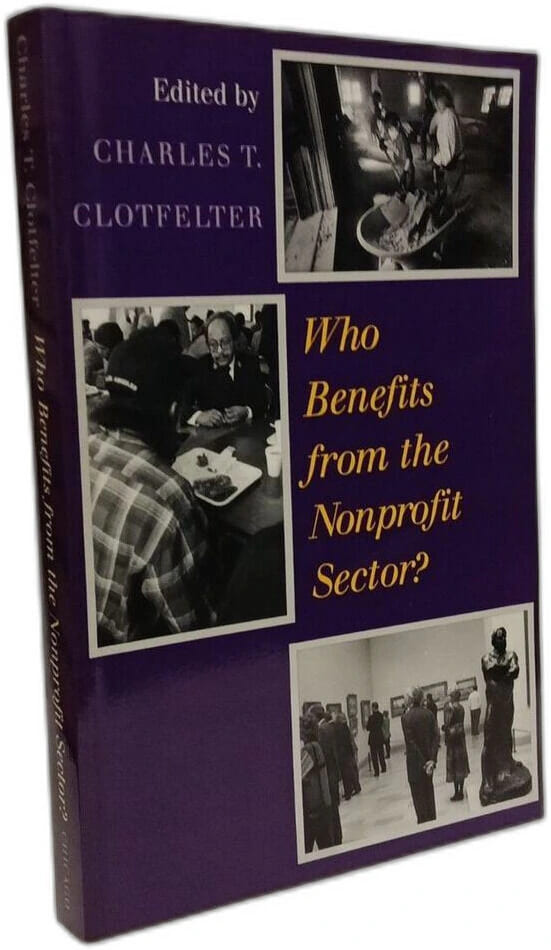
1994ref. 100159682UNIV OF CHICAGO PR 1994 296 pages 15 14x1 96x22 68cm. 1994. Broché. 296 pages.
1990Inscribed by Edwina Currie to half-title page. Appears unread. No other marks or inscriptions. Crease to spine and to upper rear corner. A very clean very tight copy with bright unmarked boards and no bumping to corners. 282pp. A collection of essays from experts of all political shades on women's position in society and practical guidance to women on the challenging issues of today.