527 risultati
2026rif. __0198980337Oxford University Press 2026. Paperback. New. 17 revised edition edition. Oxford University Press paperback
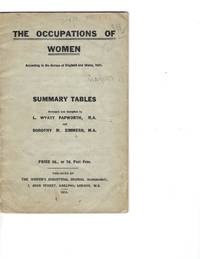
1914rif. 162641914. Papworth L. Wyatt and Dorothy M. Zimmern comps. The Occupations of Women According to the Census of England and Wales 1911 1914 uses government census data to quantify women's participation in the British labor force and identify occupations offering employment to women. Published by the Women's Industrial Council an organization concerned with women's working conditions and economic opportunities the pamphlet converts the 1911 Census into tables comparing male and female employment and distinguishing women workers according to marital and occupational status. Appearing before the First World War substantially altered women's employment in Britain the study provides a statistical record of the labor market immediately preceding wartime expansion into occupations from which women had previously been excluded or employed only in limited numbers. Papworth L. Wyatt and Dorothy M. Zimmern comps. The Occupations of Women According to the Census of England and Wales 1911. London: Women's Industrial Council 1914. Paper wrappers. The compilers arrange census figures into tables analyzing the occupations of men and women the marital status of women workers and the number of retired women workers among other categories. The statistics were assembled not simply to enumerate existing employment but to determine which industries were open to women and where further employment opportunities might be developed. By separating workers according to sex and marital status the pamphlet supplies contemporary evidence of how women's paid labor was measured and classified immediately before the economic disruptions of the First World War. This copy bears provenance from the Women's Service Library at Millicent Fawcett House connecting it to an institution devoted to collecting documentation on women's political social and economic history. The library developed from the collections of the London Society for Women's Service and was named for suffrage leader Millicent Garrett Fawcett whose work also encompassed women's educational and employment opportunities. The association is particularly pertinent to a Women's Industrial Council publication concerned with expanding women's economic participation. Handling creases and soiling to wrappers with creased corners to front wrapper and small loss at lower right corner of rear wrapper and several leaves; overall good condition. A census-based record of women's employment immediately before the First World War with provenance linking the copy to a major British collection devoted to the history of women's rights and work. unknown
rif. 467688HM Stationery Office. Paperback. Good. The Monopolies Commission Report from HM Stationery Office HM Stationery Office paperback
rif. 300-04180Republic of Benin. Paperback. Good. Good condition with wear and markings. Looks like an interesting title! Republic of Benin paperback
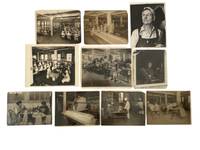
1940rif. 223731940. Women's EmploymentLaborFeminismWWII Archive of ten original photos documenting American women's industrial labor during the 1930s and 1940s. Original black-and-white press photographs taken in various factories during World War II including steel works textiles candy production and industrial assembly lines. Stamped by press agencies including Acme Newspictures Brown Brothers and International News Photos several with annotated captions on verso. This collection of press photos captures the pivotal moment when women entered the industrial workforce en masse replacing men who were fighting overseas. These images were part of a wartime propaganda campaign to normalize and promote women's factory work paving the way for long-term shifts in gender roles in the American labor force. In one striking image captioned by the N.E.A. press service as "Portrait for Mother's Day" a steel worker identified as Mrs. Neel of Gary Indiana is praised as "the American Mother- 1943 style" echoing the iconic Rosie the Riveter with a new image of female patriotism: overalls bandanna badge and goggles in hand. Another shows women boxing chocolates along a conveyor line while several others reveal the mechanical precision and physical intensity of jobs in textile finishing labeling and industrial equipment handling. This archive is emblematic of the historical inflection point that sparked the modern women's labor movement. The war effort validated women's technical skills and economic participation giving rise to a postwar generation of women who emboldened by their wartime service laid the intellectual and organizational groundwork for second wave feminism. Many of these workers would later confront the "return to domesticity" in the 1950s and become active in labor organizing civil rights and feminist causes by the 1960s. Light edge wear. Overall good to very good condition. A photographic archive capturing the genesis of modern women's industrial labor and the cultural origins of second wave feminism in the WWII workplace. unknown
1905rif. 190541905. Women Employment Albumen photograph of two women and a male supervisor working in a textile factory 1905. Measures 6" x 8.5". The photographer captures two women in modest long day dresses leaning upon a large table filled with various textiles and cloths. Beside them a man in a large black top hat stands stoically as his hands rest behind his back. In the background piles of cloth and textiles lay upon large tables and large pipes connect on the ceiling. During the second half of the 19th and early 20th century women began to work in textile clothing factories workshops coal mines tin mines commerce and on farms. Many women were employed in small industries including shirt creation nail making chain production and shoe stitching. Consequently these were known as "sweated industries" as the working hours were lengthy with low pay. Factories organized work along the lines of gender--with men performing the supervisory roles and work which was categorized as "skilled". The edges are minorly worn and the bottom right edge is cut not affecting the image. In very good condition. unknown
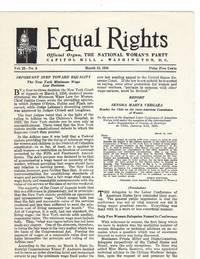
1936rif. 160251936. National Woman's Party. Equal Rights March 15 1936 documents the organization's campaign for legal equality at a time when women's workplace legislation divided American feminists over whether sex-specific protections advanced or restricted women workers. Founded in 1916 by Alice Paul and Lucy Burns during the suffrage campaign the National Woman's Party continued after ratification of the Nineteenth Amendment by advocating the Equal Rights Amendment then commonly associated with the Lucretia Mott Amendment and by opposing laws that imposed legal distinctions based solely on sex. This issue addresses the New York minimum wage controversy international equal-rights efforts and proposed workplace protections for women and children. National Woman's Party. Equal Rights. Vol. 22 No. 6. March 15 1936. 4 pages. 8 1/2 x 11 inches. Official organ of the National Woman's Party. The issue reports on the New York minimum wage case after the New York Court of Appeals struck down the state law regulating minimum wages for women; the United States Supreme Court subsequently affirmed that judgment in Morehead v. New York ex rel. Tipaldo on June 1 1936. It also discusses the Equal Rights Treaty signed at Montevideo by Cuba Ecuador Paraguay and Uruguay part of the National Woman's Party's effort to establish sex equality in international law. Another article addresses workplace hygiene and a resolution requiring employers to provide women with separate quarters for washing changing clothes and general use as well as seats for women and children when the work did not require them to remain standing. Published two years before enactment of the Fair Labor Standards Act of 1938 the issue records a central dispute in interwar women's rights politics: whether legislation written specifically for women offered necessary labor protection or created legal distinctions that could restrict women's employment and undermine demands for equal rights. The National Woman's Party pursued the latter argument while simultaneously campaigning internationally for legal equality between the sexes. The March 1936 issue therefore preserves contemporary evidence of the relationship among the Equal Rights Amendment campaign minimum wage litigation international treaty advocacy and debates over sex-specific workplace regulation. In excellent condition. unknown
2026rif. LRB48023922Paris: Editions Recreasoft 2026 Language: English. Approximately 798 pages. English: Print-on-demand reprint. Original edition : 1868. Text in English. This comprehensive report presents the findings of the British Commission on the Employment of Children Young Persons and Women in Agriculture. It includes detailed appendices and covers multiple years of investigations providing valuable insights into labor practices and conditions in the agricultural sector during the late 19th century. The work is essential for historians and researchers studying social and economic history labor laws and the role of women and children in the workforce. Book images are non-contractual. Editions Recreasoft. Softcover. New. Editions Recreasoft paperback
2026rif. LRB501842Paris: Editions Recreasoft 2026 Language: English. Approximately 676 pages. English : Print-on-demand reprint. Book images are non-contractual. Editions Recreasoft. Softcover. New. Editions Recreasoft paperback
1878rif. 189841878. Watherston Edward J. The Industrial Employment of Women in France Compared with England. London: Spottiswoods and Co. 1878. French Silk Manufactures and the Industrial Employment of Women. London: Dryden Pres - J Davy and Sons 1879. Both measure 8.5" x 5.25". 16 and 23 pages respectively. The 1878 pamphlet "The Industrial Employment of Women in France." is a comparative analysis of the labor participation rate of women in France and in England. French women were much more integrated into the labor market this study finds even despite the fact that England had a disproportionate demographic surplus of women and an even more developed industrial sector. At the conclusion of the pamphlet Watherston proposes three major steps spur female employment in England based off the French example which are the: "1. Establishment of special training schools for certain trades following a preliminary general education. 2. These training schools. must be made self-supporting within a short time. All pupils must pay a moderate fee for being taught. 3. There should be union of the managers of training schools with all manufacturers wishing to employ female labour. The union must aim both to give employment to women and to advise as to the directions in which it may be sought and into which it may be extended." Watherston lays blame for the poor labor participation rate of English women at the fact that they are barred from major employment sectors such as the railways as well as a private sector which demonstrated no inclination to hire them. He concludes that English women need organization first and foremost and should establish a "Society for the Industrial Employment of Women". The second pamphlet focuses on first the history of the French silk industry and later women's employment within it noting the unique advances that the French female silk workers enjoyed. Watherston notes that "Other countries before France made use of female labour but the French were the first who employed not only as we do the hands but also the brains of women. The technical education of female workers took place simultaneously with that of the men and it is to the results of this that not a little of the excellence of the French silk manufactures of the present day is due." Watherston goes on to examine the silk manufacture at Jujurieux which took in young women from a rural underdeveloped region and lodged fed and rigorously trained them in silk production. In both of these pamphlets he highlights and endorses enterprises that transform women into workers often through a process that includes living and training amongst fellow apprentices for years at a time. There is a prevailing belief that women must be engineered into working class subjects through this total immersion but with a confidence that they are technically and intellectually skilled enough should they be properly acclimated. Some minor chipping to left edge 3/4 in. tear on top edge of one pamphlet overall in very good condition. unknown
1942rif. 154741942. Royal Medical College of Romania. 1942 license to practice medicine issued to a woman documenting the formal admission of a female physician to professional medical practice in wartime Romania. The license records the institutional process by which medical credentials were recognized and permission to practice was conferred placing an individual woman within Romania's developing twentieth-century medical profession. Romanian women had entered medical education before the First World War but female physicians remained a minority within the country's medical establishment during the interwar period. Royal Medical College of Romania. License to Practice Medicine. Romania 1942. The document formally licenses a woman to practice medicine. Its date places the authorization during the Second World War when Romania was governed by the Antonescu regime and participating in the war alongside the Axis powers. The license provides direct evidence of a woman receiving professional medical authorization within this wartime institutional setting. Women's entry into Romanian medicine had expanded after the First World War: women increasingly studied medicine and obtained positions in hospitals maternity facilities schools and other public-health institutions although men continued to predominate in medical administration and practice. The 1942 license records the continuation of that professional development into the wartime period. The history was not confined to Romania; historian Mary Roth Walsh documented a comparable early twentieth-century contraction in women's participation in American medicine where women's share of the physician workforce declined substantially after 1900. This Romanian license supplies a specific documentary record of female medical practice during the same period of uneven access to the profession internationally. unknown
1870rif. 262319London: printed for George Edward Eyre and William Spottiswoode 1870. First Edition. Softcover. Poor copy in the original stiff-card wrappers; wear and tear as with age. Text remains in fine condition and without blemish. Provenance; from the libary of Eward Stanhope and the Library of the University College of Leicester with their bookplates. Physical description; 348 pages. Subjects; Reports. Commission of Children. 19th century reports. Great Britain. London: printed for George Edward Eyre and William Spottiswoode paperback
rif. Z1-C-030-03169H.M. Stationery Off. Used - Acceptable. Used - Acceptable. Ships from UK in 48 hours or less usually same day. Your purchase helps support Sri Lankan Children's Charity 'The Rainbow Centre'. Ex-library with wear and barcode page may have been removed. 100% money back guarantee. We are a world class secondhand bookstore based in Hertfordshire United Kingdom and specialize in high quality textbooks across an enormous variety of subjects. We aim to provide a vast range of textbooks rare and collectible books at a great price. Our donations to The Rainbow Centre have helped provide an education and a safe haven to hundreds of children who live in appalling conditions. We provide a 100% money back guarantee and are dedicated to providing our customers with the highest standards of service in the bookselling industry. H.M. Stationery Off unknown
2026rif. __0198985231Oxford University Press 2026. Hardcover. New. Oxford University Press hardcover
rif. B9780968194645Paperback / softback. New. paperback
rif. Z1-C-082-00057Great Britain Department for Education and Employment. Used - Good. Paperback. Ships from UK in 48 hours or less usually same day. Your purchase helps support Sri Lankan Children's Charity 'The Rainbow Centre'. Ex-library so some stamps and wear but in good overall condition. 100% money back guarantee. We are a world class secondhand bookstore based in Hertfordshire United Kingdom and specialize in high quality textbooks across an enormous variety of subjects. We aim to provide a vast range of textbooks rare and collectible books at a great price. Our donations to The Rainbow Centre have helped provide an education and a safe haven to hundreds of children who live in appalling conditions. We provide a 100% money back guarantee and are dedicated to providing our customers with the highest standards of service in the bookselling industry. Great Britain, Department for Education and Employment paperback
rif. Z1-C-076-00476Department For Education And Employment. Used - Good. Ships from UK in 48 hours or less usually same day. Your purchase helps support Sri Lankan Children's Charity 'The Rainbow Centre'. Ex-library so some stamps and wear but in good overall condition. 100% money back guarantee. We are a world class secondhand bookstore based in Hertfordshire United Kingdom and specialize in high quality textbooks across an enormous variety of subjects. We aim to provide a vast range of textbooks rare and collectible books at a great price. Our donations to The Rainbow Centre have helped provide an education and a safe haven to hundreds of children who live in appalling conditions. We provide a 100% money back guarantee and are dedicated to providing our customers with the highest standards of service in the bookselling industry. Department For Education And Employment unknown
rif. 18979Women's Employment Workingmen Want this Bill! An Act To Amend the Labor Law Relative to Hours of Labor. Utica: Utica Trades Assembly n.d. Measuring 9.5" x 6" on tan paper. A women's labor broadside calling attention to the modification of "labor laws relative to the hours of labor" for women and minors in New York. Decorated in bold black lettering the slogan reads "Workingmen Want this Bill!" followed by the contention that the bill "provides for a half holiday on Saturday for women and minors employed on factories without the necessity of working overtime on other days of the week". This is succeeded by the presentation of the act by "The People of the State of New York represented in Senate and Assembly with excerpts from Sections 1 2 3 and 77. Section 77 states that "Hours of labor of minors and women--No minor under the age of eighteen years and no female shall be employed at labor in any factory in this State before six o'clock in the morning or after nine o'clock in the evening of any day or for more than ten hours in any one day of sixty fifty six hours in any one week nor more than six hours on the last day of the week.". As of this writing OCLC reports fewer than three copies in the United States. This document seems to follow some text from the Keating-Owen Child Labor Act 1916. In very good condition. unknown
1935rif. 189931935. Women's Employment World-War II McConnell Dorothy. Women War and Fascism. New York: The American League Against War and Fascism 1935. 18 pages. Bound in brown cardstock wrappers. Measuring 5.5" x 8". McConnell presents a "protest against the use of women as cheap labor in factories and offices in the U.S. as well as in the fascist states" asserting that "Munitions plants employ women at dangerous tasks with long hours and low wages. Discriminatory laws against women should be defeated and women's wages made equal with men's for equal work". Wrappers are vibrant and unworn. Small penciled inscription on the title page not affecting text. An interesting pamphlet promoting the fight for women's labor safety and equal pay during WWII. Very clean and bright pages in very good condition. unknown
rif. 08180306.lvGood. Covers show significant edge curling and light corner wear. Finger smudging on edges of text block. Text itself appears bright clean and unmarked. unknown
1846rif. 72398Charleston: B. Jenkins 1846. Paperback. Very good. Paperback. 32pp. Removed from a larger volume with some residue on the spine. Foxed throughout else very good. Sabin 85301. B. Jenkins paperback
rif. 200-07988Ministry of Employment and Labour. Paperback. New. In shrink wrap. Looks like an interesting title! Ministry of Employment and Labour paperback
rif. Z1-T-034-00275Great Britain Department for Education and Employment. Used - Good. Ships from UK in 48 hours or less usually same day. Your purchase helps support Sri Lankan Children's Charity 'The Rainbow Centre'. Shows some signs of wear but in good overall condition. 100% money back guarantee. We are a world class secondhand bookstore based in Hertfordshire United Kingdom and specialize in high quality textbooks across an enormous variety of subjects. We aim to provide a vast range of textbooks rare and collectible books at a great price. Our donations to The Rainbow Centre have helped provide an education and a safe haven to hundreds of children who live in appalling conditions. We provide a 100% money back guarantee and are dedicated to providing our customers with the highest standards of service in the bookselling industry. Great Britain, Department for Education and Employment unknown
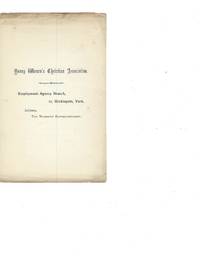
1890rif. 164641890. Young Women's Christian Association. Employment Agency Branch 1890s an organizational pamphlet documenting the policies governing a YWCA employment agency in York and the institutional mechanisms used to connect women seeking paid work with prospective employment. By the late nineteenth century YWCA branches had expanded beyond religious fellowship to provide practical services including housing vocational instruction and employment placement for women; YWCA histories record the establishment of employment bureaus and typewriting training during this period. The present pamphlet shows that employment-assistance system in practice through formal agency policies providing primary-source evidence for the study of women's labor charitable and religious social-service networks vocational placement and the changing economic position of women in late Victorian Britain. Young Women's Christian Association. Employment Agency Branch. York: Young Women's Christian Association 1890s. Self-wrappers. Pagination and dimensions not supplied. The pamphlet sets forth policies for the Association's Employment Agency Department defining the administrative framework through which the branch managed employment assistance. Its significance lies in the practical structure it records: rather than merely advocating women's economic independence the agency created a formal mechanism through which applicants and employers could be brought into contact under organizational supervision. This activity belongs to a broader late nineteenth-century transformation in women's work when employment opportunities were still strongly divided by gender but were beginning to expand into clerical professional retail medical and other occupations previously less accessible to women. The York employment agency belongs to the wider history of women's voluntary organizations intervening directly in the labor market by providing placement services training and institutional support. Such services were particularly significant for women navigating an employment landscape in which occupational options and wages remained constrained by gender. The pamphlet therefore offers evidence not simply of YWCA philanthropy but of the administrative infrastructure developed to facilitate women's entry into paid work. No specific physical defects are supplied; overall very good. A concise primary source documenting how a late Victorian women's organization translated social-service aims into a structured employment-placement program. unknown
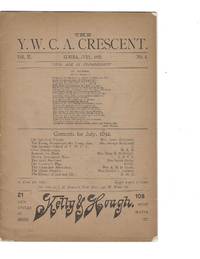
1892rif. 164651892. Young Women's Christian Association. The Y.W.C.A. Crescent July 1892 an early organizational newsletter carrying the motto "Our Aim is Progress" and documenting the public identity of the Young Women's Christian Association during the late nineteenth-century expansion of women's religious educational employment and associational activity. The emphatic language of "progress" places the publication within a culture of organized female self-improvement and collective advancement providing contemporary evidence of how a women-led Christian association presented its aims to members and readers. Without further description of the issue's internal articles its strongest interpretive value lies in this representation of YWCA community identity and the language through which women's organized activity was framed in the 1890s. The Y.W.C.A. Crescent. Vol. 2 No. 4. Young Women's Christian Association July 1892. Newsletter bearing the slogan "Our Aim is Progress." Pagination place of publication dimensions and specific internal contents are not supplied. As the fourth number of the publication's second volume the issue demonstrates an established serial publishing effort by the Association and provides material evidence of the periodical culture through which women's voluntary organizations maintained a recognizable institutional voice. An exact surviving example is independently cataloged under this title volume number and date. The issue belongs to the broader history of women's associational print culture at the close of the nineteenth century when newsletters and organizational periodicals helped sustain communities formed around religious fellowship education employment assistance and women's social development. The phrase "Our Aim is Progress" is particularly evocative of the aspirational vocabulary used by women's organizations seeking to define expanded roles for women within modern urban and professional life although the specific contents of this issue should not be inferred without examination. Covers loose or separated from the body of the newsletter; otherwise no specific defects supplied; overall very good. An early YWCA periodical useful for the study of women's organizational culture institutional publishing and the rhetoric of female advancement in the 1890s. unknown