677 risultati
rif. 16266Working Girls' Society. Circular of the Working Girls' Society late nineteenth century sets out the rules and benefits of a New York organization created for wage-earning women. The Society provided working women with rooms for social meetings classes reading and recreation after working hours while its bylaws governed membership and access to the organization's facilities. Contemporary accounts of New York working girls' clubs describe them as cooperative organizations in which members pursued self-education social activity and practical assistance rather than simply receiving charity. Circular of the Working Girls' Society. New York: Working Girls' Society n.d. Bylaws governing membership and use of the Society's library and rooms at 222 West 38th Street. The circular describes benefits available to members including special vacation privileges and discounted railway tickets combining educational and social provisions with practical assistance for women earning wages in the city. The regulations document the daily administration of a women's club formed around the needs of an expanding urban female workforce and show how membership could provide access to books meeting rooms instruction recreation and reduced-cost travel. The circular survives from the period in which working women's clubs expanded in New York; by the early twentieth century contemporary descriptions traced the movement to clubs organized during the 1880s and emphasized their classes member government and opportunities for social intercourse and self-improvement. Two very light horizontal folds and light thumb-soiling with a 2-inch tear at the bottom of the center fold; overall Very Good Condition. unknown
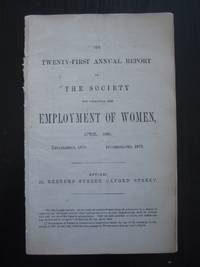
1880rif. 165711880. Society for Promoting the Employment of Women. The Twenty-First Annual Report of the Society for Promoting the Employment of Women 1880 documents an organization established to expand women's access to vocational training and paid employment in occupations beyond the limited fields conventionally open to them in nineteenth-century Britain. Founded in 1859 through the work of women's rights reformers including Jessie Boucherett Barbara Bodichon and Adelaide Anne Procter the Society connected demands for women's economic independence with practical programs for training and placement. Its purpose is stated directly in the report: "The Society is formed for promoting the Training of Women and their employment in industrial pursuits." Society for Promoting the Employment of Women. The Twenty-First Annual Report of the Society for Promoting the Employment of Women April 1880. London: Printed by John Bale & Sons 1880. First edition. The thirty-page report records the Society's work in preparing women for specific occupations and discusses the training required to enter fields including wood carving hospital nursing and hairdressing among others. Rather than arguing only for women's abstract right to employment the report records the practical means by which the Society attempted to open occupations through instruction and professional preparation. Its annual accounting of such programs shows how an organization founded by members of the mid-century women's rights movement addressed the economic restrictions confronting women through vocational initiatives maintained over more than two decades. The report appeared twenty-one years after the Society's establishment and shortly after its incorporation in 1879 when campaigns for women's property rights education professional access and suffrage were expanding the legal and economic questions surrounding women's independence. The Society's emphasis on training addressed one concrete barrier to entry into skilled occupations: women could not compete for work from which they had also been excluded from acquiring the necessary preparation. 30 pages. Original paper wrappers measuring 8 x 5 inches. Light pencil marks in the margins; otherwise very good condition. At the time this description was prepared no copies were recorded in American institutions in the OCLC search consulted; institutional holdings and OCLC records remain subject to revision. unknown
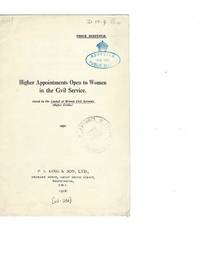
1928rif. 162621928. Council of Women Civil Servants Higher Grades. Higher Appointments Open to Women in the Civil Service 1928 publicized routes into senior British government employment three years after women became eligible for direct recruitment into the Administrative Class of the Home Civil Service. The Council founded in 1920 to represent women in administrative professional and executive grades campaigned during the interwar period for equal opportunity and equal pay and against restrictions including the marriage bar. This pamphlet addressed a practical obstacle to women's advancement: insufficient knowledge of the senior Civil Service careers then available to female applicants. Its publication belongs to the Council's broader campaign to increase women's access to government positions beyond the clerical grades. Council of Women Civil Servants Higher Grades. Higher Appointments Open to Women in the Civil Service. London: P. S. King & Son Ltd. 1928. 8½ x 5½ inches. Eight-page pamphlet in paper wrappers staple bound. The Council begins from its belief that the "number and the importance of the careers in the Civil Service open to women are not fully recognized" then supplies information intended to acquaint prospective applicants with higher appointments and the procedures for obtaining them. The text describes opportunities in administrative executive and clerical work making the pamphlet both a recruitment document and evidence of the methods used by an organization of women civil servants to encourage women to pursue positions within the government's higher grades. A contemporary listing records another copy as formerly held by the Board of Education library. The pamphlet appeared during a period when formal access to higher Civil Service employment had expanded without eliminating sex-based restrictions within government employment. Women gained access to direct recruitment into the Administrative Class in 1925 yet women civil servants continued to encounter unequal pay restricted advancement and the marriage bar; the Council subsequently presented evidence to the Royal Commission on the Civil Service in 1929-1931 and remained active in campaigns concerning equal pay and women's eligibility for government posts. The present copy has light thumb-soiling stamps on the front wrapper a library sticker on the rear and rusting to the staple binding; good condition. Its eight pages preserve the Council's own effort to translate newly available avenues of advancement into concrete information about careers and application procedures for women seeking higher appointments in the inter war British Civil Service. unknown
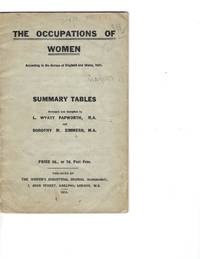
1914rif. 162641914. Papworth L. Wyatt and Dorothy M. Zimmern comps. The Occupations of Women According to the Census of England and Wales 1911 1914 uses government census data to quantify women's participation in the British labor force and identify occupations offering employment to women. Published by the Women's Industrial Council an organization concerned with women's working conditions and economic opportunities the pamphlet converts the 1911 Census into tables comparing male and female employment and distinguishing women workers according to marital and occupational status. Appearing before the First World War substantially altered women's employment in Britain the study provides a statistical record of the labor market immediately preceding wartime expansion into occupations from which women had previously been excluded or employed only in limited numbers. Papworth L. Wyatt and Dorothy M. Zimmern comps. The Occupations of Women According to the Census of England and Wales 1911. London: Women's Industrial Council 1914. Paper wrappers. The compilers arrange census figures into tables analyzing the occupations of men and women the marital status of women workers and the number of retired women workers among other categories. The statistics were assembled not simply to enumerate existing employment but to determine which industries were open to women and where further employment opportunities might be developed. By separating workers according to sex and marital status the pamphlet supplies contemporary evidence of how women's paid labor was measured and classified immediately before the economic disruptions of the First World War. This copy bears provenance from the Women's Service Library at Millicent Fawcett House connecting it to an institution devoted to collecting documentation on women's political social and economic history. The library developed from the collections of the London Society for Women's Service and was named for suffrage leader Millicent Garrett Fawcett whose work also encompassed women's educational and employment opportunities. The association is particularly pertinent to a Women's Industrial Council publication concerned with expanding women's economic participation. Handling creases and soiling to wrappers with creased corners to front wrapper and small loss at lower right corner of rear wrapper and several leaves; overall good condition. A census-based record of women's employment immediately before the First World War with provenance linking the copy to a major British collection devoted to the history of women's rights and work. unknown
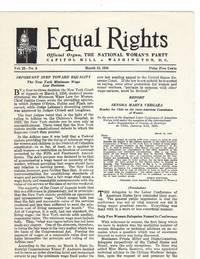
1936rif. 160251936. National Woman's Party. Equal Rights March 15 1936 documents the organization's campaign for legal equality at a time when women's workplace legislation divided American feminists over whether sex-specific protections advanced or restricted women workers. Founded in 1916 by Alice Paul and Lucy Burns during the suffrage campaign the National Woman's Party continued after ratification of the Nineteenth Amendment by advocating the Equal Rights Amendment then commonly associated with the Lucretia Mott Amendment and by opposing laws that imposed legal distinctions based solely on sex. This issue addresses the New York minimum wage controversy international equal-rights efforts and proposed workplace protections for women and children. National Woman's Party. Equal Rights. Vol. 22 No. 6. March 15 1936. 4 pages. 8 1/2 x 11 inches. Official organ of the National Woman's Party. The issue reports on the New York minimum wage case after the New York Court of Appeals struck down the state law regulating minimum wages for women; the United States Supreme Court subsequently affirmed that judgment in Morehead v. New York ex rel. Tipaldo on June 1 1936. It also discusses the Equal Rights Treaty signed at Montevideo by Cuba Ecuador Paraguay and Uruguay part of the National Woman's Party's effort to establish sex equality in international law. Another article addresses workplace hygiene and a resolution requiring employers to provide women with separate quarters for washing changing clothes and general use as well as seats for women and children when the work did not require them to remain standing. Published two years before enactment of the Fair Labor Standards Act of 1938 the issue records a central dispute in interwar women's rights politics: whether legislation written specifically for women offered necessary labor protection or created legal distinctions that could restrict women's employment and undermine demands for equal rights. The National Woman's Party pursued the latter argument while simultaneously campaigning internationally for legal equality between the sexes. The March 1936 issue therefore preserves contemporary evidence of the relationship among the Equal Rights Amendment campaign minimum wage litigation international treaty advocacy and debates over sex-specific workplace regulation. In excellent condition. unknown
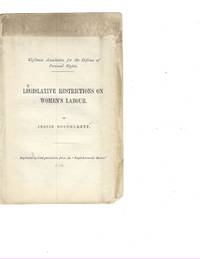
1873rif. 165771873. Boucherett Jessie. Legislative Restrictions on Women's Labour 1873 challenges proposed factory legislation limiting the hours and conditions under which women including mothers of young children could work arguing that such measures deprived adult women of authority over their own employment while providing no substitute for lost wages. Boucherett identifies the principle underlying the legislation as itself objectionable: "Another objection is that the Bill confirms the principle that women are not capable of deciding for themselves." Her opposition arose from the practical circumstances of women whose earnings supported themselves and their children placing employment restrictions within a larger debate over women's legal independence wages and control of their own labor. Boucherett Jessie. Legislative Restrictions on Women's Labour. London: Frederick Bell & Co. 1873. First edition. Reprinted by kind permission from the Englishwoman Review for the Vigilance Association for the Defence of Personal Rights. 12 pages. Original paper wrappers. 8 x 5 inches. Boucherett acknowledges the protective rationale behind the proposed measures writing "It has caused some surprise that Bills framed for so benevolent a purpose should have met with opposition from an unexpected quarter" before detailing their possible consequences for working women. She argues that reducing women's access to factory employment without guaranteeing family maintenance could produce "much suffering and some crime" since "it would always be difficult and sometimes impossible for a woman to provide sufficient food for herself and four or five little children." Her argument therefore distinguishes between women with independent means and wage-earning women for whom statutory restrictions could immediately reduce the household's supply of food and other necessities. Boucherett had founded the Society for Promoting the Employment of Women in 1859 and spent much of her career seeking expanded training and occupations for women; this pamphlet applies the same concern for economic independence to parliamentary attempts to regulate female industrial labor. Its publication also formed part of a contemporary controversy over proposals associated with Alexander Mundella and John Lubbock to extend restrictions governing women's factory employment. Rather than opposing regulation solely in the name of laissez-faire principles Boucherett bases her case on women's need to earn wages their responsibility for dependent children and their right to make employment decisions for themselves. Toning to front wrapper with a few chips and losses along the right edge. Good condition. unknown
1873rif. 165641873. Association of Factory Occupiers in the Four Counties of Lancaster York Chester and Derby. Mr. Mundella's Bill for Limiting the Hours of Labour in Factories 1873. First edition of a response by northern English factory owners to Liberal Member of Parliament Anthony John Mundella's campaign to reduce working hours for women and children in British textile mills. Following Mundella's speech before the House of Commons on June 11 1873 the employers challenged his allegations of dangerous working conditions excessive hours and elevated mortality among female and child workers. Mundella condemned the "shameful treatment" of factory laborers and drew particular attention to infant deaths associated with mothers returning to industrial employment shortly after childbirth declaring that "the return of the mother to the mill was a sentence of death on the child." The employers countered his arguments with statistics intended to demonstrate improvements in workers' health and living conditions documenting organized industrial opposition to legislation intended to protect women and children. Association of Factory Occupiers in the Four Counties of Lancaster York Chester and Derby. Mr. Mundella's Bill for Limiting the Hours of Labour in Factories. Observations of the Employers upon the Speech of Mr. Mundella M.P. Made in the House of Commons on Wednesday the 11th of June 1873. Manchester: John Heywood Excelsior Printing Works 1873. First edition. 32 pages. Original paper wrappers measuring 8¼ x 5 inches. The pamphlet reproduces passages from Mundella's parliamentary speech alongside the employers' corresponding rebuttals allowing direct comparison of the competing arguments. Three statistical tables in the appendix present mortality data employed in the controversy. Issued on behalf of the regional factory owners' association the response is dated July 24 1873 and identifies Richard Haworth as chairman Joseph Simpson as treasurer and Henry Whitworth as secretary. The dispute preceded the Factory Act of 1874 which restricted the working hours of women and young persons in textile factories and established a ten-hour working day. Mundella's campaign connected industrial working conditions with public health childhood education and infant mortality while manufacturers resisted further statutory limits by disputing the medical and statistical evidence supporting reform. The pamphlet preserves the employers' organized response to proposed labor protections including their use of mortality statistics to challenge parliamentary testimony about the consequences of factory employment. Very good condition. unknown
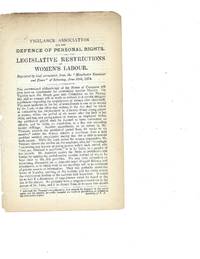
1874rif. 165761874. Vigilance Association for the Defence of Personal Rights. Legislative Restrictions on Women's Labour 1874 opposes proposed factory legislation that would prevent women from returning to industrial employment for six months after childbirth. The Association argues that a measure presented as protection would fall most heavily on women whose families depended upon their wages asking "Who in thousands of cases where there is no helper will assure them and their children bread" Its objections connect employment restrictions to married women's precarious legal and economic position particularly women deserted or unsupported by husbands and left without an enforceable claim upon their husbands' earnings. Vigilance Association for the Defence of Personal Rights. Legislative Restrictions on Women's Labour. Extract reprinted by kind permission from the Manchester Examiner and Times of Saturday June 20th 1874. London: Vigilance Association for the Defence of Personal Rights 1874. First edition extract. 4 pages. Original paper wrappers. 8 1/2 x 5 inches. The pamphlet challenges legislation directed specifically at working women while leaving wealthier women free from comparable interference. Addressing married workers it notes that there are ".many married women deserted or uncared for by their husbands" and argues that "no marriage law secures to the wife a share in the earnings of the father of her children." The text consequently treats freedom to work not as an abstract principle but as an immediate question of food wages and support for women and children and calls upon women themselves to oppose the proposed restriction. The pamphlet belongs to the Vigilance Association's campaign against statutory limitations imposed specifically upon adult women's labor during the parliamentary debates surrounding the Factory Acts in 1874. Its argument exposes a central conflict in nineteenth-century labor reform: legislation intended to protect women workers could also restrict their access to wages without providing an alternative means of family support. At the time this description was prepared no copies were located in American institutions through the OCLC search consulted; institutional records are subject to revision and should be reconfirmed. Condition information was not supplied. The four-page tract records an organized women's-rights response to factory regulation that linked employment freedom directly to marriage law household income and women's economic dependence. unknown
1859rif. 165681859. Parkes Bessie Rayner. The Market for Educated Female Labor 1859 argues that girls and young women should receive education or vocational training sufficient to support themselves rather than being prepared exclusively for marriage. Parkes wrote amid organized efforts to expand employment opportunities for middle-class women and in the same year that the Society for Promoting the Employment of Women was established. She rejects the assumption that marriage guaranteed lifelong financial support observing "The daughter may marry but her husband may die.or be too poor to support her and her children; let her at least be trained beforehand to some possible way of getting her bread." Her argument treats women's preparation for paid work as an ordinary parental responsibility rather than an emergency measure reserved for poverty. Parkes Bessie Rayner. The Market for Educated Female Labor. 1859. First edition. 6 pages present of an original 8 lacking the final two pages. Unbound measuring 8 1/4 x 5 inches. The text was delivered as a paper at the 1859 Bradford meeting of the Association for the Promotion of Social Science. Parkes states "We lay it down as a primary social law conceded by all political economists that a father ought to provide for all his children or give them the means of providing for themselves." She further counters the idea that paid employment among middle-class women was exceptional: "Probably every person present has a female relative or intimate friend whom trade-failure the exigencies of a numerous household or the early death of husband or father has compelled to this course; it is the experience of every family." The surviving text consequently links women's education to specific economic contingencies including business failure large households widowhood and the death of a father or husband. Parkes was then a central figure in the Langham Place circle and a founding editor of the English Woman's Journal established in 1858 to address women's employment education legal disabilities and related reforms. Her paper appeared as these activists were moving from publication and debate toward practical employment initiatives; the Society for Promoting the Employment of Women was founded in 1859 to train women and open additional occupations to them. At the time this description was prepared no copies were recorded in American institutional holdings consulted; OCLC search results remain subject to cataloging changes and should be reconfirmed. Repairs to the upper right corner and right edge of page 1 and a small repair to the left edge of page 6. Lacking the final two pages; good condition. The surviving six pages preserve Parkes's direct argument that women's education should provide the means for economic self-support in circumstances she described as common within middle-class families. unknown
1847rif. 162581847. Goddard Emily L. Archive of thirteen letters of recommendation and certification 1847-1853 documents a woman teacher establishing her professional qualifications across the common schools of western Massachusetts. Written by school officials and other individuals in Barre Wilbraham New Salem Athol Petersham and surrounding communities the letters certify Goddard's eligibility to teach in particular districts or attest to her general qualifications for common-school instruction. Spanning six years the correspondence records the repeated process by which a woman teacher obtained written approval and recommendations as she sought successive teaching positions in antebellum New England. Thirteen manuscript letters 1847-1853 concerning Emily L. Goddard's qualifications and employment as a teacher in western Massachusetts. The documents originate from multiple towns including Barre Wilbraham New Salem Athol and Petersham and consist principally of certifications and recommendations addressing Goddard's ability to teach a common school. The individual letters preserve the assessments she carried between districts as evidence of her preparation and prior work. Their geographic range and successive dates trace a professional record extending beyond a single appointment or school and show how recommendations from local authorities could accompany a teacher seeking employment elsewhere. Goddard's papers date from the expansion of the Massachusetts common-school movement when public education reform increased demand for teachers and teaching became an increasingly important occupation for women. Women's employment in common schools expanded substantially during the nineteenth century although hiring certification salaries and continued employment remained subject to local school authorities. This archive records those practices through one teacher's surviving credentials: thirteen documents produced over six years as Goddard accumulated certifications and endorsements in several Massachusetts communities. Fold lines and creases with very little foxing; handwriting remains clear and legible throughout. All thirteen letters in very good condition. A sustained documentary record of a woman building a teaching career within the local certification and recommendation practices of antebellum Massachusetts. unknown
1935rif. 153591935. American League Against War and Fascism. Women War and Fascism 1935 links women's labor conditions in the United States to the League's broader campaign against militarism and fascism during the Depression. The pamphlet protests the employment of women as low-paid labor in factories and offices describes dangerous work performed by women in munitions plants condemns long hours and unequal wages and calls for the defeat of discriminatory legislation and equal pay for equal work. Founded in 1933 the American League Against War and Fascism brought communists socialists liberals labor activists and clergy into a national coalition opposed to war and the expanding power of fascist governments. Its appeal for supporters to "defend peace democracy and the rights of the working people" joined opposition to fascism abroad with labor and civil-liberties campaigns in the United States. American League Against War and Fascism. Women War and Fascism. New York: The American League Against War and Fascism 1935. Original paper wrappers. 18 pages. The text identifies women's low wages as both a labor issue and a feature of militarized industrial production drawing particular attention to women employed at hazardous tasks in munitions plants for long hours and inadequate pay. Its demand that "women's wages be made equal with men's for equal work" places wage discrimination alongside discriminatory laws as conditions requiring organized political opposition. Published as Hitler consolidated Nazi rule in Germany Mussolini prepared and commenced Italy's invasion of Ethiopia and Japanese military expansion continued in Asia the pamphlet shows how the League connected developments abroad with domestic labor organizing and resistance to American militarization. The pamphlet was issued during the growth of Popular Front anti-fascist organizing several years before the United States entered the Second World War and records an effort to place women workers within campaigns against both economic exploitation and militarism. Its combination of equal-pay demands criticism of dangerous industrial labor and anti-fascist politics documents an early convergence of women's labor activism and organized opposition to fascism in the United States. Light edgewear and faint toning to wrappers with a small closed tear at the spine fold; overall Very Good. Buhle 372; Seidman M182. unknown
1942rif. 154741942. Royal Medical College of Romania. 1942 license to practice medicine issued to a woman documenting the formal admission of a female physician to professional medical practice in wartime Romania. The license records the institutional process by which medical credentials were recognized and permission to practice was conferred placing an individual woman within Romania's developing twentieth-century medical profession. Romanian women had entered medical education before the First World War but female physicians remained a minority within the country's medical establishment during the interwar period. Royal Medical College of Romania. License to Practice Medicine. Romania 1942. The document formally licenses a woman to practice medicine. Its date places the authorization during the Second World War when Romania was governed by the Antonescu regime and participating in the war alongside the Axis powers. The license provides direct evidence of a woman receiving professional medical authorization within this wartime institutional setting. Women's entry into Romanian medicine had expanded after the First World War: women increasingly studied medicine and obtained positions in hospitals maternity facilities schools and other public-health institutions although men continued to predominate in medical administration and practice. The 1942 license records the continuation of that professional development into the wartime period. The history was not confined to Romania; historian Mary Roth Walsh documented a comparable early twentieth-century contraction in women's participation in American medicine where women's share of the physician workforce declined substantially after 1900. This Romanian license supplies a specific documentary record of female medical practice during the same period of uneven access to the profession internationally. unknown
1919rif. 149951919. National Federation of Business and Professional Women's Clubs plaque 1919 commemorates the founding year of a national organization created to coordinate and advance the interests of business and professional women. Established on July 16 1919 after wartime efforts to identify women's professional skills and experience the Federation developed from organizing associated with the Women's War Council and the mobilization of women workers during World War I. Its formation preceded ratification of the Nineteenth Amendment in 1920 and placed questions of women's employment professional advancement and political participation within a national organizational structure. Large bronze embossed seal of the National Federation of Business and Professional Women's Clubs mounted on wood and dated 1919. The Federation was organized at its first national convention in St. Louis in July 1919 under the leadership of Lena Madesin Phillips with Gail Laughlin elected its first national president. Early Federation work included a national survey of business and professional women addressing their status qualifications opportunities and working conditions providing an organized basis for advocacy concerning women's economic and professional life. The plaque dates from the Federation's founding year when women were entering professional occupations in greater numbers while still lacking federally protected voting rights nationwide. The organization continued to advocate on issues affecting working women and to promote professional development leadership and economic opportunity. The bronze seal mounted on wood survives as an organizational artifact from the Federation's establishment in 1919 one year before ratification of the Nineteenth Amendment extended constitutional protection for women's suffrage nationwide. unknown
2006rif. DADAX1933043210Brand: Center for Education Employment 2006-09-21. 7. paperback. New. 6.00x1.00x8.75. Buy with confidence. Excellent Customer Service & Return policy. Brand: Center for Education Employment paperback
rif. SONG1933639261Brand: Partnerships for Community Inc 0000-00-00. paperback. Used: Good. 8.00x0.50x10.75. Buy with confidence. Excellent Customer Service & Return policy. Brand: Partnerships for Community Inc paperback
1972rif. mon0000584191HMSO 1972T. paperback. Acceptable. in x in x in. NOT an ex-library book. Pages are clean but cover has foxing stains along edges. HMSO paperback
rif. 1563700514.Gpaperback. Good. Access codes and supplements are not guaranteed with used items. May be an ex-library book. paperback
rif. BN725316mit press 1975. work in america work in america w.e.upjohn institute for employment research mit press 1975 unknown
rif. BN25482International and Comparative Employment Relations: Third Edition of International and Comparative Industrial Relations. Softcover. International and Comparative Employment Relations: Third Edition of International and Comparative Industrial Relations International and Comparative Employment Relations: Third Edition of International and Comparative Industrial Relations International and Comparative Employment Relations: Third Edition of International and Comparative Industrial Relations paperback
rif. 0080377610.Ghardcover. Good. Access codes and supplements are not guaranteed with used items. May be an ex-library book. hardcover
rif. 0101378521.Gpaperback. Good. Access codes and supplements are not guaranteed with used items. May be an ex-library book. paperback
rif. 61071173Blackwell Publishing . Papeback. New. pp. xi 449 Blackwell Publishing unknown
1997rif. 015387CN The Hague: Martinus Nijhoff Publishers 1997. Cloth. Very Good/No d/j as Published. 8vo - over 7¾" - 9¾" tall. Type: Book This is one of a series of annual publications of labour law judgements by the highest courts in a number of jurisdictions. They are intended primarily for the use of judges labour law practitioners industrial relations specialists and students who need access to authoritative information of a comparative nature on problems arising in the field of labour law and industrial relations. Each judgement reprinted in this volume is accompanied by headnotes and an annotation which sets forth among other things the legal issues involved the basic facts of the case if not included in the judgement itself the relevant statutory provisions and judicial precendents the labour law and industrial relations context in which the case arose and the significance of the judgement in the development of the law. The book provides the reader with factual information that is not coloured by the personal views of the annotators. As a rule judgements are printed "in extenso"; editorial discretion has been employed to delete or summarize portions of judgements that are purely technical or only of marginal interest. Volume 16 covers the period 1 October 1995 to 30 September 1996. N.B.Slight label residue to base of spine. Martinus Nijhoff Publishers hardcover
2001rif. 014825CN The Hague: Kluwer Law International 2001. 7th and Revised Edition. Cloth/Laminated Boards. Very Good/No d/j as Published. 8vo - over 7¾" - 9¾" tall. Type: Book This text follows on from Kluwer's "International Encyclopaedia for Labour Law and Industrial Relations" in which almost 70 international and national monographs have been published. This textbook and reference work goes a step further than the encyclopaedia in as much as most of the chapters provide comparative and integrated thematic treatment. The aim is to describe the salient characteristics and trends in labour law and industrial relations in the contemporary world. This seventh edition should be of interest to teachers and students of comparative labour law and industrial relations as well as to labour lawyers and HRM and industrial-relations specialists.698pp.N.B.Slight fade mark to base of spine. Kluwer Law International hardcover
rif. Z1-C-058-02028Institute for Employment Studies. Used - Good. Ships from UK in 48 hours or less usually same day. Your purchase helps support Sri Lankan Children's Charity 'The Rainbow Centre'. Ex-library so some stamps and wear but in good overall condition. 100% money back guarantee. We are a world class secondhand bookstore based in Hertfordshire United Kingdom and specialize in high quality textbooks across an enormous variety of subjects. We aim to provide a vast range of textbooks rare and collectible books at a great price. Our donations to The Rainbow Centre have helped provide an education and a safe haven to hundreds of children who live in appalling conditions. We provide a 100% money back guarantee and are dedicated to providing our customers with the highest standards of service in the bookselling industry. Institute for Employment Studies unknown