624 résultats
réf. chcp12adelGood. The cover has a little edge wear. The pages are clean and unmarked. unknown
1991réf. G1563700514I5N00JIST Works 1991. Paperback. Acceptable. Readable copy. Pages may have considerable notes/highlighting. ~ ThriftBooks: Read More Spend Less.Dust jacket quality is not guaranteed. JIST Works paperback
réf. 4389524-nnew. unknown
2000réf. mon0000579549Stationery Office Books 2000-05-08. Paperback. Acceptable. 0.5995 in x 29.1778 in x 21.5836 in. Ex-library book usual markings. Well read with some wear but still very useable. Stationery Office Books paperback
2012réf. G193304361XI3N00Progressive Business Publications 2012. Paperback. Good. Pages can have notes/highlighting. Spine may show signs of wear. ~ ThriftBooks: Read More Spend Less.Dust jacket quality is not guaranteed. Progressive Business Publications paperback
1873réf. 165661873. Taylor Whately Cooke. The Employment of Married Women in Manufacture 1874. First edition of a paper delivered at the Social Science Congress in Norwich in October 1873 opposing proposed legislation that would restrict or prohibit married women's employment in British manufacturing. Taylor challenges the argument that married women should be excluded from factory labor because of their maternal and domestic responsibilities emphasizing the financial consequences for working-class families dependent upon women's earnings. He condemns the inconsistency of restricting married women's industrial employment while permitting women in agriculture and domestic service to continue working without comparable legal limitations. His argument addresses a central dispute in Victorian labor reform: whether legislation intended to protect women from industrial exploitation could instead deprive them of economic independence and impose unequal restrictions upon their employment. Taylor Whately Cooke. The Employment of Married Women in Manufacture. A Paper Read at the Social Science Congress Held at Norwich October 1873. London: Frederick Bell & Co. Steam Printers King's Rd. Chelsea 1874. First edition. 12 pages. Original paper wrappers measuring 8 x 5¼ inches. Reprinted for the Vigilance Association for the Defence of Personal Rights the pamphlet develops an economic and legal argument against restricting married women's factory employment. Taylor writes: "It is at first sign a very humane sentiment no doubt to assert that married women should be relieved from all hard work because of the duties which maternity casts upon them; but when as that the same time you relieve them of some fifteen shillings a-week without providing any substitute you must not be surprised if they themselves do not view your condescension in the same light." His reference to fifteen shillings a week places the loss of wages rather than the stated benevolence of protective legislation at the center of his objection. The pamphlet appeared during parliamentary debates preceding the Factory Act of 1874 which further regulated the working hours of women and young persons in textile factories. The Vigilance Association for the Defence of Personal Rights opposed legislation that restricted adult women's freedom to contract for employment particularly when comparable restrictions did not apply to men. Taylor's comparison of factory workers with women employed in agriculture and domestic service exposes the unequal treatment of female occupations under proposed labor regulations. His paper documents opposition to sex-specific industrial legislation within the nineteenth-century movement for women's legal and economic rights. Very good condition. unknown
réf. GOR006782046Paperback. Very Good. paperback
1960réf. 238201960. Civil rights law and racial justice ephemera from circa 1961 to 1975 documenting the expansion of anti discrimination policy from state and local campaigns into federal employment regulation fair housing advocacy administrative enforcement and the 1970s critique of institutional racism. The six publications move from the Kentucky Advisory Committee's reporting on discrimination in Louisville Lexington Frankfort and Hopkinsville through the federal legal apparatus created around the Civil Rights Act of 1964 and Executive Order 11246 then into national organizing and statistical analysis of racial disparities during the following decade. By 1975 Fact Sheets on Institutional Racism framed inequalities in business ownership banking education housing media health and government as products of "White Control and Minority Oppression" extending the group's documentary range from laws against discriminatory acts to an analysis of the institutions in which racial inequality persisted. Archive of six pamphlets and ephemeral publicationseach approx 7 x 8 inches to 8 x 10 inches United States circa 1961 to 1975. 1 Kentucky Advisory Committee to the U.S. Commission on Civil Rights. Kentucky. Circa 1961. Report on civil rights activity in Louisville Lexington Frankfort and Hopkinsville addressing public accommodations employment housing and the development of the Kentucky Commission on Human Rights. Its introduction describes the state committee reports as "on-the-spot findings of informed and conscientious citizens seeking to discover the extent of denials of equal justice in their respective States and possible remedies" while also recording the activity of religious groups in breaking racial barriers. 2 Fair Housing for All: We Welcome Neighbors of Any Race Creed or Color. Circa 1960s. Public facing fair housing advocacy piece built around the image of a house enclosing the words "FOR ALL" explicitly joining residential integration to opposition to discrimination by race creed or color. 3 U.S. Commission on Civil Rights. Equal Employment Opportunity Under Federal Law: A Guide to Federal Law Prohibiting Discrimination on Account of Race Religion or National Origin in Private and Public Employment. Clearinghouse Publication No. 17. August 1969. The guide sets out "The Duty of Nondiscrimination" and procedures for filing employment discrimination complaints then explains coverage under the Civil Rights Act of 1964 the Equal Employment Opportunity Commission Executive Order 11246 for federal contractors and subcontractors the National Labor Relations Act Section 1981 the Civil Rights Act of 1968 Title VI federal employment state and local government employment and "Affirmative Steps Toward Equal Employment Opportunity." 4 State of Kansas Commission on Civil Rights. The Kansas Act Against Discrimination. Circa 1972 or later. The introductory note traces the statute from its passage in 1953 through amendments in 1961 1963 1965 1967 1970 and 1972. Those amendments successively extended protection into employment hotels and restaurants broader public accommodations and real estate transactions while enlarging the Commission's investigatory and subpoena powers and in 1972 authorizing investigation of complaints of sex discrimination. 5 YWCA of the U.S.A. National Convocation on Racial Justice. Americana Hotel New York City June 15 1972. Program for a national meeting organized around plenary sessions and morning and afternoon panels naming Senator Hugh Scott Representative Ronald V. Dellums Representative Shirley Chisholm Dr. Reginald Wilson Hon. Richard Hatcher and Hon. McGeorge Bundy among its speakers. 6 Foundation for Change Inc. and Council for Interracial Books for Children. Fact Sheets on Institutional Racism: White Control and Minority Oppression. August 1975. Organized under the headings Economy Health Housing Education Media Government and Census the publication compiles contemporary statistics from sources including the U.S. Bureau of the Census Black Enterprise Ebony Jet and the Economic Priorities Report. Its economy section reports that Black Americans owned 1.2 percent of business equity 1.2 percent of farm equity and 0.1 percent of stock equity; that only one of 650 seats on the American Stock Exchange belonged to a Black firm; and that Black Americans held 72 of 14000 directorships among the 1000 largest corporations. The publications record successive stages in the institutional response to racial discrimination. The Kentucky report belongs to the period when state advisory committees gathered local testimony and documented unequal treatment before the principal federal civil rights legislation of the mid 1960s; the Kansas pamphlet records how one state repeatedly enlarged the jurisdiction and enforcement powers of its civil rights commission between 1953 and 1972. The 1969 federal employment guide shows the resulting network of statutes executive authority complaint procedures commissions and sanctions through which nondiscrimination became an administrative responsibility extending across private employment public employment organized labor and federal contracting. The fair housing piece translates the same legal and political struggle into direct public persuasion while the 1972 YWCA program places elected officials including Dellums and Chisholm within a national organizational campaign for racial justice. By 1975 Fact Sheets on Institutional Racism measured disparities that remained after more than a decade of civil rights legislation citing ownership corporate governance banking and income statistics to argue that formal legal equality had not altered the distribution of economic power. Light handling and edge wear scattered toning and occasional spotting or soiling visible to wrappers; manuscript notation and institutional library markings to the Kentucky report; contents generally clean and legible. Overall good condition. A compact documentary record of the movement from prohibiting racial discrimination in law to enforcing those prohibitions through public institutions and confronting the economic and institutional inequalities that remained. unknown
1972réf. mon0000586802Stationery Office Books 01/07/1972 00:00:01. paperback. Acceptable. in x in x in. NOT an ex-library book. Cover has a few stains but otherwise in good condition but still very useable. Stationery Office Books paperback
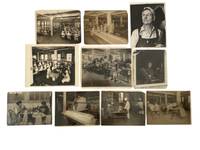
1940réf. 223731940. Women's EmploymentLaborFeminismWWII Archive of ten original photos documenting American women's industrial labor during the 1930s and 1940s. Original black-and-white press photographs taken in various factories during World War II including steel works textiles candy production and industrial assembly lines. Stamped by press agencies including Acme Newspictures Brown Brothers and International News Photos several with annotated captions on verso. This collection of press photos captures the pivotal moment when women entered the industrial workforce en masse replacing men who were fighting overseas. These images were part of a wartime propaganda campaign to normalize and promote women's factory work paving the way for long-term shifts in gender roles in the American labor force. In one striking image captioned by the N.E.A. press service as "Portrait for Mother's Day" a steel worker identified as Mrs. Neel of Gary Indiana is praised as "the American Mother- 1943 style" echoing the iconic Rosie the Riveter with a new image of female patriotism: overalls bandanna badge and goggles in hand. Another shows women boxing chocolates along a conveyor line while several others reveal the mechanical precision and physical intensity of jobs in textile finishing labeling and industrial equipment handling. This archive is emblematic of the historical inflection point that sparked the modern women's labor movement. The war effort validated women's technical skills and economic participation giving rise to a postwar generation of women who emboldened by their wartime service laid the intellectual and organizational groundwork for second wave feminism. Many of these workers would later confront the "return to domesticity" in the 1950s and become active in labor organizing civil rights and feminist causes by the 1960s. Light edge wear. Overall good to very good condition. A photographic archive capturing the genesis of modern women's industrial labor and the cultural origins of second wave feminism in the WWII workplace. unknown
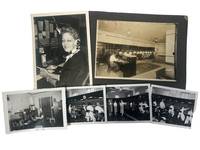
1900réf. 200911900. Telephone operator photo archive circa 1900 to 1958 documents women's labor within telephone exchange systems showing how urban communications depended on trained female operators seated at switchboards connecting calls handling information and maintaining the human infrastructure behind early and mid twentieth century telephone service. The material documents telephone communication labor through photographs of switchboard rooms operators wearing headsets plug boards supervisory presence and grouped clerical activity revealing how connection work operated in practice before automated dialing fully displaced manual exchange work. The archive supports research into women's wage labor communications history gendered office work New York telephone service and the disciplined workplace culture that positioned young women as the public voice and operational center of the telephone network. The archive consists of six black-and-white photographs including five silver gelatin photographs and one early albumen photograph with images measuring from approximately 3.5 x 4.25 inches to 7 x 9 inches. The date range appears to extend from the early twentieth century to 1958 based on the later dated images. Several photographs show women seated in tight rows facing large switchboards wearing heavy headsets with horn mouthpieces and working among dense arrangements of cords and plugs. The early albumen photograph shows a row of women facing the switchboards while a female supervisor watches over the room indicating both the gendered hierarchy and procedural discipline of the exchange floor. One image shows an operator turning toward the camera with a plug in hand smiling while gesturing toward the board. Four smaller photographs dated 1958 show teams of women moving between boards and a small group with paperwork behind the operating area; pencil inscriptions on the versos identify the location as New York. The photographs are valuable because they make visible the labor system behind telephone service: rows of operators standardized equipment supervisors paperwork and the coordinated manual routing of calls. They also record the gendered character of communications work in which women's voices posture speed and manner were made part of the service itself. Light handling wear minor edge wear and expected age toning; images remain crisp with equipment and personnel details clearly visible; overall very good. Strong women's labor and communications history archive documenting the human operation of telephone exchange systems across the first half of the twentieth century and into the postwar period. unknown
1878réf. 189841878. Watherston Edward J. The Industrial Employment of Women in France Compared with England. London: Spottiswoods and Co. 1878. French Silk Manufactures and the Industrial Employment of Women. London: Dryden Pres - J Davy and Sons 1879. Both measure 8.5" x 5.25". 16 and 23 pages respectively. The 1878 pamphlet "The Industrial Employment of Women in France." is a comparative analysis of the labor participation rate of women in France and in England. French women were much more integrated into the labor market this study finds even despite the fact that England had a disproportionate demographic surplus of women and an even more developed industrial sector. At the conclusion of the pamphlet Watherston proposes three major steps spur female employment in England based off the French example which are the: "1. Establishment of special training schools for certain trades following a preliminary general education. 2. These training schools. must be made self-supporting within a short time. All pupils must pay a moderate fee for being taught. 3. There should be union of the managers of training schools with all manufacturers wishing to employ female labour. The union must aim both to give employment to women and to advise as to the directions in which it may be sought and into which it may be extended." Watherston lays blame for the poor labor participation rate of English women at the fact that they are barred from major employment sectors such as the railways as well as a private sector which demonstrated no inclination to hire them. He concludes that English women need organization first and foremost and should establish a "Society for the Industrial Employment of Women". The second pamphlet focuses on first the history of the French silk industry and later women's employment within it noting the unique advances that the French female silk workers enjoyed. Watherston notes that "Other countries before France made use of female labour but the French were the first who employed not only as we do the hands but also the brains of women. The technical education of female workers took place simultaneously with that of the men and it is to the results of this that not a little of the excellence of the French silk manufactures of the present day is due." Watherston goes on to examine the silk manufacture at Jujurieux which took in young women from a rural underdeveloped region and lodged fed and rigorously trained them in silk production. In both of these pamphlets he highlights and endorses enterprises that transform women into workers often through a process that includes living and training amongst fellow apprentices for years at a time. There is a prevailing belief that women must be engineered into working class subjects through this total immersion but with a confidence that they are technically and intellectually skilled enough should they be properly acclimated. Some minor chipping to left edge 3/4 in. tear on top edge of one pamphlet overall in very good condition. unknown
réf. 18979Women's Employment Workingmen Want this Bill! An Act To Amend the Labor Law Relative to Hours of Labor. Utica: Utica Trades Assembly n.d. Measuring 9.5" x 6" on tan paper. A women's labor broadside calling attention to the modification of "labor laws relative to the hours of labor" for women and minors in New York. Decorated in bold black lettering the slogan reads "Workingmen Want this Bill!" followed by the contention that the bill "provides for a half holiday on Saturday for women and minors employed on factories without the necessity of working overtime on other days of the week". This is succeeded by the presentation of the act by "The People of the State of New York represented in Senate and Assembly with excerpts from Sections 1 2 3 and 77. Section 77 states that "Hours of labor of minors and women--No minor under the age of eighteen years and no female shall be employed at labor in any factory in this State before six o'clock in the morning or after nine o'clock in the evening of any day or for more than ten hours in any one day of sixty fifty six hours in any one week nor more than six hours on the last day of the week.". As of this writing OCLC reports fewer than three copies in the United States. This document seems to follow some text from the Keating-Owen Child Labor Act 1916. In very good condition. unknown
1935réf. 189931935. Women's Employment World-War II McConnell Dorothy. Women War and Fascism. New York: The American League Against War and Fascism 1935. 18 pages. Bound in brown cardstock wrappers. Measuring 5.5" x 8". McConnell presents a "protest against the use of women as cheap labor in factories and offices in the U.S. as well as in the fascist states" asserting that "Munitions plants employ women at dangerous tasks with long hours and low wages. Discriminatory laws against women should be defeated and women's wages made equal with men's for equal work". Wrappers are vibrant and unworn. Small penciled inscription on the title page not affecting text. An interesting pamphlet promoting the fight for women's labor safety and equal pay during WWII. Very clean and bright pages in very good condition. unknown
1905réf. 190541905. Women Employment Albumen photograph of two women and a male supervisor working in a textile factory 1905. Measures 6" x 8.5". The photographer captures two women in modest long day dresses leaning upon a large table filled with various textiles and cloths. Beside them a man in a large black top hat stands stoically as his hands rest behind his back. In the background piles of cloth and textiles lay upon large tables and large pipes connect on the ceiling. During the second half of the 19th and early 20th century women began to work in textile clothing factories workshops coal mines tin mines commerce and on farms. Many women were employed in small industries including shirt creation nail making chain production and shoe stitching. Consequently these were known as "sweated industries" as the working hours were lengthy with low pay. Factories organized work along the lines of gender--with men performing the supervisory roles and work which was categorized as "skilled". The edges are minorly worn and the bottom right edge is cut not affecting the image. In very good condition. unknown
1911réf. 182771911. Imperial size albumen portraits of faculty and students at American Medical College. St. Louis Missouri 1911. Large photo measures 24 x 20 inches. 40 subjects every one of them male except for a single female student listed below as "F Heflin." Photographed by Hays Studio. Mounted to photographer's board. The American Medical College a medical school founded in 1873 graduated its first woman in 1888. In 1911 the American Medical College combined with the Barnes Medical College. The following year the combined school became the Medical Department of the National University of Arts and Sciences in St. Louis. The National University then merged with the St. Louis College of Physicians and Surgeons around 1915. Female students like this one would have come in at a significant disadvantage proving her qualifications against skepticism in a field notorious for gender discrimination. The value of female doctors for female patients in particular has been profound. Board scuffed on one side does not affect images or text. Chipped at corner and top does not affect images or text. Overall very good condition. Expressions and details in images clear. unknown
réf. 18100Silver gelatin photo of nurses in uniform posed in operating room. C. 1900. Measures 8" x 11" inches. Photo shows 25 women arranged in three rows with 3 men standing behind them. The nurses wear long white smocks over gray dresses with white cuffs and small white hats perched on their heads. Their bodies are turned toward the camera but their gazes wander about the room with some looking directly into the camera but others looking elsewhere. Three men in lab coats with black ties visible beneath stand behind them gazing over the women's heads toward the camera. Surgical equipment in the form of two large metal barrels connected by pipes stand against the wall behind the group in the room with tiled floor and subway tiles running floor to ceiling. Nursing in the early twentieth century was one of the few professional fields available to women though opportunities for advancement were rare. In addition to working with patients nurses were required to change and launder linens prepare meals scrub the floors and order supplies. Still the number of women who became nurses rose rapidly through the early twentieth century. Photo is mounted to black photographer's board with "Compliments of.Massey Ltd 235 Yonge st" on verso. The women's names are written in neat rows in pencil on verso. The women in this photo were pioneers in a field they would come to dominate. unknown
1887réf. 174331887. Women's Employment MABEL Robert F. Our Working Women and Their Earnings. United States 1887. First Edition. 13 pages measuring approximately 6" x 10" inches. At the time that this description is being written no copies are recorded in American institutions. OCLC search results are at best an estimate and can vary over time. The article begins "We as a nation have made no effort to teach our redundant female population to support itself although our position as a mother of colonies leaves us with a steadily increasing proportion of women who through the emigration of their male relatives are forces to provide for themselves." and concludes that "a woman's technical training will have still done her a good service in quickening her intelligence and in thus making her a wiser mother to her children and a more sympathetic companion to her husband above all in banishing much care by ensuring to her a means of livelihood in case of need." A compassionate thoughtful appraisal of the state of women's labor and financial prospects in the United States backed up by employment and pay statistics from the end of the 19th century. Cleanly disbound. Chipped along top edge. Toning. Pages clean and uncreased. Overall in good condition. unknown
1910réf. 175081910. Women Employment Feminism and Women's Rights Summary of Eight Papers and Discussions Upon the Disabilities of Mothers as Workers. London: Fabian Women's Group 1910. Measures 8.5" x 5" inches. 32 pages. This pamphlet summarizes the problems that arise from the modern expectation of women to work difficult industrial jobs as well as the traditional duties of motherhood. This pamphlet was produced by the Fabian Women's Group which acted as a suffrage pressure group directed at the Labour Party that also advocated for women workers. The summarized section was edited by Charlotte Payne Townshend wife of George Bernard Shaw. Paper titles include: The Physical Disabilities of Maternity The Influence of Hygiene and Physical Culture upon the Disabilities of Motherhood The Effects upon children of the Mother's Activity Outside the Home and more. From "Motherhood and Industrial Work" Frau Lily Braun states: "The evils of exploited labor are seen at their worst in the employment of married women with children. The wages of many a workman do not suffice for family maintenance and the wife's work is absolutely essential to make up what is needed.In the early morning she starts for her work; and the cooking washing cleaning and sewing must be done in the evening by an overtaxed wearied woman. Premature age and spiritual exhaustion are the result." Some minor stains from rusted staples in the gutter of the spine not affecting text. Overall in very good condition. unknown
1919réf. 163201919. Ministry of Reconstruction Women's Advisory Committee. Report of the Sub-Committee Appointed to Consider the Position after the War of Women Holding Temporary Appointments in Government Departments 1919 addresses the status of women recruited into temporary government service during World War I and the terms under which they might remain in public employment after demobilization. The report concerns the transition from wartime labor to the permanent Civil Service including questions of women's eligibility for continued appointment equality of treatment with male colleagues pay and the assignment of clerical duties. Produced as the British government confronted the employment consequences of women's expanded wartime service it records official consideration of whether women who had entered departments under emergency conditions should retain a place in the postwar state workforce. Ministry of Reconstruction. Women's Advisory Committee. Report of the Sub-Committee Appointed to Consider the Position after the War of Women Holding Temporary Appointments in Government Departments. Presented to Parliament by Command of His Majesty. London: Published by His Majesty's Stationery Office 1919. Folio. 8 pages. The sub-committee consisted of six women and two men and was charged specifically with examining the position of women holding temporary government appointments after the war. Its recommendations address routes by which women might become permanent government employees and argue for treatment on terms comparable to male colleagues including questions of equal pay and the expectation that women should not automatically be assigned additional clerical work because of their sex. As an official parliamentary publication rather than an outside campaign tract the report documents how women's wartime employment had become an administrative question within government itself. Women entered British government departments in substantially increased numbers during World War I filling posts created or expanded by wartime administration while large numbers of men were serving in the armed forces. The end of the war raised immediate questions about whether these appointments would be terminated converted into permanent positions or reorganized along sex-segregated lines. This report preserves the Women's Advisory Committee's intervention in that process and records specific arguments over permanence pay duties and women's place in the postwar Civil Service. Modern blue card wrappers with paper label. Very good condition. An official 1919 statement of the employment claims advanced for women whose wartime government service had demonstrated their capacity to perform work previously reserved largely for men. unknown
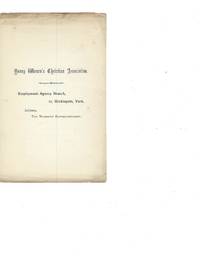
1890réf. 164641890. Young Women's Christian Association. Employment Agency Branch 1890s an organizational pamphlet documenting the policies governing a YWCA employment agency in York and the institutional mechanisms used to connect women seeking paid work with prospective employment. By the late nineteenth century YWCA branches had expanded beyond religious fellowship to provide practical services including housing vocational instruction and employment placement for women; YWCA histories record the establishment of employment bureaus and typewriting training during this period. The present pamphlet shows that employment-assistance system in practice through formal agency policies providing primary-source evidence for the study of women's labor charitable and religious social-service networks vocational placement and the changing economic position of women in late Victorian Britain. Young Women's Christian Association. Employment Agency Branch. York: Young Women's Christian Association 1890s. Self-wrappers. Pagination and dimensions not supplied. The pamphlet sets forth policies for the Association's Employment Agency Department defining the administrative framework through which the branch managed employment assistance. Its significance lies in the practical structure it records: rather than merely advocating women's economic independence the agency created a formal mechanism through which applicants and employers could be brought into contact under organizational supervision. This activity belongs to a broader late nineteenth-century transformation in women's work when employment opportunities were still strongly divided by gender but were beginning to expand into clerical professional retail medical and other occupations previously less accessible to women. The York employment agency belongs to the wider history of women's voluntary organizations intervening directly in the labor market by providing placement services training and institutional support. Such services were particularly significant for women navigating an employment landscape in which occupational options and wages remained constrained by gender. The pamphlet therefore offers evidence not simply of YWCA philanthropy but of the administrative infrastructure developed to facilitate women's entry into paid work. No specific physical defects are supplied; overall very good. A concise primary source documenting how a late Victorian women's organization translated social-service aims into a structured employment-placement program. unknown
1873réf. 165671873. Kinnear John Boyd. The Right of Women to Labour 1873 argues against restrictions on women's employment and examines the economic consequences of industrialization for women who depended upon paid work. Kinnear a Scottish lawyer writer and later Liberal politician rejects occupational exclusion based on sex writing "there are other things which women can do at least as well as men.Then why should women not do it" His argument extends beyond access to employment to the conditions under which women worked including their difficulty in "forming effective trade unions to secure their rights." The pamphlet thus addresses both women's right to enter occupations and their limited power to protect themselves collectively once employed. Kinnear John Boyd. The Right of Women to Labour. Being Portions of an Essay Re-printed by Permission from "Woman's Work and Woman's Culture." London: Printed by Frederick Bell & Co. Chelsea S.W. 1873. First edition. 14 pages. The text reprints portions of Kinnear's contribution to Josephine Butler's Woman's Work and Woman's Culture first published in 1869 a collection addressing women's education employment legal status suffrage and professional opportunities. Kinnear argues that mechanization and the movement of production from households into factories had eliminated forms of work traditionally performed by women while exposing those who remained in industrial employment to increased competition. He answers these changes by demanding access to work according to ability rather than sex and by identifying workers' collective organization as a means of defending wages and employment rights. Published amid nineteenth-century campaigns to expand women's access to education professions property rights and political participation Kinnear's pamphlet concentrates specifically on economic independence and the organization of women workers. One pamphlet 14 pages in original paper wrappers measuring 8 x 5 1/4 inches. Very good condition. Its discussion of occupational exclusion mechanization and trade union organization records an early argument that women's economic rights required both access to paid employment and the ability to defend their position within the labor market. unknown
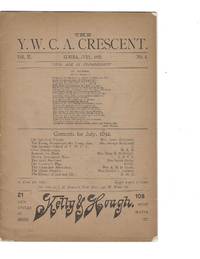
1892réf. 164651892. Young Women's Christian Association. The Y.W.C.A. Crescent July 1892 an early organizational newsletter carrying the motto "Our Aim is Progress" and documenting the public identity of the Young Women's Christian Association during the late nineteenth-century expansion of women's religious educational employment and associational activity. The emphatic language of "progress" places the publication within a culture of organized female self-improvement and collective advancement providing contemporary evidence of how a women-led Christian association presented its aims to members and readers. Without further description of the issue's internal articles its strongest interpretive value lies in this representation of YWCA community identity and the language through which women's organized activity was framed in the 1890s. The Y.W.C.A. Crescent. Vol. 2 No. 4. Young Women's Christian Association July 1892. Newsletter bearing the slogan "Our Aim is Progress." Pagination place of publication dimensions and specific internal contents are not supplied. As the fourth number of the publication's second volume the issue demonstrates an established serial publishing effort by the Association and provides material evidence of the periodical culture through which women's voluntary organizations maintained a recognizable institutional voice. An exact surviving example is independently cataloged under this title volume number and date. The issue belongs to the broader history of women's associational print culture at the close of the nineteenth century when newsletters and organizational periodicals helped sustain communities formed around religious fellowship education employment assistance and women's social development. The phrase "Our Aim is Progress" is particularly evocative of the aspirational vocabulary used by women's organizations seeking to define expanded roles for women within modern urban and professional life although the specific contents of this issue should not be inferred without examination. Covers loose or separated from the body of the newsletter; otherwise no specific defects supplied; overall very good. An early YWCA periodical useful for the study of women's organizational culture institutional publishing and the rhetoric of female advancement in the 1890s. unknown
réf. 16260Broadside calling on women to join a mass demonstration against reductions to the WPA 1937 documents organized opposition to cutbacks in one of the New Deal's principal employment programs during the continuing economic instability of the Great Depression. Addressing women specifically the broadside argues that WPA reductions threatened not only workers directly employed by the program but wage standards more broadly warning that increased unemployment would place downward pressure on earnings. Its appeal places women within contemporary campaigns over public employment wages and federal responsibility for economic relief. Broadside calling women to protest WPA cuts. Issuer not identified. 1937. 8.5 × 11 inches. The text urges women to participate in a mass demonstration protesting cuts to WPA funding and asks them to consider both their direct relationship to federal work programs and the wider consequences of rising unemployment. By connecting reduced WPA employment with falling wages the broadside frames the demonstration as a labor issue extending beyond current relief workers and calls upon women to participate in organized political action against the reductions. Very fragile with small tears and chips along the top and right edges; overall Good Condition. The broadside preserves direct evidence of women being recruited into Depression-era labor protest and of arguments linking New Deal employment programs to wage conditions across the broader workforce. unknown
réf. 16266Working Girls' Society. Circular of the Working Girls' Society late nineteenth century sets out the rules and benefits of a New York organization created for wage-earning women. The Society provided working women with rooms for social meetings classes reading and recreation after working hours while its bylaws governed membership and access to the organization's facilities. Contemporary accounts of New York working girls' clubs describe them as cooperative organizations in which members pursued self-education social activity and practical assistance rather than simply receiving charity. Circular of the Working Girls' Society. New York: Working Girls' Society n.d. Bylaws governing membership and use of the Society's library and rooms at 222 West 38th Street. The circular describes benefits available to members including special vacation privileges and discounted railway tickets combining educational and social provisions with practical assistance for women earning wages in the city. The regulations document the daily administration of a women's club formed around the needs of an expanding urban female workforce and show how membership could provide access to books meeting rooms instruction recreation and reduced-cost travel. The circular survives from the period in which working women's clubs expanded in New York; by the early twentieth century contemporary descriptions traced the movement to clubs organized during the 1880s and emphasized their classes member government and opportunities for social intercourse and self-improvement. Two very light horizontal folds and light thumb-soiling with a 2-inch tear at the bottom of the center fold; overall Very Good Condition. unknown