VOICI LES FAITSLivre Rare Book
Voici les faits. Trimestriel N° 3. On parle de chômage…
1950Best.-Nr. 100139Couverture souple. Brochure. 16 pages.

Librairie et Cætera · Belin-Beliet, Frankreich9,00 €
910 Ergebnisse
Best.-Nr. DADAX0415467217New unknown
Best.-Nr. DADAX0367249553New unknown
1950Best.-Nr. 100139Couverture souple. Brochure. 16 pages.
Best.-Nr. 0880992093New. paperback. New. Satisfaction Guaranteed or your money back. paperback
Best.-Nr. DADAX0230251544New unknown
1928Best.-Nr. 3495322Berlin, Hobbing, 1928. XVI, 301 S. Mit Tabellen und graphischen Darstellungen. Hlwd (Stempel auf Titel).
Best.-Nr. DADAX0367024926New unknown
Best.-Nr. DADAX0199693382New unknown
in-8°, 294 pp., broche, couv. illustree. Bel exemplaire (pli a la couv.). [DV-16]
1998library sticker on spine; library stamp on title page and catalogue page; text tight and bright. A practical guide to getting back to work after redundancy or early retirement, aimed at the 40-55 age group, which offers advice on deciding what direction to take, with ideas for how to look for a job, how to retrain, when to consider self-employment, and how to adjust to change Ex-Library
1953Previous owner's name and slight foxing to front end paper. No other marks or inscriptions to contents. No creasing to covers or to spine. A very clean very tight copy with unmarked black cloth boards, slightly dusty page edges and minor rubbing to corners. 256pp. Over eighty professions for the boys of the 1950s. Illustrated with black & white photographs. A scarce book.
1998No marks or inscriptions. No creasing to covers or to spine. A lovely clean very tight copy with bright unmarked boards and no bumping to corners. 248pp. A practical effective program to transform managers into skilled facilitators.
1979No marks or inscriptions. No creasing to covers or to spine. A very clean very tight copy with bright unmarked slightly foxed boards and no bumping to corners. 40pp. A discussion of the means needed to further the aims of the proletariat.
Best.-Nr. BN725316mit press 1975. work in america work in america w.e.upjohn institute for employment research mit press 1975 unknown
1873Best.-Nr. 165661873. Taylor Whately Cooke. The Employment of Married Women in Manufacture 1874. First edition of a paper delivered at the Social Science Congress in Norwich in October 1873 opposing proposed legislation that would restrict or prohibit married women's employment in British manufacturing. Taylor challenges the argument that married women should be excluded from factory labor because of their maternal and domestic responsibilities emphasizing the financial consequences for working-class families dependent upon women's earnings. He condemns the inconsistency of restricting married women's industrial employment while permitting women in agriculture and domestic service to continue working without comparable legal limitations. His argument addresses a central dispute in Victorian labor reform: whether legislation intended to protect women from industrial exploitation could instead deprive them of economic independence and impose unequal restrictions upon their employment. Taylor Whately Cooke. The Employment of Married Women in Manufacture. A Paper Read at the Social Science Congress Held at Norwich October 1873. London: Frederick Bell & Co. Steam Printers King's Rd. Chelsea 1874. First edition. 12 pages. Original paper wrappers measuring 8 x 5¼ inches. Reprinted for the Vigilance Association for the Defence of Personal Rights the pamphlet develops an economic and legal argument against restricting married women's factory employment. Taylor writes: "It is at first sign a very humane sentiment no doubt to assert that married women should be relieved from all hard work because of the duties which maternity casts upon them; but when as that the same time you relieve them of some fifteen shillings a-week without providing any substitute you must not be surprised if they themselves do not view your condescension in the same light." His reference to fifteen shillings a week places the loss of wages rather than the stated benevolence of protective legislation at the center of his objection. The pamphlet appeared during parliamentary debates preceding the Factory Act of 1874 which further regulated the working hours of women and young persons in textile factories. The Vigilance Association for the Defence of Personal Rights opposed legislation that restricted adult women's freedom to contract for employment particularly when comparable restrictions did not apply to men. Taylor's comparison of factory workers with women employed in agriculture and domestic service exposes the unequal treatment of female occupations under proposed labor regulations. His paper documents opposition to sex-specific industrial legislation within the nineteenth-century movement for women's legal and economic rights. Very good condition. unknown
1873Best.-Nr. 165661873. Taylor Whately Cooke. The Employment of Married Women in Manufacture 1874. First edition of a paper delivered at the Social Science Congress in Norwich in October 1873 opposing proposed legislation that would restrict or prohibit married women's employment in British manufacturing. Taylor challenges the argument that married women should be excluded from factory labor because of their maternal and domestic responsibilities emphasizing the financial consequences for working-class families dependent upon women's earnings. He condemns the inconsistency of restricting married women's industrial employment while permitting women in agriculture and domestic service to continue working without comparable legal limitations. His argument addresses a central dispute in Victorian labor reform: whether legislation intended to protect women from industrial exploitation could instead deprive them of economic independence and impose unequal restrictions upon their employment. Taylor Whately Cooke. The Employment of Married Women in Manufacture. A Paper Read at the Social Science Congress Held at Norwich October 1873. London: Frederick Bell & Co. Steam Printers King's Rd. Chelsea 1874. First edition. 12 pages. Original paper wrappers measuring 8 x 5¼ inches. Reprinted for the Vigilance Association for the Defence of Personal Rights the pamphlet develops an economic and legal argument against restricting married women's factory employment. Taylor writes: "It is at first sign a very humane sentiment no doubt to assert that married women should be relieved from all hard work because of the duties which maternity casts upon them; but when as that the same time you relieve them of some fifteen shillings a-week without providing any substitute you must not be surprised if they themselves do not view your condescension in the same light." His reference to fifteen shillings a week places the loss of wages rather than the stated benevolence of protective legislation at the center of his objection. The pamphlet appeared during parliamentary debates preceding the Factory Act of 1874 which further regulated the working hours of women and young persons in textile factories. The Vigilance Association for the Defence of Personal Rights opposed legislation that restricted adult women's freedom to contract for employment particularly when comparable restrictions did not apply to men. Taylor's comparison of factory workers with women employed in agriculture and domestic service exposes the unequal treatment of female occupations under proposed labor regulations. His paper documents opposition to sex-specific industrial legislation within the nineteenth-century movement for women's legal and economic rights. Very good condition. unknown books
Best.-Nr. DADAX0367733080New unknown
Best.-Nr. 1441566902.Ghardcover. Good. Access codes and supplements are not guaranteed with used items. May be an ex-library book. hardcover
Best.-Nr. 36289aafDresden, Zahn & Jaensch, 1896, in-8°, 40 S., Stempel a.d. Titelbl., Hlwd. (Bibl.).
Best.-Nr. 4389524-nnew. unknown
2007Best.-Nr. Q-1405134089Wiley-Blackwell 2007-11-12. Paperback. New. In shrink wrap. Looks like an interesting title! Wiley-Blackwell paperback
Best.-Nr. DADAX0333683188New unknown
Best.-Nr. DADAX1847202497New unknown
1887Best.-Nr. 174331887. Women's Employment MABEL Robert F. Our Working Women and Their Earnings. United States 1887. First Edition. 13 pages measuring approximately 6" x 10" inches. At the time that this description is being written no copies are recorded in American institutions. OCLC search results are at best an estimate and can vary over time. The article begins "We as a nation have made no effort to teach our redundant female population to support itself although our position as a mother of colonies leaves us with a steadily increasing proportion of women who through the emigration of their male relatives are forces to provide for themselves." and concludes that "a woman's technical training will have still done her a good service in quickening her intelligence and in thus making her a wiser mother to her children and a more sympathetic companion to her husband above all in banishing much care by ensuring to her a means of livelihood in case of need." A compassionate thoughtful appraisal of the state of women's labor and financial prospects in the United States backed up by employment and pay statistics from the end of the 19th century. Cleanly disbound. Chipped along top edge. Toning. Pages clean and uncreased. Overall in good condition. unknown
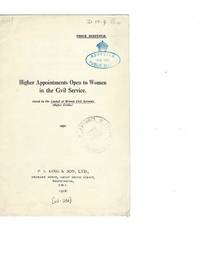
1928Best.-Nr. 162621928. Council of Women Civil Servants Higher Grades. Higher Appointments Open to Women in the Civil Service 1928 publicized routes into senior British government employment three years after women became eligible for direct recruitment into the Administrative Class of the Home Civil Service. The Council founded in 1920 to represent women in administrative professional and executive grades campaigned during the interwar period for equal opportunity and equal pay and against restrictions including the marriage bar. This pamphlet addressed a practical obstacle to women's advancement: insufficient knowledge of the senior Civil Service careers then available to female applicants. Its publication belongs to the Council's broader campaign to increase women's access to government positions beyond the clerical grades. Council of Women Civil Servants Higher Grades. Higher Appointments Open to Women in the Civil Service. London: P. S. King & Son Ltd. 1928. 8½ x 5½ inches. Eight-page pamphlet in paper wrappers staple bound. The Council begins from its belief that the "number and the importance of the careers in the Civil Service open to women are not fully recognized" then supplies information intended to acquaint prospective applicants with higher appointments and the procedures for obtaining them. The text describes opportunities in administrative executive and clerical work making the pamphlet both a recruitment document and evidence of the methods used by an organization of women civil servants to encourage women to pursue positions within the government's higher grades. A contemporary listing records another copy as formerly held by the Board of Education library. The pamphlet appeared during a period when formal access to higher Civil Service employment had expanded without eliminating sex-based restrictions within government employment. Women gained access to direct recruitment into the Administrative Class in 1925 yet women civil servants continued to encounter unequal pay restricted advancement and the marriage bar; the Council subsequently presented evidence to the Royal Commission on the Civil Service in 1929-1931 and remained active in campaigns concerning equal pay and women's eligibility for government posts. The present copy has light thumb-soiling stamps on the front wrapper a library sticker on the rear and rusting to the staple binding; good condition. Its eight pages preserve the Council's own effort to translate newly available avenues of advancement into concrete information about careers and application procedures for women seeking higher appointments in the inter war British Civil Service. unknown