656 risultati
1873rif. 165671873. Kinnear John Boyd. The Right of Women to Labour 1873 argues against restrictions on women's employment and examines the economic consequences of industrialization for women who depended upon paid work. Kinnear a Scottish lawyer writer and later Liberal politician rejects occupational exclusion based on sex writing "there are other things which women can do at least as well as men.Then why should women not do it" His argument extends beyond access to employment to the conditions under which women worked including their difficulty in "forming effective trade unions to secure their rights." The pamphlet thus addresses both women's right to enter occupations and their limited power to protect themselves collectively once employed. Kinnear John Boyd. The Right of Women to Labour. Being Portions of an Essay Re-printed by Permission from "Woman's Work and Woman's Culture." London: Printed by Frederick Bell & Co. Chelsea S.W. 1873. First edition. 14 pages. The text reprints portions of Kinnear's contribution to Josephine Butler's Woman's Work and Woman's Culture first published in 1869 a collection addressing women's education employment legal status suffrage and professional opportunities. Kinnear argues that mechanization and the movement of production from households into factories had eliminated forms of work traditionally performed by women while exposing those who remained in industrial employment to increased competition. He answers these changes by demanding access to work according to ability rather than sex and by identifying workers' collective organization as a means of defending wages and employment rights. Published amid nineteenth-century campaigns to expand women's access to education professions property rights and political participation Kinnear's pamphlet concentrates specifically on economic independence and the organization of women workers. One pamphlet 14 pages in original paper wrappers measuring 8 x 5 1/4 inches. Very good condition. Its discussion of occupational exclusion mechanization and trade union organization records an early argument that women's economic rights required both access to paid employment and the ability to defend their position within the labor market. unknown
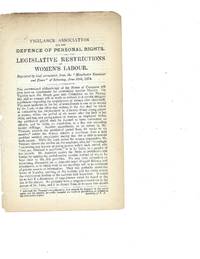
1874rif. 165761874. Vigilance Association for the Defence of Personal Rights. Legislative Restrictions on Women's Labour 1874 opposes proposed factory legislation that would prevent women from returning to industrial employment for six months after childbirth. The Association argues that a measure presented as protection would fall most heavily on women whose families depended upon their wages asking "Who in thousands of cases where there is no helper will assure them and their children bread" Its objections connect employment restrictions to married women's precarious legal and economic position particularly women deserted or unsupported by husbands and left without an enforceable claim upon their husbands' earnings. Vigilance Association for the Defence of Personal Rights. Legislative Restrictions on Women's Labour. Extract reprinted by kind permission from the Manchester Examiner and Times of Saturday June 20th 1874. London: Vigilance Association for the Defence of Personal Rights 1874. First edition extract. 4 pages. Original paper wrappers. 8 1/2 x 5 inches. The pamphlet challenges legislation directed specifically at working women while leaving wealthier women free from comparable interference. Addressing married workers it notes that there are ".many married women deserted or uncared for by their husbands" and argues that "no marriage law secures to the wife a share in the earnings of the father of her children." The text consequently treats freedom to work not as an abstract principle but as an immediate question of food wages and support for women and children and calls upon women themselves to oppose the proposed restriction. The pamphlet belongs to the Vigilance Association's campaign against statutory limitations imposed specifically upon adult women's labor during the parliamentary debates surrounding the Factory Acts in 1874. Its argument exposes a central conflict in nineteenth-century labor reform: legislation intended to protect women workers could also restrict their access to wages without providing an alternative means of family support. At the time this description was prepared no copies were located in American institutions through the OCLC search consulted; institutional records are subject to revision and should be reconfirmed. Condition information was not supplied. The four-page tract records an organized women's-rights response to factory regulation that linked employment freedom directly to marriage law household income and women's economic dependence. unknown
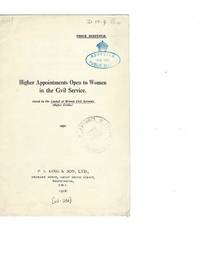
1928rif. 162621928. Council of Women Civil Servants Higher Grades. Higher Appointments Open to Women in the Civil Service 1928 publicized routes into senior British government employment three years after women became eligible for direct recruitment into the Administrative Class of the Home Civil Service. The Council founded in 1920 to represent women in administrative professional and executive grades campaigned during the interwar period for equal opportunity and equal pay and against restrictions including the marriage bar. This pamphlet addressed a practical obstacle to women's advancement: insufficient knowledge of the senior Civil Service careers then available to female applicants. Its publication belongs to the Council's broader campaign to increase women's access to government positions beyond the clerical grades. Council of Women Civil Servants Higher Grades. Higher Appointments Open to Women in the Civil Service. London: P. S. King & Son Ltd. 1928. 8½ x 5½ inches. Eight-page pamphlet in paper wrappers staple bound. The Council begins from its belief that the "number and the importance of the careers in the Civil Service open to women are not fully recognized" then supplies information intended to acquaint prospective applicants with higher appointments and the procedures for obtaining them. The text describes opportunities in administrative executive and clerical work making the pamphlet both a recruitment document and evidence of the methods used by an organization of women civil servants to encourage women to pursue positions within the government's higher grades. A contemporary listing records another copy as formerly held by the Board of Education library. The pamphlet appeared during a period when formal access to higher Civil Service employment had expanded without eliminating sex-based restrictions within government employment. Women gained access to direct recruitment into the Administrative Class in 1925 yet women civil servants continued to encounter unequal pay restricted advancement and the marriage bar; the Council subsequently presented evidence to the Royal Commission on the Civil Service in 1929-1931 and remained active in campaigns concerning equal pay and women's eligibility for government posts. The present copy has light thumb-soiling stamps on the front wrapper a library sticker on the rear and rusting to the staple binding; good condition. Its eight pages preserve the Council's own effort to translate newly available avenues of advancement into concrete information about careers and application procedures for women seeking higher appointments in the inter war British Civil Service. unknown
1890rif. 164641890. Young Women's Christian Association. Employment Agency Branch 1890s an organizational pamphlet documenting the policies governing a YWCA employment agency in York and the institutional mechanisms used to connect women seeking paid work with prospective employment. By the late nineteenth century YWCA branches had expanded beyond religious fellowship to provide practical services including housing vocational instruction and employment placement for women; YWCA histories record the establishment of employment bureaus and typewriting training during this period. The present pamphlet shows that employment-assistance system in practice through formal agency policies providing primary-source evidence for the study of women's labor charitable and religious social-service networks vocational placement and the changing economic position of women in late Victorian Britain. Young Women's Christian Association. Employment Agency Branch. York: Young Women's Christian Association 1890s. Self-wrappers. Pagination and dimensions not supplied. The pamphlet sets forth policies for the Association's Employment Agency Department defining the administrative framework through which the branch managed employment assistance. Its significance lies in the practical structure it records: rather than merely advocating women's economic independence the agency created a formal mechanism through which applicants and employers could be brought into contact under organizational supervision. This activity belongs to a broader late nineteenth-century transformation in women's work when employment opportunities were still strongly divided by gender but were beginning to expand into clerical professional retail medical and other occupations previously less accessible to women. The York employment agency belongs to the wider history of women's voluntary organizations intervening directly in the labor market by providing placement services training and institutional support. Such services were particularly significant for women navigating an employment landscape in which occupational options and wages remained constrained by gender. The pamphlet therefore offers evidence not simply of YWCA philanthropy but of the administrative infrastructure developed to facilitate women's entry into paid work. No specific physical defects are supplied; overall very good. A concise primary source documenting how a late Victorian women's organization translated social-service aims into a structured employment-placement program. unknown
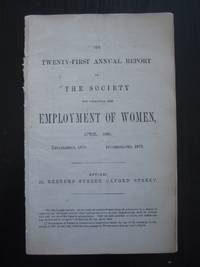
1880rif. 165711880. Society for Promoting the Employment of Women. The Twenty-First Annual Report of the Society for Promoting the Employment of Women 1880 documents an organization established to expand women's access to vocational training and paid employment in occupations beyond the limited fields conventionally open to them in nineteenth-century Britain. Founded in 1859 through the work of women's rights reformers including Jessie Boucherett Barbara Bodichon and Adelaide Anne Procter the Society connected demands for women's economic independence with practical programs for training and placement. Its purpose is stated directly in the report: "The Society is formed for promoting the Training of Women and their employment in industrial pursuits." Society for Promoting the Employment of Women. The Twenty-First Annual Report of the Society for Promoting the Employment of Women April 1880. London: Printed by John Bale & Sons 1880. First edition. The thirty-page report records the Society's work in preparing women for specific occupations and discusses the training required to enter fields including wood carving hospital nursing and hairdressing among others. Rather than arguing only for women's abstract right to employment the report records the practical means by which the Society attempted to open occupations through instruction and professional preparation. Its annual accounting of such programs shows how an organization founded by members of the mid-century women's rights movement addressed the economic restrictions confronting women through vocational initiatives maintained over more than two decades. The report appeared twenty-one years after the Society's establishment and shortly after its incorporation in 1879 when campaigns for women's property rights education professional access and suffrage were expanding the legal and economic questions surrounding women's independence. The Society's emphasis on training addressed one concrete barrier to entry into skilled occupations: women could not compete for work from which they had also been excluded from acquiring the necessary preparation. 30 pages. Original paper wrappers measuring 8 x 5 inches. Light pencil marks in the margins; otherwise very good condition. At the time this description was prepared no copies were recorded in American institutions in the OCLC search consulted; institutional holdings and OCLC records remain subject to revision. unknown
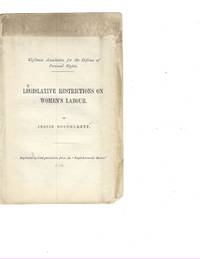
1873rif. 165771873. Boucherett Jessie. Legislative Restrictions on Women's Labour 1873 challenges proposed factory legislation limiting the hours and conditions under which women including mothers of young children could work arguing that such measures deprived adult women of authority over their own employment while providing no substitute for lost wages. Boucherett identifies the principle underlying the legislation as itself objectionable: "Another objection is that the Bill confirms the principle that women are not capable of deciding for themselves." Her opposition arose from the practical circumstances of women whose earnings supported themselves and their children placing employment restrictions within a larger debate over women's legal independence wages and control of their own labor. Boucherett Jessie. Legislative Restrictions on Women's Labour. London: Frederick Bell & Co. 1873. First edition. Reprinted by kind permission from the Englishwoman Review for the Vigilance Association for the Defence of Personal Rights. 12 pages. Original paper wrappers. 8 x 5 inches. Boucherett acknowledges the protective rationale behind the proposed measures writing "It has caused some surprise that Bills framed for so benevolent a purpose should have met with opposition from an unexpected quarter" before detailing their possible consequences for working women. She argues that reducing women's access to factory employment without guaranteeing family maintenance could produce "much suffering and some crime" since "it would always be difficult and sometimes impossible for a woman to provide sufficient food for herself and four or five little children." Her argument therefore distinguishes between women with independent means and wage-earning women for whom statutory restrictions could immediately reduce the household's supply of food and other necessities. Boucherett had founded the Society for Promoting the Employment of Women in 1859 and spent much of her career seeking expanded training and occupations for women; this pamphlet applies the same concern for economic independence to parliamentary attempts to regulate female industrial labor. Its publication also formed part of a contemporary controversy over proposals associated with Alexander Mundella and John Lubbock to extend restrictions governing women's factory employment. Rather than opposing regulation solely in the name of laissez-faire principles Boucherett bases her case on women's need to earn wages their responsibility for dependent children and their right to make employment decisions for themselves. Toning to front wrapper with a few chips and losses along the right edge. Good condition. unknown
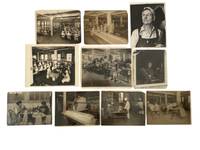
1940rif. 223731940. Women's EmploymentLaborFeminismWWII Archive of ten original photos documenting American women's industrial labor during the 1930s and 1940s. Original black-and-white press photographs taken in various factories during World War II including steel works textiles candy production and industrial assembly lines. Stamped by press agencies including Acme Newspictures Brown Brothers and International News Photos several with annotated captions on verso. This collection of press photos captures the pivotal moment when women entered the industrial workforce en masse replacing men who were fighting overseas. These images were part of a wartime propaganda campaign to normalize and promote women's factory work paving the way for long-term shifts in gender roles in the American labor force. In one striking image captioned by the N.E.A. press service as "Portrait for Mother's Day" a steel worker identified as Mrs. Neel of Gary Indiana is praised as "the American Mother- 1943 style" echoing the iconic Rosie the Riveter with a new image of female patriotism: overalls bandanna badge and goggles in hand. Another shows women boxing chocolates along a conveyor line while several others reveal the mechanical precision and physical intensity of jobs in textile finishing labeling and industrial equipment handling. This archive is emblematic of the historical inflection point that sparked the modern women's labor movement. The war effort validated women's technical skills and economic participation giving rise to a postwar generation of women who emboldened by their wartime service laid the intellectual and organizational groundwork for second wave feminism. Many of these workers would later confront the "return to domesticity" in the 1950s and become active in labor organizing civil rights and feminist causes by the 1960s. Light edge wear. Overall good to very good condition. A photographic archive capturing the genesis of modern women's industrial labor and the cultural origins of second wave feminism in the WWII workplace. unknown
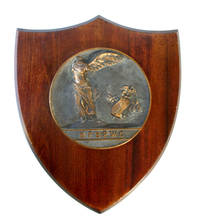
1919rif. 149951919. National Federation of Business and Professional Women's Clubs plaque 1919 commemorates the founding year of a national organization created to coordinate and advance the interests of business and professional women. Established on July 16 1919 after wartime efforts to identify women's professional skills and experience the Federation developed from organizing associated with the Women's War Council and the mobilization of women workers during World War I. Its formation preceded ratification of the Nineteenth Amendment in 1920 and placed questions of women's employment professional advancement and political participation within a national organizational structure. Large bronze embossed seal of the National Federation of Business and Professional Women's Clubs mounted on wood and dated 1919. The Federation was organized at its first national convention in St. Louis in July 1919 under the leadership of Lena Madesin Phillips with Gail Laughlin elected its first national president. Early Federation work included a national survey of business and professional women addressing their status qualifications opportunities and working conditions providing an organized basis for advocacy concerning women's economic and professional life. The plaque dates from the Federation's founding year when women were entering professional occupations in greater numbers while still lacking federally protected voting rights nationwide. The organization continued to advocate on issues affecting working women and to promote professional development leadership and economic opportunity. The bronze seal mounted on wood survives as an organizational artifact from the Federation's establishment in 1919 one year before ratification of the Nineteenth Amendment extended constitutional protection for women's suffrage nationwide. unknown
rif. 18979Women's Employment Workingmen Want this Bill! An Act To Amend the Labor Law Relative to Hours of Labor. Utica: Utica Trades Assembly n.d. Measuring 9.5" x 6" on tan paper. A women's labor broadside calling attention to the modification of "labor laws relative to the hours of labor" for women and minors in New York. Decorated in bold black lettering the slogan reads "Workingmen Want this Bill!" followed by the contention that the bill "provides for a half holiday on Saturday for women and minors employed on factories without the necessity of working overtime on other days of the week". This is succeeded by the presentation of the act by "The People of the State of New York represented in Senate and Assembly with excerpts from Sections 1 2 3 and 77. Section 77 states that "Hours of labor of minors and women--No minor under the age of eighteen years and no female shall be employed at labor in any factory in this State before six o'clock in the morning or after nine o'clock in the evening of any day or for more than ten hours in any one day of sixty fifty six hours in any one week nor more than six hours on the last day of the week.". As of this writing OCLC reports fewer than three copies in the United States. This document seems to follow some text from the Keating-Owen Child Labor Act 1916. In very good condition. unknown
1873rif. 165641873. Association of Factory Occupiers in the Four Counties of Lancaster York Chester and Derby. Mr. Mundella's Bill for Limiting the Hours of Labour in Factories 1873. First edition of a response by northern English factory owners to Liberal Member of Parliament Anthony John Mundella's campaign to reduce working hours for women and children in British textile mills. Following Mundella's speech before the House of Commons on June 11 1873 the employers challenged his allegations of dangerous working conditions excessive hours and elevated mortality among female and child workers. Mundella condemned the "shameful treatment" of factory laborers and drew particular attention to infant deaths associated with mothers returning to industrial employment shortly after childbirth declaring that "the return of the mother to the mill was a sentence of death on the child." The employers countered his arguments with statistics intended to demonstrate improvements in workers' health and living conditions documenting organized industrial opposition to legislation intended to protect women and children. Association of Factory Occupiers in the Four Counties of Lancaster York Chester and Derby. Mr. Mundella's Bill for Limiting the Hours of Labour in Factories. Observations of the Employers upon the Speech of Mr. Mundella M.P. Made in the House of Commons on Wednesday the 11th of June 1873. Manchester: John Heywood Excelsior Printing Works 1873. First edition. 32 pages. Original paper wrappers measuring 8¼ x 5 inches. The pamphlet reproduces passages from Mundella's parliamentary speech alongside the employers' corresponding rebuttals allowing direct comparison of the competing arguments. Three statistical tables in the appendix present mortality data employed in the controversy. Issued on behalf of the regional factory owners' association the response is dated July 24 1873 and identifies Richard Haworth as chairman Joseph Simpson as treasurer and Henry Whitworth as secretary. The dispute preceded the Factory Act of 1874 which restricted the working hours of women and young persons in textile factories and established a ten-hour working day. Mundella's campaign connected industrial working conditions with public health childhood education and infant mortality while manufacturers resisted further statutory limits by disputing the medical and statistical evidence supporting reform. The pamphlet preserves the employers' organized response to proposed labor protections including their use of mortality statistics to challenge parliamentary testimony about the consequences of factory employment. Very good condition. unknown
1873rif. 165661873. Taylor Whately Cooke. The Employment of Married Women in Manufacture 1874. First edition of a paper delivered at the Social Science Congress in Norwich in October 1873 opposing proposed legislation that would restrict or prohibit married women's employment in British manufacturing. Taylor challenges the argument that married women should be excluded from factory labor because of their maternal and domestic responsibilities emphasizing the financial consequences for working-class families dependent upon women's earnings. He condemns the inconsistency of restricting married women's industrial employment while permitting women in agriculture and domestic service to continue working without comparable legal limitations. His argument addresses a central dispute in Victorian labor reform: whether legislation intended to protect women from industrial exploitation could instead deprive them of economic independence and impose unequal restrictions upon their employment. Taylor Whately Cooke. The Employment of Married Women in Manufacture. A Paper Read at the Social Science Congress Held at Norwich October 1873. London: Frederick Bell & Co. Steam Printers King's Rd. Chelsea 1874. First edition. 12 pages. Original paper wrappers measuring 8 x 5¼ inches. Reprinted for the Vigilance Association for the Defence of Personal Rights the pamphlet develops an economic and legal argument against restricting married women's factory employment. Taylor writes: "It is at first sign a very humane sentiment no doubt to assert that married women should be relieved from all hard work because of the duties which maternity casts upon them; but when as that the same time you relieve them of some fifteen shillings a-week without providing any substitute you must not be surprised if they themselves do not view your condescension in the same light." His reference to fifteen shillings a week places the loss of wages rather than the stated benevolence of protective legislation at the center of his objection. The pamphlet appeared during parliamentary debates preceding the Factory Act of 1874 which further regulated the working hours of women and young persons in textile factories. The Vigilance Association for the Defence of Personal Rights opposed legislation that restricted adult women's freedom to contract for employment particularly when comparable restrictions did not apply to men. Taylor's comparison of factory workers with women employed in agriculture and domestic service exposes the unequal treatment of female occupations under proposed labor regulations. His paper documents opposition to sex-specific industrial legislation within the nineteenth-century movement for women's legal and economic rights. Very good condition. unknown
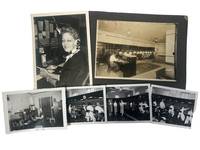
1900rif. 200911900. Telephone operator photo archive circa 1900 to 1958 documents women's labor within telephone exchange systems showing how urban communications depended on trained female operators seated at switchboards connecting calls handling information and maintaining the human infrastructure behind early and mid twentieth century telephone service. The material documents telephone communication labor through photographs of switchboard rooms operators wearing headsets plug boards supervisory presence and grouped clerical activity revealing how connection work operated in practice before automated dialing fully displaced manual exchange work. The archive supports research into women's wage labor communications history gendered office work New York telephone service and the disciplined workplace culture that positioned young women as the public voice and operational center of the telephone network. The archive consists of six black-and-white photographs including five silver gelatin photographs and one early albumen photograph with images measuring from approximately 3.5 x 4.25 inches to 7 x 9 inches. The date range appears to extend from the early twentieth century to 1958 based on the later dated images. Several photographs show women seated in tight rows facing large switchboards wearing heavy headsets with horn mouthpieces and working among dense arrangements of cords and plugs. The early albumen photograph shows a row of women facing the switchboards while a female supervisor watches over the room indicating both the gendered hierarchy and procedural discipline of the exchange floor. One image shows an operator turning toward the camera with a plug in hand smiling while gesturing toward the board. Four smaller photographs dated 1958 show teams of women moving between boards and a small group with paperwork behind the operating area; pencil inscriptions on the versos identify the location as New York. The photographs are valuable because they make visible the labor system behind telephone service: rows of operators standardized equipment supervisors paperwork and the coordinated manual routing of calls. They also record the gendered character of communications work in which women's voices posture speed and manner were made part of the service itself. Light handling wear minor edge wear and expected age toning; images remain crisp with equipment and personnel details clearly visible; overall very good. Strong women's labor and communications history archive documenting the human operation of telephone exchange systems across the first half of the twentieth century and into the postwar period. unknown
1871rif. 165651871. To the Right Honorable Richard Assheton Cross M.P. Secretary of State for the Home Department dated 1871 in the supplied description. Petition by British women workers opposing proposed factory legislation that threatened to restrict women's paid employment particularly that of married women and mothers. The petitioners object to proposals that would "restrict the paid labour of all women.or even make all married women half-timers" arguing that legislation presented as protecting female workers could instead deprive them of wages and economic independence. Their objections distinguish between protections against dangerous industrial conditions and restrictions imposed specifically because of sex or marital status. The petition documents women's direct intervention in nineteenth-century labor legislation challenging the assumption that Parliament could protect married women by limiting their right to earn wages. To the Right Honorable Richard Assheton Cross M.P. Secretary of State for the Home Department. 1871 date requires verification. 4 pages. Measuring 8 x 5 inches. The memorialists argue that regulations imposed upon married women would discriminate against unmarried women as well establishing different legal rights to employment according to marital status. They declare "Your Memorialists assert that it is unjust to place restriction son the labour of unmarried women for the presumed protection of married women or mothers" and further maintain that "any special restrictions upon the labour of married women is practically a penalty imposed on marriage as regards to the woman." These statements identify the economic consequences of proposed restrictions and insist that marriage and motherhood should not diminish a woman's right to paid employment. The petition belongs to Victorian debates over factory regulation women's industrial employment and the distinction between protective legislation and unequal treatment under labor law. While reformers sought shorter hours and safer working conditions for women and children opponents of sex-specific restrictions argued that compulsory limits could reduce women's earnings exclude them from certain occupations and reinforce their financial dependence upon men. The memorialists articulate this objection in their own words documenting women's resistance to legislation that treated marital status as grounds for restricting employment. Chipping with small losses along the upper and right edges repairs to two tears on page 2 and loss to the upper left corner. Good condition. unknown
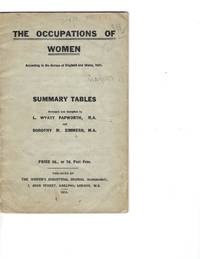
1914rif. 162641914. Papworth L. Wyatt and Dorothy M. Zimmern comps. The Occupations of Women According to the Census of England and Wales 1911 1914 uses government census data to quantify women's participation in the British labor force and identify occupations offering employment to women. Published by the Women's Industrial Council an organization concerned with women's working conditions and economic opportunities the pamphlet converts the 1911 Census into tables comparing male and female employment and distinguishing women workers according to marital and occupational status. Appearing before the First World War substantially altered women's employment in Britain the study provides a statistical record of the labor market immediately preceding wartime expansion into occupations from which women had previously been excluded or employed only in limited numbers. Papworth L. Wyatt and Dorothy M. Zimmern comps. The Occupations of Women According to the Census of England and Wales 1911. London: Women's Industrial Council 1914. Paper wrappers. The compilers arrange census figures into tables analyzing the occupations of men and women the marital status of women workers and the number of retired women workers among other categories. The statistics were assembled not simply to enumerate existing employment but to determine which industries were open to women and where further employment opportunities might be developed. By separating workers according to sex and marital status the pamphlet supplies contemporary evidence of how women's paid labor was measured and classified immediately before the economic disruptions of the First World War. This copy bears provenance from the Women's Service Library at Millicent Fawcett House connecting it to an institution devoted to collecting documentation on women's political social and economic history. The library developed from the collections of the London Society for Women's Service and was named for suffrage leader Millicent Garrett Fawcett whose work also encompassed women's educational and employment opportunities. The association is particularly pertinent to a Women's Industrial Council publication concerned with expanding women's economic participation. Handling creases and soiling to wrappers with creased corners to front wrapper and small loss at lower right corner of rear wrapper and several leaves; overall good condition. A census-based record of women's employment immediately before the First World War with provenance linking the copy to a major British collection devoted to the history of women's rights and work. unknown
1919rif. 163201919. Ministry of Reconstruction Women's Advisory Committee. Report of the Sub-Committee Appointed to Consider the Position after the War of Women Holding Temporary Appointments in Government Departments 1919 addresses the status of women recruited into temporary government service during World War I and the terms under which they might remain in public employment after demobilization. The report concerns the transition from wartime labor to the permanent Civil Service including questions of women's eligibility for continued appointment equality of treatment with male colleagues pay and the assignment of clerical duties. Produced as the British government confronted the employment consequences of women's expanded wartime service it records official consideration of whether women who had entered departments under emergency conditions should retain a place in the postwar state workforce. Ministry of Reconstruction. Women's Advisory Committee. Report of the Sub-Committee Appointed to Consider the Position after the War of Women Holding Temporary Appointments in Government Departments. Presented to Parliament by Command of His Majesty. London: Published by His Majesty's Stationery Office 1919. Folio. 8 pages. The sub-committee consisted of six women and two men and was charged specifically with examining the position of women holding temporary government appointments after the war. Its recommendations address routes by which women might become permanent government employees and argue for treatment on terms comparable to male colleagues including questions of equal pay and the expectation that women should not automatically be assigned additional clerical work because of their sex. As an official parliamentary publication rather than an outside campaign tract the report documents how women's wartime employment had become an administrative question within government itself. Women entered British government departments in substantially increased numbers during World War I filling posts created or expanded by wartime administration while large numbers of men were serving in the armed forces. The end of the war raised immediate questions about whether these appointments would be terminated converted into permanent positions or reorganized along sex-segregated lines. This report preserves the Women's Advisory Committee's intervention in that process and records specific arguments over permanence pay duties and women's place in the postwar Civil Service. Modern blue card wrappers with paper label. Very good condition. An official 1919 statement of the employment claims advanced for women whose wartime government service had demonstrated their capacity to perform work previously reserved largely for men. unknown
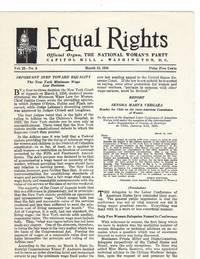
1936rif. 160251936. National Woman's Party. Equal Rights March 15 1936 documents the organization's campaign for legal equality at a time when women's workplace legislation divided American feminists over whether sex-specific protections advanced or restricted women workers. Founded in 1916 by Alice Paul and Lucy Burns during the suffrage campaign the National Woman's Party continued after ratification of the Nineteenth Amendment by advocating the Equal Rights Amendment then commonly associated with the Lucretia Mott Amendment and by opposing laws that imposed legal distinctions based solely on sex. This issue addresses the New York minimum wage controversy international equal-rights efforts and proposed workplace protections for women and children. National Woman's Party. Equal Rights. Vol. 22 No. 6. March 15 1936. 4 pages. 8 1/2 x 11 inches. Official organ of the National Woman's Party. The issue reports on the New York minimum wage case after the New York Court of Appeals struck down the state law regulating minimum wages for women; the United States Supreme Court subsequently affirmed that judgment in Morehead v. New York ex rel. Tipaldo on June 1 1936. It also discusses the Equal Rights Treaty signed at Montevideo by Cuba Ecuador Paraguay and Uruguay part of the National Woman's Party's effort to establish sex equality in international law. Another article addresses workplace hygiene and a resolution requiring employers to provide women with separate quarters for washing changing clothes and general use as well as seats for women and children when the work did not require them to remain standing. Published two years before enactment of the Fair Labor Standards Act of 1938 the issue records a central dispute in interwar women's rights politics: whether legislation written specifically for women offered necessary labor protection or created legal distinctions that could restrict women's employment and undermine demands for equal rights. The National Woman's Party pursued the latter argument while simultaneously campaigning internationally for legal equality between the sexes. The March 1936 issue therefore preserves contemporary evidence of the relationship among the Equal Rights Amendment campaign minimum wage litigation international treaty advocacy and debates over sex-specific workplace regulation. In excellent condition. unknown
1980Name on front end paper. No other marks or inscriptions. No creasing to covers. A very clean very tight pamphlet with slightly foxed unmarked rear cover and no bumping to corners. 20pp. A report on the problems facing women in gaining employment.
1916rif. 183494London: Chiswick Press 1916. First edition of this illustrated government publication promoting women's wartime employment. Women's War Work contains a detailed list of several hundred roles left vacant by men that women successfully fulfilled. Several of these are demonstrated by characterful photographs which show women employed in a range of professions including the postal service factories breweries and shops. The War Office recruited women into the workplace to maintain productivity produce munitions and ensure that as many men as possible were available for the Armed Forces. By July 1916 it was estimated that 750000 women across Britain had taken up such work and the War Office produced Women's War Work in September to further increase their numbers. The preface asserts that employers who had women in their workface would "readily admit that the results achieved by the temporary employment of women far exceed their original estimates and even so are capable of much further extension" p. 5. Women's contributions to the war effort drastically changed public perception of their capabilities and helped women over 30 to achieve enfranchisement in 1918. Provenance: from the collection of the suffrage historian Elizabeth Crawford. Quarto. 72 black and white photographs. Drab paper wrappers front and rear cover printed in black. Library sticker of the Women's Service Library and withdrawal stamp on front inside cover former shelfmark to front cover in pencil former bookseller's price to half-title. Spine repaired loss to ends wrappers lightly toned extremities a little creased extending to outer leaves at bottom corner occasional light finger-soiling to contents but otherwise clean: a very good copy of a fragile publication. unknown
1989Dust jacket shows minor wear; gilt title on top board and spine wearing off a little. Contents remain clean and sound throughout. Used
1994212 pages. "These essays emphasize the social, cultural, economic, historical, and geographical contexts in which women work, and the effect of specific conditions on women's experineces." - from back cover. Soiling to top edge. Few markings to contents. Light wear. Sound working copy. Book
1991No marks or inscriptions. Very small crease to lower spine corner of front cover, none to rear or to spine. A lovely clean very tight copy with bright unmarked boards and no bumping to corners. 236pp. An examination of the world of work in the light of the major changes which took place in the previous decade.
rif. BN725316mit press 1975. work in america work in america w.e.upjohn institute for employment research mit press 1975 unknown
1984little creasing on the corners of the cover and on the spine, last owers name on the FEP.
1978Previous owner's name inside front cover. No other marks or inscriptions. Tiny crease to upper edge of front cover, none to rear, crease to spine. A very clean very tight copy with bright unmarked boards and no bumping to corners. 310pp. We do not use stock photos, the picture displayed is of the actual book for sale. Every one of our books is in stock in the UK ready for immediate delivery.
1979No marks or inscriptions. No creasing to covers or to spine. A very clean very tight copy with bright unmarked slightly foxed boards and no bumping to corners. 40pp. A discussion of the means needed to further the aims of the proletariat.