360 Ergebnisse
Best.-Nr. 17043A Londres, 1775. With 1 folding map and 4 folding tables. viii, 293, (1) pp. 8vo. Contemporary marbled calf, spine gilt in compartments, red morocco label with gilt lettering, gilt triple fillets on sides, red edges. Kress 7170; Goldsmiths 11330; Einaudi 5517; INED 4798; Higgs 6403; Peignot, Livres Condamnés, i, p. 141. First edition. Severely prosecuted attack on the Fermiers-Généraux, forbidden already in 1776. 'Diatribe sanglante contre les fermiers généraux et les abus scandaleux de leurs agents. L'auteur met en scene un malheureux dont les 'suppôts de la ferme' ont ruiné la famille et fait périr le père de chagrin' (INED). According to a manuscript note in the Kress copy: '..... l'on croit que cette sanglante diatribe des fermiers généraux a été composée, imprimée et répandue sous les auspices du ministère actuel (celui de Turgot & Malesherbes).'This, in fact, is the first edition of a work which became better known under the title "L'Ami du Peuple François, ou Mémoire adressée à Mr. Turgot, ....." published at Limoges one year later (1776). Even the motto in both works is identical: "Ni Ferme ni regie: l'une et l'autre font la perte des Etats." The present work contains the same text as the "L'Ami du Peuple" (upto page 84, and then the pages 256-269) and contains in addition much detailed information about the taxes. It was probably deemed to complex or technical and was published again in 1776 as "L'Ami du Peuple François" this time omitting the detailed information about the taxes. The work suggests Turgot to abolish the tax system in use as it is injust and odious, of relatively little profit to the king but very profitable for the taxfarmers and hard-pressing on the population. The work describes in detail the various taxes in existence, their effects, the cruel practises of the taxfarmers, the uneven division of the taxes and the disastrous effects.It is told in the form of a story: the anonymous author recounts the story of his father and his family and how they were, little by little, driven to complete ruin. His father, responsible for the collecting of taxes in his village, is thrown in jail and his possessions confiscated by the taxfarmers because of his inability to raise the requested taxes from the other taxable inhabitants of his village.
Best.-Nr. 26118Bourg (Ain), Chez Janinet, Imprimeur-Libraire du Roi, 1819. 64 pp. 8vo. Stab-sewn in original pale yellow covers, a bit frayed at edges. Not in Kress; not in Goldsmiths; not in Einaudi; not in Mattioli; Louandre & Bourquelot, iv, p. 153 for other works by the author but not this one; Quérard, iii, p. 451, listing the third edition published in 1821. First edition. The author, inhabitant of Treffort in the department l'Ain, was a prolific philantropist. In this curious work he exposes with much details a revolutionary financial project which he would like to see implemented in all civilized nations. The gist of the project is no less than the abolition of all taxes: they will be replaced by a voluntary contribution: "C'est sur l'orgueil, le luxe et l'amour-propre que je vais proposer d'établir un impôt." The method is simple and clear: no-one is allowed to decorate his horses, carriages, clothes, furniture, harness, etc. etc. unless a license has been bought. Granier's argument is based on human nature: if something is dear to someone, he will want it; if it distinguishes it is appreciated and desired, and the more it is wanted. Hence, many will pay to be able to obtain what they want and what will distinguish them from others. Granier also deals with possible objections to his project, gives calculations of income generated through his project, and exposes clearly the unjust and uneven division of taxes in existence: a day-worker pays 15 % taxes on his glass of wine, whereas those who can afford to purchase wine "en gros" pay only 5%!Granier is the author of various other works: Moyen d'améliorer l'état social en diminuant l'excès de la fréquentation des cafés, billards, ...., Moyen d'éteindre la mendicité, d'améliorer le sort des pauvres .... and of Moyen pour produire spontanément et à peu de frais un moteur capable de suppléer aux pompes de feu ..... A very nice copy, a bit spotted, uncut.
Best.-Nr. 64982Le 2e texte est édité par Momoro, pas de mention d'éditeur pour les 2 autres, 1788,1789, de 13x20.5 cm environ, (1) ff., viij pp., 248 pp., iii pp., 160 pp., 75 pp., (1) ff., pleine reliure d'époque, dos lisse avec pièce de titre rouge, orné de fleurons dorés, chasses dorées et coupes dorées, tranches finement mouchetées, gardes de couleurs. Galerie de ver sur un mors sur 5 cm avec petit manque de cuir sur la coiffe, 1 coupe frottée, rares rousseurs, bon état pour le reste.
1775Best.-Nr. 21886Amsterdam 1775 In-8 13 Volumes in-8, 11 en plein veau, 2 brochés (4) -392 pp + IV - 320 pp + (2) - 316 pp + (3) 356 pp + (3) -275 + 400 + (2) - 380 (2 ff tables + (2) -380 + (2) 588 + (2) 372- (2) + (3) - 392 + (2) -288 + (2) - 226 pp, les tomes 5 et 13 sont brochés Ex-Libris, hors mis quelques coins émoussés les volumes sont en bon état. certains volumes sont à la date de 1774.
Best.-Nr. 4571A Soissons, et se trouve à Paris, Chez P.G. Simon, 1764. With woodcut device on title. (2), 76 pp. 8vo. Modern marbled boards, red label with gilt lettering (Laurenchet). Kress 6201; Einaudi 3362; Higgs 3306; Mattioli 1971; INED 2877 (edition 1765); Weulersse, i, xxvii; not in Goldsmiths; Granier, Bibliographie Charitable, 1330; not in Dada. Very rare first edition. Guillaume François Le Trosne (1728-1780) joined the physiocrats in 1764, contributing articles to their journals, and writing works defending their ideas. 'He became one of the most lucid exponents of the physiocratic doctrine; his views express most clearly the evolution of the school. At first an enthusiastic, inflexible adept of the abstract physiocratic system, he nevertheless evidenced a preference for practical questions, as reflected in his La liberté du commerce des grains, toujours utile et jamais nuisible (Paris, 1765).In this work, Le Trosne condemns the vagabond as a parasite on, and an enemy of, society. 'Only in politics did he remain absolutely faithful to absolutism ..... and hostile to democracy, that 'bizarre and monstrous' government which he doubtless pictured in the form of the violent popular demonstrations against the dealer in wheat or as personified by the vagabonds who had set fire to one of the farms of the magistrate' (ESS). Discusses the current situation in France, measures, legal and otherwise, taken to combat or remedy the situation, discusses the distinction to be made between vagabonds and beggars, and discusses possible solutions, one of which is condamning vagabonds to the galleys, and ends with a project for beggars and ways to combat mendicity. 'Ils provoquent le renchérissement de la main-d'oeuvre, car leur oisiveté diminue le nombre des travailleurs; ils favorisent encore l'augmentation des tailles' (INED: They cause the increase of cost of manpower, of labour, as their idleness reduces the number of workers; they rather favor the increase of the "tailles" (a tax)" (our translation)).
Best.-Nr. 15945Bourges, 1787. With 11 tables. 3 volumes. (12), 19, 345, (10) pp.; (4), 287, (12) pp.; (2), 48, 262 pp. 4to. Modern half morocco. Lavergne, Assemblées provinciales, pp. 33-66. Complete set of the best edition with subject indexes, of the proceedings of the very first Assemblée Provinciale, as planned by Turgot and created by Necker. The distinction between the three orders was practically neglected and the voting was by call. This Assemblée was, together with the one of Haute-Guienne, the only one to survive until the revolution. During the years of its existence, the Assemblée made important decisions: the corvée was abolished and in this respect Berri became the example for all other provinces; improvement of waterways, extensively dealt with in the proceedings, was promoted because of the high costs of transport by land; the new doctrine of Turgot of 'liberté du travail' was adopted. Important document as the Berry was a sort of experiment for the future provincial assemblies. In these minutes one finds essais on agriculture, industry, various taxes in use, the Ponts et Chaussees, the future construction of the canal and its navigation. - Rare in this complete state. The first two volumes with the half-title: 'Collection des procès-verbaux de l'Assemblée provinciale du Berri'.
1572In -4°, 8 cc. Raro documento originale che appalta la riscossione delle tasse al banchiere Zanchini. Le riscossioni sono dettagliate per luoghi, confraternite, categorie, etc. etc. A rare original document in which the tax gathering is given to Zanchini banker. Gatherings are specified by places, cathegories, etc.
Best.-Nr. 27210A Bruxelles, 1779. xiv, 776, (2, errata, blank), 10 pp. 4to. Contemporary calf, spine gilt with raised bands, red label with gilt lettering, marbled edges, some minor blemishes to binding. Kress B.175; Goldsmiths 11860; Einaudi 207; INED 137; Quérard, La France Littéraire, i, p. 126; Dupin/Camus 954bis, pointing to the fact that this work is only complete with the 10 pages supplement, as is the case here; Le Bucher bibliographique, 114. Very rare only edition and suppressed by the Cour des Aides in February 1779 because it was considered contrary to the authority of the Court, it lacked respect for its decisions and it violated the confidentiality of the decisions. This precious and scarce volume, which was not available on the market and which was suppressed in 1779, contains the work of Malesherbes during his tenure in office at the Cour des Aides, that is, the work of 25 years: the reports of the sessions of the Cour des Aides and the remonstrances. It was published with tacit permission and did not contain, in the first instance, those pleas in which Malerherbes addressed the king in quite frank language. These withheld texts were shortly thereafter nevertheless printed and inserted and they form the indispensible 10 page supplement at the end of the volume.The Court des Aides was suppressed, together with the Parliaments, by Maupeou in his attempt at reform; it played, under Malesherbes, a significient role of opposition to what the Court considered to be "royal arbitrariness" and basically shared the "constitutionalist" ideology common to most members of the Grande Robe. The Court was suppressed in 1771 and re-instated in 1774: Malesherbes was recalled to Paris with the reconstituted Cour des Aides on the accession of Louis XVI; it was at this point that he spearheaded the famous 1775 Remontrances of the cour des aides, which detailed the problems facing the regime and envisioned a total overhaul of fiscal policy. Louis XVI was so impressed with the plan -and fearful for the future of his government- that Malesherbes was appointed minister of the maison du roi in 1775. He held office as a royal minister only nine months; the Court proved intransigent in its opposition to his proposals for fiscal restraint and other reforms, including curtailing the arbitrary issuance of lettres de cachet, and he soon found himself bereft of political support. He resigned together with Turgot in 1776.- Pages 71-72 bound between pages 66-67, and with the pages 71-72 bis present, 457-8 omitted in numbering, numbers 465-66 used twice, but text complete.
1569pp. (12), 150 [i.e. 251], (1), bel frontespizio inciso su legno, con stemmi e il ritratto dell’autore, e numerosi legni nel testo. Tra p. 214 e 215 inserite 4 carte con una nota manoscritta e alcuni calcoli. Legatura in piena pergamena con titolo manoscritto al dorso. Seconda edizione italiana. rara opera di matematica, interessante specialmente per le parti dedicate all’aritmetica mercantile, alla riscossione dei tributi e al commercio. Vari gli argomenti che vengono trattati, sia di calcolo, che istruzioni per la costruzione di torri, pozzi, strade ecc.; ma anche metodi per misurare le superfici di terreni piani edificabili e zone montuose, calcolare la portata dell’acqua di un fiume, misurare gli edifici; molti i riferimenti agli usi e costumi napoletani. La sua opera dimostra a pieno l’attenzione che la Chiesa iniziava a dimostrare nei confronti dei bisogni della popolazione. Lapazzaia nacque a Monopoli da famiglia oriunda albanese. Matematico e sacerdote, fu canonico della cattedrale di Monopoli e protonotario apostolico. Insegnò matematica e geometria. Morì nel 1564. Smith (Rara) p. 322: «He considers also the rule of three, the rule of five, interest, exchange, partnership, alligation, rule of false, and the extraction of roots». Riccardi VII, 51. Manca ad Adams. Sullo stampatore v. Diz. tip. edit. it. pp. 242-45.
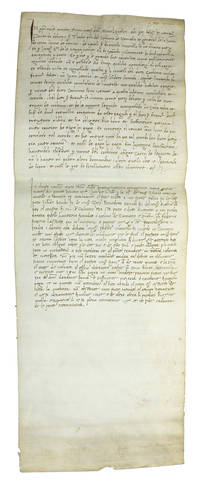
1488Best.-Nr. ABC_45211Venice 1488. Italian notarial document on vellum 44.5 x 16 cm; text block ca. 27 x 14 cm. Written in two fine cursive hands. A promissory note drawn up by a notary public of the Venetian Republic: Francesco Marcello a Venetian gentleman owed the main commissioner of Venice 3300 ducats for customs taxes in Damascus. The creditor renounces all other claims and Marcello is to pay the debt in 11 annual instalments of 300 ducats beginning the year following the drafting of the document but he was to put up collateral the following month: "Parendo debitor ser Thadio Polo del Cothimo de Damasco et general de la soria de certa suma de denari de i qual ser Francesco Marcello se ne chiama piezo: et per i magnifici siori de le raxon vechie el fo sententiando volontarie in ducati tremillia et trexento per parte. Et perchè per le grande sue adversità come publicamente ognuno intende non è possibele che senza qualche axeveleza el possi pagar et essendo visto et cognossudo questo per li comessi del dicto Cothimo misier Francesco Falier misser Zuan Bembo et misser Benedeto Sanudo azoché scorando el tempo senza qualche conclusion de haverse con qualche habilità a pagar per nome del dicto Cothimo sono venuti a questa ultima conclusion et acordo chel dicto ser Francesco se chiama come piezo debitor per resto de tute raxon de Cothimo et de le uxure seguide computando la sententia tolta ut supra de ducati tremillia et trexento da esser pagadi per el dicto ser Francesco ducati trexento alanno et sia obligato dar bona et sufficiente piezarìa over caution de paga in paga. Et comenza el tempo anno uno da poi concluso tal acordo: et die mexe uno da poi tal acordo dar dicta piezarìa over caution et cussi de paga in paga fin integra satisfatction havendoli isoproducti per nome del Cothimo a pregar Carta de Segurtà de non li haver ni poder altro domandar .". Immediately below this statement is a confirmation by the Damascus consul Giovanni Mocenigo of the obligation to pay the sum of 3300 ducats in 11 annual instalments by the Venetian gentleman Francesco Marcello and his son.A remarkable early Renaissance document concerning a legal agreement set up by the three commissioners of the council of the Venetian court known as the "Quarantia Civil Vecchia" commissioned to oversee the correct collection of the customs tax which was to be paid by merchants on goods imported from or exported to Egypt and Syria.In fine condition. hardcover