JOUY, L.F. DE.Livre Rare Book
Livre Rare Book
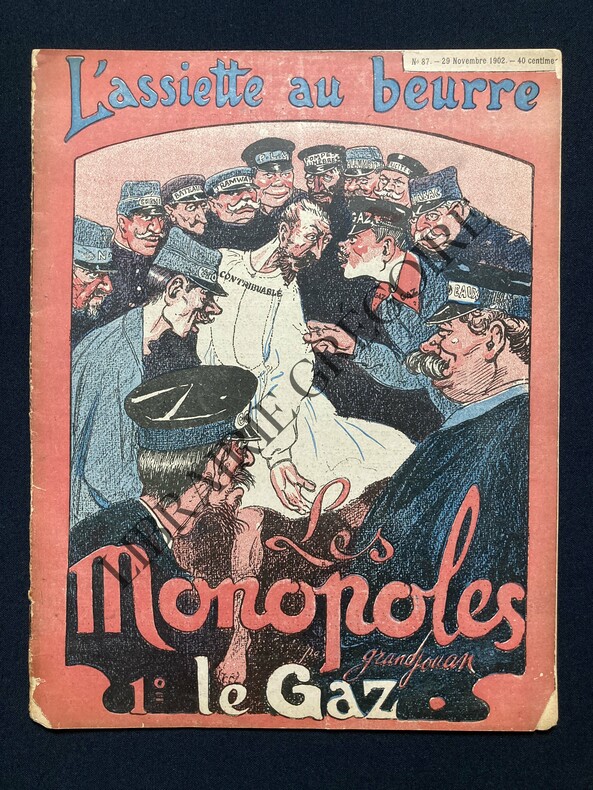
L'ASSIETTE AU BEURRE-N°87-29 NOVEMBRE 1902-LES MONOPOLES-PAR GRANDJOUAN-1° LE GAZ
1902réf. ABE-175882473154416 PAGES-31,7 CM X 24,6 CM-ETAT D'USAGE
Librairie Grégoire · Rennes, France15,00 €
357 résultats
réf. 18329A Paris, Chez Durand Neveu, 1775. (4), 457, (1, blank), (6) pp. 12mo. Contemporary marbled calf, spine gilt with raised bands and gilt lettering, lightly rubbed and shaved along extremities. Goldsmiths 11324; Higgs 6218; not in Kress (citing the 1751 edition 5127); not in Einaudi; not in INED. Last and best edition. Louis-François de Jouy specialized in canonical law and gained a reputation of such high learning that the clergy of France nominated him into one of their councils. The present work is a detailed survey of the history of the Dîme, its various definitions such as the Dîmes ecclésiastiques, the Dîmes inféodées, the Dîmes personelles, etc., etc.
réf. 15431No place, (1787?). With folding table. 18 pp. 8vo. Modern half morocco. Not in Kress; not in Goldsmiths; not in Stourm. First edition. Proposes to have 3 million family heads likely to pay tax assessed for one single tax only reaching from 5 to 750 livres, which would bring 724 millions. All other taxes could then be suppressed.
réf. 26118Bourg (Ain), Chez Janinet, Imprimeur-Libraire du Roi, 1819. 64 pp. 8vo. Stab-sewn in original pale yellow covers, a bit frayed at edges. Not in Kress; not in Goldsmiths; not in Einaudi; not in Mattioli; Louandre & Bourquelot, iv, p. 153 for other works by the author but not this one; Quérard, iii, p. 451, listing the third edition published in 1821. First edition. The author, inhabitant of Treffort in the department l'Ain, was a prolific philantropist. In this curious work he exposes with much details a revolutionary financial project which he would like to see implemented in all civilized nations. The gist of the project is no less than the abolition of all taxes: they will be replaced by a voluntary contribution: "C'est sur l'orgueil, le luxe et l'amour-propre que je vais proposer d'établir un impôt." The method is simple and clear: no-one is allowed to decorate his horses, carriages, clothes, furniture, harness, etc. etc. unless a license has been bought. Granier's argument is based on human nature: if something is dear to someone, he will want it; if it distinguishes it is appreciated and desired, and the more it is wanted. Hence, many will pay to be able to obtain what they want and what will distinguish them from others. Granier also deals with possible objections to his project, gives calculations of income generated through his project, and exposes clearly the unjust and uneven division of taxes in existence: a day-worker pays 15 % taxes on his glass of wine, whereas those who can afford to purchase wine "en gros" pay only 5%!Granier is the author of various other works: Moyen d'améliorer l'état social en diminuant l'excès de la fréquentation des cafés, billards, ...., Moyen d'éteindre la mendicité, d'améliorer le sort des pauvres .... and of Moyen pour produire spontanément et à peu de frais un moteur capable de suppléer aux pompes de feu ..... A very nice copy, a bit spotted, uncut.
réf. 18643A Nancy, Chez la veuve Leclerc, 1776. 2 volumes in 1. (16), 349, (1) pp.; (2), 358, (16) pp. 4to. Modern vellum, red label with gilt lettering. Kress S.4854; Masui, i, p. 404; not in Goldsmiths; not in Einaudi; not in INED; not in Franklin, Les Sources de l'histoire de France; not in Catalogue de l'Histoire de France; Conlon 76:1033. First edition. Henri Antoine Regnard de Gironcourt (1719-1786), became a lawyer at Epinal in 1746 and published several Mémoires dealing with taxes on merchandise to be levied on behalf of religious orders, a practice which existed since the tenth century. He also wrote a number of works and articles on the history of the Lorraine. The present work was his most important and is an esteemed historical treatise on French finances and the responsible officers. - Very good copy and rare.
réf. 18391A Paris, Chez Valleyre père, 1762. (2), x, (4), 468, (20) pp. 12mo. Contemporary marbled calf, spine gilt with raised bands, red edges, corners very lightly bumped. Kress 6021; INED 2614; Higgs 2669; not in Goldsmiths; not in Einaudi; not in Leblanc; not in Masui; not in Stammhammer, Bibliographie der Finanzwissenschaft; not in Camus; Conlon 62:879. First edition. Historical and legal treatise which studies the dîmes in relation to religion, law and the origins of the monarchy and stating that the dîmes were not, at the outset, due to the church. Edme de la Poix de Fréminville studied law. His main interests were related to feudal questions and his works were of importance. - Occasional light browning. Rare.
réf. 26195(Paris), De l'Imprimerie de Georges Jouvenel, (1721). With woodcut head-piece. 12 pp. 4to. Modern boards. Not in Conlon. Printed in the upper inner margin above the head-piece "Regie de Cordier. Deuxième année" and handwritten the date and the word "Gabelles". Deals in 17 articles with these taxes, article 14, covering the pages 8-11, gives details of the bonusses to be received by the collectors of these taxes: they range from 300 to 600 livres.
réf. 16498A La Haye, 1764. Together 3 volumes in 1. (4), 60, 107, (1) pp.; (2), 26 pp.; 24 pp. 8vo. Contemporary marbled calf, spine gilt in compartments, red label with gilt lettering, red edges, lightly worn, some spots. First work: Kress 6086; Goldsmiths 9873; INED 1276; Higgs 3017; Conlon 63:751. First issue of the first edition. In this vehemently written work, the fermiers-généraux were accused of corruption. It caused the author's imprisonment in the Bastille. The volume was printed by Lambert and distributed by Ormancy, who also were arrested. Four years after its publication the book was still sold secretly at high prices. Second work: Not in Kress; Goldsmiths 10025; Higgs 3018; INED 4797; Conlon 63:752.First edition.According to Goldsmiths this is not by Darigrand, but a reply to Darigrand's work, INED also believes this work to be written by another, anonymous, author, Conlon lists it under Darigrand.Third work: Not in Kress; Goldsmiths 10020; Higgs 3268; INED 4778; Conlon 64:441.First edition.Loosely inserted: ARRET de la cour du parlement de Rouen, qui ordonne que la brochure intitulée: Réponse à l'auteur de l'anti-financier, fera lacerée & brulé par l'exécuteur de la Haute-Justice, au pied du grand escalier de palais; enjoint à ceux qui en auroient des exemplaires, de les apporter au Greffe de la Cour, pour y être pareillement lacérés & brulés, &c. Du 9 Avril 1764. (Drop-head title). A Rouen, Chez J.J. le Boullenger, (1764).Not in Kress; Goldsmiths 10017; Higgs 3252.
réf. 16499A Londres et se vend à Paris, Chez la veuve Delormel & Fils, 1757. Together 4 works bound in 1 volume. (4), 60, 107, (1) pp.; xxiv, 224 pp.; 109, (1) pp.; 67, (1) pp. and 1 table. 8vo. Contemporary polished calf, spine richly gilt, raised bands, gilt triple fillets on sides, red label with gilt lettering, a very nice copy. First work: Kress 6086-7; Goldsmiths 9873; INED 1276; Higgs 3017. First issue of the first edition. In this vehemently written work, the fermiers-généraux were accused of corruption. It caused the author's imprisonment in the Bastille. The volume was printed by Lambert and distributed by Ormancy, who also were arrested. Four years after its publication the book was still sold secretly at high prices.Second work: Not in Kress; Conlon 75:640 (claiming two volumes).First edition.Of importance for the history of the years preceding the Revolution.Third work: Conlon 82:401.First edition.Fourth work: INED 620; Conlon 57:547.First edition.
réf. 17155Londres (Paris?), 1751. 3 parts in 1 volume. (6), 112 pp.; 175 pp.; 171 pp. 12mo. Contemporary marbled calf, spine gilt in compartments, gilt fillet on sides, marbled edges, spine somewhat rubbed, slightly damaged at head and foot. Stourm 81; Conlon 51:499; INED 1094 (one part only); not in Kress; not in Goldsmiths; not in Einaudi. First edition. Legal and historical work dealing with Machault's plans to tax the ecclesiastical properties. The clergy maintained that they were exempt from tax and that whatever they paid was a voluntary gift. Chauvelin maintains that the clergy can not be exempt from taxes if the king thinks he ought to ask a contribution from them. The issue was hotly debated at the time, as the long list of works cited by Stourm shows. The work was condamned, Machault's plans failed and the exempt position of the clergy was maintained upto the revolution.
réf. 17894A Paris, 1776. (2), 155, (1) pp. 8vo. Contemporary marbled calf, spine gilt in compartments, gilt lettering. Kress 7193; not in Goldsmiths; not in Einaudi; this edition not in INED; Camus 1566; Peinot, Livres Condamnés, i, p. 43 (with wrong date). Third edition, published in the same year as the first edition, the other two having only 48 and 72 pages respectively. Pierre-François Boncerf, French writer on agrarian subjects. While a clerk in the ministry of finance under Turgot he published a pamphlet, Les inconvénients des droits féodaux. According to Palgrave the work was published with the consent of Turgot. In it he attacked the contemporary system of feudal dues as ruinous to those who pay them, of little advantage to its benificiaries and contrary to the principles of freedom. The solemn condemnation of the pamphlet by the parlement of Paris, which the king vetoed, and the ensuing controversy in the press, in which Voltaire took a prominent part, established Boncerf's reputation and resulted in the translation of the work into many European languages. The pages 70-end contain the relevant texts by Montesquieu. The work was first published anonymously, a second edition was published with the pseudonym M. Francaleu.
réf. 18836Londres, 1775. 2 volumes in 1. (1), 155, (1) pp.; 275, (3) pp. 8vo. Contemporary marbled calf, spine gilt with raised bands, red morocco label with gilt lettering, small damage to joint at the foot of the volume. First work: Kress 7193; not in Goldsmiths; not in Einaudi; this edition not in INED; cf: Camus 1566; Peinot, Livres Condamnés, i, p. 43 (with wrong date). Third edition, published in the same year as the first edition, first edition with this title. Pierre-François Boncerf, French writer on agrarian subjects. While a clerk in the ministry of finance under Turgot he published a pamphlet, Les inconvénients des droits féodaux. According to Palgrave the work was published with the consent of Turgot. In it he attacked the contemporary system of feudal dues as ruinous to those who pay them, of little advantage to its benificiaries and contrary to the principles of freedom. The solemn condemnation of the pamphlet by the parlement of Paris, which the king vetoed, and the ensuing controversy in the press, in which Voltaire took a prominent part, established Boncerf's reputation and resulted in the translation of the work into many European languages. The pages 70-end contain the relevant texts by Montesquieu. The first edition was published anonymously, the second edition under the assumed name M. Francaleu. Second work: Higgs 6537; INED 3188 (1831 edition); Martin & Walter 24430; not in Goldsmiths (see 11518 for the second edition).First edition. Philosophical and political study on despotism and its effects it pretents to refute the theories of Rousseau while the author in reality attacks straight forward the government. Of actual value seems again his remark 'La nation finit toujours par être plus puissante que le tyran lorsque le pouvoir arbitraire parvenu à son dernier délire a dissous tous les liens de l'opinion et épuisé les ressources que la terre offre à ceux qui la cultivent en liberté. Ainsi les hommes se vengent tôt ou tard.' 'Dans cet insolent libelle, intitulé Essai sur le Despotisme, sous couleur de réfuter les théories de Jean-Jacques sur la bonté naturelle de l'homme, l'auteur s'attaquait de front aux pouvoirs' (Duc de Castries, Mirabeau, p. 105). Important work proclaiming democratic ideas and openly attacking despotism: 'Après cette vue philosophique générale, l'ouvrage s'attaquait seulement au 'despotisme d'un seul'' (Duc de Castries, op.cit)
réf. 15945Bourges, 1787. With 11 tables. 3 volumes. (12), 19, 345, (10) pp.; (4), 287, (12) pp.; (2), 48, 262 pp. 4to. Modern half morocco. Lavergne, Assemblées provinciales, pp. 33-66. Complete set of the best edition with subject indexes, of the proceedings of the very first Assemblée Provinciale, as planned by Turgot and created by Necker. The distinction between the three orders was practically neglected and the voting was by call. This Assemblée was, together with the one of Haute-Guienne, the only one to survive until the revolution. During the years of its existence, the Assemblée made important decisions: the corvée was abolished and in this respect Berri became the example for all other provinces; improvement of waterways, extensively dealt with in the proceedings, was promoted because of the high costs of transport by land; the new doctrine of Turgot of 'liberté du travail' was adopted. Important document as the Berry was a sort of experiment for the future provincial assemblies. In these minutes one finds essais on agriculture, industry, various taxes in use, the Ponts et Chaussees, the future construction of the canal and its navigation. - Rare in this complete state. The first two volumes with the half-title: 'Collection des procès-verbaux de l'Assemblée provinciale du Berri'.
réf. 27210A Bruxelles, 1779. xiv, 776, (2, errata, blank), 10 pp. 4to. Contemporary calf, spine gilt with raised bands, red label with gilt lettering, marbled edges, some minor blemishes to binding. Kress B.175; Goldsmiths 11860; Einaudi 207; INED 137; Quérard, La France Littéraire, i, p. 126; Dupin/Camus 954bis, pointing to the fact that this work is only complete with the 10 pages supplement, as is the case here; Le Bucher bibliographique, 114. Very rare only edition and suppressed by the Cour des Aides in February 1779 because it was considered contrary to the authority of the Court, it lacked respect for its decisions and it violated the confidentiality of the decisions. This precious and scarce volume, which was not available on the market and which was suppressed in 1779, contains the work of Malesherbes during his tenure in office at the Cour des Aides, that is, the work of 25 years: the reports of the sessions of the Cour des Aides and the remonstrances. It was published with tacit permission and did not contain, in the first instance, those pleas in which Malerherbes addressed the king in quite frank language. These withheld texts were shortly thereafter nevertheless printed and inserted and they form the indispensible 10 page supplement at the end of the volume.The Court des Aides was suppressed, together with the Parliaments, by Maupeou in his attempt at reform; it played, under Malesherbes, a significient role of opposition to what the Court considered to be "royal arbitrariness" and basically shared the "constitutionalist" ideology common to most members of the Grande Robe. The Court was suppressed in 1771 and re-instated in 1774: Malesherbes was recalled to Paris with the reconstituted Cour des Aides on the accession of Louis XVI; it was at this point that he spearheaded the famous 1775 Remontrances of the cour des aides, which detailed the problems facing the regime and envisioned a total overhaul of fiscal policy. Louis XVI was so impressed with the plan -and fearful for the future of his government- that Malesherbes was appointed minister of the maison du roi in 1775. He held office as a royal minister only nine months; the Court proved intransigent in its opposition to his proposals for fiscal restraint and other reforms, including curtailing the arbitrary issuance of lettres de cachet, and he soon found himself bereft of political support. He resigned together with Turgot in 1776.- Pages 71-72 bound between pages 66-67, and with the pages 71-72 bis present, 457-8 omitted in numbering, numbers 465-66 used twice, but text complete.
réf. 18132A Amsterdam (France), 1764. With engraved frontispiece. 37, (1) pp. 8vo. Modern boards. Kress S.4328; INED 4546; not in Higgs; not in Goldsmiths; not in Einaudi; Weller, Die falschen und fingierten Druckorte, ii, p. 166. First edition. Very sharp pamphlet against the fermiers généraux. The author remained unknown, but 'on avait pourtant arrêté et mis à la Bastille un nommé Darigrand auquel on attribuait l'Antifinancier, qui parait avoir été écrit par la même plume que les Antropophages; mais il fut relâché avant la mise en circulation de ce dernier libelle' (INED). - Title-page and first few leaves browned.
réf. VLE-661P., May et Motteroz, 1891, in-8, 48 pages broché, dos abimé, petit manque angulaire au premier plat
1902réf. ABE-175882473154416 PAGES-31,7 CM X 24,6 CM-ETAT D'USAGE
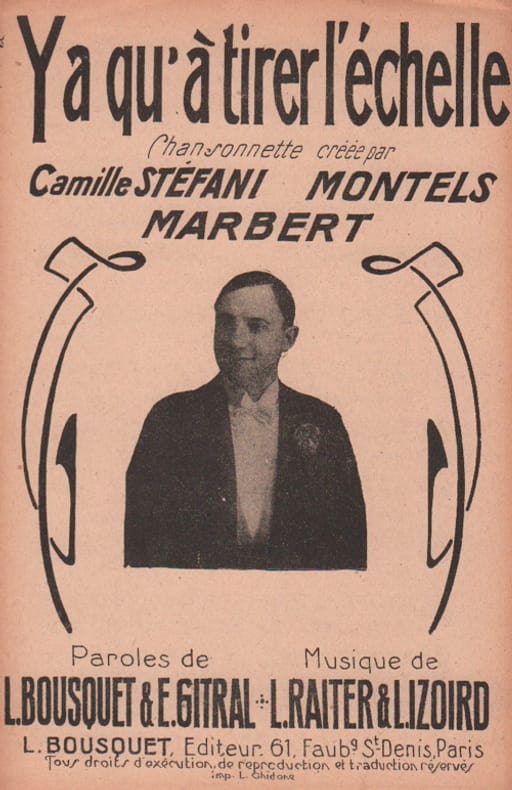
réf. 105867Bousquet
1631réf. PHO-1968Paris, chez Toussainct Quinet, 1631. In-8 (173x114mm), 7ff.-872pp.-8ff., vélin époque, manque au dos, travail de ver avec atteinte à qlqs lettres sur une trentaine de feuillets, petites rousseurs.
réf. 608Paris Librairie Alphonse Picard 1914 in 8 (24x16) 1 volume broché, 172 pages. Bon exemplaire ( Photographies sur demande / We can send pictures of this book on simple request )
réf. 2553Paris Durand Pissot 1756 in 12 1 volume reliure pleine basane fauve de l'époque, dos à nerfs orné, 368 pages, le dernier cahier est légèrement et uniformément jauni. Bon exemplaire ( Photographies sur demande / We can send pictures of this book on simple request )
réf. 14680S.l 1789 in 8 (21,5x14) 1 volume broché sous couverture muette d'attente de l'époque (papier gris), titre, 187 pages et XXIII, non rogné. Bon exemplaire ( Photographies sur demande / We can send pictures of this book on simple request )
réf. 17820Paris Honoré Champion 1906 in 8 (25x16,5) 1 volume broché, 298 pages, avec 1 carte noir et blanc. ''Contribution à l'histoire de l'impôt sous l'ancien régime''. Bon exemplaire
réf. 25669Paris Chez Durand / Pissot 1751 in 12 (16,5x10) 1 volume reliure pleine basane fauve marbrée de l'époque, dos à nerfs orné, tranches teintées rouge, 1 faux feuillet non chiffré de table des chapitres, 366 pages, et 3 faux feuillets non chiffrés (approbation et privilege du Roi). Louis-François de Jouy, Avocat au Parlement. Edition originale. Bel exemplaire ( Photographies sur demande / We can send pictures of this book on simple request )
réf. 26760Paris Chez Durand Neveu, Libraire 1775 in 12 (17,5x10,5) 1 volume reliure plein veau fauve marbré de l'époque, dos lisse orné, pièce de titre de maroquin rouge, tranches marbrées, faux-titre, titre, 457 pages, et 2 faux-feuillets non chiffrés d'approbation in fine, toute petite trace claire sur l'extrémité de la marge supérieure, petite usure au niveau de la coiffe supérieure, supra libris sur le plat supérieur: Lascoux. Nouvelle édition revue, corrigée & considérablement augmentée. Bel exemplaire ( Photographies sur demande / We can send pictures of this book on simple request )
réf. 29468Paris Guiraudet et Gallay, imprimeur et libraire. Juillet 1824 1182 in 8 (19x12,5) 1 volume broché, couverture muette de papier ancien, faux-titre, titre, 32 pages. A la.suite du même: MEMENTO ET BARÊME DE LA PERSPECTIVE DE NOTRE AVENIR FINANCIER, en cas de naufrage au port (Paris, imprimerie de A. Henry, Mars 1825, 119 pages). Bon exemplaire ( Photographies sur demande / We can send pictures of this book on simple request )