234 risultati
rif. 3407Club Mondial du Livre, 1958 17 x 20, 491 pp., nombreuses illustrations (photo. et dessins), cartonnage éditeur illustré, bon état
rif. 41135Genève, Auteur-Editeur sans date, vers 1929, 220x145mm, 284pages, demi-reliure. Plats papie marbré. Auteur et titre dorés au dos. Bel exemplaire.
2007rif. 912442007 Editions Grasset - 2007 - In-8 broché couverture illustrée - 347p
1934rif. 28726Corbigny 1934 une photographie originale en noir, format : 13 x 18 cm , avec une explication de la photo tapée à la machine en bleu au dos, photo Meurisse (19 janvier 1934)
1935rif. 2011160874xbvkBrünn u.a., Verlag Rudolf M. Rohrer, ohne Jahr (Datierung des Vorwortes 'Mai 1935'). 58 Seiten. - Brauner Halbleineneinband mit braun-marmorierten Buchdeckeln und handschriftlichem Papierrückenschild; 8vo.(ca. 22,5 x 16,5 cm).
1976rif. 311037München : Deutscher Taschenbuch-Verlag, 1976. 435 S. ; 18 cm. Originalbroschur.
2012rif. 19401Koch Media GmbH - DVD, 2012. 1 DVD DVD
1945rif. ABE-38520534181937687372 PAGES-43 CM X 60 CM-P1: "TOUT CELA N'EST PAS TRAGIQUE" REPONDAIT PETAIN EN 1942-M.MICHEL CLEMENCEAU A ETE ENTENDU PAR LA HAUTE COUR, 3 PHOTOS-A BADEN-BADEN CAPITALE MILITAIRE TOUS LES FRANCAIS PORTENT L'UNIFORME-UNE FORTERESSE VOLONTE S'ECRASE CONTRE LE PLUS GRAND GRATTE-CIEL DE NEW-YORK-P2: LES DEPOSITIONS DE M.CLEMENCEAU ET DU GENERAL DOYEN-LES PROJETS CONSTITUTIONNELS EN DISCUSSION A LA CONSULTATIVE LE GENERAL INTERVIENT-1 COUPURE 8 CM EN MARGE DE PLIURE HORIZONTALE
1993rif. 04419Bonn, Rentrop, 1993. PP, 160S, gut
1986rif. 03845Biel, Institut Finanzanalyse, 1986. kt, 100S, gutes Exemplar,
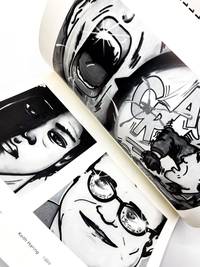
1984rif. 53609New York: Sidney Janis 1984. First edition. Very good plus. Scarce catalogue of this early joint exhibition by graffiti artists Crash and Daze at the Sidney Janis gallery in New York. Artists and frequent co-exhibitors Daze and Crash were both born in New York City in the early 1960s and both began building a style and a reputation in their teens in the late '70s first meeting in 1977. In October 1980 Crash curated the first major graffiti show Graffiti Art Success for America at Fashion Moda in the South Bronx; Daze was first featured in a gallery space in 1981 in the Beyond Words exhibition alongside Jean-Michel Basquiat and Keith Haring. Crash's own portraits of Basquiat and Haring are among the nine pieces illustrated in this catalogue selected from the 18 and 19 works in each artist's exhibition checklist. 11'' x 8.5''. Original saddle-stapled black and white wrappers. 9 black and white plates. 8 pages. Light edgewear and rubbing to wrappers. (Sidney Janis) unknown books
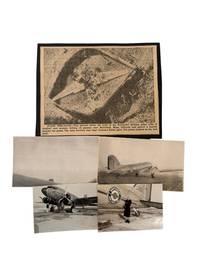
1941rif. 235251941. Northwest Airlines Flight 5 crash archive documenting one of the most deadly commercial aviation disasters in the carrier's early history pairing operational views of Northwest's Douglas airliners with contemporary evidence from the fatal October 30 1941 crash near Moorhead Minnesota. Flight 5 was a scheduled transcontinental Northwest Airlines route traveling from Chicago toward Seattle through Minneapolis Fargo Billings Butte and Spokane when its Douglas DC-3A-269 registration NC21712 encountered severe icing and poor visibility during approach. The aircraft plunged to the ground in fog and freezing conditions killing twelve passengers and two crew members. Captain Clarence F. Bates emerged as the sole survivor. The subsequent Civil Aeronautics Board investigation concluded that dangerous ice accumulation on the wings played a critical role in the disaster making the crash an important chapter in the evolution of commercial aviation safety during the final weeks before America entered the Second World War. Archive of four silver gelatin photographs and a contemporary newspaper clipping photographs approx 3.5" x 5" to 5" x 7" circa 1941. The photographs capture Northwest Airlines aircraft in active service during the same period as the disaster. One image shows a Northwest airliner standing on a frozen airfield with registration number NC21711 visible on the tail and prominent "Northwest" and "U.S. Mail Air Express" markings along the fuselage. Another view depicts a woman posing beside the company's large winged emblem with mail and express service markings visible near the tail section. A third photograph records ground operations beneath a Northwest aircraft as personnel stand near a baggage cart marked "Shell" illustrating the everyday routines of America's growing commercial airline network. A final image looks outward from above an aircraft wing toward the horizon placing the viewer inside the world of prewar air travel. The accompanying newspaper clipping dramatically contrasts these routine scenes with aerial views of the burned wreckage of NC21712 near Moorhead identifying the disaster the fourteen fatalities the role of fog and icing and Captain Bates' remarkable survival. The archive place the optimism and expansion of early commercial aviation beside the harsh realities of flying in an era when weather forecasting radio navigation aircraft de-icing technology and long-distance passenger service were still developing. Created less than six weeks before the United States entered World War II the archive captures Northwest Airlines at a pivotal moment when passenger travel air mail contracts and express cargo routes were rapidly connecting the Midwest Northern Plains Rocky Mountains and Pacific Northwest. The juxtaposition of aircraft operating normally in service with contemporary documentation of Flight 5's destruction transforms the group into more than a simple airline archive-it becomes a visual record of the risks ambitions and technological challenges of American aviation on the eve of wartime expansion. Light handling wear mild curling toning and creasing to the newspaper clipping; photographs remain very good. A tightly related aviation archive combining identifiable Northwest Airlines aircraft visible registration numbers airline operations and one of the carrier's most significant prewar disasters. unknown books
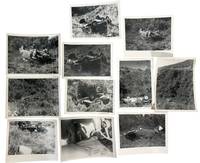
rif. 23903Automobile accident photo archive circa 1940s to 1950s documenting a severe rollover in which a passenger car left the roadway and came to rest inverted on a steep brush covered hillside. Eleven successive views record the wreck from the road above at intermediate distance and at close range preserving the vehicle's position damage and surrounding terrain. The sequence gives unusually sustained coverage to a single rural crash scene rather than treating the wreck as an isolated snapshot. Photo archive of 11 likely silver gelatin photographs circa 1940s to 1950s. The photographs show the overturned automobile from multiple sides its undercarriage and wheels exposed with several wider views establishing the considerable distance between the roadway and the point where the car stopped. Closer photographs record crushed body panels and the collapsed passenger compartment; one interior view shows a human arm amid the damaged cabin while another image includes a man standing beside the wreck. By the late 1940s photography had become an established part of formal traffic accident investigation: FBI police training material in 1947 specifically addressed photographic evidence in accident work and 1950 guidance included photographing and measuring the scene among standard investigative procedures. FBI: Law Enforcement Bulletin The repeated changes of distance and viewpoint here closely parallel that documentary concern with position damage and scene context. Light edge wear minor curling and occasional handling marks. Overall in good condition. A concentrated photographic record of a serious midcentury automobile rollover from landscape view to damaged interior. unknown books
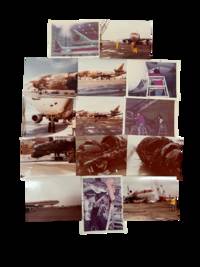
1978rif. 233051978. Continental Airlines Flight 603 disaster photographs documenting the burned wreckage and structural damage of the DC 10 runway overrun at Los Angeles International Airport on March 1 1978 one of the most consequential American aviation accidents of the late 1970s and a major catalyst for changes in tire safety standards rejected takeoff procedures and aircraft evacuation systems. Flight 603 a Continental Airlines DC 10 10 scheduled from Los Angeles to Honolulu attempted to abort takeoff after multiple tire failures near decision speed on a wet runway; the aircraft overran runway 6R at LAX the left main landing gear collapsed beyond the pavement fuel tanks ruptured and a major fire engulfed the underside and left side of the aircraft during evacuation. The NTSB recorded 2 deaths and 28 serious injuries in its formal report while later accounts place the eventual death toll at 4 after additional passengers later died from injuries sustained in the crash. Photo archive of 14 color snapshot photographs each approximately 3.5" x 4.5" Los Angeles International Airport California March 1978. The photographs show Continental Airlines McDonnell Douglas DC 10 10 N68045 after the accident resting heavily fire damaged on the runway and adjacent overrun area. Multiple images focus closely on the burned underside of the fuselage where large sections of aluminum skin have been completely burned away exposing the aircraft's internal rib structure wiring insulation and lower cabin framework. Other views show extensive scorching along the left side of the aircraft blackened and partially melted fuselage panels around the wing root and landing gear area collapsed structural sections beneath the passenger cabin and debris scattered across the wet runway surface. Several photographs widen outward to show emergency and recovery operations surrounding the aircraft including personnel service vehicles cranes and towing equipment positioned around the destroyed DC 10. One image records the full profile of the aircraft from a distance emphasizing the scale of the burn damage extending across much of the fuselage exterior. Together the photographs document not merely the existence of the accident but the specific physical consequences of the runway overrun and post crash fire: ruptured lower fuselage sections exposed aircraft structure burned cabin undersides and the recovery environment at LAX immediately after the disaster. Flight 603 became an important case study in late twentieth century aviation safety because the accident linked tire failure runway conditions aircraft stopping performance and evacuation survivability within the emerging era of mass deregulated air travel. The NTSB investigation led to recommendations intended to "significantly reduce the incidence of tire failures during takeoffs and rejected takeoffs" while later FAA and industry reforms addressed tire testing standards takeoff performance calculations and the durability and fire resistance of emergency evacuation slides. These photographs preserve the material evidence behind those institutional and engineering changes documenting the burned airframe and structural destruction that transformed Flight 603 into a major reference point in modern commercial aviation safety history. Minor wear from handling. Overall very good condition. unknown books
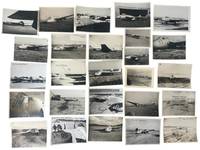
1957rif. 233541957. De Havilland Vampire jet photographs documenting French Air Force training accident inspection and air base control at Meknès Morocco in the years immediately following Moroccan independence with direct evidence of how Base École 708 recorded aircraft damage runway incidents and jet operations within the shrinking French military presence in North Africa. French military personnel are identifiable not through portraiture but through the administrative system embedded in the material itself: repeated verso stamps reading Section Photo 21/708 Meknès dated from 1957 to 1959 and technical annotations that turn the group into an official working record rather than informal aviation imagery. The historical force of the archive lies in that function. Meknès served as a major French fighter training center the de Havilland Vampire formed part of its early jet instruction program and the base remained active until its dissolution in 1961 placing these photographs within the last phase of French air force operations in Morocco after France recognized Moroccan independence in 1956. Photo archive of approximately 27 silver gelatin photographs approximately 4.5 x 3.5 inches each Meknès Morocco 1957 to 1959. The images center on multiple de Havilland Vampire aircraft marked with large fuselage letters including TT UA RD RG RE and UM photographed from the nose wing cockpit tail and runway line in a methodical sequence. Several prints isolate impact evidence and structural damage: one close view marks "traces de frottement" on a crushed nose section another labels "cockpit avion abordeur / plan gauche avion abordé" and others identify "vue générale" "vue 3/4 arrière" and "axe de la bande" showing that the planes were being recorded for inspection orientation and incident analysis. Additional photographs show grounded jets in grass beside the field aircraft parked on the tarmac in rows hangar exteriors and broad runway views with service vehicles nearby. The versos carry dated Meknès section stamps penciled numbering and occasional reference notes from French military photographic and cinematographic services preserving the bureaucratic chain by which the images were produced filed and cross referenced. The archive belongs to the first generation of French jet aviation in North Africa. The Vampire was among the earliest jet fighters used by the French Air Force and Meknès was one of the key training sites where pilots moved into jet instruction before the school later shifted to newer aircraft and eventually left Morocco. In that setting aircraft photography was not decorative; it was part of the operational machinery of flight training maintenance and accident inquiry. These prints preserve that machinery at the moment when French colonial authority in Morocco had formally ended but French bases and training institutions still operated on Moroccan soil linking jet modernization to decolonization and military retrenchment. Written notes and official stamps throughout; light handling wear from use otherwise well preserved. Overall good condition. unknown books
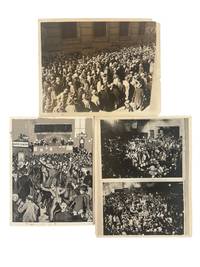
1930rif. 225141930. New York Stock Exchange photo archive three press images dated 1893 to the early 1930s documenting major moments of financial crisis and market activity in the United States. The material captures both interior trading floor operations and exterior public response during periods of extreme volatility including the Panic of 1893 and the economic downturn following the 1929 stock market crash. These images provide direct visual evidence of how financial markets functioned in practice showing brokers traders and public crowds reacting to rapid shifts in economic conditions and offering insight into the social and institutional centrality of the New York Stock Exchange during periods of national instability. Three original photographs and printed image including a halftone engraving dated May 18 1893 alongside two press photographs bearing stamps from 1930 and 1932 each measuring approximately 7 x 9 inches to 8 x 10 inches. The 1893 image originally published in Frank Leslie's Illustrated Newspaper depicts the interior of the Exchange during the Panic of 1893 with brokers in formal attire densely clustered beneath ticker boards and gas lighting engaged in open outcry trading. A later double-image press photograph presents elevated views over the trading floor showing large groups of traders gathered around circular posts holding telephones and exchange slips illustrating the mechanics of pre-digital trading systems. The final photograph an Acme press image with original caption on verso shows a dense crowd gathered outside the Exchange on Broad Street during the early years of the Great Depression with men in suits and hats pressed together as they observe market activity and posted updates. Verso annotations editorial crop marks and press stamps indicate these images were used in contemporary newspaper reporting on stock market conditions. Spanning four decades of financial history these images document the continuity and transformation of market behavior from the late nineteenth century through the Great Depression. The Panic of 1893 marked by railroad failures and widespread bankruptcies and the crash of 1929 which contributed to prolonged economic collapse both intensified trading activity and public engagement with the Exchange. The photographs illustrate the persistence of open outcry systems reliance on manual communication and the physical concentration of traders and observers in moments of crisis. This archive supports research into financial history media representation of economic events and the lived experience of market speculation during periods of instability. Light handling wear minor edge creasing and some editorial markings; overall very good condition. A concise visual record of market activity and public response across two major economic crises. unknown books
rif. 31827CRADDOCK Billy "Crash". Signed Photograph. An 8- by 10-inch black-and-white publicity photograph signed by Craddock. $25.00. unknown books
rif. 0205140912-7-1Allyn & Bacon. First Edition. Acceptable. The item might be beaten up but readable. May contain markings or highlighting as well as stains bent corners or any other major defect but the text is not obscured in any way. Allyn & Bacon unknown
rif. DADAX1138184055New unknown
rif. DADAX1473625068New unknown
rif. SONG0520288297Used: Good unknown
rif. DADAX1633939502New unknown
rif. SONG1506706495Used: Good unknown
rif. DADAX1710942754New unknown
rif. DADAX1138919268New unknown