14.731 resultados
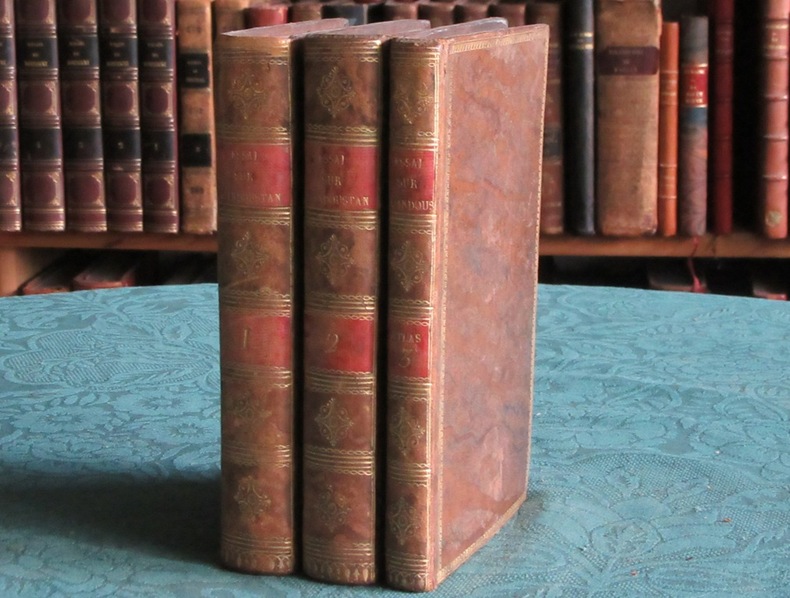
ref. 24270A Amsterdam, Et se trouve à Paris chez Duchesne, 1756. xlvii, (1), 352 pp. 12mo. Contemporary marbled calf, spine richly gilt with raised bands, red label with gilt lettering, red edges. Echerverria & Wilkie 56/40; Sabin 75520; Chadenat 4121; JFBL S61; INED 4034; Higgs 1501; Kress 5567; Conlon 56:1257; not in Goldsmiths; not in Einaudi. First edition, and very rare, of this work which discusses in 18 letters and at the moment the Seven Years' War was about to start, the consequences of the presence of various European nations in North America with the aim to find some sort of balance of power between the various colonizing European nations, to avoid a war and to encourage commerce and trade. 'There are several issues of this edition occasioned by cancellanda (D4-5, D11-12, E10, G11, and I5-8, all of which are present in this copy). No copy is known, however, that is not a mixture of both canellanda and cancellantia: thus, what the original text was as first printed is problematic. (.....) In the two BN copies, (....), the imprint date has been alterted in manuscript to read M.DCC.LVII. (This is also the case with the present copy where the second 'I' has been added in manuscript.) This is a series of letters dated July-September 1756, forming an essay on international power politics with special reference to European colonial systems in America' (Echeverria & Wilkie).'Intéressant pour l'origine de la guerre du Canada' (Chadenat). 'A consideration of Europe's involvement in North America with a view to establishing a balance of power among the colonizing nations which would eliminate war and encourage commerce' (JFBL). 'Déterminer la nature des divers équilibres propres aux différentes colonies septentrionales et méridionales des peuples de l'Europe, en étudiant les variations de leurs cultures, leur commerce, leur population, leurs différentes distances, etc.' (INED). - Contemporary signature and author's name in blank portion of title.
ref. ORD-16352Sans indication de lieu ni de date [Genève. Pellet. 1780]. In-4 (183 x 261mm) dos lisse maroquin rouge orné de filets et d'un semis d'étoiles or, plats veau raciné à double encadrement de filets or, gardes marbrées, bien complet des 23 tableaux et des 50 cartes dressées par Bonne, la plupart dépliants. Menus défauts mais bon exemplaire.
ref. 11307A Avignon, Et se vend à Lyon, Chez REGUILLIAT, Libraire, Place Louis Legrand, 1770 - In-8 dans une sobre et saine reliure demi chagrin cognac, dos à cinq nerfs et titre au petit fer dans le second caisson, signet de soie, bel exemplaire de reliure postérieures, XVJ - 272 pages, piqûres sporadiques, petits manques papier sur les 4 premières pages, mouillures sans gravité sur les dix première pages. Très agréable.
1803ref. 001778Paris Chez Gérard, Imprimerie de Munier 1803. Trois volumes in-8 (205 x 130 mm), demi-veau glacé bleu marine, dos lisse orné or et à froid, tranches mouchetées (reliure milieu 19e s.). Seconde édition française, ornée d'une carte dépliante et de 11 planches gravées sur acier d'après les dessins de l'auteur, représentant le Mont Vernon et la maison du Général Washington, les Chutes du Niagara, le Cap-Diamant, etc. Ex-libris Mr de Gaudechart. (dos très légèrement passé, quelques défauts, frottements sur les plats, quelques manques de cuir tome 1, quelques petites déchirures marginales, t. 3 sur les 30 premières pages mouillure angulaire, rousseurs). // Three octavo volumes (205 x 130 mm), dark blue glazed half calf, smooth spine tooled in gilt and blind, sprinkled edges (middle of 19th-cent. binding). Second french edition, illustrated with a folding map and 11 plates engraved on steel after the author's drawings, depicting Mont Vernon and General Washington's house, Niagara Falls, Cap-Diamant, etc. Bookplate Mr de Gaudechart. (spine a little bit faded, some defects, rubbings on covers, some lack of leather vol. 1, some little tears, vol. 3 water-stain on top corner of the 30 first pages, spots).
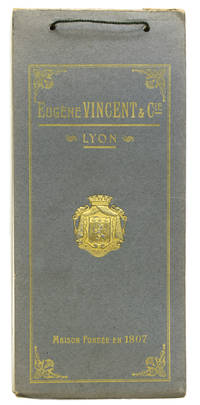
1907ref. 302671Lyon: Imprimerie Gougenheim Frères 1907. 30 numbered chromolithograph plates. Thin oblong 8vo 9-3/4 x 4-1/4 in. Printed gray wrappers stapled and with hole punches and string gold foil stamped arms on front cover. Light wear to covers. With the distribution stamp of Albert Martin 6 Rue des Tonneliers Marseille. 30 numbered chromolithograph plates. Thin oblong 8vo 9-3/4 x 4-1/4 in. A finely printed trade catalogue illustrating the liqueurs and brandies offered by the Lyon wine distributors Eugéne Vincent & Cie including Crème de Cacoa-chouva various brands of curaçao and triple sec anisette fruit brandies Peronneau absinthe and Grog Americain a bottled punch. Imprimerie Gougenheim Frères unknown
1907ref. 302671Lyon: Imprimerie Gougenheim Frères 1907. 30 numbered chromolithograph plates. Thin oblong 8vo 9-3/4 x 4-1/4 in. Printed gray wrappers stapled and with hole punches and string gold foil stamped arms on front cover. Light wear to covers. With the distribution stamp of Albert Martin 6 Rue des Tonneliers Marseille. 30 numbered chromolithograph plates. Thin oblong 8vo 9-3/4 x 4-1/4 in. A finely printed trade catalogue illustrating the liqueurs and brandies offered by the Lyon wine distributors Eugéne Vincent & Cie including Crème de Cacoa-chouva various brands of curaçao and triple sec anisette fruit brandies Peronneau absinthe and Grog Americain a bottled punch. Imprimerie Gougenheim Frères unknown books
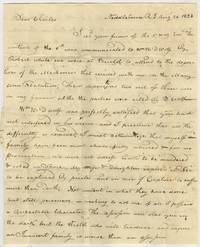
1823ref. BK0184Middletown Rhode Island 1823. Autograph letter signed three pages on a folded sheet with integral address panel to Charles E. Dudley in Albany and Newport postal markings. 7 ¾ x 9 ¾ inches. Old folds scattered staining and some marginal losses a few affecting text. Good to very good. A letter from Newport mariner John Wood concerning his acrimonious departure from the DeWolf family's Mary Ann plantation in Cuba and the ensuing legal dispute with James DeWolf and Charles Collins. Wood was almost certainly the same John Wood whose signature appears on an 1806 Newport agreement for an illegal voyage transporting enslaved Africans from Cape Coast to Havana now held by the Smithsonian's National Museum of African American History and Culture.1 By 1823 he was residing on the Mary Ann plantation one of several Cuban estates belonging to the DeWolfs among the most prominent families involved in the American slave trade. His relationship with DeWolf and Collins had evidently collapsed over his obligations on the estate resulting in what he describes as his forced departure from Cuba under apparently dangerous conditions with his family and a contentious effort to settle their accounts. Writing to his friend Charles E. Dudley then mayor of Albany and a New York state senator Wood reports that three mechanics who had resided with him on the plantation had recently given depositions in Bristol Rhode Island. Two of the three had testified in his favor though all had been called by DeWolf. Wood was particularly incensed by the circumstances surrounding his family's departure from Cuba writing: "I must acknowledge that myself & family have been most shamefully abused & for no provocation we were set adrift liable to be murdered & robbed on Shore My Wife & Daughter exposed at Sea to be captured By pirates and in case of Capture to suffer more than Death; Not content in what they have done but still persevere in wishing to rob me of all I possess a Respectable Character. The assassin will stab you in the dark but the Wretch who will traduce and injure an Innocent family is worse than an assassin." Wood goes on to describe receiving two writs from DeWolf and Collins and transcribes an August 8 letter from James DeWolf explaining his decision to pursue legal action despite their previous discussions of an amicable settlement: "Lest you should think me inconsistent in causing an action to be brought after the last conversation we had I take leave to explain my wishes to come to an amicable settlement by referring to men as we talked remains the same my object is to put the business in a legal and proper train for bringing it to a close . & to enable me to avail of the testimony of the people who were on the Estate with you." Wood expected the Rhode Island Supreme Court meeting at Bristol the following month to appoint referees to settle the accounts. The precise origin of the disagreement is not stated though the depositions of the mechanics and the references to outstanding accounts suggest a dispute over Wood's contractual obligations or activities on the plantation. Wood 1770-1826 was a Newport merchant and captain with longstanding connections to Atlantic commerce. He died at Cape Coast West Africa in 1826 three years after writing the present letter. James DeWolf 1764-1837 then serving in the United States Senate had amassed a substantial fortune through the slave trade and his Cuban plantation interests. Charles Collins his brother-in-law had served as collector of customs at Bristol from 1804 to 1820 an appointment closely connected to the family's slave-trading operations. The Mary Ann plantation is documented in the DeWolf Papers at the Rhode Island Historical Society which include inventories from 1818 and 1820 and contemporary plans of the plantation grounds. The present letter preserves Wood's account of his treatment by the DeWolf family together with his transcription of DeWolf's explanation for pursuing legal action. 1 "Agreement facilitating illegal trade of enslaved Africans" National Museum of African American History & Culture accessed October 12 2026 https://nmaahc.si.edu/object/nmaahc_2019.28.1. . unknown
1823ref. BK0184Middletown Rhode Island 1823. Autograph letter signed three pages on a folded sheet with integral address panel to Charles E. Dudley in Albany and Newport postal markings. 7 ¾ x 9 ¾ inches. Old folds scattered staining and some marginal losses a few affecting text. Good to very good. A letter from Newport mariner John Wood concerning his acrimonious departure from the DeWolf family's Mary Ann plantation in Cuba and the ensuing legal dispute with James DeWolf and Charles Collins. Wood was almost certainly the same John Wood whose signature appears on an 1806 Newport agreement for an illegal voyage transporting enslaved Africans from Cape Coast to Havana now held by the Smithsonian's National Museum of African American History and Culture.1 By 1823 he was residing on the Mary Ann plantation one of several Cuban estates belonging to the DeWolfs among the most prominent families involved in the American slave trade. His relationship with DeWolf and Collins had evidently collapsed over his obligations on the estate resulting in what he describes as his forced departure from Cuba under apparently dangerous conditions with his family and a contentious effort to settle their accounts. Writing to his friend Charles E. Dudley then mayor of Albany and a New York state senator Wood reports that three mechanics who had resided with him on the plantation had recently given depositions in Bristol Rhode Island. Two of the three had testified in his favor though all had been called by DeWolf. Wood was particularly incensed by the circumstances surrounding his family's departure from Cuba writing: "I must acknowledge that myself & family have been most shamefully abused & for no provocation we were set adrift liable to be murdered & robbed on Shore My Wife & Daughter exposed at Sea to be captured By pirates and in case of Capture to suffer more than Death; Not content in what they have done but still persevere in wishing to rob me of all I possess a Respectable Character. The assassin will stab you in the dark but the Wretch who will traduce and injure an Innocent family is worse than an assassin." Wood goes on to describe receiving two writs from DeWolf and Collins and transcribes an August 8 letter from James DeWolf explaining his decision to pursue legal action despite their previous discussions of an amicable settlement: "Lest you should think me inconsistent in causing an action to be brought after the last conversation we had I take leave to explain my wishes to come to an amicable settlement by referring to men as we talked remains the same my object is to put the business in a legal and proper train for bringing it to a close . & to enable me to avail of the testimony of the people who were on the Estate with you." Wood expected the Rhode Island Supreme Court meeting at Bristol the following month to appoint referees to settle the accounts. The precise origin of the disagreement is not stated though the depositions of the mechanics and the references to outstanding accounts suggest a dispute over Wood's contractual obligations or activities on the plantation. Wood 1770-1826 was a Newport merchant and captain with longstanding connections to Atlantic commerce. He died at Cape Coast West Africa in 1826 three years after writing the present letter. James DeWolf 1764-1837 then serving in the United States Senate had amassed a substantial fortune through the slave trade and his Cuban plantation interests. Charles Collins his brother-in-law had served as collector of customs at Bristol from 1804 to 1820 an appointment closely connected to the family's slave-trading operations. The Mary Ann plantation is documented in the DeWolf Papers at the Rhode Island Historical Society which include inventories from 1818 and 1820 and contemporary plans of the plantation grounds. The present letter preserves Wood's account of his treatment by the DeWolf family together with his transcription of DeWolf's explanation for pursuing legal action. 1 "Agreement facilitating illegal trade of enslaved Africans" National Museum of African American History & Culture accessed October 12 2026 https://nmaahc.si.edu/object/nmaahc_2019.28.1. . unknown books
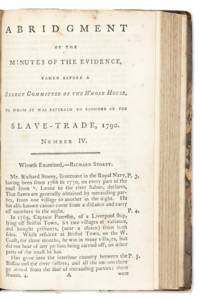
1789ref. 187101789. Committee of the Whole House of the British Parliament investigation into the Atlantic slave trade recorded in Abridgment of the Minutes of the Evidence Taken Before a Committee of the Whole House to Whom It Was Referred to Consider of the Slave Trade published 1789 to 1791 presenting one of the earliest parliamentary documentary compilations addressing the operation and human consequences of the transatlantic slave trade. The volumes preserve testimony gathered during parliamentary inquiries that examined the practices of British slave traders and the treatment of enslaved Africans transported across the Atlantic. These proceedings formed part of the political campaign in Britain that eventually culminated in the abolition of the British slave trade in 1807. The collected evidence includes statements from ship surgeons naval officers merchants and other witnesses whose accounts describe the conditions experienced by enslaved Africans during capture transport and plantation labor. Abridgment of the Minutes of the Evidence Taken Before a Committee of the Whole House To Whom It Was Referred to Consider of the Slave Trade. London: 1789-1791. First edition first printing. Four volumes bound in two books. The compilation reproduces testimony presented before Parliament concerning the organization and operation of the slave trade and includes firsthand statements describing the physical suffering and resistance of enslaved Africans during transport. Surgeon Alexander Falcon-Bridge who had firsthand experience aboard slave ships described acts of despair among captives: he "Has known several enslaved persons to refuse sustenance with a design to starve themselves. refusing to take medicines when sick because they wished to die. Many other slaves expressed the same." Another witness Royal Navy surgeon Thomas Trotter recorded the emotional trauma experienced by captives during embarkation noting that "Slaves on being brought on board showed signs of extreme distress and despair from a feeling of their situation and regret at being torn from friends and connections." The volumes therefore preserve testimony that exposed the violence and human suffering embedded within the Atlantic slave trading system. During the eighteenth century European and American traders transported millions of Africans across the Atlantic through a commercial system that relied on maritime networks linking West Africa the Caribbean and the Americas. Parliamentary investigations of the slave trade in the late eighteenth century were fueled in part by abolitionist activism and public campaigns demanding government inquiry into the practice. Publications of witness testimony such as this abridged parliamentary record circulated evidence used by reformers advocating the end of the trade. Four volumes bound in two books with folding table in the fourth volume. Octavo format. Contemporary marbled quarter calf bindings with modern bookplates on the front past down. Wear present with most spine titles lacking and foxing primarily affecting the title pages; text remains clear. Overall condition very good. unknown books
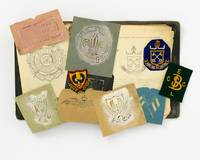
ref. 146921The collection comprises: 1 A ring-bound folder containing nearly 100 designs for cap and blazer badges including 40 with mounted examples of the finished embroidered patches. The designs are full-scale pencil drawings some coloured and most with typed or manuscript details of the colours designs and materials e.g. 'Royal Blue Cap. Badge worked all gold'. Badges for schools predominate with some of the wealthier private schools calling for multiple designs. For instance St Peters College has different designs for: Colours Junior Second First and First for prefects tennis cap regular and for prefects house and school prefects rowing cap regular and for prefects and old scholars. Also well represented are sporting clubs mainly baseball and cricket including the South Australian Cricket Association as well as a small number of youth clubs fraternities and other societies. The mount leaves are pulled at the punched holes and a little stained and torn; one leaf is defective; overall an impressive and extraordinary collection. 2 Approximately 300 hand-cut stencils paper or card used to transfer designs to the fabric where they would then be worked over by skilled embroiderers using free-motion or 'Irish' embroidery machines. The stencils include many designs not in the sample book including company logos and many other school and association badges. Of particular note are several relating to the Australian military forces in the Second World War including two for a Royal Australian Air Force pilot's wings one pricked for pouncing one a cut stencil one for what appears to be a torpedoman's shoulder patch and one for the Red Cross Transport Service. Some are dated with the earliest noted being for the West Torrens Cricket Club South Australian Cricket Association premiers 1932-33; the latest date noted is 1940. Companies represented include General Motors-Holden GM-H Amscol Mastakraft itself Howells Electric Motors Amalgamated Airways and the Simson's Electric Light Company Cricket Club. Sporting clubs include the Port Adelaide Football Club and the MCC. 3 Four loose cloth patches one for the S.A. Emergency Fire Service H.Q. Reserve. 4 Half a dozen further pencil designs on paper one relating to the Royal Life Saving Society. A large quantity. unknown
1807ref. 18918Ce dernier pris dans une année moyenne, depuis 1702 jusqu'en 1770, époque de la suppression du privilège de l'ancienne compagnie des indes orientales, par Mr Legoux de Flaix, avec 1 atlas comprenant 1 carte dépliante et 14 planches.Edition originale. A Paris, Chez Pougin, libraire - 1807 - (T1 : xvi pp + 459 pp + errata du T1), (T2 : 447 pp + errata du T2).Reliure plein veau de l'époque. Dos lisses ornés de fleurons dorés avec titre et tomaison. Pièce de titre maroquin rouge. Filet doré encadrant les plats. Tranches marbrés. Pas de rousseur. Très bon état. Format in-8°(21x13).Le premier tome traite du commerce intérieur et des importations, et le second volume est entièrement voué aux exportations et dont il passe en revue les différentes marchandises, principalement des tissus et des épices.
ref. 18389A Amsterdam, et se trouve à Paris, Chez Hochereau, Desaint, Lacombe, 1768. 3 parts in 1 volume. (2), 152 pp.; 69, (1) pp.; 201, (1) pp. 12mo. Contemporary marbled calf, spine gilt, red morocco label, gilt lettering, gilt stamped unidentified arms in upper compartment, marbled edges. Kress 6516; Goldsmiths 10441; Einaudi 4432; INED 273; Higgs 4373; Leblanc 99; Weulersse, i, pp. 160-161. First edition. I: Premier Traité sur le commerce des bleds.II: Second Traité Sur la Mouture des Grains, & sur le Commerce des Farines.III: Troisième Traité, sur la Fabrication et le commerce du pain, et sur le vrai moyen de pourvoir aux approvisionnements publics. Nicolas Baudeau (1739-c1792). Born at Amoise, Baudeau entered the church, becoming a Canon and Professor of theology at the Chancelade Abbey. He was subsequently called to Paris in the service of Archbishop de Beaumont. In 1765, Baudeau founded the periodical Ephémérides du Citoyen, at that time a journal defending the mercantile system, in oppostion to Quesnay and his followers. Baudeau however was converted to Physiocracy in 1766 by Mirabeau and he turned his journal over to the promotion of physiocracy. He was the editor till late 1768 when he handed editorial responsibility to Dupont de Nemours. Perhaps the most interesting of Baudeau's many writings is his systematic exposition and development of the Physiocratic theory of luxury, the most complete version of that theory and as such wrongly ignored. The Avis au Peuple 'est un livre pratique, semi-technique, puisqu'il s'agit de mouture et de boulangerie; une oeuvre d'expédient, pourrait-on-dire, écrite en vue de remédier d'urgence à la cherté, 'enfin d'aider aux vues saines et généreuses de l'Administration, qui en de telles circonstances porte seule le poids de la misère du peuple et de l'ignorance des subministrations'' (Weulersse). - Lacks the title-page to the third part. Very rare.
ref. 18196No place, 1769. With 1 folding table. 145 (misnumbered 147, pagination jumps from 123 to 126, text complete; 2, (Avis au relieur, blank) pp. 8vo. Contemporary blind paper covers with paper label on spine, very nice copy, entirely unpressed, with very wide margins and uncut. Einaudi 2247; Higgs 4642; Mattioli 334; Leblanc, De Thomas More à Chaptal, contribution bibliographique à l'histoire économique, 290; not in Kress; not in Goldsmiths; not in INED. First edition.There are a few copies which contain a long note on the pages 122-124, which note refers to the session of the Parlement de Paris. In this note, not printed in this copy, which is why the pagination jumps, the author defends the Abbé Baudeau and his work Avis aux honnêtes gens qui veulent bien faire, a work which had become the subject of a request for its prohibition. Copies with this note have consecutive pagination: why this note was apparently withdrawn and no longer printed in later produced copies is unknown, but it does explain the jump in pagination. During the discussion on free trade of grains several 'Parlements' gave their opinions. 'Celui de Dauphiné donnait solennellement, le 26 avril 1769, un Avis qui était une exposition magistrale de la doctrine physiocratique, d'une orthodoxie impeccable. "Ouvrage excellent à tous égards, s'écrie Dupont en l'annonçant aux 'lecteurs patriotes' aux 'bons citoyens'; ouvrage que nos derniers neveux baigneront encore des larmes de leur reconnaissance, comme nous l'avons fait nous-même en le lisant."....... l'Avis fut rendu public. L'impression produite pouvait être si forte que le Parlement de Paris s'arrangea pour faire disparaître la brochure: "Cet ouvrage est devenu bientôt excessivement rare, écrit Bachaumont, parce que le système qu'on propose à Sa Majesté est totalement opposé à ce que les Parlements de Paris et de Rouen ont écrit sur cette matière, et que cette première Compagnie n'a pas trouvé bon qu'on répandit sous ses yeux un écrit si contraire à sa façon de penser.'' Le manifeste du Parlement de Dauphiné n'en émut pas moins l'opinion , et son succès rejaillit sur le parti tout entier' (Weulersse, i, p. 200). In short, the opinion expressed in this text (in favour of free trade, competition, etc.) was quite the opposite of the opinion held by the magistrates, and hence they decided it was not a good idea to have a text circulate that was so opposed to their way of thinking. 'Le Parlement du Dauphiné se fait défenseur de l'Edit de 1764, donc de la liberté du commerce des grains et de la concurrence. Il s'élève contre les entraves et les limitations qui lui sont apportées' (Leblanc, op.cit.) - Extremely rare.
ref. 165484Londres, et se trouve à Paris, Duchesne, 1756 in-8, 215-[1] pp., avec un frontispice gravé par Sornique d'après Charles Eisen, basane fauve, dos à nerfs cloisonné et fleuronné, encadrement de simple filet à froid sur les plats, simple filet doré sur les coupes, tranches rouges (reliure de l'époque). Coiffes frottées, coins émoussés, mais bon exemplaire.
ref. 219418Amsterdam, et se trouve à Paris, Desaint, 1778 in-12, [2] ff. n. ch., 168 pp., basane fauve marbrée, dos lisse cloisonné et fleuronné, pièce de titre cerise, encadrement de simple filet à froid sur les plats, tranches rouges (reliure de l'époque). Discrètes restaurations aux coiffes.
1741ref. ABC_50545Amsterdam: Hendrik Boussière 1741. Tipped into a passe-partout. A long sheet ca. 40.5 x 14.5 cm printed on two sides with the woodcut coat of arms of Amsterdam at the head. Exceptionally rare issue of a commodity price current for the Amsterdam market providing merchants with up-to-date market prices for a wide range of goods. This publication was issued every Monday from 1609 onward although comparable price lists are known to have circulated as early as 1585. To regulate the market the guilds of merchants and traders were required to publish standardised price information on a weekly basis. These lists were submitted to the authorities such as the mayor sheriff and aldermen as well as to subscribers but could also be purchased at the stock exchange. They were especially popular among foreign merchants.The present issue dated 13 February 1741 provides a detailed overview of contemporary market prices across a wide range of commodities. These include herbs and spices sugar materials for paint production pharmaceutical goods salt metals and munitions flax and hemp animal skins pitch and tar fish oils tobacco honey and wax as well as various textiles including silks cottons and woollens. It further records prices for butter wines grains and seeds. The list concludes with exchange rates for several currencies. Ephemeral by nature and often discarded after use these publications are now very scarce. We have only been able to trace one other copy of the present issue.The work has been folded in the past the bottom margin has been cut somewhat short with some loss of text. Otherwise in very good condition.l Internationaal Instituut voor Sociale Geschiedenis PM 405 1 copy; Wittop Koning Geschiedenis van de Pharmacie in Nederland figure 78 this copy; cf. W.P. Sautijn Kluit "De Amsterdamsche prijs-courantiers in de 17e en 18e eeuw" in: R. Fruin red. Bijdragen voor vaderlandsche geschiedenis en oudheidkunde Nieuwe Reeks deel 8 1875 p. 58-66; STCN 427437431 1 copy other issue from the same year; Wittop Koning p. 82. Hendrik Boussière, unknown
1741ref. ABC_50545Amsterdam 1741. Hendrik Boussière Tipped into a passe-partout. A long sheet ca. 40.5 x 14.5 cm printed on two sides with the woodcut coat of arms of Amsterdam at the head. 2 pp. Exceptionally rare issue of a commodity price current for the Amsterdam market providing merchants with up-to-date market prices for a wide range of goods. This publication was issued every Monday from 1609 onward although comparable price lists are known to have circulated as early as 1585. To regulate the market the guilds of merchants and traders were required to publish standardised price information on a weekly basis. These lists were submitted to the authorities such as the mayor sheriff and aldermen as well as to subscribers but could also be purchased at the stock exchange. They were especially popular among foreign merchants.The present issue dated 13 February 1741 provides a detailed overview of contemporary market prices across a wide range of commodities. These include herbs and spices sugar materials for paint production pharmaceutical goods salt metals and munitions flax and hemp animal skins pitch and tar fish oils tobacco honey and wax as well as various textiles including silks cottons and woollens. It further records prices for butter wines grains and seeds. The list concludes with exchange rates for several currencies. Ephemeral by nature and often discarded after use these publications are now very scarce. We have only been able to trace one other copy of the present issue.The work has been folded in the past the bottom margin has been cut somewhat short with some loss of text. Otherwise in very good condition.l Internationaal Instituut voor Sociale Geschiedenis PM 405 1 copy; Wittop Koning Geschiedenis van de Pharmacie in Nederland figure 78 this copy; cf. W.P. Sautijn Kluit "De Amsterdamsche prijs-courantiers in de 17e en 18e eeuw" in: R. Fruin red. Bijdragen voor vaderlandsche geschiedenis en oudheidkunde Nieuwe Reeks deel 8 1875 p. 58-66; STCN 427437431 1 copy other issue from the same year; Wittop Koning p. 82. unknown
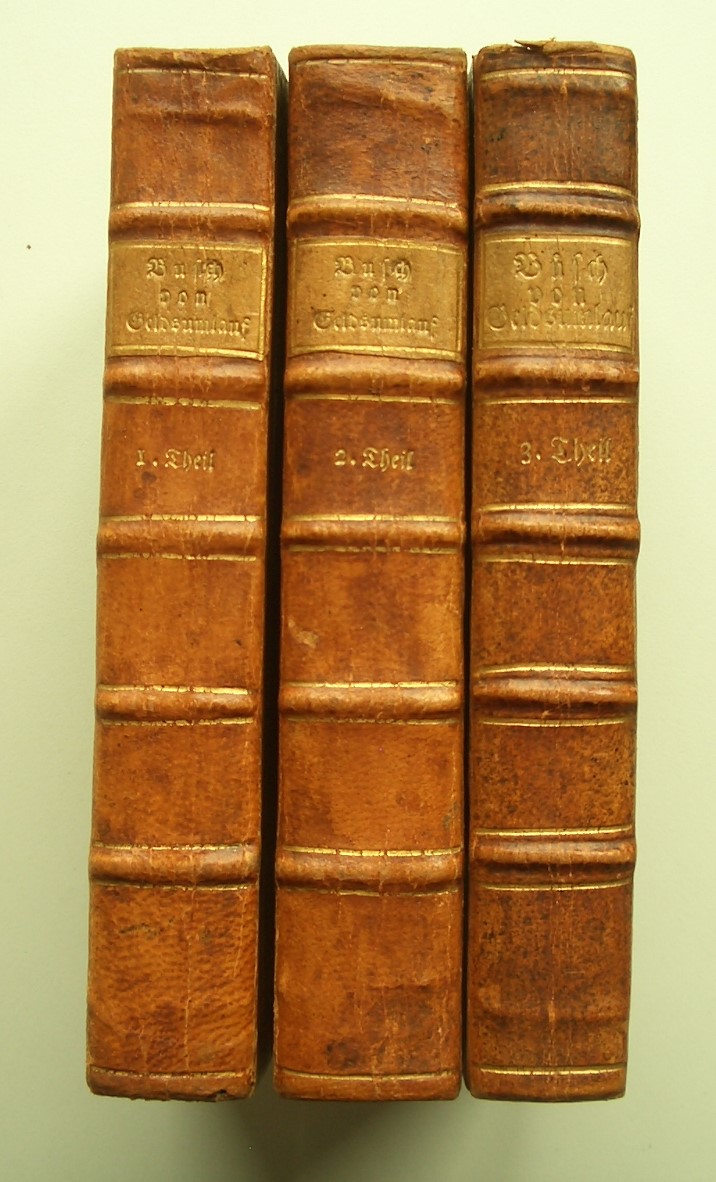
1784ref. 58163 Bände. Hamburg u. Kiel, C. E. Bohn, 1780 u. 1784. 8vo. (20,0 x 11,5 cm). 1: 16 Bl., 511 S., (1 S. Verbesserungen). 2: 2 Bl., 599 S., (1 S. Verbesserungen). 3: 1 Bl., X S., 484 S. Halblederbände d. Zt. mit Sprenkelpapierbezug u. goldgeprägtem Rückenschild.
1798ref. 20354Paris, imprimerie de Ch. Houel, an VI - 1798 ; 23 tomes in-8 (197 mm), veau fauve marbré, dos lisse à faux nerfs décoratifs dorés, pièce de titre marron clair, roulette sur les coupes, tranches rouges (reliure de l'époque) ; T.I : Essai sur l'origine des connaissances humaines, [4], XVI, Avertissement des Editeurs, signé Arnoux Mousnier, XII, 522 pp., [1] f. blanc, portrait ovale de Condillac gravé par A. Clément d'après P. Duval ; T.II : Traité des systèmes, [4], 406, 6 pp. ; T.III : Traité des sensations, [4], 675 pp. ; T.IV : Le commerce et le gouvernement, [4], 359 pp. (i.e. 559 pp.) ; T.V : Cours d'Etudes pour l'instruction du Prince de Parme. (1) La grammaire, [4], CL, 384, 22 pp. ; T.VI : (2) L'Art de penser, [4], 255 pp., [1 bl.], 12 pp. ; T.VII : (3) L'Art d'écrire, [4], 443, [1 bl.], 20 pp. ; T.VIII : (4) L'Art de raisonner, [4], 353, [1 bl.], 21 pp., 9 planches dépliantes ; T.IX ; X ; XI ; XII ; XIII ; XIV (5, 6, 7, 8, 9, 10) : Histoire ancienne, [4], 437, [1 bl.], 18 pp., [4], 526, 28 pp., [4], 517, [1 bl.], 24 pp., [4], 644 pp., [4], 370 pp., [4], 464 pp. ; T.XV ; XVI ; XVII ; XVIII ; XIX ; XX : Histoire Moderne, (11) [4], 604 pp., (12) [4], 410, 24 pp., (13) [4], 439 pp., (14) [4], 495 pp., (15) [4], 544 pp., (16); [4], 541, [1 bl.], 38 pp. ; T.XXI : (17) De l'étude de l'Histoire, [4], 412, 4 pp. ; T.XXII : La logique, ou les premiers développemens de l'art de penser, [4], 231 pp. ; T.XXIII : La langue des calculs, [4], 487 pp.
ref. ORD-19744Paris. Agasse. An 10. - 1802. In-4 (212 x 291 mm) dos lisse basane brune, filets dorés, pièce de titre maroquin rouge, plats marbrés, portrait gravé par Viel d'après Roland en frontispice, VIII pages, 2ff.n.ch. et 67 pages en français et en arabe pour les Traités de Commerce faits par M. Durand, Directeur de la Compagnie du Sénégal avec les Princes maures de la rive droite du Sénégal, 43 planches gravées dont 16 de cartes repliées et 27 planches de vues et d'histoire naturelle. Première édition. Bel exemplaire.
ref. 45282Imprimerie Impériale.1809.In-folio demi-relié.4 Mémoires reliés ensemble. 47 p.de "Mémoire sur le nilomètre de l'ile d'éléphantine et les mesures égyptiennes."/16 p.du "Mémoire sur les mesures agraires des anciens égyptiens."/ 64 p. "Observation sur la Vallée d'Egypte et sur l'exhaussement séculaire du sol qui la recouvre Planche dépliante et Appendice"./ 224 p.du "Mémoire sur l'Agriculture,l'Industrie,et le Commerce de l'Egypte." Ouvrage dédicacé par l'Auteur.Etat correct avec des rousseurs ou des brunissures.demi-cuir vert à coins.Dos à 5 nerfs avec caractères et fleurons dorés.Initiales en queue.Pierre-Aimé Girard ,Ingénieur des Ponts et Chaussées,participa à l'Expédition d'Egypte en 1789.
1906A massive Japanese commercial reference from the early 1900s. Approximately 2,000 pages. Text primarily in Japanese, other than the 18-page bilingual (Japanese/English) index and an intriguing bilingual fold-out sample of various contemporary export documents. Two items laid inside front board include a double-sided bilingual glossary of commonly used trade terms and a wonderful 22" wide by 16" high colour map of the world with trade routes to/from Japan indicated in red. Most text on the map is Japanese with some place names in both English and Japanese. Please note that library name is stamped through the blank upper right corner of the map. Elaborately gilt-decorated backstrip with title in Japanese and English bears considerable wear but is still handsome and, dare we say, mysterious. Per a handwritten inscription inside back board, this copy was presented to representatives of the Seattle Chamber of Commerce in Tokyo on 24 October, 1908 by Mr. Shonojo Moriyama, Proprietor of the Dobun_____. Edges adorned with partially-faded marbling. Usual library markings. Above-average wear. Binding intact. A marvelously unique item. Book
1748ref. PHO-1192Paris , chez les Frères Guerin, 1748.2 volumes in-12 , 6ff-415pp - 386pp , relié plein cuir , dos a nerfs orné avec pièce de titre et tomaison rouge (Tome 2 , reliure pastiche) , tranches différentes .
1788ref. 4941Mit Holzschnitt-Druckermarke auf dem Titel u. großem Kopfstück in Holzschnitt (unten links monogrammiert "L. fec."). De Dato Berlin, den 20sten October 1788. Gedruckt bei J. G. Decker und Sohn, Königlichen Geheimen Oberhofbuchdruckern. Folio (34,0 x 21,7 cm). 285 (recte 273) S. Halblederband d. Zt. mit blauem Bezugspapier (Herrnhuter Papier).
1692ref. 624120Hamburg, Redlich, 1692. Angebunden: DERSELBE. Wolabgefaster und sehr dienlicher Unterricht vom Pfändungs-Recht, worinnen gezeiget wird, wie man mit den Pfändungsverfahren, und zu Vermeidung vieler ... Ungelegenheiten ... sich verhalten solle. Halle u. Celle, Hoffmann, 1693. 4to. Kollation: I. 4 Bl., 706 S., 48 Bl. Register. - II. 4 Bl. (d.l.w., Frontispiz fehlt), 72 S. Pergament d. Zeit (leicht fleckig). [2 Warenabbildungen]