[TRADE]Biblio.com
16.533 resultados
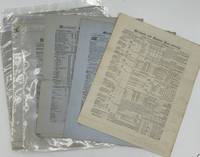
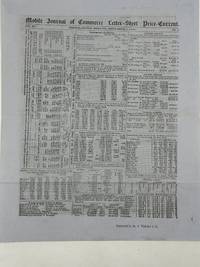
1854ref. 70354Mobile AL: Mobile Journal of Commerce 1854. 4to 29 cm. Bifolio three pages blank verso of integral leaf employed for addressing. An issue devoted to an "Annual Report of the Market" with three columns of text comparative tables for crops important trade ports in country and abroad a table comparing annual activity in Mobile with seven other southern ports or states a 10-year table of activity in Mobile and much more. Forwarded by Jas. G. Whitaker & Co. to a Providence Rhode Island company. Old fold lines else very good. Mobile Journal of Commerce unknown
1854ref. 70354Mobile AL: Mobile Journal of Commerce 1854. 4to 29 cm. Bifolio three pages blank verso of integral leaf employed for addressing. An issue devoted to an "Annual Report of the Market" with three columns of text comparative tables for crops important trade ports in country and abroad a table comparing annual activity in Mobile with seven other southern ports or states a 10-year table of activity in Mobile and much more. Forwarded by Jas. G. Whitaker & Co. to a Providence Rhode Island company. Old fold lines else very good. Mobile Journal of Commerce unknown books
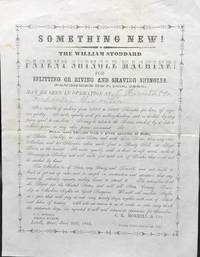
1856ref. 64451Fond du Lac Wis: Herald Print 1856. Broadside. 25.5 x 20 cm. Printed on blue paper text within an ornamental border signed in type at conclusion of text by C.K. Morrill & Co. of Lowell Mass dated June 12th 1855. Old fold lines but no wear. Not in Wisconsin Imprints Inventory and not found on OCLC. There are only a handful of separate Fond du Lac imprints before 1855 the most notable being a History of the County of Fond du Lac 1854. The weekly Fountain City Herald was published from 1852 to 1856. Herald Print unknown
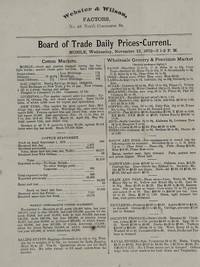
1872ref. 70357Mobile AL: Webster & Wilson Factors 1872. Printed handbill 10 ½ x 8 inches on two columns one dealing with the market in cotton with market statement for Mobile Liverpool and New York the other concerning rthe wholesale grocery and provision market including bacon pork fish whiskey tobacco grain other meats and vegetables hardware naval stores etc. Old fold lines else very good. Webster & Wilson, Factors unknown books
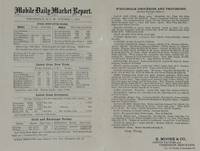
1874ref. 70358Mobile AL: R. Moore & Co 1874. Printed handbill 8 ½ x 11 inches two columns one printing "Official Report Cotton Exchange" a report on gold and exchange and latest reports from New York and Liverpool the other a report on wholesale groceries and provisions meats fish coffee "country produce" naval stores tobacco etc. Old fold lines small snag in central fold Very good. R. Moore & Co unknown books
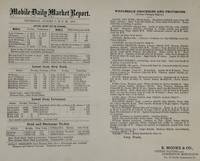
1875ref. 70359Mobile AL: R. Moore & Co 1875. Printed handbill 8 ½ x 11 inches two columns one printing "Official Report Cotton Exchange" for Mobile a report on gold and exchange and latest reports from New York and Liverpool the other a report on wholesale groceries and provisions meats fish coffee "country produce" naval stores tobacco etc. Old fold lines small snag in central fold Very good. R. Moore & Co unknown books
1856ref. 64451Fond du Lac Wis: Herald Print 1856. Broadside. 25.5 x 20 cm. Printed on blue paper text within an ornamental border signed in type at conclusion of text by C.K. Morrill & Co. of Lowell Mass dated June 12th 1855. Old fold lines but no wear. Not in Wisconsin Imprints Inventory and not found on OCLC. There are only a handful of separate Fond du Lac imprints before 1855 the most notable being a History of the County of Fond du Lac 1854. The weekly Fountain City Herald was published from 1852 to 1856. Herald Print unknown books
1904ref. 70360Mobile AL: Sanford & Wilson John Forsyth and others 1904. 4to. 1-4 pages each issue some issues lacking a blank integral leaf. 39 scattered issues from this period published under several variant titles by several different publishers; the largest run in the group consists of 26 issues September 1 1859 -- August 18 1860 of 31 issued during the period under the title Merchants' and Planters' Prices-Current published by John Forsyth. The balance of the group consists of five issues published 1848-1859 and ten issues published 1866-1904. Each issue includes all manner of information concerning trade from the port of Mobile during the past week especially cotton with names of ships coming and going destinations tables of goods comparisons with previous years a weekly review if the Mobile market business news notes etc. The long run from 1859 and 1860 offers an excellent view of the market on the eve of the Civil War. Several issues have letters written on the recto of an otherwise blank integral leaf. Overall a very good lot. For the 39 issues Sanford & Wilson, John Forsyth [and others] unknown
1904ref. 70360Mobile AL: Sanford & Wilson John Forsyth and others 1904. 4to. 1-4 pages each issue some issues lacking a blank integral leaf. 39 scattered issues from this period published under several variant titles by several different publishers; the largest run in the group consists of 26 issues September 1 1859 -- August 18 1860 of 31 issued during the period under the title Merchants' and Planters' Prices-Current published by John Forsyth. The balance of the group consists of five issues published 1848-1859 and ten issues published 1866-1904. Each issue includes all manner of information concerning trade from the port of Mobile during the past week especially cotton with names of ships coming and going destinations tables of goods comparisons with previous years a weekly review if the Mobile market business news notes etc. The long run from 1859 and 1860 offers an excellent view of the market on the eve of the Civil War. Several issues have letters written on the recto of an otherwise blank integral leaf. Overall a very good lot. For the 39 issues Sanford & Wilson, John Forsyth [and others] unknown books
1842ref. 3123New Orleans: January 21 1842. About very good. 3pp. on a folded folio sheet. Old folds. Small loss from wax seal affecting a few words on third page. Light wear and soiling. A wandering "woe is me" missive from Charles Penfield to his business partners back home in Massachusetts detailing his numerous misfortunes on a journey by boat to Mexico and thence to New Orleans. He writes: "To tell you of my misfortunes I think you should rather console with me than to sensure sic me however you can write your friends in Baltimore & let them see me &c. First of my troubles I was fined in Mexico as you have the documents to amount of moste 600 dollars with the expenses. Next misfortune was detained in town 22 days to attend to the board 2 dolls. per day horse hire about 25 or 40 dolls. with expenses on the road vessel being 40 miles before the town. Next I took the yellow fever or Mexican fever & as you must expect my bill was high when I went to town. The deaths was 25 a day population of 6000." He goes on to detail freight costs to New Orleans and the other expenses related to the journey writing: "You had better get these papers translated by some Spanish merchant in Boston & make claim on Mr. Brown." He also notes in a post script that the price of freighting cotton to Liverpool is a half penny per pound. A detailed account of the trials and tribulations of uncertain business ventures in antebellum America. January 21 unknown
1842ref. 3123New Orleans: January 21 1842. About very good. 3pp. on a folded folio sheet. Old folds. Small loss from wax seal affecting a few words on third page. Light wear and soiling. A wandering "woe is me" missive from Charles Penfield to his business partners back home in Massachusetts detailing his numerous misfortunes on a journey by boat to Mexico and thence to New Orleans. He writes: "To tell you of my misfortunes I think you should rather console with me than to sensure sic me however you can write your friends in Baltimore & let them see me &c. First of my troubles I was fined in Mexico as you have the documents to amount of moste 600 dollars with the expenses. Next misfortune was detained in town 22 days to attend to the board 2 dolls. per day horse hire about 25 or 40 dolls. with expenses on the road vessel being 40 miles before the town. Next I took the yellow fever or Mexican fever & as you must expect my bill was high when I went to town. The deaths was 25 a day population of 6000." He goes on to detail freight costs to New Orleans and the other expenses related to the journey writing: "You had better get these papers translated by some Spanish merchant in Boston & make claim on Mr. Brown." He also notes in a post script that the price of freighting cotton to Liverpool is a half penny per pound. A detailed account of the trials and tribulations of uncertain business ventures in antebellum America. January 21 unknown books
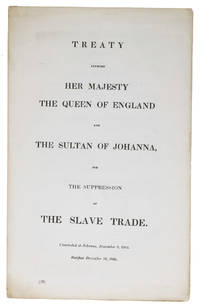
1845ref. ABC_48495Johanna Anjouan 1845. Ca. 32.5 x 20.5 cm. Original paper wrappers. 5 1 blank pp. Historically important treaty between Queen Victoria of the United Kingdom of Great Britain and Ireland 1819-1901 and Sultan Selim dates unknown of Johanna present-day Anjouan for the suppression of the slave trade. The treaty was concluded in November 1844. The present work is the ratified version from 10 December 1845 signed by Sultan Selim and Christopher Wyvill 1792-1863 captain of the HMS Cleopatra and formation commander of the British Royal Navy in Africa between 1849-1853. The publication is exceptionally rare. We have not been able to find any printed copies anywhere else either in sales records or libraries. The archives of the UK parliament make mention of the treaty but it appears to be otherwise unknown.In the present work the Sultan of Anjouan states that: "There shall be no dealing in slaves in our territory and no slaves shall be imported to be sold in our country". He further allows the British to inspect Anjouan ships and take them to an English port if they are found engaging in slave trade. The present treaty which is of significant historical importance is an excellent example of the measures that were undertaken across the world to stop the slave trade.The leaves are slightly creased and browned around the edges. Otherwise in good condition. unknown
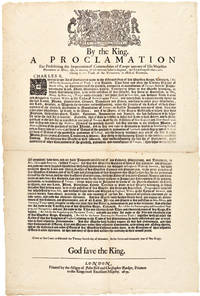
1675ref. 45901London: Printed by the Assigns of John Bill and Christopher Barker 1675. Enforcing the Triangular Trade: The Basis for the British Colonial System A rare broadside reiterating and reinforcing the decree of the English government that all foreign goods destined for British colonies must first pass through England a policy of mercantilism later termed the "triangle trade." "This program permitted the profits from colonial trade and commerce to center in England promoted British shipping and enabled the British government to support itself by taxing this trade as it flowed through England" - DAH. The English government began its mercantilist policies under the Commonwealth government in a series of "navigation acts" which regulated English trade. The first Navigation Act passed in 1651 targeted Dutch commerce. It stipulated that only English ships could carry freight into English territories and that if a ship was not English it could only carry goods from the country from whence it hailed i.e. Dutch ships could only import Dutch goods etc. Acts passed in 1660 and 1663 under the Restoration government of Charles II isolated trade even further mandating that British colonial goods only be imported to England and forbidding English trade on anything other than English vessels. This policy of trade which was continued for the next two hundred years marked the ascent of British colonial mercantilism and planted the seeds of discontent which resulted in the American Revolution one hundred years later. The present proclamation is an enforcement of the Navigation Act of 1663 An Act for the Encouragement of Trade under which "no commodities of the growth production or manufacture of Europe shall be imported into any land island plantation colony territory or place to his Majesty belonging." In other words all European trade to the American and East Indian colonies of the English had to pass through English ports en route. As the law is being disobeyed to the detriment of trade and tax revenue the proclamation extends power for enforcement to the officials of the realm. It states: ".whereas his Majesty is well informed that notwithstanding the said Act of Parliament great quantities of other commodities.have been and are daily imported into several of his colonies plantations and territories in Asia Africa and America.and that his Majesties subjects of some of his colonies and plantations have not onely sic supplied themselves with such commodities not shipped in England.but have conveyed them by land and water to other of his Majesties colonies and plantations to the great prejudice of his Majesties customs and of the trade and navigation of this kingdom." An important proclamation which illustrates the difficulty in maintaining and enforcing the laws central to the first British Empire. Old fold lines. Repaired with tissue on verso along vertical fold. A few other small tears or tissue repairs. Very good. ESTC R25339. WING C3378. GOLDSMITHS' 2112. STEELE I:3619. KRESS S1421. DAH III p.374. unknown
1675ref. 45901London: Printed by the Assigns of John Bill and Christopher Barker 1675. Enforcing the Triangular Trade: The Basis for the British Colonial System A rare broadside reiterating and reinforcing the decree of the English government that all foreign goods destined for British colonies must first pass through England a policy of mercantilism later termed the "triangle trade." "This program permitted the profits from colonial trade and commerce to center in England promoted British shipping and enabled the British government to support itself by taxing this trade as it flowed through England" - DAH. The English government began its mercantilist policies under the Commonwealth government in a series of "navigation acts" which regulated English trade. The first Navigation Act passed in 1651 targeted Dutch commerce. It stipulated that only English ships could carry freight into English territories and that if a ship was not English it could only carry goods from the country from whence it hailed i.e. Dutch ships could only import Dutch goods etc. Acts passed in 1660 and 1663 under the Restoration government of Charles II isolated trade even further mandating that British colonial goods only be imported to England and forbidding English trade on anything other than English vessels. This policy of trade which was continued for the next two hundred years marked the ascent of British colonial mercantilism and planted the seeds of discontent which resulted in the American Revolution one hundred years later. The present proclamation is an enforcement of the Navigation Act of 1663 An Act for the Encouragement of Trade under which "no commodities of the growth production or manufacture of Europe shall be imported into any land island plantation colony territory or place to his Majesty belonging." In other words all European trade to the American and East Indian colonies of the English had to pass through English ports en route. As the law is being disobeyed to the detriment of trade and tax revenue the proclamation extends power for enforcement to the officials of the realm. It states: ".whereas his Majesty is well informed that notwithstanding the said Act of Parliament great quantities of other commodities.have been and are daily imported into several of his colonies plantations and territories in Asia Africa and America.and that his Majesties subjects of some of his colonies and plantations have not onely sic supplied themselves with such commodities not shipped in England.but have conveyed them by land and water to other of his Majesties colonies and plantations to the great prejudice of his Majesties customs and of the trade and navigation of this kingdom." An important proclamation which illustrates the difficulty in maintaining and enforcing the laws central to the first British Empire. Old fold lines. Repaired with tissue on verso along vertical fold. A few other small tears or tissue repairs. Very good. ESTC R25339. WING C3378. GOLDSMITHS' 2112. STEELE I:3619. KRESS S1421. DAH III p.374. unknown books
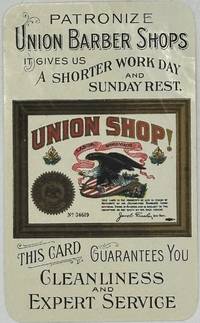
1917ref. 70201Newark NJ: Whitbread & Hoag Co. 1917. Trade card 3 ¾ x 2 ¼ inches verso printing a calendar for 1918 framed by "Patronize Union Barber Shops / Journey men Barbers International Union of America." Color plasticized card. Very good. Whitbread & Hoag Co..) unknown books
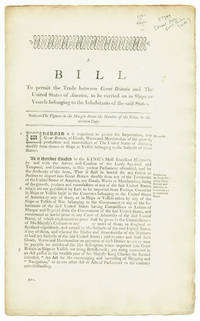
1809ref. 47399London. 1809. A Failed Opportunity to Normalize U.S.-British Trade Relations Rare printing of a British Parliamentary "slip bill" seeking to reestablish trade between Great Britain and the United States a few years before the outbreak of the War of 1812 and in the midst of great tension between the two nations. This bill was considered by Parliament in the spring of 1809 in the wake of President Jefferson's rescinding the Embargo Act and following the negotiations between U.S. Secretary of State Robert Smith and British envoy David Erskine which created a glimmer of hope that Anglo-American relations might be repaired after a period of great stress and turmoil. In March 1809 Jefferson signed the Non-Intercourse Act which rescinded the Embargo of 1807 and held out the promise of resuming trade with England and France if either of those nations ended its commercial restrictions toward the United States. The Erskine-Smith negotiations of April held out the promise of improved relations and in May the Parliament considered the present bill which permitted trade between Great Britain and the United States to be carried on in American ships. Unfortunately Prime Minister Canning disavowed the Erskine-Smith Agreement in late May and Anglo-American relations continued to deteriorate culminating in outright warfare in 1812. Slip bills are printed during the legislative process in small numbers for the use of legislators and staff. They are ephemeral items and their survival is rare. A printed note before the text of the bill reads "the figures in the margin denote the Number of the Folios in the written copy" which indicates just how early in the legislative process these bills were printed. OCLC locates only a single copy at the University of Massachusetts. Folio. Lightly tanned around the edges. Near fine. OCLC 49887290. unknown
1801ref. 56123Great Britain. ca. 1801-1807. British Essay on the Importance of American Trade During the Napoleonic Wars An interesting but unattributed and apparently unpublished manuscript essay with a caption title reading: "Loose Memo. Respectg. American Commerce." The gist of the memo is set forth in the first sentence: "The Americans are at all times the best customers of G.B. - in peace they take 1/3 of her manufactured exports - in War much more." In addition to the eager American market for British goods the author notes that British goods are often trans-shipped via America to other markets where Great Britain would not normally have access thanks to America's neutral status: ".you have only to change the name of the manufacturer & the wants of the Colonists will shut their eyes on the origin of the fabric. I have known Liverpool ware ornamented with the Portrait of Geo. III passed as German manufactures." The author notes that while the understandable economic downturn during the Revolution and for several years after the "peace of '83" resulted in some problematic credit relations between the U.S. and the British market much has changed. "The industry & the enterprise of our countrymen aided no doubt by the enjoyment of a neutral position has enabled them to throw off their dependence on the British merchant or manufacturer. They now have a sufficient capital of their own and a very important proportion of their imports are now paid for in ready money or in bills at short sight." The author explains that American merchants are able to export their surpluses of their own production and surplus British goods to the Continental market and transfer that money directly to creditors in Great Britain with an added perk: "The result of this species of trade must be ruinous to France. She is drained of her wealth to enrich & invigorate her enemy." Finally the author provides a specific example of this favored trading relationship with regard cotton. At this time the author estimates that Great Britain imports three-fifths of all cotton from the United States - some 150000 bags of cotton annually weighing 250lbs. each. The U.S. buys back nearly one-third of all cotton goods manufactured in Great Britain yielding a net profit of over £2.5 million to Great Britain. The author adds that this ratio holds for almost all raw materials produced in the United States. This essay was almost certainly written during the earlier part of the Napoleonic Wars; the author cites an 1801 speech by Lord Grenville which helps narrow the date range and it seems unlikely the Embargo Act of 1807 had been passed yet. Regardless the essay promotes Anglo-American trade and cooperation at least insofar as it enriches Britain and cripples France at a time when other forces were driving the two countries toward war. Light tanning and soiling occasional ink smudges. Very good. unknown
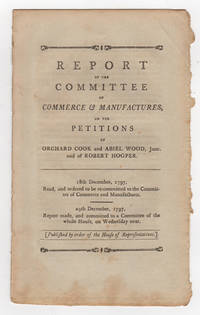
1797ref. 43741Philadelphia: Printed by William Ross 1797. First edition. Removed. Very good mostly unopened uncut untrimmed copy minor browning at lower edge. 3 226-232 2 pp. 8vo. Evans dated it both 1797 and 1798. two petitions both concerning a waving of taxes on spirits the Orchard Cook and Abiel Wood case claiming the ship was wrecked on an island and the cost of recovering the cargo exceeded the cost of the mechandise and that their insurance had lapsed. In the second case Hooper claimed he was lax in filing papers for re-shipping a cargo overseas. Wisely both were declined as the committee felt the government is not in the business of insuring that a business is successful and well run. Ah to return to those days. Orchard Cook 1763-1819 and Abiel Wood 1772-1834 had a better idea. They both became U.S. Representatives from Massachusetts. OCLC locates eight copies. Evans 33015. Evans 34753. ESTCW15017. [Printed by William Ross] unknown
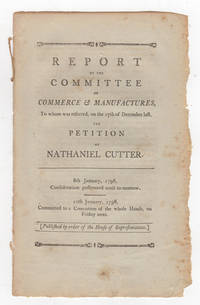
1798ref. 43744Philadelphia 1798. First edition. Removed. A very good copy lightly soiled and edge worn. 4 pp. 8vo. Nathaniel Cutter wanted relief from being re-taxed on goods that left Massachusetts where he had paid tax and then returned to the same port with the same goods because he was harrassed by the British and French and turned away in the Dominican Republic. The committee wisely wrote: "Your Committee however cannot find any good reason for relieving him against consequences of a risque which every exporter ought to calculate for himself." Cutter would continue to take risks suppling the French in Saint-Domingue and a claim was allowed him in 1803 by the American Commission in Paris for unpaid costs by the French See Greg H. Williams: The French Assault on American Shipping 1793-1813: A History p. 154. Evans 34754. ESTCW25464. unknown
1809ref. 47399London. 1809. A Failed Opportunity to Normalize U.S.-British Trade Relations Rare printing of a British Parliamentary "slip bill" seeking to reestablish trade between Great Britain and the United States a few years before the outbreak of the War of 1812 and in the midst of great tension between the two nations. This bill was considered by Parliament in the spring of 1809 in the wake of President Jefferson's rescinding the Embargo Act and following the negotiations between U.S. Secretary of State Robert Smith and British envoy David Erskine which created a glimmer of hope that Anglo-American relations might be repaired after a period of great stress and turmoil. In March 1809 Jefferson signed the Non-Intercourse Act which rescinded the Embargo of 1807 and held out the promise of resuming trade with England and France if either of those nations ended its commercial restrictions toward the United States. The Erskine-Smith negotiations of April held out the promise of improved relations and in May the Parliament considered the present bill which permitted trade between Great Britain and the United States to be carried on in American ships. Unfortunately Prime Minister Canning disavowed the Erskine-Smith Agreement in late May and Anglo-American relations continued to deteriorate culminating in outright warfare in 1812. Slip bills are printed during the legislative process in small numbers for the use of legislators and staff. They are ephemeral items and their survival is rare. A printed note before the text of the bill reads "the figures in the margin denote the Number of the Folios in the written copy" which indicates just how early in the legislative process these bills were printed. OCLC locates only a single copy at the University of Massachusetts. Folio. Lightly tanned around the edges. Near fine. OCLC 49887290. unknown books
1797ref. 43741Philadelphia: Printed by William Ross 1797. First edition. Removed. Very good mostly unopened uncut untrimmed copy minor browning at lower edge. 3 226-232 2 pp. 8vo. Evans dated it both 1797 and 1798. two petitions both concerning a waving of taxes on spirits the Orchard Cook and Abiel Wood case claiming the ship was wrecked on an island and the cost of recovering the cargo exceeded the cost of the mechandise and that their insurance had lapsed. In the second case Hooper claimed he was lax in filing papers for re-shipping a cargo overseas. Wisely both were declined as the committee felt the government is not in the business of insuring that a business is successful and well run. Ah to return to those days. Orchard Cook 1763-1819 and Abiel Wood 1772-1834 had a better idea. They both became U.S. Representatives from Massachusetts. OCLC locates eight copies. Evans 33015. Evans 34753. ESTCW15017. [Printed by William Ross] unknown books
1798ref. 43744Philadelphia 1798. First edition. Removed. A very good copy lightly soiled and edge worn. 4 pp. 8vo. Nathaniel Cutter wanted relief from being re-taxed on goods that left Massachusetts where he had paid tax and then returned to the same port with the same goods because he was harrassed by the British and French and turned away in the Dominican Republic. The committee wisely wrote: "Your Committee however cannot find any good reason for relieving him against consequences of a risque which every exporter ought to calculate for himself." Cutter would continue to take risks suppling the French in Saint-Domingue and a claim was allowed him in 1803 by the American Commission in Paris for unpaid costs by the French See Greg H. Williams: The French Assault on American Shipping 1793-1813: A History p. 154. Evans 34754. ESTCW25464. unknown books
1801ref. 56123Great Britain. ca. 1801-1807. British Essay on the Importance of American Trade During the Napoleonic Wars An interesting but unattributed and apparently unpublished manuscript essay with a caption title reading: "Loose Memo. Respectg. American Commerce." The gist of the memo is set forth in the first sentence: "The Americans are at all times the best customers of G.B. - in peace they take 1/3 of her manufactured exports - in War much more." In addition to the eager American market for British goods the author notes that British goods are often trans-shipped via America to other markets where Great Britain would not normally have access thanks to America's neutral status: ".you have only to change the name of the manufacturer & the wants of the Colonists will shut their eyes on the origin of the fabric. I have known Liverpool ware ornamented with the Portrait of Geo. III passed as German manufactures." The author notes that while the understandable economic downturn during the Revolution and for several years after the "peace of '83" resulted in some problematic credit relations between the U.S. and the British market much has changed. "The industry & the enterprise of our countrymen aided no doubt by the enjoyment of a neutral position has enabled them to throw off their dependence on the British merchant or manufacturer. They now have a sufficient capital of their own and a very important proportion of their imports are now paid for in ready money or in bills at short sight." The author explains that American merchants are able to export their surpluses of their own production and surplus British goods to the Continental market and transfer that money directly to creditors in Great Britain with an added perk: "The result of this species of trade must be ruinous to France. She is drained of her wealth to enrich & invigorate her enemy." Finally the author provides a specific example of this favored trading relationship with regard cotton. At this time the author estimates that Great Britain imports three-fifths of all cotton from the United States - some 150000 bags of cotton annually weighing 250lbs. each. The U.S. buys back nearly one-third of all cotton goods manufactured in Great Britain yielding a net profit of over £2.5 million to Great Britain. The author adds that this ratio holds for almost all raw materials produced in the United States. This essay was almost certainly written during the earlier part of the Napoleonic Wars; the author cites an 1801 speech by Lord Grenville which helps narrow the date range and it seems unlikely the Embargo Act of 1807 had been passed yet. Regardless the essay promotes Anglo-American trade and cooperation at least insofar as it enriches Britain and cripples France at a time when other forces were driving the two countries toward war. Light tanning and soiling occasional ink smudges. Very good. unknown books
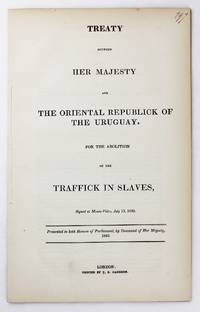
1842ref. 6316London: T.R. Harrison 1842. Near fine. 38pp. stitched. Very minor bumps to top edge of first leaf light dust-soiling to outer leaves. A very rare treaty between Queen Victoria’s Britain and the “Oriental Republick of the Uruguay” printed in both English and Spanish in two parallel columns throughout. According to the text the parties were “mutually animated by a sincere desire to co-operate for the utter extinction of the barbarous Traffick in Slaves.for the special purpose of immediately attaining this object so far as relates to the total and final abolition of the Slave Trade of the Oriental Republick of the Uruguay.” The treaty is comprised of fourteen original articles plus three annexes totaling forty-six additional articles and four additional articles at the end covering a host of issues pertaining to the suppression of the slave trade. These issues included enforcement procedures the establishment of “Mixed Courts of Justice” “Regulations in respect to treatments of liberated negroes” and much more. With regard to slaves found on international vessels the two nations hoped for “permanent good treatment and a full and complete emancipation according to the humane intentions of the Parties of the Treaty.” The present treaty was part of a larger effort by the British Crown to put an end to the transatlantic slave trade in the first half of the 19th century; at this same time Britain had reached terms on a similar treaty with the Republic of Texas and other nations. The document is signed at the end in type by J.H. Mandeville and Jose Ellauri representatives of the two countries who originally signed the treaty at Montevideo on July 13 1839; the present work was “Presented to both Houses of Parliament by Command of Her Majesty” in 1842 likely due to bureaucratic delays. Uruguay would have been an important ally for Great Britain in monitoring the seas against the transatlantic slave trade given its position opposite the South Atlantic Ocean from West Africa. OCLC records just a single physical copy of this treaty at the University of Arizona. Cundall 2854. T.R. Harrison unknown
1842ref. 6316London: T.R. Harrison 1842. Near fine. 38pp. stitched. Very minor bumps to top edge of first leaf light dust-soiling to outer leaves. A very rare treaty between Queen Victoria’s Britain and the “Oriental Republick of the Uruguay” printed in both English and Spanish in two parallel columns throughout. According to the text the parties were “mutually animated by a sincere desire to co-operate for the utter extinction of the barbarous Traffick in Slaves.for the special purpose of immediately attaining this object so far as relates to the total and final abolition of the Slave Trade of the Oriental Republick of the Uruguay.” The treaty is comprised of fourteen original articles plus three annexes totaling forty-six additional articles and four additional articles at the end covering a host of issues pertaining to the suppression of the slave trade. These issues included enforcement procedures the establishment of “Mixed Courts of Justice” “Regulations in respect to treatments of liberated negroes” and much more. With regard to slaves found on international vessels the two nations hoped for “permanent good treatment and a full and complete emancipation according to the humane intentions of the Parties of the Treaty.” The present treaty was part of a larger effort by the British Crown to put an end to the transatlantic slave trade in the first half of the 19th century; at this same time Britain had reached terms on a similar treaty with the Republic of Texas and other nations. The document is signed at the end in type by J.H. Mandeville and Jose Ellauri representatives of the two countries who originally signed the treaty at Montevideo on July 13 1839; the present work was “Presented to both Houses of Parliament by Command of Her Majesty” in 1842 likely due to bureaucratic delays. Uruguay would have been an important ally for Great Britain in monitoring the seas against the transatlantic slave trade given its position opposite the South Atlantic Ocean from West Africa. OCLC records just a single physical copy of this treaty at the University of Arizona. Cundall 2854. T.R. Harrison unknown books