8733 resultados
ref. 0366652842.Gpaperback. Good. Access codes and supplements are not guaranteed with used items. May be an ex-library book. paperback
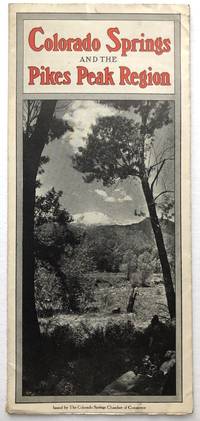
ref. 40043COLORADO SPRINGS-MANITOU CHAMBER OF COMMERCE. COME TO COLORADO SPRINGS - MANITOU: THE PIKES PEAK REGION. Colorado Springs: The Chamber 1920s. Square 8vo. Colored illustrated wrappers. 22 pages. Scarce travel promotion for Colorado Springs and region in the 1920s. A richly illustrated many in color booklet of the sites natural wonders as well as tourist resort activities available to the automobile traveler. unknown
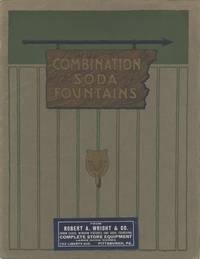
1925ref. 6884Decatur Ill.; Fort Wayne Ind: the company; The General Printing Corp 1925. Folio x cm. 24 pages. Illustrated throughout and with a color illustrated title page. Printed throughout in green and black ink. An attractively printed trade catalogue for the Combination Soda Fountain Company founded in 1898 with the introduction of the “Iceless” soda water machine. The company further expanded in 1919 with the purchase of the Wise Soda Apparatus Company of Ohio. The catalogue depicts and provides information for various scale soda water set-ups both counter and wall type as well as a few pages of smaller equipment and accessories. A bit or edgewear to the decorated stiff wrappers printed in black green brown and gold otherwise fine. With the ownership label of the Robert A. Wright & Co. “Complete Store Equipment” of Pittsburgh. No publications of the company are located by OCLC. the company; The General Printing Corp unknown
1929ref. 7485Hartford: Colt's Patent Fire Arms Manufacturing Co 1929. First Thus. Stiff Printed Wrappers. Very Good. 4to. Pp. 36 2 laid in leaves. Black & white illustrations. Stiff gray paper wraps saddle stapled titles embossed and printed in blue blind embossed border and Rampant Colt. Laid in Retail Price List "PL 11" of January 1930. Laid in announcement of "Two New .22 Caliber Colt Revolvers." Covers minimally stained leaves crisp and bright. A brief history begins "Ninety-three Years of Colt Fire Arms Manufacture" dated from the first revolvers made at Paterson New Jersey in 1836. The new .22 caliber products announced are the Official Police Revolver and Officers' Model Target Revolver. Front cover emblazoned with the company motto" "The Arm of Law and Order". A handsome fresh copy now preserved in a clear archival sleeve with an acid-free backing. Colt's Patent Fire Arms Manufacturing Co unknown
1914ref. H6793Colorado Springs: The Prompt Printery 1914. Very Good. 9 inches tall folded 23.5 x 18 inches unfolded with a birds eye map of the region other pictures plus text and photos on the other side. The Prompt Printery unknown
1917ref. SB9433Colorado Springs CO: The Colorado Springs Chamber of Commerce 1917. Ex-library copy one stamp and penciled markings on top inner corner of page 3 no other markings stamps or labels throughout. Small tear near top inner corner on title page otherwise extremely clean and tight. Small tear on front top edge near the corner on head of spine bottom front corner is chipped other corners are folded small library stamp on front bottom corner edges are slightly folded. 87pp. . Second Edition. Stapled Wraps. Very Good. Illus. by Photographs. 8vo - over 7¾" - 9¾" tall. Ex-Library Paperback. The Colorado Springs Chamber of Commerce Paperback
1927ref. 73445Detroit: General Motors 1927. First edition. Folio. 30 2 pp. Color illustrations throughout. Publisher's pictorial color wrappers. Light edge wear but a very good copy.This catalog announces in a very colorful manner the new colors available for Cadillacs. Each two page spread has the name of the color e.g. Bird of Paradise along with an animal or scene representative of that color and its application of the body and interior of a 1927 Cadillac. General Motors unknown
ref. 6084601like new. unknown
ref. 1313641294.Gpaperback. Good. Access codes and supplements are not guaranteed with used items. May be an ex-library book. paperback
ref. 3512534like new. unknown
2006ref. DADAX1425564291University of Michigan Library 2006-09-13. paperback. New. 6.14x1.21x9.21. Buy with confidence. Excellent Customer Service & Return policy. University of Michigan Library paperback
ref. 1418128295.Ghardcover. Good. Access codes and supplements are not guaranteed with used items. May be an ex-library book. hardcover
ref. 1425564291.Gpaperback. Good. Access codes and supplements are not guaranteed with used items. May be an ex-library book. paperback
ref. B9781425564292Paperback / softback. New. paperback
ref. B9781418128296Hardback. New. hardcover
2006ref. SONG1425564291University of Michigan Library 2006-09-13. paperback. Used: Good. 6.14x1.21x9.21. Buy with confidence. Excellent Customer Service & Return policy. University of Michigan Library paperback
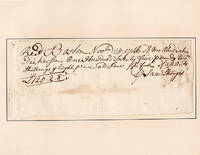
1746ref. 101446Boston November 15 1746. 1746. Very good. - A 3-1/8 inch high by 7-5/8 inch wide autograph document penned on laid paper as a receipt for payment received "Recd Boston Novbr 15 1746 of Mr. Obadiah Dickerson One Hundred Twenty five pounds two Shillings & Eight pence old Tenor. In full of All Amts." Signed "Saml. Sturgis". The receipt is further annotated on the verso. Once folded with some minor staining & darkening the document in inlaid into 7-1/2 inch high by 10-3/4 inch wide heavier cream stock with a black ink ruled frame such that the verso is visible. Near fine. The prominent Boston trader Samuel Sturgis was heavily involved in shipping & commerce. Later on May 31 1762 he and Samuel Crocker signed a contract with Thomas Hancock for chartering the ship Lucretia for transport to Nova Scotia and Cape Breton. Boston, November 15, 1746.
1909ref. List3421Ohio Illinois Michigan and Ontario 1909. Seventy-four letters in thirty-seven envelopes mainly dating between 1885 and 1895. With two undated and one empty envelope. Conditions vary with a few letters having damage intersecting with significant amounts of text and others Near Fine. Overall excellent. A collection of letters mainly sent between Captain William Faragher 1842–1921 and his second wife Harriet Chamberlin 1853–1920 with several from Faragher’s children from his first marriage Burton 1872–1961 and Maude 1875–1952. Most letters are from Chamberlin to Faragher with fourteen from Faragher to Chamberlin. Faragher owned and captained several merchant ships in Lake Erie and Lake St. Clair—presumably sailboats as he frequently complains of having been stuck without wind. He also describes more severe weather out on the lake writing from St. Clair Michigan: “I am anxious to get down from here but as the day advanced the wind began to frisken and it began to snow hard and as it was freezing hard it had rained then snowed and then froze hard saturday night so the poor Venture was in a sad plight but she was in a worse one when we got to where we lay run as it breezed up fresh and the wind dead ahead the water was flying over her in all directions and froze wherever it fell and besides it had turned into a blinding snow storm but we had a certain point to make . she seemed as anxious to get to a place of safety as I did and as the boys say she got there and none too soon as it has been blowing a gale ever since and snowing and freezing but we are in the lee and at a good dock and are comfortable but oh the wind is whistling through the rigging .” November 20 1887 In the 1880s steamships were increasing in popularity on the Great Lakes primarily because of sailboats’ susceptibility to both calm and weather; steamboats were bulky for their capacity and slow but more reliable whereas sailboats could carry overall more cargo.1 Generally steamers took packaged goods and passengers and sailboats mainly schooners took bulk cargo. The Great Lakes were the site of much shipping innovation; Faragher’s fleet was not yet behind the times but steam would overtake sail in the 1880s and 90s. Faragher’s cargo was mainly produce—apples and grapes—though he does mention picking up salt and other materials. His letters indicate that his business involved both shipping and mercantile aspects: he chose and bought the products shipped them to their destination and then also had to find and sell to customers. The grapes in particular seem to cause a lot of trouble: “We left Lorain Sunday morning early and had a nice trip to the Island got there at 4 PM bustled around monday morning and bought 400 baskets of grapes and had them all aboard by dark . it commenced to snow just as we got to Marine City bad bad omen for grapes but imagine my chagrin when I went up town and not a store or commission house wanted a grape folks were full of grapes and there was no sale for them and they said that I had got left and if the truth were known they were glad of it but its a cold day when I get left if trying will lit me out but one thing certain the weather and the lateness of the season were against me but you know I never cross a bridge before I get to it well we hauled up to our old Island Saturday morning and I sold out to my old friend . we had sold since 11 am 190 baskets of grapes . only half our cargo and at a good margin too. People would ask are you the man that was arrested here for selling grapes when told yes they seldom failed to buy but the strangest part was the number of ladies that came to buy”. October 28 1887 Though he does not narrate the incident in which he was arrested for grape peddling—nor does it appear to have made the paper—he later mentions yet another grape-related debacle this time at Port Huron: “Sander and I went to town to sell the grapes today . when down came a city official and wanted to know if I had a license to sell . well I couldent sell another grape without paying 5.00 a day license that was a stormer you see the whole sale men were going to drive me out of the market . but they were not as sharp as they thought they were I went and gave a bill of sale of my whole cargo to a citizen here and he appointed one of his agents to sell the grapes” September 20 1888 Faragher’s letters here do not discuss the financial state of his business but given Chamberlin’s statements it cannot have been all too positive. Chamberlin’s letters depict a woman struggling with her financial circumstances and with how the era’s expectations of her gender intersected with them. In one illustrative letter she writes: “A man drove by here Sat. asking for you. Ms. Lawler has given him her note to collect. He says the interest brings it to nearly fifty dollars. I told him I thought you could not meet it just at present but he said he must have the money and would give you just one week and if it was not paid then he would let the law settle it. Marvin and Laird are his lawyers. Mr. Laird is the one who helped get my money from father’s estate. I would not have them connected in this way about you for – O a great deal!! I have thought and planned till it seems as though my brain would burst. I have inquired about that law regarding taking any more married women as teachers. If Mr. Day would work for me it might perhaps be broken. There will be a vacancy in the Detroit building this fall. Will if I possibly can I want to commence teaching in Sept. The children would have to learn to do more about the house and with both of us earning it seems as though some of these harassing debts must be settled after a time. The frequent calls of men with bills against you have taken away all my pride and I believe I am humble enough to do most anything now.” July 11 1887 In 1887 Ohio passed the Married Women’s Property Act which allowed married women to keep their own property separate from their husbands’—in fact Chamberlin occasionally mentions “her” money in her correspondence. At the same time the state’s Board of Education was debating passing an act that would not only ban school districts from hiring married women as teachers but also fire all the married women it then employed. Newspaper reporting at the time indicates that this measure was not particularly popular not the least because married women tended to be older and more experienced with the job. Chamberlin clearly perceives her role as a wife in a rather more progressive way at one point writing to Faragher that “a true wife” is “not a doll-baby to be kept in finery” N.d. after he had taken out a loan to send her money for a new hat. Throughout their correspondence Chamberlin is perhaps surprisingly open with Faragher about her opinions particularly on his work and their financial affairs; for instance: “I should like to examine your pocket-book after that $25 tax money left it. What are you going to live on up there while you are hunting for freight Sawdust won’t put any fat on your bones. Sailing up and down past Saginaw bay won’t prolong your life or lessen your grey hairs. What are you sailing for anyway For the sake of wearing yourself out and giving employment to two or three men and keeping the Root from rusting out I guess I am naughty!” May 25 1894 She also frequently provides her opinion on whether and at what rate Faragher should sell his two other ships besides the Root the Venture and the Sassacus. She continues in the same letter: “I know I almost had a regular fight yesterday morning right there on the lounge. I wanted to do my housework and I couldn’t. I wanted to sew and I couldn’t sit up long for that. I wanted to help you and I couldn’t. I wanted to earn money and whereas I used to earn fifty-five cents for every hour I worked now I can not earn anything. Then if I could not do for self and family I wanted to make church and S.S. calls but I couldn’t walk for that.” Of course she was at that time prevented from these activities by her health not by gendered standards but she clearly had financial ambitions for herself. After her time as a regular school teacher Chamberlin taught at a Sunday school where she earned a few cents per student and in one letter reported having eighty-one students in a single session. Chamberlin also struggles with the expectations of her as step-mother to Faragher’s two children from his first marriage to Emma Humphrey 1848–1880. She writes: “I get so discouraged sometimes and it seems as though I am in the wrong place as mother. I think of Emma as my sister. I want to do as she would have me. I look upon my work as sacred. And yet sometimes I feel as though life was not worth living.” November 5 1886 She frequently describes conflict with Burt who was then in his late teens to early twenties writing that she could not “have quite the very own mother-love for him” though she is “sure that Emma was not more conscientious in her desires to do right by him than I am” May 20 1891. As it still is today the role of step-mother was a difficult and frequently demonized one with the trauma of losing a mother and wife often in conflict with the feminine duty of maintaining perfect domestic harmony. In general Chamberlin seems to have been somewhat out of step with the feminine ideal of the time even telling Faragher in a letter describing the death of an acquaintance’s baby how glad she was to not have any children of her own. Overall a look at the private lives and difficulties of a middle-class Ohio household as despite the relative prestige of its head being a captain-owner it struggled with debt. Of interest to both historians of Great Lakes trade and those of women’s roles in the late nineteenth century. 1 Dina M. Bazzill “The Missing Link Between Sail and Steam: Steambarges and the Joys of Door County Wisconsin” East Carolina University Program in Maritime Studies Research Report no. 19 2007. unknown
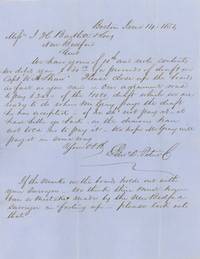
1855ref. List3333Massachusetts New York Maine Pennsylvania and others 1855. Fifty letters with four empty envelopes or covers. Forty-four letters addressed to I.H. Bartlett & Sons: two from the 1830s eight from the 1840s and thirty-four from the 1850s. With five letters addressed to Capt. John C. Blanchard 1838 1839 1844 and 1849 and one to Cumston & Hatch N.d. Overall excellent to Near Fine. Ivory Hovey Bartlett 1794–1871 was a merchant and whale oil seller based in New Bedford Massachusetts. Bartlett moved to New Bedford from Plymouth in 1819 first dealing in grain and later transitioning to general merchandise and whaling.1 Whale oil and spermaceti were widely used in lamps and as lubricant and whalebone baleen was used for structure in items like umbrellas and corsets. In the nineteenth century whaling was the basis of New Bedford’s economy—supporting shipbuilding refineries toolworks and more—making it the wealthiest city in North America at the peak of the industry in the midcentury. Whaling declined in the 1860s with the rise of petroleum which could be both used as a lubricant and distilled into kerosene for lighting. Offered here is a collection of letters mainly to Bartlett’s company I.H. Bartlett & Sons with five to Captain John C. Blanchard of Searsport Maine and one to Cumston & Hatch. The latter is unknown; Blanchard was in the cotton and sugar trades sailing between the US Europe and West Indies. Letters to Bartlett are mainly from other mercantile firms; they pay bills make purchases discuss oil prices and occasionally complain. For instance Robert Robinson of Portland Maine writes: “I have just got 4 Casks of my oil 3 of the last and 1 of the invoice of 30th ult. I cannot understand why my oil should be keep back in this way. Hyde had seven casks by yesterdays Boat the same boat which mine came by it seem’s as if the fates where against this Oil as yesterday boat did not arrive untill late yesterday afternoon and this mornings boat has arrived without the balance there must be something wrong somewhere . I must say I think such neglect should be made known but perhaps it would be better to suffer for fear of the future. I shall not be able to get off any oil untill tomorrow as the oil was not out of the boat untill this morning. it is not thirteen days since that one cask left New Bedford .”. October 13 1852 Most of Bartlett’s customers buy whale oil though beef molasses and coal are also discussed but some are interested in whalebone; as are Wright Bros & Co a Philadelphian umbrella manufacturer who write to complain about market speculation: “The fact appears to us that speculation and the calculation of holders put the price kept it so high that it considerably lessened consumption – so much so of late that some have been disposed to slide it off below New Bedford rates very quietly.” October 23 1852 The letters to all parties are generally all business except for two of the five to John Blanchard: one from his wife Caroline Houston and one from fellow Searsport captain David Nickels Jr. 1823–1888 who writes from Bangor: “I see by to day’s Mercantile gazette that you are in trouble I can sympathize with you God knows I have had a good share of it since I left the land of Gospel light and liberty as the good people say in their prayers I have been in this place fifteen days you doubtless knew I was chartered by Capt Pendleton to go from Leith to Bangor for a cargo of slates and from here to Boston I sailed from Leith on the 27th of November last for this place I got as far as the Orkney Islands on the 30th of November the wind blowing heavy from the westward and having a pilot belonging to the Orkneys on board I concluded to take the harbour of Longhope and lay till a shift of wind or till it moderated . in spite of all our endeavouring we were driven on shore broke the keel out of her filled as high as the lower deck which was on the 3d of December and on the 22d of March we left the Orkney Islands after having been near four months there When I got here I found the man who was to freight the Barque from here to Boston had neglected to place funds in the hands of the slate agent of this place consequently he refuses to put slates on board of the vessel till he receives funds from Boston .”. May 13 1849 Overall a look at the dealings of maritime merchants in the mid-nineteenth century particularly in the critical east coast whaling industry. 1 “Death of a Well-Known Merchant” The Standard-Times February 6 1871 2. unknown
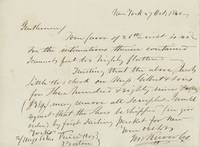
1849ref. List3334New York City 1849. Eight letters. Overall excellent. A small collection of letters to Boston-based grocers Silas Pierce & Co. sent from New York by steamboat with notes on covers or stamps reading “Boat Mail” or “Steam Boat Mail”. Five of the letters are from Wyckoff & Scrymser which was likely owned by a member or members of the prominent New York Wyckoff family the Scrymser surname first appears in the Wyckoff family history in 18411. Wyckoff & Scrimser discuss sweet and red wine prices “opperations in Trent” likely Trento Italy delayed shipments and issues with products; for instance: “The Harmony has not yet made her appearance neither the Aselia the non arrival of the latter is very perplexing but we see no remedy for it. . Annexed please find the sales of the Raisins amount Nett proceeds to your Co Nine Thousand One Hundred Seventy Four 06/100 Dollars which we hope may be found correct and satisfactory. There were a number of the parcels that were sold from the wharf but rejected which we were obliged to and store that the objections might not be known &c. The half boxes . did not have any external appearance of damage and could onky be known by opening. We rather congratulated ourselves that we have got off so well with this fruit as we had strong fears of the result.” December 29 1843 Also discussing business with Italy is a letter from Wm. A Lüs on behalf of Ferd. Baller & Co. of Messina which traded in citrus fruit: “The principal object of my friends is to introduce their Brand favorably into your market & their efforts to do this will alone be sufficient to secure you a superior article of fruit & other Goods; . they are also in the position of obtaining any other Sicilian produce at the most advantageous terms while at Messina or Palermo through their agent there.” August 30 1849 Demand for citrus products was high as it had been discovered late in the 18th century that citrus prevented and cured scurvy. Demand was so great in fact that some researchers partly credit the citrus trade with creating the Sicilian mafia.2 A letter from the Bank of Commerce in New York discusses credit and lastly Joseph Knowles possibly of the Massachusetts-based Thomas Knowles & Company sends an intriguing note: “Your favor of the 26th inst is rec’d For the intimations therein contained I cannot feel too highly flattered — Trusting that the above Jacob Little Co’s check on Messrs Gilbert & Sons for Three hundred eighty nine dollars $389 may remove all scruples – I would request that the shoes be shipped in good order by first sailing packet for New York”. October 27 1840 This is plausibly related to the investor and stock speculator Jacob Little 1794–1865 known for his short-selling tactics and generally considered as Knowles suggests unscrupulous.3 Of interest to researchers of mercantile history in the northeast and steamboat mail. 1 Mr. and Mrs. M. B. Streeter Eds. The Wyckoff Family in America: A Genealogy The Tuttle Company 1934: 310. 2 Arcangelo Dimico Alessia Isopi and Ola Olsson “Origins of the Sicilian Mafia: The Market for Lemons” The Journal of Economic History 77 no. 4 December 2017: 1083–1115. 3 “The Convertible Bonds: How Jacob Little Manipulated Matters Years Ago” The New York Times February 23 1882. unknown
1762ref. ABC_508791762. Various sizes. Ad 1-3: Contemporary sturdy paper wrappers sewn on 3 vellum supports; ad 4: the 12 documents are held together by a narrow paper wrapper with the text: "Onafgedaane Indiësche zaaken concentreerende de Amphioen Societeyt" and a string. With 12 manuscript documents and a manuscript on paper in 2 different hands. 15 1 blank; 3 ll. Collection of thirteen Dutch manuscripts concerning the Amfioensociëteit Amfioen Society documenting both its establishment in 1745 and its dissolution half a century later. Founded by the Dutch East India Company VOC to maintain its monopoly on the opium trade in the Dutch East Indies the Amfioensociëteit controlled one of the colony's most profitable monopolies until its liquidation in 1794.The earliest manuscript ads 1-3 contains the charter octrooi granted to the society for the period 1745-1755 together with its renewal for 1755-1765. Although the original charter was printed in Batavia in 1745 and survives in a single known copy that edition does not include the renewal. The present manuscript further contains a third text added in a different hand and dated November 1762 concerning the management of the society's outstanding affairs. Written on paper bearing the watermark of the VOC Chamber of Amsterdam it was probably intended for official administrative use.The remaining twelve documents relate to the financial settlement following the dissolution of the society in 1794. Most date from 1793 1794 and 1797 with one document dated 1807 reflecting the prolonged liquidation process. They concern the distribution of assets among shareholders outstanding debts and other administrative matters arising from the winding up of the company. Several documents are signed by Pieter van de Weert dates unknown cashier of the Amfioensociëteit while others mention Jacob Mossel 1704-1761 governor-general of the Dutch East Indies and the society's first director and Gerard Maximiliaan Taets van Amerongen 1727-1788 who was married to Mossel's daughter. Although several documents are headed "Copie" they are contemporary manuscript records rather than later transcripts many containing calculations annotations and other traces of active administrative use. Together they document the final years of the Amfioen Sociëteit and the administration of its dissolution.The wrappers of ads 1-3 are somewhat water stained with worm holes in the back wrapper and final leaf. The leaves are somewhat water stained especially the 3 final leaves an ink stain on leaf 12; the remaining 12 documents are folded several with small tears in the margins without loss of text occasional mild soiling. Otherwise in good condition.l Cf. Landwehr VOC 1449 printed copy of ad 1; STCN 240022416 1 copy; Wit Herman de 2012. Aandeelhouders van de opgeheven Amfioensociëteit in 1801. hardcover
1890ref. 106522Chromolithograph advertising and promotion cards various sizes from 3 ¼" x 3 ¼" to 6" x 8". Normal aging a little browning on reverse text on reverse of one card basically gone. A couple of colorful little girl and flower cards one an advertisement for Magic Yeast indicating E.W. Gillett as manufacturer. Fairly colorful lot.
1916ref. 2092902141301921Geisha-do 1916. Soft Cover. Fine. Number of books: 1 Geisha-do paperback
ref. 184644China: mostly early 20th century. Surviving traces of businesses otherwise lost to time including 19 cards from Hong Kong advertising curio merchants tailors photographers cobblers and jewellers. The remaining 6 were issued in Weihaiwei 2 Shanghai 3 and Beijing. Though unmarked as such these cards - with the exception of the Beijing example - were assembled by Arthur Hacker 1932-2013 a historian of China and a civil servant in Hong Kong from 1967 to 1989. Together 25 cards 47 x 85 mm to 80 x 109 mm including duplicate. Printed in English or in English and Chinese. Occasional pencil annotations. Marking and signs of handling couple of closed tears: very good. unknown
ref. 1161030069.Gpaperback. Good. Access codes and supplements are not guaranteed with used items. May be an ex-library book. paperback