8 358 résultats
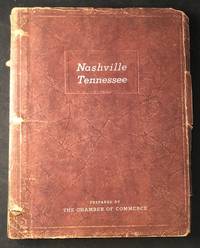
1937réf. 2527Nashville TN: The Chamber of Commerce Nashville TN 1937. First Edition First Printing. Original wraps. Good . 9 X 11 1/4 Inches. 62 PP Folding Map. Original February 5 1937 Portfolio created by the Nashville Chamber of Commerce. A fairly incredible "time-capsule" glance and 20th Century Nashville in the making. This unique book was created specifically for the purpose of garnering the business of the Norvell & Wallace Lumber factory. We assume that other similar copies were created on an individual basis when the city saw fit to "scout" major companies for the area. We have located "0" copies on OCLC and "0" auction records. The summary states "The principal advantages Nashville offers to industry and other lines of business is summarized from this survey." The index includes: agricultural resources altitude area assessed valuation building and construction city government civic and social data building permits churches civic-fraternal and welfare organizations education golf courses hospitals and medical facilities hotels newspapers office buildings parks and playgrounds Parthenon postal receipts public buildings radio stations streets theatres Tennessee State Fair climate financial instituions living conditions location manufacturing attitude toward new industries industrial development in Nashville Labor costs Labor relations Labor Laws and Regulations Labor Supply Workmen's Compensation Law markets mineral resources population public utilities state and local taxes transportation facilities airlines express freight local passenger service interurban service motor truck railroads river transportation vital statistics wholesale and retail establishments. A few of the stats that immediately jumped out at me - 1 The report predates any television station in Nashville 2 When polling races in the city the report denotes 111025 white citizens 42836 negro citizens and 5 of "other" races 3 only two airlines American and Eastern service the city and the municipal airport was dedicated only a few months before this report. 21 tables and graphs including rail distance and hours by train to other US cities flying hours from Nashville power rates gainful workers condition of the banks of Nashville and more. The folding map mounted at rear measures roughly 25 X 30 inches. Origianl stab binding intact. Pages and text clean. Covers are separated from the text. The map does exhibit a few closed tears and a bit of wear at folds. The Chamber of Commerce (Nashville, TN) unknown
1932réf. 307823Seattle Shiatoru: Hokubei nihonjinkai shogyo kaigisho North American–Japanese Chamber of Commerce 1932. Third Edition. The third edition after much shorter versions published in 1928 and 1929. This is a promotional publication printed at a Japanese-language press in Seattle intended to encourage pan-Pacific trade through the port of Seattle. Chapters are devoted to manufacturing commercial business the current state of Seattle trade trade with Japan and Seattle's municipal administration education and media outlets. Notably the English introduction from the Seattle mayor makes no mention of the local Japanese community emphasizing only mutual trade between Seattle and Japan. The half-tone plates depict views of Seattle and accommodations for Japanese merchants. The supporting ads mostly at the back however are from many Japanese-owned businesses in the region. 6 2 110 2 1 2 23 pages plus 14 pages of half-tone photographic plates including one folding plate and a folding chart. OCLC: 1020884327 Japan 835589810 Japan 20869632 University of Washington for this 1932 edition. Similar holdings for the 1929 edition. No recorded holdings for the 1928 edition. Third edition. A very good copy in the original wrappers. With professional conservation by ECS to remove rusted staples and infill holes in the paper sheets left by the staples. The binding was then sewn through the original staple holes. The conservation report will be supplied with this copy. Hokubei nihonjinkai shogyo kaigisho (North American–Japanese Chamber of Commerce) unknown
1762réf. 2191Cadiz: Don Manuel Esoinosa de los Monteros 1762. Hardcover. Very Good. 4to - over 9¾ - 12" tall. 4to. 20.5 x 14 cm 158 pp. 1 f. index. With woodcut head- and tail-pieces blazon of Charles III and two Spanish galleons. Bound in mottled calf over boards spine gilt in six decorative compartments. Somewhat worn at extremities. Generally very good. First enlarged edition of an illustrated merchant's guide to the duties and tariffs levied by the Spanish crown on exports from the Americas chiefly gold and silver but also concerning timber textiles furs coffee spices and foodstuffs.After first offering a general overview of Spanish colonial commerce with Western Europe Garcia de Prado provides a wide range of practical instructions for traders negotiating the hazardous waters of colonial finance giving sample calculations for the volume of shipping containers converting currency and-crucially-providing a comprehensive alphabetical list of the royal tariffs on exports from America and the West Indies printed as a table for quick reference in terms of maravedis de plata silver coins of account and quintales approx. 46 kg. The second half of the work is concerned with trade in gold and silver explaining the six classes of government tariffs and their application to quintales of the metals in their various states acuñada labrada grana fina etc. Printed at the Royal Navy Office in Cadiz where Spanish shipping vessels would have arrived from the Americas the present work anticipates later efforts by the Spanish Bourbons-particularly Charles III and the Marquis de Esquilache-to reform the fiscal administration of its colonial properties. Garcia de Prado remarks in his introduction that a much smaller work un Quaderno with the same title was printed in 1745 and that the present work aims to augment and update the information contained therein. JCB.III.1320; Medina 3999; Palau 58415; Sabin 15037 Don Manuel Esoinosa de los Monteros hardcover
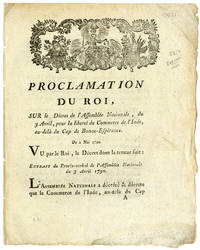
1790réf. 51521Rouen: L. Oursel 1790. With a Partially-Printed Letter Transmitting the French Revolutionary Proclamation Proclamation by the Revolutionary government of France abolishing the monopoly of the French East India Company on trade beyond the Cape of Good Hope and declaring it open to all Frenchmen. The Compagnie des Indes Orientales was established in 1664 to compete with the British and Dutch East India companies. It had considerable difficulty maintaining itself financially through its long history and it was finally liquidated in 1769. In 1785 it was reconstituted and granted a seven-year monopoly on trade beyond the Cape of Good Hope but the French Revolution and the democratic zeal that accompanied it put an end to that with the present decree. The brief proclamation is accompanied by a transmittal form from the Bureau Intermediane du Departement de Montivilliers indicating that one copy of the proclamation was sent to the recipient. Quarto on a folded folio sheet. Light wear and soiling. Very good. unknown
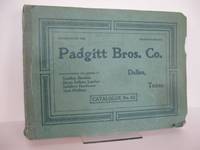
1917réf. 57734Dallas TX: printed by Egan Printing Co. for the company 1917. Trade catalogue. Oblong 4to. 526 pp. Frontispiece trademark illustration and numerous other illustrations from line drawings and photographs. Padgitt Brothers Company was established in 1869 and incorporated in 1900; the company's success "in supplying the needs of the saddlery trade of the Southwest gave them first-hand knowledge of materials and design that were recognized as standard wherever good goods are sold." Their catalogues were "a veritable encyclopedia of saddlery facts classified for your convenience . there is no reason why this book should not prove a 'silent partner' in the success of every dealer who will utilize its pages freely." The profusely illustrated catalogue with pricing information is organized into sections for saddles and varieties of tack down to spurs buckles hobbles canvas wagon covers buggy tops blankets and feedbags. The Padgitt "Bronco Brand" saddle and accessories were widely known throughout the Southwest. OCLC locates two copies of this number National Cowboy & Western Heritage Museum San Jacinto Museum of History. Owner's name on front wrapper a very good copy. Printed green wrappers original printed cloth tape spine some soiling and chipping to wrappers tape repair to verso of rear wrapper chipping to margin of final blank. #6216. (printed by Egan Printing Co., for the company) unknown
1900réf. 263502Lyon France: J. Bouvard & Cie 20 Rue Lafont 1900. 14 thick card sheets with samples centrally mounted vertically to recto and verso some sheets quite thick to accommodate larger epaulets each with manuscript notations of name size etc. 11-3/4 x 6-3/4 inches. Black cloth album with the printed label of "J. Bouvard et Cie Fabrique de Dorures Soireries Ornaments d'Eglise" to front paste-down. Some wear commensurate with age and use spotting and thumbsoiling apparently complete with all samples backing possibly restored at an early date. 14 thick card sheets with samples centrally mounted vertically to recto and verso some sheets quite thick to accommodate larger epaulets each with manuscript notations of name size etc. 11-3/4 x 6-3/4 inches. This very unusual French sample book contains a large range of epaulets and sequin samples with a few lettering and star samples. J. Bouvard & Cie 20, Rue Lafont unknown
réf. 53K000002L7EUnited States Department of Comm. unknown_binding. Like New. . No writing or tears unknown_binding United States Department of Comm unknown
1973réf. ZB644081Berkeley Calif. ; Vancouver : Faculty of Commerce and Business Administr 1973. Volumes 9-26 lacking Volume 18 else an uninterrupted run of complete volumes partly bound minor library markings else text clean & bindings tight. - If you are reading this this item is actually physically in our stock and ready for shipment once ordered. We are not bookjackers. Buyer is responsible for any additional duties taxes or fees required by recipient's country. Photos available upon request. Berkeley, Calif. ; Vancouver : Faculty of Commerce and Business Administr unknown
1942réf. 2091502135500375Manzhou Yingkou Chamber of Commerce 1942. Soft Cover. Fine. Number of pages: 2 2 23 364 118p Size: 16x22cm Manzhou Yingkou Chamber of Commerce paperback
1942réf. 2091502135500132Yingkou Chamber of Commerce 1942. Soft Cover. Fine. Number of pages: 2 2 23 364 118p Size: 16x22cm Yingkou Chamber of Commerce paperback
1883réf. 174897London: Harrison & Sons 1883. A single copy traced institutionally First edition of this valuable collection of official papers over half of which concerns Admiralty patrols and slavery cases in the Zanzibar region. Many items of correspondence were sent by or to the influential Arabist Samuel Barrett Miles 1838-1914 the political agent and consul-general. Records show only the British Library's copy. For Britain curtailing the slave trade in the Indian Ocean and Arabian Sea was a means to consolidate control over the region. In 1873 it signed anti-slaving treaties with the Sultan of Muscat and after blockading Zanzibar Sultan Barghash bin Said al-Busaidi r. 1870-88. Throughout the 1870s the Admiralty bolstered its naval presence. Textual and statistical memoranda from Miles and others reported encounters by patrolling vessels with slaving dhows and fugitive slaves the seizure and destruction of vessels and legal proceedings. An important moment was the lethal encounter in December 1881 of HMS London with a dhow flying French colours. As related by Rear-Admiral Gore Jones Commander-in-Chief East Indies Station to the Secretary of the Admiralty "no one on London was expecting action and all were personally unarmed. The Arabs instantly fired and then rushed on board." London's captain Charles Brownrigg "fought like a lion" but was fatally stabbed through the heart pp. 188-9. The incident hardened British resolve; in the late 19th century slavers were increasingly forced to seek overland rather than maritime routes. The compilation also includes two documents concerning Persia a report of a man who had escaped from slavery in Mecca and a short despatch on the sentencing of a slaver submitted by Lynedoch Needham Moncrieff the acting British consul at Jeddah. Folio. Tables in text. Original blue wrappers spine and covers lettered in black. Losses at spine ends a few chips and light stains to covers contents clean: very good. Bennett The Arab State of Zanzibar: A Bibliography 510. unknown
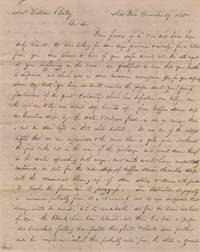
1835réf. BK0025New York City 1835. Autograph letter signed by the merchant firm Baker & Moore 4 pp. addressed to General William Battey care of Dr. Charles Luzenberg at the Franklin Infirmary on the Pontchartrain Railroad New Orleans. Stampless folded letter with red circular "NEW-YORK" December 31 datestamp and manuscript "25" rate. Appx. 1000 words. File folds; otherwise very good. A lengthy commercial letter written thirteen days after the Great Fire of New York describing the destruction of the city's mercantile district and tracing its immediate effects through insurance capital banking commodity prices and trade with New Orleans. Written by the New York firm of Baker & Moore to their associate William Battey the letter provides a near-contemporary account of the fire an assessment of the city's financial resilience and instructions for exploiting the resulting fluctuations in the markets for brandy wine raisins tobacco iron and copper. The fire began on the evening of December 16 during an extraordinary cold spell and northwest gale. Frozen hydrants wells cisterns and hoses left the city's volunteer fire companies largely unable to contain it. By the following day the fire had destroyed much of the commercial district between Wall Street and the East River including the Merchants' Exchange and hundreds of stores and warehouses. Buildings were eventually demolished with gunpowder to create firebreaks at Exchange Place and Coenties Slip. Contemporary estimates varied but approximately 674 buildings were destroyed with losses eventually placed at twenty million dollars or more.1 Baker & Moore begin by describing the extent of the burned district the severe weather and the use of explosives to arrest the flames: "Since my last you have no doubt received the paper sent you giving particulars of the great calamity which has befallen our City. On the 16th our City was about half burned up. From Coffee House Slip to Coenties Slip by the water & William Street is all in ruins. There is but one store left in that whole district. It was one of the coldest nights that we ever experienced & the wind blew a gale from Northwest. The fire broke out in the rear of the Exchange and went down through to the water spreading both ways and would have undoubtedly continued on but for the wide slips of Coffee House & Coenties Slip with the occasional blowing up of some stores & houses with powder to check the flame in its progress" The account quickly turns from the physical destruction to the distribution of its financial losses: "The destruction of property is immense probably from 10 to 15000000$ and it was supposed that many would be ruined but tis remarkable so far we have not heard of one. The Banks have been liberal and there has been a proper and benevolent feeling manifested throughout & should some further aid be brought in which probably will from the State or general government we think there may be no failures. The Insurance companies most of them are ruined and the principal loss is in Insurance capital. The loss will in some instances fall upon those who cannot well afford it. Many widows & orphans have had their all taken from them. The loss is large and New York has met with a great calamity but she is made of such materials & her facilities are so large & varied that the mercantile community will bear up under more than any other place in the Union & we think in one year's time it will be almost forgotten." The confidence expressed here correctly anticipated the city's rapid commercial recovery. Banks and government agencies extended credit and payment terms rebuilding began almost immediately and the burned district was reconstructed with new countinghouses and warehouses. The disaster also exposed the inadequacy of New York's water supply and firefighting arrangements contributing to later infrastructure and institutional reforms. Baker & Moore then apply the disaster to their own trade with New Orleans. Hundreds of warehouses and their contents had been destroyed increasing prices of imported foods wines and spirits. The firm instructs Battey to use the New York price current to obtain higher prices for their consignments: "This fire has advanced most all kinds of goods. Raisins are worth here $3-$3½. Wines such as Mess. Eastman's have advanced with us 4-6 cents. So many hundred casks destroyed must advance it and make it higher through the season. More than one half the Brandy was consumed tis now selling at $1.75 and some are asking $2. We wish what we sent you sold & this will be a favorable time to sell-show N.Y. price current-and get as good a price as you can. There will we think be no want of Brandy. Those raisins we think you had better dispose of at once. We think from N.O. current must pay something handsome for us. In regard to old Iron we find good old iron will always sell for the money for 112½ gross hundred equal to 1c per lb. Cast & wrought are same price. If you can come across a lot to do you may make it answer & pay us well. Copper if you can buy low enough may pay something. We thought hay might pay out but tis so high we cannot buy to send. We are of opinion that goods generally will be higher in consequence of this fire yet when we consign goods we wish them sold when they can to pay and we wish Eastman & Co. to sell and close up our affairs in their hands." The concluding paragraph briefly introduces events in Florida. The Second Seminole War had begun that month following mounting resistance to the forced removal of the Seminole people from Florida. Baker & Moore believed that the conflict might affect the movements of a brig expected in New Orleans: "We observe that trouble is anticipated with the Indians in Florida & if so our Brig may not get a load of them & be in N. Orleans earlier than we anticipated tis uncertain what will be the result they may detain her longer until they can get them on board." The wording appears to indicate that the vessel was expected to transport a group of Native people although the letter does not identify the brig its owners or the precise circumstances of the contemplated voyage. The recipient General William Battey was then in New Orleans apparently acting as Baker & Moore's commercial representative while also attending to his health at the Franklin Infirmary. The firm gave him considerable discretion to supervise consignments collect funds purchase goods when opportunities arose and forward current market information to New York. The address places him in the care of Dr. Charles Aloysius Luzenberg who founded the Franklin Infirmary with municipal support in 1835 and subsequently helped establish the Medical College of Louisiana the forerunner of Tulane's medical school.2 Baker & Moore appear to have been commission or importing merchants whose own affairs escaped direct damage but whose trade was immediately altered by the destruction of competing inventories. The letter thus follows the fire from the burned commercial district into the decisions of a New York firm and its representative in New Orleans. A substantial contemporary account of the Great Fire of 1835 documenting the destruction of New York's commercial center and the disaster's immediate movement through insurance banking commodity markets interregional credit and trade with New Orleans. We find no similar examples on the secondary market or in auction records. 1 Herbert Asbury "The Great Fire of 1835" The New Yorker July 26 1930. 2 Louisiana Historical Association "Luzenberg Charles Aloysius" in Dictionary of Louisiana Biography accessed August 2 2026 https://www.lahistory.org/resources/dictionary-louisiana-biography/dictionary-of-louisiana-biography-l/. . unknown
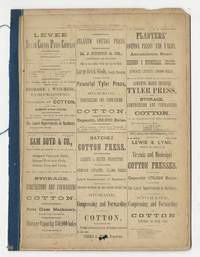
1880réf. 1631880. Photo album; Albumen prints 30; Each 5 3/4 x 4 inches An interesting and unusual album consisting of photographic reproductions of all four pages from the September 1 1880 issue followed by all 26 pages of the Annual Review of Commercial New Orleans published as a supplement on the same day. The photographs chronicle an immense amount of advertisements for the business houses stores and companies active in New Orleans at the time including ads for photographers T. Lilienthal and W. W. Washburn. Also present are ads for various insurance agencies and banks; dealers and importers of everything from musical instruments barbed wire French plate mirrors and fireworks to furniture books stationary and dry-goods; and of course odd-ball promotions for bizarre 19th-century miracle cures such as "Kidnegen: The Great Kidney Regulator and Ditretic" and Reed's Tonic "a thorough remedy in every case of Malarial fever." Also advertised are products and companies still recognized today such as Lea and Perrins Genuine Worcestershire sauce and Procter & Gamble Soaps. At least 2 pages are dedicated solely to the Cotton trade in the region and dealers in "Plantation Machinery." Meandering in-between the company advertisements are brief reports on the current state of trade in all manner of business sectors; Lumber Freight Paper-making Leather manufacturing Land prices Mineral resources and many many more. The greatest mystery here is why the album was produced in the first place; perhaps as a means to later reproduce the list of businesses--a sort of Yellow Pages. It is fairly likely that the photographs were produced by either Lilienthal or Washburn due to their inclusion in the directory. Another point of curiosity is the size of the album. While the minuscule text is mostly legible under magnification the miniature quality of the advertisements does not exactly suggest every day use! The photographs are mounted recto/verso to 15 cards which were formerly attached to the present gilt-decorated morocco album. The cloth hinges have fully deteriorated and the cards are loose and collated in order. unknown
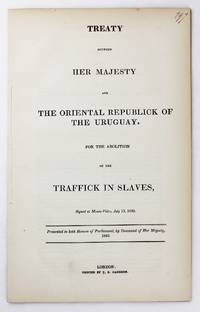
1842réf. 6316London: T.R. Harrison 1842. Near fine. 38pp. stitched. Very minor bumps to top edge of first leaf light dust-soiling to outer leaves. A very rare treaty between Queen Victoria’s Britain and the “Oriental Republick of the Uruguay” printed in both English and Spanish in two parallel columns throughout. According to the text the parties were “mutually animated by a sincere desire to co-operate for the utter extinction of the barbarous Traffick in Slaves.for the special purpose of immediately attaining this object so far as relates to the total and final abolition of the Slave Trade of the Oriental Republick of the Uruguay.” The treaty is comprised of fourteen original articles plus three annexes totaling forty-six additional articles and four additional articles at the end covering a host of issues pertaining to the suppression of the slave trade. These issues included enforcement procedures the establishment of “Mixed Courts of Justice” “Regulations in respect to treatments of liberated negroes” and much more. With regard to slaves found on international vessels the two nations hoped for “permanent good treatment and a full and complete emancipation according to the humane intentions of the Parties of the Treaty.” The present treaty was part of a larger effort by the British Crown to put an end to the transatlantic slave trade in the first half of the 19th century; at this same time Britain had reached terms on a similar treaty with the Republic of Texas and other nations. The document is signed at the end in type by J.H. Mandeville and Jose Ellauri representatives of the two countries who originally signed the treaty at Montevideo on July 13 1839; the present work was “Presented to both Houses of Parliament by Command of Her Majesty” in 1842 likely due to bureaucratic delays. Uruguay would have been an important ally for Great Britain in monitoring the seas against the transatlantic slave trade given its position opposite the South Atlantic Ocean from West Africa. OCLC records just a single physical copy of this treaty at the University of Arizona. Cundall 2854. T.R. Harrison unknown
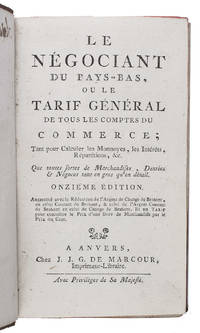
1780réf. 95L94ST53226Antwerp 1780. 12mo. Johannes Judocus Gerardus de Marcour Contemporary mottled tanned sheepskin gold-tooled spine with olive title-label red edges. XXIII 1 543 1 pp. Corrected and augmented eleventh edition of a handbook for merchants and traders in the Southern Netherlands here in a French edition but also available in Dutch Den Nederlandschen negociant . All editions appear to be very rare. It consists of numerous tables giving information for the conversion of monetary units weights and measures.The privilege p. XXIV is issued in the name of Maria Theresa who died in 1780 and De Marcour was active from 1764 to 1797. The many unnumbered editions no doubt confused publishers who probably numbered their editions to follow the highest number they had seen: the University of Kansas has a ninth edition Liege 1784 the Hendrik Conscience library a ninth Antwerp De Marcour 1792; ; and there is a tenth Antwerp Grangé 1798.With some early 19th-century annotations on endpapers. Spine slightly rubbed one leaf party detached but otherwise in very good condition.l Groote Vijftig jaar boekdrukkunst te Antwerpen p. 31; Anet 3 copies; STCV 1 of the same copies; WorldCat 2 of the same copies. unknown
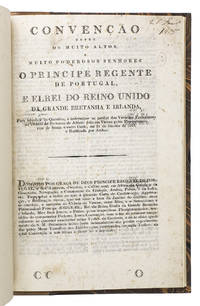
réf. ABC_48887Lisbon: Na Impressão Regia 1815. Modern half calf marbled paper sides with the title and year of publication lettered in gold on the spine. Small folio ca. 28.5 x 18 cm. With the text printed in two columns in Portuguese on the left and in English on the right. Very rare first Portuguese edition of this treaty between Portugal and the United Kingdom of Great Britain and Ireland concerning the indemnification of Portuguese subjects for certain detained slave trade vessels as a result of British actions undertaken in pursuit of the abolition of the slave trade. "Britain agreed to pay compensation for the several Portuguese slavers detained brought before and condemned by British courts on the ground of illegal slave-trading along the African coast prior to 1814" J.P. van Niekerk "British Portuguese and American judges in Adderley Street ." pp. 22-23. Another edition of this same treaty in 8 pages was printed in the same year in Rio de Janeiro with the complete imprint including the place of publication.The present bilateral treaty comprising three articles printed in two columns in Portuguese and English was drafted on 21 January 1815 during the Congress of Vienna a series of international diplomatic meetings held in Vienna from September 1814 to June 1815 concerning the new layout of the European political and constitutional order after the downfall of the French Emperor Napoleon Bonaparte. The signatories of the present treaty were plenipotentiary at the Congress of Vienna formally this treaty was concluded between the Prince Regent of Portugal - future King John VI 1767-1826 - and the King of Great Britain and Ireland George III 1738-1820 as mentioned in the title.A more detailed description is available upon request.With the book plate of "Biblioteca de Hariberto de Miranda Jordão Filho" mounted on the front pastedown. The text leaves with a vague horizontal and vertical fold in the centre a manuscript annotation "21 Janeiro 1815" in brown ink in the upper outer corner of the first page some foxing. Otherwise in good condition.l Gauz Portuguese and Brazilian books in the JCB 815/10; Porbase 3240734 1 copy; WorldCat 1042407673 12791342 38346960 4 copies; cf. Camargo & Moraes Bibl. da Impressão Régia do Rio de Janeiro I 428; Rodrigues 735 & 737 Rio de Janeiro ed.; for more context relating to the treaty: Lesaffer R. "Vienna and the Abolition of the Slave Trade" Oxford Public International Law online via: https://opil.ouplaw.com/page/498; Niekerk J.P. van "British Portuguese and American judges in Adderley Street: the international legal background to and some judicial aspects of the Cape Town Mixed Commissions for the suppression of the transatlantic slave trade in the nineteenth century Part 1" in: The Comparative and International Law Journal of Southern Africa Vol. 37 No. 1 March 2004 pp. 1-39. online via: https://journals.co.za/doi/pdf/10.10520/AJA00104051_114. Na Impressão Regia, unknown
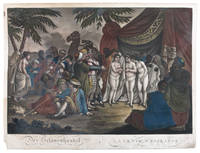
1800réf. I7DD3T6LJ6QQNo place 1800. 27 x 40 cm. Aquatint in contemporary hand colour engraved by "J. L. T." after "J. R. P." Three partly exposed women before a large tent being advertised and inspected by several men dressed in fine oriental garb. On the left is another woman whose price is under discussion while the background shows date palms and two dromedaries.Rather severe water stains and a few small holes in the blank margin; some scuff marks in the image; trimmed closely with loss to lower left corner. A very appealing print. Rare. unknown
1839réf. 188502Likely London: Ordered by the House of Commons to be Printed 1839. A beverage of empire - the demise of the Chinese tea monopoly First edition covering material submitted by East India Company representatives between 1834 and 1838 - a crucial period during which Britain laid the foundations of its tea empire in Assam. The splendid maps incorporate the findings of explorers such as Captain Francis Jenkins and the observations of tea-growing made in China by the Macartney and Amherst embassies. The documents concern the key actors in the growth of Britain's formal tea empire including Jenkins the powerful Bengal civil servant William Hay Macnaghten and the members of the Tea Committee established by Governor William Bentinck in 1834. Pages 36-37 carry the text of the committee's momentous 24 December 1834 report announcing that the tea plant was indigenous to Assam: "We have no hesitation in declaring this discovery. to be by far the most important and valuable that has ever been made on matters connected with the agricultural or commercial resources of this empire." Five years later the first twelve chests of Assam-grown tea were auctioned in London to great fanfare. Copies are held at the British Library Linnaean Society Calke Abbey UCLA National Agricultural Library Institut de France and National Library of Australia. Folio 331 x 215 mm. With 5 lithographed plates 3 leaves of explanatory letterpress 6 folding maps 3 with hand-colouring illustrations and tables in text. Twentieth-century dark blue buckram spine lettered in gilt original blue printed wrappers bound in. Ex-Reading University Library with its bookplates including on front cover index card holder and other markings and stamps on endpapers; a little old underlining in text. Light spotting internally maps in well-preserved condition and without stamps: very good. hardcover
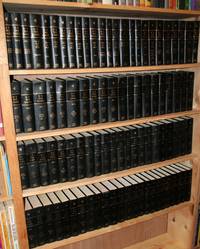
réf. 006865New York : Commerce Clearing House 1913-1986 1986. Hardcover. Fine/No Jacket. 91 volumes ; A nearly complete run from 1913-1986 ; almost 75 years of tax litigation history ; At head of title: CCH./ Published: Chicago IL : CCH Incorporated / Accompanied by separately numbered Consolidated volumes vol. 1 1913/1929-v. 5 1917/1940 published 1938-1940 which make available in permanent bound form the opinions originally reproduced and reported in the publisher's "court decisions" division of Standard federal tax service./ "The fifth vol. of the consolidated vols. presents court decisions handed down under the excess profits tax statutes which were effective from 1917 to 1921."--Foreword to v. 5 ; LC: KF6280.A2; HJ3251.A39; Dewey: 343/.73/0402643 ; OCLC: 3157871 ; ISSN: 0277-402X; Other format's ISSN: 1084-0125; National Library: 011150635; LCCN: 37-1000 ; without vols. for 79-2 80-2 81-83 84-1 and duplicates of 74 & 75-1 ; As published in book form we must point out that this set can be used without electricity computers or the internet! ; A fine first impression for anyone entering a law office ; or could make a great stage prop ; FINE New York : Commerce Clearing House, 1913-1986 hardcover
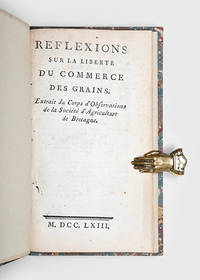
1763réf. 1730471763. Grain policy in the ancien régime First edition of this exceptionally scarce economic tract on the grain trade. We trace only two institutional copies worldwide: at the University of Chicago and the BnF. The recent spine label attributes this work to Louis Paul Abeille 1719-1807 an early convert to physiocracy and a friend of Quesnay and Mirabeau. Abeille served as secretary of commerce under Louis XV & XVI from 1769-83. A series of subsistence crises brought concerns over public access to grain to the forefront of French economic debate in the mid-18th century. In the absence of public granaries government policy was to regulate more strictly the distribution of grain by private commercial interests but periodic subsistence crises revealed the inadequacy of this policy. Over the next decade the physiocrats continued to promote deregulation of the grain trade which contributed to spiralling prices and the Flour War of 1775. The attribution to Abeille is presumably based on his publication in 1760 of the Corps d'observations de la Société d'agriculture de commerce et des arts établie par les États de Bretagne années 1757 & 1758 which brought him to the attention of Quesnay and Mirabeau in Paris. Abeille was the secretary of the Agricultural Society of Brittany a learned society for agricultural improvement. Duodecimo 159 x 92 mm. Recent marbled paper boards gilt label to spine edges sprinkled red. Minor foxing and browning: a very good copy. Not in Black Goldsmiths' or Kress. hardcover
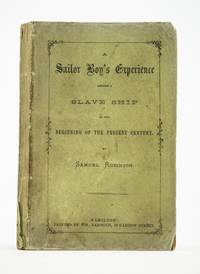
1867réf. ST20572Hamilton Scotland: W. Naismith 1867. FIRST EDITION. 168 x 106 mm. 6 1/2 x 4 1/4". vii 183 pp. In the very rare original green paper wrappers. Spine cocked wrappers somewhat soiled spine with paper beginning to lift along the bottom inch of the rear joint other minor exterior defects but the volume solid and internally in excellent condition. QUITE A GOOD COPY of a fragile inexpensively produced volume one would expect to find in shambles. Told in the form of letters drawn from the author's actual correspondence as well as his contemporary journals this first-hand account by a young sailor of the transatlantic slave trade in the years 1800-04 brings those horrific voyages vividly to life. At the same time the author writing in direct unvarnished prose makes it clear he is at least as much an observer of difficult sea life in general as he is concerned with the abolition of a great evil. In the preface Robinson 1786-1875 explains his reasons for publishing this record of his time aboard a slave ship: "I have heard so many gross misstatements respecting West Indian slavery and the horrors of the 'Middle Passage' that I formed the resolution should time be allowed me to give the result of my own experience . . . in order to disabuse the minds of many well-meaning people." He is rightly aware that some readers may be offended by unconvincing apology in an account encumbered with naïveté : "It is doubtless the opinion of many that I put myself into a wrong position and incurred blame and obloquy by entering into this obnoxious trade at all. It may be so; I will not dispute the matter. I certainly did not feel myself comfortable or at home in the service. But let it be remembered in my favour that the trade was then a lawful one; whilst at the same time I was induced to enter it by what is called an accidental circumstance . . . and an irresistible desire for a seafaring life so completely carried me away that it became a matter of perfect indifference to me where the ship went if not to the bottom provided I was aboard of her--or in what trade engaged if not a pirate." As indicated the letters originating in various ports in England West Africa and the West Indies depict a harsh life at sea for all involved but most especially for the wretches who made up the ship's cargo. An accident on board nearly cost Robinson his foot and ended his career at sea just a year before in his words "the united voice of a generous and philanthropic people" passed the Emancipation Bill into law ending British participation in the slave trade. The phrasing here makes it clear our narrator had his heart mostly in the right place. This is a very rare book which is not surprising for a pocket-sized work from a provincial press near Glasgow issued in insubstantial paper wrappers. OCLC records just two copies in libraries both in the UK while RBH and ABSA seem to list no copies at auction except the present one. W. Naismith unknown
1930réf. 42850Leicester UK: Cascelloid 1930. Very good . Beautifully-produced trade catalogue from the Cascelloid "Palitoy" company displaying a wide range of baby dolls and other toys. Several uncomfortable designs of black children with pitch-dark skin date this catalogue at roughly the 1930s when the Cascelloid company was dubbed the "House of Constant Progress" by the industry press for its material innovations with the plastics Bexoid and Plastex. One page features a celluoid model by the noted designer Mary Lucie Attwell a doll named "Diddums." The catalogue also displays the company's offerings of animal dolls die-cast trucks pool toys golf and ping-pong sets rattles pinwheels and more. Needless to say color photography was not the norm at this time and this catalogue comprises a beautiful set of vivid and sharp photographic prints. A truly exceptional example unlike anything we've seen: simultaneously surreal and nostalgic. Oblong 4to. album. Blue leather-covered boards. Contains 29 color photographs all 9" by 6.5" approx. mounted on rectos one each of light-gray cardboard leaves. About very good plus overall. Moderate rubbing and edgewear to boards. Several pages display mild soiling and offsetting from photos. Prints just a bit yellowed but remain sharp vivid and clean. [Cascelloid] unknown
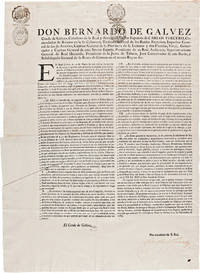
1785réf. 57874Mexico. November 22 1785. Announcing the Compañia Real de Filipinas Regulating Trade with the Philippines A very rare Mexico City printing of the announcement of the creation of the Royal Company of the Philippines by Spanish royal decree in 1785 which regulated and effectively monopolized trade with the Philippines. This copy bears the manuscript rubric of Don Bernardo de Gálvez and signature of his secretary Joseph de Gorraes. Gálvez then Viceroy of New Spain ordered this broadside printed for the reason that "An Establishment so important and of such general interest should be understood and known by all" our translation. The creation of the Royal Company would be particularly relevant to residents of Mexico as most if not all of the trade with the Philippines would come through New Spain. Accompanying the announcement this broadside also prints Articles 1 2 14 21 and 100 of the royal decree which were considered to effectively summarize the purpose and mechanics of the new Company. The articles printed here proclaim that the Company is to enjoy the protection of the Crown for at least twenty-five years establish a fund to back its shares describe how shares and subscriptions could be purchased and organize a general meeting of shareholders. Notably absent from this broadside is the important article of the decree which closed Manila's ports to foreign vessels giving the Company an effective monopoly on all trade between Asia and the Americas. The Royal Company of the Philippines quickly gained vast wealth from this lucrative deal transporting commodities such as indigo coffee sugar spices and cotton across the Pacific. Regardless of its initial success the Company did not endure - the wave of rebellions against Spanish rule in Central and South America in the early 19th century quickly rendered it obsolete and the company was officially dissolved in 1834. A rare broadside announcing this important Royal Decree to the people of the Western Hemisphere; OCLC records only one copy at the Bancroft Library. Broadside printed on two joined sheets of sealed paper 23½ x 17 inches in total. Old folds and light creases a few small worm holes. Very good. OCLC 21747301. unknown
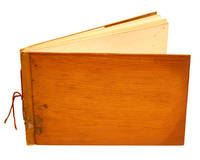
1893réf. 607017Lowman & Hanford 1893. First Edition. Wraps. Very Good. A Rare Northwest imprint; this was from the library of noted historian Edmond S. Meaney with his signature to the front pastedown and further inscribed 'From C. T. Conover Seattle Wash.' This copy has been specially bound with a leather spine and two bevelled and varnished wooden boards. 38pp. with 10 b/w plates one panorama shot of the waterfront and one map. Issued as a souvenir for Seattle's guests on the occasion of the celebration commemorating the completion of the Great Northern Railway to its Pacific terminus at Seattle and the inauguration of through traffic June 1893. WorldCat only located 3 copies. [Lowman & Hanford] unknown
1939réf. 1729691939. INK TRADE CATALOGUE. Kraski. Trest 'Poligraf'. 173 unnumbered leaves of text and illustrations. Vertical 4to 265 x 175 mm publisher's cloth fastened with string. Moscow: Nauchno-issledovatel'skii institut poligraficheskoi i izdatel'skoi tekhniki 1939. The State Trust of the All-Union Economic Council of National Economy "Poligraf" existed since 1924 and produced movable types. They also produced printing inks. In this sample book they are divided by the techniques they were intended for: movable-type printing lithography offset lithography mezzotint. The samples are on different kinds of papers to show the differences for printing. At the end is an overview of complementary mixtures and drying oils including fatty printing pastes to increase the capacity of printed forms. One of 300 copies only. Of the greatest rarity and not listed on OCLC. hardcover