[United States - Great Britain Trade]:Biblio.com
17 322 résultats
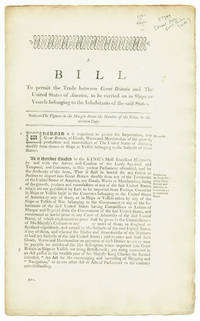
1809réf. 47399London. 1809. A Failed Opportunity to Normalize U.S.-British Trade Relations Rare printing of a British Parliamentary "slip bill" seeking to reestablish trade between Great Britain and the United States a few years before the outbreak of the War of 1812 and in the midst of great tension between the two nations. This bill was considered by Parliament in the spring of 1809 in the wake of President Jefferson's rescinding the Embargo Act and following the negotiations between U.S. Secretary of State Robert Smith and British envoy David Erskine which created a glimmer of hope that Anglo-American relations might be repaired after a period of great stress and turmoil. In March 1809 Jefferson signed the Non-Intercourse Act which rescinded the Embargo of 1807 and held out the promise of resuming trade with England and France if either of those nations ended its commercial restrictions toward the United States. The Erskine-Smith negotiations of April held out the promise of improved relations and in May the Parliament considered the present bill which permitted trade between Great Britain and the United States to be carried on in American ships. Unfortunately Prime Minister Canning disavowed the Erskine-Smith Agreement in late May and Anglo-American relations continued to deteriorate culminating in outright warfare in 1812. Slip bills are printed during the legislative process in small numbers for the use of legislators and staff. They are ephemeral items and their survival is rare. A printed note before the text of the bill reads "the figures in the margin denote the Number of the Folios in the written copy" which indicates just how early in the legislative process these bills were printed. OCLC locates only a single copy at the University of Massachusetts. Folio. Lightly tanned around the edges. Near fine. OCLC 49887290. unknown
1801réf. 56123Great Britain. ca. 1801-1807. British Essay on the Importance of American Trade During the Napoleonic Wars An interesting but unattributed and apparently unpublished manuscript essay with a caption title reading: "Loose Memo. Respectg. American Commerce." The gist of the memo is set forth in the first sentence: "The Americans are at all times the best customers of G.B. - in peace they take 1/3 of her manufactured exports - in War much more." In addition to the eager American market for British goods the author notes that British goods are often trans-shipped via America to other markets where Great Britain would not normally have access thanks to America's neutral status: ".you have only to change the name of the manufacturer & the wants of the Colonists will shut their eyes on the origin of the fabric. I have known Liverpool ware ornamented with the Portrait of Geo. III passed as German manufactures." The author notes that while the understandable economic downturn during the Revolution and for several years after the "peace of '83" resulted in some problematic credit relations between the U.S. and the British market much has changed. "The industry & the enterprise of our countrymen aided no doubt by the enjoyment of a neutral position has enabled them to throw off their dependence on the British merchant or manufacturer. They now have a sufficient capital of their own and a very important proportion of their imports are now paid for in ready money or in bills at short sight." The author explains that American merchants are able to export their surpluses of their own production and surplus British goods to the Continental market and transfer that money directly to creditors in Great Britain with an added perk: "The result of this species of trade must be ruinous to France. She is drained of her wealth to enrich & invigorate her enemy." Finally the author provides a specific example of this favored trading relationship with regard cotton. At this time the author estimates that Great Britain imports three-fifths of all cotton from the United States - some 150000 bags of cotton annually weighing 250lbs. each. The U.S. buys back nearly one-third of all cotton goods manufactured in Great Britain yielding a net profit of over £2.5 million to Great Britain. The author adds that this ratio holds for almost all raw materials produced in the United States. This essay was almost certainly written during the earlier part of the Napoleonic Wars; the author cites an 1801 speech by Lord Grenville which helps narrow the date range and it seems unlikely the Embargo Act of 1807 had been passed yet. Regardless the essay promotes Anglo-American trade and cooperation at least insofar as it enriches Britain and cripples France at a time when other forces were driving the two countries toward war. Light tanning and soiling occasional ink smudges. Very good. unknown
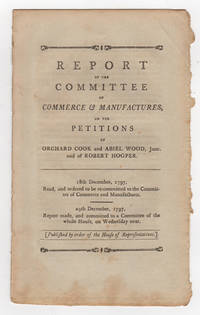
1797réf. 43741Philadelphia: Printed by William Ross 1797. First edition. Removed. Very good mostly unopened uncut untrimmed copy minor browning at lower edge. 3 226-232 2 pp. 8vo. Evans dated it both 1797 and 1798. two petitions both concerning a waving of taxes on spirits the Orchard Cook and Abiel Wood case claiming the ship was wrecked on an island and the cost of recovering the cargo exceeded the cost of the mechandise and that their insurance had lapsed. In the second case Hooper claimed he was lax in filing papers for re-shipping a cargo overseas. Wisely both were declined as the committee felt the government is not in the business of insuring that a business is successful and well run. Ah to return to those days. Orchard Cook 1763-1819 and Abiel Wood 1772-1834 had a better idea. They both became U.S. Representatives from Massachusetts. OCLC locates eight copies. Evans 33015. Evans 34753. ESTCW15017. [Printed by William Ross] unknown
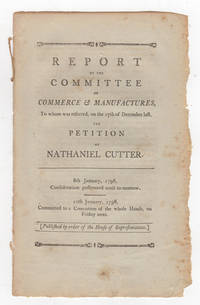
1798réf. 43744Philadelphia 1798. First edition. Removed. A very good copy lightly soiled and edge worn. 4 pp. 8vo. Nathaniel Cutter wanted relief from being re-taxed on goods that left Massachusetts where he had paid tax and then returned to the same port with the same goods because he was harrassed by the British and French and turned away in the Dominican Republic. The committee wisely wrote: "Your Committee however cannot find any good reason for relieving him against consequences of a risque which every exporter ought to calculate for himself." Cutter would continue to take risks suppling the French in Saint-Domingue and a claim was allowed him in 1803 by the American Commission in Paris for unpaid costs by the French See Greg H. Williams: The French Assault on American Shipping 1793-1813: A History p. 154. Evans 34754. ESTCW25464. unknown
1809réf. 47399London. 1809. A Failed Opportunity to Normalize U.S.-British Trade Relations Rare printing of a British Parliamentary "slip bill" seeking to reestablish trade between Great Britain and the United States a few years before the outbreak of the War of 1812 and in the midst of great tension between the two nations. This bill was considered by Parliament in the spring of 1809 in the wake of President Jefferson's rescinding the Embargo Act and following the negotiations between U.S. Secretary of State Robert Smith and British envoy David Erskine which created a glimmer of hope that Anglo-American relations might be repaired after a period of great stress and turmoil. In March 1809 Jefferson signed the Non-Intercourse Act which rescinded the Embargo of 1807 and held out the promise of resuming trade with England and France if either of those nations ended its commercial restrictions toward the United States. The Erskine-Smith negotiations of April held out the promise of improved relations and in May the Parliament considered the present bill which permitted trade between Great Britain and the United States to be carried on in American ships. Unfortunately Prime Minister Canning disavowed the Erskine-Smith Agreement in late May and Anglo-American relations continued to deteriorate culminating in outright warfare in 1812. Slip bills are printed during the legislative process in small numbers for the use of legislators and staff. They are ephemeral items and their survival is rare. A printed note before the text of the bill reads "the figures in the margin denote the Number of the Folios in the written copy" which indicates just how early in the legislative process these bills were printed. OCLC locates only a single copy at the University of Massachusetts. Folio. Lightly tanned around the edges. Near fine. OCLC 49887290. unknown books
1797réf. 43741Philadelphia: Printed by William Ross 1797. First edition. Removed. Very good mostly unopened uncut untrimmed copy minor browning at lower edge. 3 226-232 2 pp. 8vo. Evans dated it both 1797 and 1798. two petitions both concerning a waving of taxes on spirits the Orchard Cook and Abiel Wood case claiming the ship was wrecked on an island and the cost of recovering the cargo exceeded the cost of the mechandise and that their insurance had lapsed. In the second case Hooper claimed he was lax in filing papers for re-shipping a cargo overseas. Wisely both were declined as the committee felt the government is not in the business of insuring that a business is successful and well run. Ah to return to those days. Orchard Cook 1763-1819 and Abiel Wood 1772-1834 had a better idea. They both became U.S. Representatives from Massachusetts. OCLC locates eight copies. Evans 33015. Evans 34753. ESTCW15017. [Printed by William Ross] unknown books
1798réf. 43744Philadelphia 1798. First edition. Removed. A very good copy lightly soiled and edge worn. 4 pp. 8vo. Nathaniel Cutter wanted relief from being re-taxed on goods that left Massachusetts where he had paid tax and then returned to the same port with the same goods because he was harrassed by the British and French and turned away in the Dominican Republic. The committee wisely wrote: "Your Committee however cannot find any good reason for relieving him against consequences of a risque which every exporter ought to calculate for himself." Cutter would continue to take risks suppling the French in Saint-Domingue and a claim was allowed him in 1803 by the American Commission in Paris for unpaid costs by the French See Greg H. Williams: The French Assault on American Shipping 1793-1813: A History p. 154. Evans 34754. ESTCW25464. unknown books
1801réf. 56123Great Britain. ca. 1801-1807. British Essay on the Importance of American Trade During the Napoleonic Wars An interesting but unattributed and apparently unpublished manuscript essay with a caption title reading: "Loose Memo. Respectg. American Commerce." The gist of the memo is set forth in the first sentence: "The Americans are at all times the best customers of G.B. - in peace they take 1/3 of her manufactured exports - in War much more." In addition to the eager American market for British goods the author notes that British goods are often trans-shipped via America to other markets where Great Britain would not normally have access thanks to America's neutral status: ".you have only to change the name of the manufacturer & the wants of the Colonists will shut their eyes on the origin of the fabric. I have known Liverpool ware ornamented with the Portrait of Geo. III passed as German manufactures." The author notes that while the understandable economic downturn during the Revolution and for several years after the "peace of '83" resulted in some problematic credit relations between the U.S. and the British market much has changed. "The industry & the enterprise of our countrymen aided no doubt by the enjoyment of a neutral position has enabled them to throw off their dependence on the British merchant or manufacturer. They now have a sufficient capital of their own and a very important proportion of their imports are now paid for in ready money or in bills at short sight." The author explains that American merchants are able to export their surpluses of their own production and surplus British goods to the Continental market and transfer that money directly to creditors in Great Britain with an added perk: "The result of this species of trade must be ruinous to France. She is drained of her wealth to enrich & invigorate her enemy." Finally the author provides a specific example of this favored trading relationship with regard cotton. At this time the author estimates that Great Britain imports three-fifths of all cotton from the United States - some 150000 bags of cotton annually weighing 250lbs. each. The U.S. buys back nearly one-third of all cotton goods manufactured in Great Britain yielding a net profit of over £2.5 million to Great Britain. The author adds that this ratio holds for almost all raw materials produced in the United States. This essay was almost certainly written during the earlier part of the Napoleonic Wars; the author cites an 1801 speech by Lord Grenville which helps narrow the date range and it seems unlikely the Embargo Act of 1807 had been passed yet. Regardless the essay promotes Anglo-American trade and cooperation at least insofar as it enriches Britain and cripples France at a time when other forces were driving the two countries toward war. Light tanning and soiling occasional ink smudges. Very good. unknown books
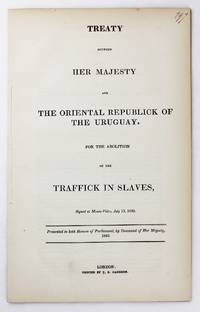
1842réf. 6316London: T.R. Harrison 1842. Near fine. 38pp. stitched. Very minor bumps to top edge of first leaf light dust-soiling to outer leaves. A very rare treaty between Queen Victoria’s Britain and the “Oriental Republick of the Uruguay” printed in both English and Spanish in two parallel columns throughout. According to the text the parties were “mutually animated by a sincere desire to co-operate for the utter extinction of the barbarous Traffick in Slaves.for the special purpose of immediately attaining this object so far as relates to the total and final abolition of the Slave Trade of the Oriental Republick of the Uruguay.” The treaty is comprised of fourteen original articles plus three annexes totaling forty-six additional articles and four additional articles at the end covering a host of issues pertaining to the suppression of the slave trade. These issues included enforcement procedures the establishment of “Mixed Courts of Justice” “Regulations in respect to treatments of liberated negroes” and much more. With regard to slaves found on international vessels the two nations hoped for “permanent good treatment and a full and complete emancipation according to the humane intentions of the Parties of the Treaty.” The present treaty was part of a larger effort by the British Crown to put an end to the transatlantic slave trade in the first half of the 19th century; at this same time Britain had reached terms on a similar treaty with the Republic of Texas and other nations. The document is signed at the end in type by J.H. Mandeville and Jose Ellauri representatives of the two countries who originally signed the treaty at Montevideo on July 13 1839; the present work was “Presented to both Houses of Parliament by Command of Her Majesty” in 1842 likely due to bureaucratic delays. Uruguay would have been an important ally for Great Britain in monitoring the seas against the transatlantic slave trade given its position opposite the South Atlantic Ocean from West Africa. OCLC records just a single physical copy of this treaty at the University of Arizona. Cundall 2854. T.R. Harrison unknown
1842réf. 6316London: T.R. Harrison 1842. Near fine. 38pp. stitched. Very minor bumps to top edge of first leaf light dust-soiling to outer leaves. A very rare treaty between Queen Victoria’s Britain and the “Oriental Republick of the Uruguay” printed in both English and Spanish in two parallel columns throughout. According to the text the parties were “mutually animated by a sincere desire to co-operate for the utter extinction of the barbarous Traffick in Slaves.for the special purpose of immediately attaining this object so far as relates to the total and final abolition of the Slave Trade of the Oriental Republick of the Uruguay.” The treaty is comprised of fourteen original articles plus three annexes totaling forty-six additional articles and four additional articles at the end covering a host of issues pertaining to the suppression of the slave trade. These issues included enforcement procedures the establishment of “Mixed Courts of Justice” “Regulations in respect to treatments of liberated negroes” and much more. With regard to slaves found on international vessels the two nations hoped for “permanent good treatment and a full and complete emancipation according to the humane intentions of the Parties of the Treaty.” The present treaty was part of a larger effort by the British Crown to put an end to the transatlantic slave trade in the first half of the 19th century; at this same time Britain had reached terms on a similar treaty with the Republic of Texas and other nations. The document is signed at the end in type by J.H. Mandeville and Jose Ellauri representatives of the two countries who originally signed the treaty at Montevideo on July 13 1839; the present work was “Presented to both Houses of Parliament by Command of Her Majesty” in 1842 likely due to bureaucratic delays. Uruguay would have been an important ally for Great Britain in monitoring the seas against the transatlantic slave trade given its position opposite the South Atlantic Ocean from West Africa. OCLC records just a single physical copy of this treaty at the University of Arizona. Cundall 2854. T.R. Harrison unknown books
1936réf. 44300Washington: Bureau of the Census 1936. 1936. 8 1/4" x 9" vanilla sheet folded in half to create 4 panels. Cover panel offers title and farming scene with various statistics on sides. 2-panel color map showing population by color. One page of facts and facts pertaining to Texas. A fascinating brochure. Light soiling and with light wear to extremities. Bureau of the Census, 1936. unknown
1939réf. 158Washington DC: United States Government Printing OFfice 1939. Second Edition. Cloth. Very good. Inserted maps and charts fold-out: Index Map: Coast and Geodetic Survey Charts 1939; U.S. Coast and Geodetic Survey Inside Route Key West to Rio Grande No. 1 1936 Florida and Gulf of Mexico; No. 2 1936 Gulf of Mexico: Sabine Pass to St. George Sound; No. 3 1936 Gulf of Mexico: coast of Texas. 8vo; vi 397pp; pale green buckram over board with black decorative border and title to front cover and spine stamped in black seal of Department of Commerce to back cover; purple stamp of Hydrographic Office Navy to front free endpaper; errata and updates with tipped in corrections at page; light green edges; light foxing to edges and cover light soiling to cover lightly cocked forward; binding tight maps all present and clean; very good. United States Government Printing OFfice unknown
1939réf. 158Washington DC: United States Government Printing OFfice 1939. Second Edition. Cloth. Very good. Inserted maps and charts fold-out: Index Map: Coast and Geodetic Survey Charts 1939; U.S. Coast and Geodetic Survey Inside Route Key West to Rio Grande No. 1 1936 Florida and Gulf of Mexico; No. 2 1936 Gulf of Mexico: Sabine Pass to St. George Sound; No. 3 1936 Gulf of Mexico: coast of Texas. 8vo; vi 397pp; pale green buckram over board with black decorative border and title to front cover and spine stamped in black seal of Department of Commerce to back cover; purple stamp of Hydrographic Office Navy to front free endpaper; errata and updates with tipped in corrections at page; light green edges; light foxing to edges and cover light soiling to cover lightly cocked forward; binding tight maps all present and clean; very good. United States Government Printing OFfice unknown books
1885réf. AQ35201Washington: Government Printing Office 1885. 438pp. Together with: US TRADE REPORTS. Reports of the commission appointed under an act of congress approved july 7 1884 "to ascertain and report upon the best modes of securing more intimate international and commercial relations between the united states and the several countries of central and south america." Washington. Government Printing Office 1886. First edition. 491pp 1. With two large folding maps to rear. 8vo. Modern burgundy cloth ruled and lettered in gilt to spine. Very lightly rubbed. Very occasional spotting; edges of some leaves browned. The sole edition of several collected reports of the United States government outlining the details of the appointment of a Central and South American Commission in July 1884 with the aim of improving international and commercial relations with the nations of Central and South America. The ventures of the Commission were addressed by President Chester A. Arthur as he delivered to Congress the Annual Message of the President on December 1 1884: 'The Central and South American Commission appointed by authority of the act of July 7 1884 will soon proceed to Mexico. It has been furnished with instructions which will be laid before you. They contain a statement of the general policy of the Government for enlarging its commercial intercourse with American States. The commissioners have been actively preparing for their responsible task by holding conferences in the principal cities with merchants and others interested in Central and South American trade.' . First edition. Government Printing Office hardcover
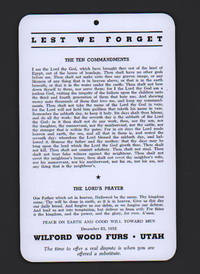
réf. 54790Trade card 3 3/4" x 6" The date listed is 1952 however this is most likely a reproduction. unknown books
réf. 166566S.l.n.d. in-4, 25 pp., dérelié. Petit manque à la page 5, sans atteinte au texte.
réf. 206898Valenciennes, Imprimerie de la veuve J.-B.-G. Henry, 1773 in-12, 252 pp., broché sous couverture d'attente de papier marbré, manque la première couverture.
réf. ORD-15394Paris. 15 Avril 1820. In-4 (199 x 251mm) broché, sans couverture, tel que paru, 18, (2) pages. Bel exemplaire.
1779réf. 11842Orléans, Veuve Rouzeau-Montaut, 1779. In-12 de [2]-VIII-394 pages, plein veau marbré brun, dos à nerfs orné de filets et fleurons dorés, pièce de titre bordeaux, filet doré sur les coupes, tranches rouge. Ex-libris de Béat Fidèle Antoine Jean Dominique de La Tour-Châtillon de Zurlauben, militaire et fameux histoirien suisse.
1935réf. 44871Vancouver: Vancouver Chamber of Commerce Evergreen Hotel 1935. 1935. WASHINGTON. First edition. 8 1/2" x 6" in pictorial wrappers showing Beacon Rock. 24 pp. Numerous photo illustrations illustrated ads maps 1 double-page centerfold pictorial map. Land promotion and local history of Vancouver Washington detailing city growth history and economic opportunities as the Great Depression receded. Light tanning to edge of front wrapper along with very light wear to the extremities as well as rubbing to spine. Very good. Vancouver Chamber of Commerce, Evergreen Hotel, 1935. unknown
1900réf. 858291900 Le Puy, Marchessou, 1900, in 8° broché, 231 pages ; couverture fanée, le plat inférieur manque.
réf. 209381Rouen, Imprimerie de I.-S. Lefevre, 1843 in-8, 16 pp., broché. Trace de crayon de couleur verte en page 4 seulement, datant vraisemblablement de l'époque.
réf. 116926Paris, Imprimerie de Selligue, 1830 in-8, 76 pp., bradel papier marbré (rel. moderne).
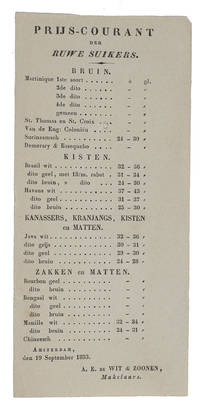
1721réf. LC4D1MQ3QGJ6Amsterdam 1721. 1 leaf 21 x 8 cm; 1 leaf 20.5 x 8 cm; 1 leaf 17.5 x 8 cm. Jacobus van Egmond Ad 1: Text printed on both sides each in a border built up from typographic ornaments. Ad 2: Text printed on one side. Ad 3: Text printed on one side. 3 documents. Ad. 1: Rare VOC ships manifest for cargo shipped from the East Indies - Batavia and Ceylon Sri Lanka - on 22 East-Indiamen sailing on 1 December 1720 from Batavia and on 15 November from Ceylon. The list includes more than 100 different colonial wares and gives the weights in pounds or the lengths in feet: from pepper more than 6.5 million pounds cloves 694000 pounds cinnamon 604000 pounds and coffee more than 1.77 million pounds to 962 pounds of Javanese cardamom some jewels and rariora and many feet of silk and linen cloth. Small wormhole affecting two characters otherwise in good condition.Ad. 2: Rare list of the results of the auctions of colonial wares organized in 1781 by the Chambers of the VOC Amsterdam 30 April 1781; Zeeland 7 May; Delft 15 May; Rotterdam 17 May; Hoorn 22 May; Enkhuizen 23 May including pepper cinnamon nutmeg etc. with the prices fetched. With a small tear not affecting the text. Still in good condition.Ad. 3: Price list of the various varieties of raw sugar: brown sugar from Martinique Surinam etc.; sugar packed in chests from Brazil Havana; in bales from Bengal Manilla etc.Small hole not affecting the text.l Ad. 1: cf. Landwehr VOC 1123-1134 other manifests. hardcover
1667réf. ABC_508101667. Ca. 23.5 x 26.5 cm and ca. 20 x 24 cm. With a woodcut decorated initial on each ordinance. Two closely related Dutch Republic broadsides both concerned with the suppression of fraud in the spice trade under the monopoly and protection of the Dutch East India Company. Together they form a vivid legal response to widespread commercial adulteration of imported spices particularly pepper nutmeg and mace reflecting both the economic importance and vulnerability of the Dutch spice trade in the 17th century. Both texts are issued as public ordinances intended for proclamation and posting throughout the provinces and both impose heavy fines and confiscation for violations alongside rewards for informants and penalties distributed between officials and local relief funds.The first proclamation from 16 September 1667 responds to reports of severely compromised pepper entering the Dutch Republic via England explicitly referencing the aftermath of the Great Fire of London. The text describes burnt pepper imported after the disaster which is said to retain only the outward appearance of pepper while being stripped of all quality and even emitting a foul smell. Authorities warn that such material is being mixed with genuine spice and sold fraudulently undermining both consumers and the reputation of the VOC.The second later and more extensive proclamation of 22 November 1669 significantly broadens the scope of earlier regulations. Rather than focusing solely on pepper it addresses systematic adulteration across a wide range of spices including pepper nutmeg mace and powdered spice residues. It describes the importation of dust powder and refuse of spices from abroad which are being reprocessed and mixed with genuine goods or artificially manipulated such as being moistened with water to increase weight and deceive buyers.The margins of both of the ordinances are cut short the first ordinance shows some browning and a minor tear. Otherwise in good condition. unknown