17 322 résultats
1667réf. ABC_508101667. Ca. 23.5 x 26.5 cm and ca. 20 x 24 cm. With a woodcut decorated initial on each ordinance. Two closely related Dutch Republic broadsides both concerned with the suppression of fraud in the spice trade under the monopoly and protection of the Dutch East India Company. Together they form a vivid legal response to widespread commercial adulteration of imported spices particularly pepper nutmeg and mace reflecting both the economic importance and vulnerability of the Dutch spice trade in the 17th century. Both texts are issued as public ordinances intended for proclamation and posting throughout the provinces and both impose heavy fines and confiscation for violations alongside rewards for informants and penalties distributed between officials and local relief funds.The first proclamation from 16 September 1667 responds to reports of severely compromised pepper entering the Dutch Republic via England explicitly referencing the aftermath of the Great Fire of London. The text describes burnt pepper imported after the disaster which is said to retain only the outward appearance of pepper while being stripped of all quality and even emitting a foul smell. Authorities warn that such material is being mixed with genuine spice and sold fraudulently undermining both consumers and the reputation of the VOC.The second later and more extensive proclamation of 22 November 1669 significantly broadens the scope of earlier regulations. Rather than focusing solely on pepper it addresses systematic adulteration across a wide range of spices including pepper nutmeg mace and powdered spice residues. It describes the importation of dust powder and refuse of spices from abroad which are being reprocessed and mixed with genuine goods or artificially manipulated such as being moistened with water to increase weight and deceive buyers.The margins of both of the ordinances are cut short the first ordinance shows some browning and a minor tear. Otherwise in good condition. unknown
Second edition, 110pp., pamphlet with a marbled paper spine. Hanson, 4813n; Goldsmiths', 7306.
1813réf. BK0183Lisbon 1813. Autograph letter signed 3 pp. on a folded sheet with integral address panel to Messrs. Brown & Ives Providence Rhode Island and Newport "SHIP" and circular datestamps. 8 x 9 ¾ inches. Folded for mailing with considerable wear along the folds several tears and small losses including losses from opening the seal affecting scattered words. Good overall and substantially legible. A commercial letter written from Lisbon during the War of 1812 by "P. Falconer" probably the Baltimore merchant Peregrine Falconer. The identification remains somewhat tentative but the 1812 Baltimore directory lists Comegys Falconer & Co. merchants at 190 Baltimore Street while later Maryland Chancery records document the estate of Peregrine Falconer; Missouri archival records also document Falconer and Comegys and both "Perregrine" and "Perry" Falconer. Falconer was preparing to sail from Lisbon for Falmouth and writes Brown & Ives with the latest commercial and political intelligence reaching Portugal. He expected the widening European opposition to Napoleon to bring still more nations into the war then turned immediately to British policy toward American trade: "from the complexion of affairs that in the course of the Summer all the powers in Europe will be joined against France. If I am correctly informed a new duty of 6d. pr lb in addition is imposed in Britain upon American Cotton . Savannah Charleston & New York in a state of Blockade - this with the new duty has advanced the Price of Cotton .". The Russo-Prussian alliance had been concluded only weeks earlier Sweden joined the anti-Napoleonic alliance on March 24 and the coalition would continue to expand during the year. At the same time the English Parliament was debating additional duties on American cotton: on March 31 the government proposed sixpence per pound on American cotton imported in foreign vessels while Alexander Baring warned that American cotton carried by neutral ships would consequently bear a total duty of ninepence per pound. British naval pressure on the American coast was also rapidly increasing during the spring of 1813 trapping increasing amounts of American shipping in port. Falconer's letter thus records from Lisbon the immediate commercial relationship between the blockade British taxation and the price of American cotton. The war also forced Falconer to reconsider how Brown & Ives should communicate with him once he reached Britain. He gives explicit instructions intended to obscure their route: "I presume the only means of corresponding with Liverpool will be by the way of Lisbon. I have to request that you will write to me . frequently enclosing your letters under cover to Messrs. - & Brown without marking 'Via Lisbon' as letters coming from America are all opened in Britain." The remainder concerns the practical movement of merchants and shipping through the same wartime network including Falmouth and Liverpool passage arrangements vessels preparing to sail and convoying. Overall a useful merchant's-eye letter from the spring of 1813 with the blockade of American ports the British cotton duty the developing coalition against Napoleon and the routing of commercial correspondence all appearing as parts of the same Atlantic problem. . unknown
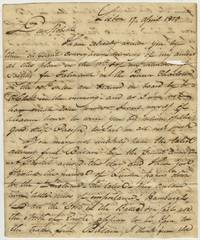
1813réf. BK0183Lisbon 1813. Autograph letter signed 3 pp. on a folded sheet with integral address panel to Messrs. Brown & Ives Providence Rhode Island and Newport "SHIP" and circular datestamps. 8 x 9 ¾ inches. Folded for mailing with considerable wear along the folds several tears and small losses including losses from opening the seal affecting scattered words. Good overall and substantially legible. A commercial letter written from Lisbon during the War of 1812 by "P. Falconer" probably the Baltimore merchant Peregrine Falconer. The identification remains somewhat tentative but the 1812 Baltimore directory lists Comegys Falconer & Co. merchants at 190 Baltimore Street while later Maryland Chancery records document the estate of Peregrine Falconer; Missouri archival records also document Falconer and Comegys and both "Perregrine" and "Perry" Falconer. Falconer was preparing to sail from Lisbon for Falmouth and writes Brown & Ives with the latest commercial and political intelligence reaching Portugal. He expected the widening European opposition to Napoleon to bring still more nations into the war then turned immediately to British policy toward American trade: "from the complexion of affairs that in the course of the Summer all the powers in Europe will be joined against France. If I am correctly informed a new duty of 6d. pr lb in addition is imposed in Britain upon American Cotton . Savannah Charleston & New York in a state of Blockade - this with the new duty has advanced the Price of Cotton .". The Russo-Prussian alliance had been concluded only weeks earlier Sweden joined the anti-Napoleonic alliance on March 24 and the coalition would continue to expand during the year. At the same time the English Parliament was debating additional duties on American cotton: on March 31 the government proposed sixpence per pound on American cotton imported in foreign vessels while Alexander Baring warned that American cotton carried by neutral ships would consequently bear a total duty of ninepence per pound. British naval pressure on the American coast was also rapidly increasing during the spring of 1813 trapping increasing amounts of American shipping in port. Falconer's letter thus records from Lisbon the immediate commercial relationship between the blockade British taxation and the price of American cotton. The war also forced Falconer to reconsider how Brown & Ives should communicate with him once he reached Britain. He gives explicit instructions intended to obscure their route: "I presume the only means of corresponding with Liverpool will be by the way of Lisbon. I have to request that you will write to me . frequently enclosing your letters under cover to Messrs. - & Brown without marking 'Via Lisbon' as letters coming from America are all opened in Britain." The remainder concerns the practical movement of merchants and shipping through the same wartime network including Falmouth and Liverpool passage arrangements vessels preparing to sail and convoying. Overall a useful merchant's-eye letter from the spring of 1813 with the blockade of American ports the British cotton duty the developing coalition against Napoleon and the routing of commercial correspondence all appearing as parts of the same Atlantic problem. . unknown books
1900réf. 70853Warrenton VA: Joseph A. Jeffries 1900. Small broadside 9 ½ x 6 inches printing a long advertising statement for the store "Restore your health keep your health and add to your comfort by placing your orders where you may be assured they will be conscientiously filled" signed in type at the end "Joseph A. Jeffries Practical Pharmacist. Jeffries 1840-1919 served in the 17th Virginia during the Civil War and ran the pharmacy under his own name 1877-1908. Apparently not recorded on OCLC. Old central fold else very good. Joseph A. Jeffries unknown
1900réf. 70853Warrenton VA: Joseph A. Jeffries 1900. Small broadside 9 ½ x 6 inches printing a long advertising statement for the store "Restore your health keep your health and add to your comfort by placing your orders where you may be assured they will be conscientiously filled" signed in type at the end "Joseph A. Jeffries Practical Pharmacist. Jeffries 1840-1919 served in the 17th Virginia during the Civil War and ran the pharmacy under his own name 1877-1908. Apparently not recorded on OCLC. Old central fold else very good. Joseph A. Jeffries unknown books
First edition, vi, [1], 26 pp., disbound. Kress, 4479; Goldsmith, 7700.
Third Edition, 35, [1] pp., modern marbled wrappers. Kress, 4538; Goldsmith, 7763.
27, [1]pp., final leaf stained, stitched as issued, uncut.
1851réf. 61963London: Longman Brown Green and Longmans 1851. First Edition. First printing. Octavo 21cm. Two volumes in brown cloth stamped in blind and gilt; blue and white printed endpapers with publisher's advertisements; xii244pp; vi248pp; 10 tinted lithographs some with hand coloring and 3 black and white lithographs. Errata slip in vol. I following contents. Binder's ticket of Remnant & Edmonds London to rear pastedown of vol. I. Ownership inscriptions of F. J. Young to front endpaper versos. Unfaded and straight frayed at spine ends vol. I with tear to cloth over rear joint and minor perforations to paper over interior hinges vol. II starting split to front joint short tears to cloth over both joints and short 2-in crack to rear hinge; occasional spots of browning but generally clean: Very Good. A Royal Naval officer's journals of visits to Dahomey a kingdom located in what is now southern Benin published with an antislavery intent: "It is the object of the author.to illustrate the dreadful slave hunts and ravages the annihiliations and exterminations consequent on this trade; and to bring prominently before the British public the sacred service they are rendering" through their efforts to halt the slave trade p.iv vol.I. NOT IN ABBEY. Longman, Brown, Green, and Longmans unknown
1851réf. 61963London: Longman Brown Green and Longmans 1851. First Edition. First printing. Octavo 21cm. Two volumes in brown cloth stamped in blind and gilt; blue and white printed endpapers with publisher's advertisements; xii244pp; vi248pp; 10 tinted lithographs some with hand coloring and 3 black and white lithographs. Errata slip in vol. I following contents. Binder's ticket of Remnant & Edmonds London to rear pastedown of vol. I. Ownership inscriptions of F. J. Young to front endpaper versos. Unfaded and straight frayed at spine ends vol. I with tear to cloth over rear joint and minor perforations to paper over interior hinges vol. II starting split to front joint short tears to cloth over both joints and short 2-in crack to rear hinge; occasional spots of browning but generally clean: Very Good. A Royal Naval officer's journals of visits to Dahomey a kingdom located in what is now southern Benin published with an antislavery intent: "It is the object of the author.to illustrate the dreadful slave hunts and ravages the annihiliations and exterminations consequent on this trade; and to bring prominently before the British public the sacred service they are rendering" through their efforts to halt the slave trade p.iv vol.I. NOT IN ABBEY. Longman, Brown, Green, and Longmans unknown books
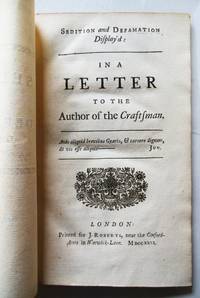
1731réf. 825London: Printed for J. Roberts near the Oxford Arms in Warwick-Lane 1731. First edition. Very good. Octavo. approx. 20 cm. 2 viii 48 pp. Complete with half-title. Disbound; woodcut title vignette initials and ornaments. Notation in 18th century hand on half-title referring to the Dedication "Suppos'd by Lord Harvey sic." Very good or better. First edition. The dedication preface contains a scathing attack on William Pulteney who then mistakenly attributed authorship to John Lord Hervey and responded with A Proper Reply culminating in a duel both combatants were uninjured. The true author was Sir William Yonge Sir Robert Walpole's lieutenant notoriously disliked by George II. The text includes a pointed reference to losses sustained by British merchants in the West Indies on the lower quarter of page 13. . ESTC T47414. Printed for J. Roberts, near the Oxford Arms in Warwick-Lane unknown
1871réf. 62250Hartford CT: Columbian Book Co. 1871. 8vo. xxi 1 23-602 pp. plus 4 pp. publisher’s ads. Steel-engraved frontisp. with numerous woodcut engravings & illustrations. Plum-coloured publisher’s cloth gilt bear stamped on front cover title lettering embossed in blind on spine minor foxing to frontisp. minor sunning & wear to spine edgewear slight uniform interior toning still a VG- copy. Second printing of this informative work gathered from the author’s first-hand interviews with early settlers and mountain men of the Pacific Northwest including Joe Meek William Henry Gray and others. Much of the work was actually written in the house of noted Oregon pioneer & author Belle W. Cooke who describes how she was “often reading the manuscript to my father and mother for comment.” Victor herself notes after publication that some of the historical facts regarding Marcus Whitman his efforts in the Oregon Country and the massacre orally related to her by Gray needed to have been checked more carefully. Victor d. 1902 was the primary author for the Bancroft histories of Oregon Washington and the Northwest Coast as well as a noted author of poetry and literature. See Powers History of Oregon Literature pp. 282 305-309 Graff 4477 1870 ed. Columbian Book Co., hardcover
First Edition, 8vo (170 x 100 mm), [4], 183, [1] pp., "From the Editor" written in ink on fly-leaf, folding table, turn-ins offset, contemporary calf, upper cover detached, spine rubbed, label. Provenance: Frank Herbert Muir, CBE was an English comedy writer, radio and television personality, with his signature in pencil on front paste-down. Kress, 6148; Goldsmith, 9909; Higgs, 2966; Roscoe, A624 (1).
réf. AQ27989vs.: vs. 1820-40s An archive comprised of sixty-eight loose articles of late Georgian and early Victorian manuscript and printed ephemera relating to the purchase of alcohol including a number of bill-heads for merchants in inter alia Glasgow and London. The majority of the manuscript material - predominantly receipts and purchase orders - are addressed to Nottingham-based wine merchant Thomas Bailey 1785-1856 father of poet Philip James Bailey 1816-1902 noted author of Festus 1839. The elder Bailet who established his business in 1817 relinquished control in the 1830s in order to devote himself more fully to his roles as newspaper editor and author. The later material in this archive dating to the 1840s is addressed to Bailey's son-in-law and successor John Brown. A remarkable opportunity to acquire an archive of mid-nineteenth century commercial material directly connected to the provincial wine and spirit trade. . [vs.], [1820-40s] unknown
1741réf. AQ25221London: Sold by J. Roberts 1741. 40pp. Uncut. Stitched as issued. A trifle dusty. Scattered spotting. The sole edition of an anonymous pamphlet written in reply both to Samuel Webber's An account of a scheme for preventing the exportation of our wool London 1740 and William Webster's 1689-1758 The consequences of trade. London 1740 which called for reforms to woollen manufactory. ESTC T46871. First edition. 8vo. Sold by J. Roberts unknown
Third edition, 8vo (220 x 140 mm), x, [1], 432pp., hand-coloured folding engraved map,, 2 folding engraved plates, occasional spotting and off- setting, recent cloth, leather title label to spine.
réf. ORD-3537Guide illustré en 5 sections et en 5 langues. Réuni à l'Album Universel des Eaux minérales, des Bains de mer & des Stations d'hiver. 19°Année. 1881. Paris. Cambon. 1881. In-f°(295 x 385mm) percaline rouge de l'éditeur, lettrage or, tranches dorées, fx-titre, titre et 386 pages non chiffrées, nombreuses illustrations. Reliure en assez mauvais état, ors presque complètement passés, bon état intérieur.
réf. 105567A Paris, de l'Imprimerie Royale, 1785 in-4, 4 pp.
réf. ORD-3617Qui condamne le nommé Ladmiral, Epicier-Chandelier, en 50 livres d'amende, pour être contrevenu aux Arrêts, Sentences, Ordonnances & Réglements de Police concernant la vente des Suifs. Pierres. 1782. 3pp.in-4 sans couverture, bandeau.
réf. 152816Paris, N.-H. Nyon, 1788 in-4, 14 pp., en feuilles, cousu.
réf. 237786Paris, P. G. Simon, 1779 in-4, 4 pp., en feuille.
réf. DADAX0300192169New unknown
réf. 1528394062.Gpaperback. Good. Access codes and supplements are not guaranteed with used items. May be an ex-library book. paperback
réf. DADAX0199285586New unknown