[SLAVERY & ABOLITION] MELLOR, EnochBiblio.com
1 561 résultats
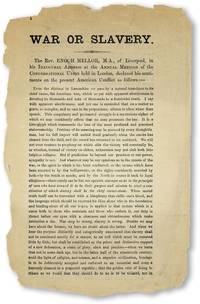
1863réf. 46597Manchester: Union and Emancipation Society n.d. ca. 1863. First Edition. Original broadsheet handbill 22x13.5cm.; extremities chipped with shallow losses not approaching text the whole rather dust-soiled and unevenly toned else Good or better overall. Text reproduces an address delivered by the Rev. Enoch Mellor of Liverpool "in his INAUGURAL ADDRESS at the ANNUAL MEETING of the CONGREGATIONAL UNION held in London" in which he "declared his sentiments on the present American Conflict." Mellor 1823-1881 was the life-long minister of the non-conformist Square Congregational Church in Halifax West Yorkshire with the exception of a five-year period coinciding with this address when he succeeded the abolitionist Congregational minister Thomas Raffles 1788-1863. Mellor's argument begins with reference to the Lancashire Cotton Panic an economic depression caused by a dearth of baled cotton imports following the start of the American Civil War. Mellr goes on to say that "War /may/ be wrong slavery /is/ wrong" comparing its presence on the American continent with that of the propagation of polygamy "carefully and resolutely laid as a foundation-stone in the territory of Utah. Union and Emancipation Society unknown
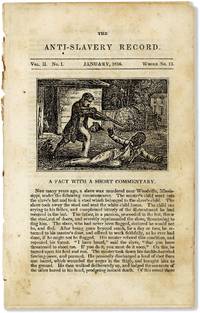
1836réf. 82919New York: American Anti-Slavery Society 1836. 12mo 19cm. Stitched self-wrappers; pp.1-12. Removed; first and final leaves detached but present; light soil scattered faint foxing; tear to bottom inch of bound edge away from text; complete and Good. Woodcut decoration at head of text a strikingly violent image depicting the murder of a Black man by his enslaver in Woolville Mississippi. Single issue of this monthly abolitionist periodical that ran from 1835 to 1837 published by the American Anti-Slavery Society under the direction of Elizur Wright. It was "a small magazine with excellent woodcuts containing principally extracts from other publications" that was "distributed freely without charge" and "found its way into the schools and colleges everywhere" Dumond p.267. Wright stated that in September 1835 the Society published 25000 copies of the Record p.267. BLOCKSON 9174. LCP AFRO-AMERICANA 622. American Anti-Slavery Society unknown
1836réf. 82919New York: American Anti-Slavery Society 1836. 12mo 19cm. Stitched self-wrappers; pp.1-12. Removed; first and final leaves detached but present; light soil scattered faint foxing; tear to bottom inch of bound edge away from text; complete and Good. Woodcut decoration at head of text a strikingly violent image depicting the murder of a Black man by his enslaver in Woolville Mississippi. Single issue of this monthly abolitionist periodical that ran from 1835 to 1837 published by the American Anti-Slavery Society under the direction of Elizur Wright. It was "a small magazine with excellent woodcuts containing principally extracts from other publications" that was "distributed freely without charge" and "found its way into the schools and colleges everywhere" Dumond p.267. Wright stated that in September 1835 the Society published 25000 copies of the Record p.267. BLOCKSON 9174. LCP AFRO-AMERICANA 622. American Anti-Slavery Society unknown books
1863réf. 46597Manchester: Union and Emancipation Society n.d. ca. 1863. First Edition. Original broadsheet handbill 22x13.5cm.; extremities chipped with shallow losses not approaching text the whole rather dust-soiled and unevenly toned else Good or better overall. Text reproduces an address delivered by the Rev. Enoch Mellor of Liverpool "in his INAUGURAL ADDRESS at the ANNUAL MEETING of the CONGREGATIONAL UNION held in London" in which he "declared his sentiments on the present American Conflict." Mellor 1823-1881 was the life-long minister of the non-conformist Square Congregational Church in Halifax West Yorkshire with the exception of a five-year period coinciding with this address when he succeeded the abolitionist Congregational minister Thomas Raffles 1788-1863. Mellor's argument begins with reference to the Lancashire Cotton Panic an economic depression caused by a dearth of baled cotton imports following the start of the American Civil War. Mellr goes on to say that "War /may/ be wrong slavery /is/ wrong" comparing its presence on the American continent with that of the propagation of polygamy "carefully and resolutely laid as a foundation-stone in the territory of Utah. Union and Emancipation Society unknown books
1856réf. 33708Philadelphia 1856. 24pp disbound three small binding holes in blank left margin. Two early signatures of Wm. Thompson Shafer on title page. Light spotting throughout. About Good. This scarce pamphlet says the "great issue" is whether "Slavery shall be allowed to overspread a territory of greater extent than that of the whole United States" and "whether the policy of our government is to continue to be that of Slavery Extension or Slavery Restriction." All the power of the presidency is "being used to force the withering and blighting scourge of Slavery upon the National domain." Pursuing this tyrannical course our government "shall lend its aid in striking a deathblow to the freedom of speech the liberty of the press and the security for life personal liberty possession and peace." LCP 4300. OCLC 22829199 4- LCP No. IL U Haverford Detroit Pub. Lib. as of April 2017. unknown
1856réf. 33708Philadelphia 1856. 24pp disbound three small binding holes in blank left margin. Two early signatures of Wm. Thompson Shafer on title page. Light spotting throughout. About Good. This scarce pamphlet says the "great issue" is whether "Slavery shall be allowed to overspread a territory of greater extent than that of the whole United States" and "whether the policy of our government is to continue to be that of Slavery Extension or Slavery Restriction." All the power of the presidency is "being used to force the withering and blighting scourge of Slavery upon the National domain." Pursuing this tyrannical course our government "shall lend its aid in striking a deathblow to the freedom of speech the liberty of the press and the security for life personal liberty possession and peace." LCP 4300. OCLC 22829199 4- LCP No. IL U Haverford Detroit Pub. Lib. as of April 2017. unknown books
réf. ORD-12396Ouvrage orné d'une Carte dressée par M. Lapie et de Planches dessinées par H. Vernet, et autres artistes distingués. Paris. Mongie Aîné. 1821. 2 tomes en 2 volumes in-8 (138 x 220mm) dos à 5 nerfs, basane violette virée au fauve, filets et caissons or, plats toile chagrinée violette, gardes marbrées, XVI, 348 pages et 2ff., 368, (4) pages. Les hors texte du tome II sont remplacés par des photocopies à l'exception de la vue dépliante de Tanger qui est à la fois en version originale et en photocopie. SANS LA GRANDE CARTE. Dos de couvertures abîmés dans leur partie inférieure sinon bon état, très rares rousseurs.
réf. ORD-6942With Map and Illustrations. London. Sampson Low, Marston, Low and Searle. 1873. In-8 (145 x 204mm) dos à 5 nerfs et coins veau vert foncé, pièce de titre veau rouge, plats toile chagrinée, XIV, (2), 304 pages, grande carte rempliée hors texte (piquée et réparée sans perte), frontispice, illustrations en noir dont 8 hors texte. Des rousseurs éparses sinon assez bon exemplaire.
réf. 058273Paris Gustave Barba, Libraire-Editeur 1853 grand in 8 (27,5x18,5) 1 volume reliure demi chagrin aubergine de l'époque, dos à nerfs orné de riches caissons dorés, 323 pages, avec de nombreuses illustrations, dont hors-texte sous serpentes, des rousseurs claires éparses sur les premières et les dernières pages, et sur les serpentes, signature ex-libris ancienne sur la page de faux-titre. Roman américain traduit par Emile de La Bédollière. Rare édition illustrée. Bon exemplaire, reliure décorative de l'époque ( Photographies sur demande / We can send pictures of this book on simple request )
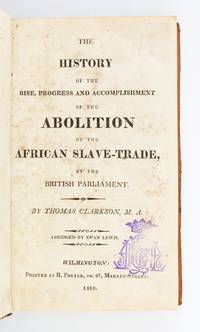
1816réf. ST19567-131Wilmington: Printed by R. Porter 1816. Abridged Edition. 180 x 115 mm. 7 x 4 1/2". 348 pp.Abridged by Evan Lewis. Contemporary tree calf smooth spine with double gilt rules tan leather label with gilt lettering. With one small illustration of a seal in text. Title with crowned monogram stamp in purple ink. Sabin 13486. Calf with significant wear front hinge exposed but the binding very tight; text as expected with varying sometimes noticeable degrees of foxing and browning because of quality of paper. First published in two volumes in 1808 this important work on the history of the slave trade is an "invaluable" resource and "contains much essential autobiographical and other information." DNB The present edition was condensed into one volume in order to "be more generally diffused among the people of the United States" where slavery would not be abolished for another half a century. Thomas Clarkson 1760-1846 was a leading English abolitionist who advocated for an end to slavery world-wide and was an original founder of the Committee for the Abolition of the Slave Trade as well as the pacifist Society for the Promotion of Permanent and Universal Peace. Printed by R. Porter
1816réf. ST19567-131Wilmington: Printed by R. Porter 1816. Abridged Edition. 180 x 115 mm. 7 x 4 1/2". 348 pp.Abridged by Evan Lewis. Contemporary tree calf smooth spine with double gilt rules tan leather label with gilt lettering. With one small illustration of a seal in text. Title with crowned monogram stamp in purple ink. Sabin 13486. Calf with significant wear front hinge exposed but the binding very tight; text as expected with varying sometimes noticeable degrees of foxing and browning because of quality of paper. First published in two volumes in 1808 this important work on the history of the slave trade is an "invaluable" resource and "contains much essential autobiographical and other information." DNB The present edition was condensed into one volume in order to "be more generally diffused among the people of the United States" where slavery would not be abolished for another half a century. Thomas Clarkson 1760-1846 was a leading English abolitionist who advocated for an end to slavery world-wide and was an original founder of the Committee for the Abolition of the Slave Trade as well as the pacifist Society for the Promotion of Permanent and Universal Peace. Printed by R. Porter books
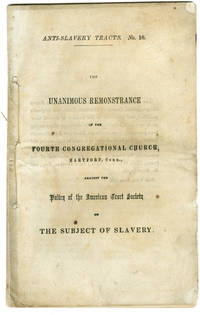
1855réf. 55824New York: American Anti-Slavery Society 1855. Criticizing the American Tract Society for Suppressing Anti-Slavery Works The scarce second printing of what is technically the first edition of this anti-slavery pamphlet printed in New York by the American Anti-Slavery Society from the same "stereotype plates.without alteration" as the edition printed in Hartford earlier the same year. The text focuses on an appeal to the American Tract Society to take a more vocal and concerted stand against slavery. The authors of the text accuse the American Tract Society of "suppression" of anti-slavery sentiment by censorship of certain works it publishes that speak against the institution and an overall sin of "studied and persistent omission" by not itself issuing "a direct condemnation of the most giant iniquity of our land." The text is signed in print at the conclusion by "The Members of the Fourth Congregational Church Hartford Conn." The work was issued as the sixteenth entry in the American Anti-Slavery Society's "Anti-Slavery Tracts." Gathered signatures stitched as issued. Minor edge wear spotting and soiling. Very good. SABIN 30676. unknown
1855réf. 55824New York: American Anti-Slavery Society 1855. Criticizing the American Tract Society for Suppressing Anti-Slavery Works The scarce second printing of what is technically the first edition of this anti-slavery pamphlet printed in New York by the American Anti-Slavery Society from the same "stereotype plates.without alteration" as the edition printed in Hartford earlier the same year. The text focuses on an appeal to the American Tract Society to take a more vocal and concerted stand against slavery. The authors of the text accuse the American Tract Society of "suppression" of anti-slavery sentiment by censorship of certain works it publishes that speak against the institution and an overall sin of "studied and persistent omission" by not itself issuing "a direct condemnation of the most giant iniquity of our land." The text is signed in print at the conclusion by "The Members of the Fourth Congregational Church Hartford Conn." The work was issued as the sixteenth entry in the American Anti-Slavery Society's "Anti-Slavery Tracts." Gathered signatures stitched as issued. Minor edge wear spotting and soiling. Very good. SABIN 30676. unknown books
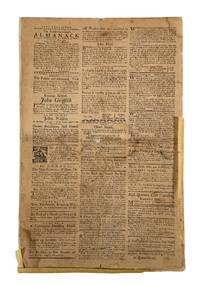
1771réf. 143781771. The Almanack 1771 contains an advertisement offering a fourteen-year-old enslaved Black boy for sale in Boston documenting the commercial trafficking of enslaved children in colonial Massachusetts only five years before the Declaration of Independence. The notice states: "To be sold for want of employment a likely Negro Boy that won't drink rum he is about 14 years old." Its language reduces the unnamed child to age perceived suitability and drinking habits before offering him for sale preserving direct evidence of how slavery entered the ordinary commercial language and newspaper economy of eighteenth-century Boston. A second advertisement relating to slavery appears in the same issue. The Almanack. Boston 1771. Folio newspaper approximately 15 x 10 inches. The sale notice was printed among the newspaper's advertisements rather than as a report or editorial discussion of slavery placing the transaction within the periodical's routine marketplace of property labor and services. Particularly revealing is the seller's stated reason "for want of employment" which explicitly connects the proposed sale of the fourteen-year-old boy to the enslaver's assessment of his economic utility. Slavery remained legal in Massachusetts in 1771 even as the political disputes that would culminate in the American Revolution intensified in Boston. The advertisement predates the 1780 Massachusetts Constitution and the early 1780s freedom suits associated with the effective end of slavery in the Commonwealth. As a Boston notice offering an enslaved child for sale it provides specific evidence that human bondage and its newspaper marketplace formed part of New England life during the generation that articulated revolutionary claims concerning liberty. Overall foxing scattered soiling and several small edge tears; otherwise very good condition. unknown
1771réf. 143781771. The Almanack 1771 contains an advertisement offering a fourteen-year-old enslaved Black boy for sale in Boston documenting the commercial trafficking of enslaved children in colonial Massachusetts only five years before the Declaration of Independence. The notice states: "To be sold for want of employment a likely Negro Boy that won't drink rum he is about 14 years old." Its language reduces the unnamed child to age perceived suitability and drinking habits before offering him for sale preserving direct evidence of how slavery entered the ordinary commercial language and newspaper economy of eighteenth-century Boston. A second advertisement relating to slavery appears in the same issue. The Almanack. Boston 1771. Folio newspaper approximately 15 x 10 inches. The sale notice was printed among the newspaper's advertisements rather than as a report or editorial discussion of slavery placing the transaction within the periodical's routine marketplace of property labor and services. Particularly revealing is the seller's stated reason "for want of employment" which explicitly connects the proposed sale of the fourteen-year-old boy to the enslaver's assessment of his economic utility. Slavery remained legal in Massachusetts in 1771 even as the political disputes that would culminate in the American Revolution intensified in Boston. The advertisement predates the 1780 Massachusetts Constitution and the early 1780s freedom suits associated with the effective end of slavery in the Commonwealth. As a Boston notice offering an enslaved child for sale it provides specific evidence that human bondage and its newspaper marketplace formed part of New England life during the generation that articulated revolutionary claims concerning liberty. Overall foxing scattered soiling and several small edge tears; otherwise very good condition. unknown books
réf. 9248Philadelphia, William Brown, 1824. In 8 de 69 pp. (sous couverture), (rousseurs).
réf. 9546Valence, Pierre Aurel, (1791). 8 pp. in 4.
réf. 203291Clermont-Ferrand, Imprimerie d'Antoine Delcros, 1791 in-4, 12 pp., en feuilles.
réf. 211363S.l. [Paris], s.d. (1839) in-4, paginé 655-671, dérelié.
réf. ORD-13283N°13943 du Bulletin des Lois N°1432. 12 Octobre 1847.. In-8 (ca 145 x 220mm) sans couverture, non rogné, tel que paru. Pages 929 à 935 du bulletin. Papier lgt bruni, bords de feuilles poussiéreux, rares rousseurs, assez bon état.
1911réf. 0057141911 Paris, Ollendorff, 1911. In-12 (195 X 185 mm marges comprises) broché, couverture à rabats ; (3) ff., IX-446 pages, (1) f. Marge latérale du feuillet de titre et témoins en partie brunis, petite déchirure recollée en tête du feuillet de faux-titre.
réf. 168584Paris, A. Picard et fils, 1904 gr. in-8, [4] pp., XL-238 pp., demi-basane verte, dos à nerfs (reliure de l'époque). Dos passé.
1784réf. 20547Paris P.G. Simon & N. H. Nyon 1784 in-4 de 4 pp. dérel
réf. 239948Lisbonne, Imprimerie nationale, 1914 in-8, 116 pp., broché. Dos défraîchi.
1969réf. 1000742581969. 463 pages. Fort-de-France Société d'Histoire de la Martinique 1969. Broché 17 cm x 25 5 cm 463 pages 1 photo hors-texte. Texte présenté et annoté par G. Debien photo du conseiller en frontispice table des noms. Rousseurs sur la couverture et les tranches sinon très bon état intérieur