SLAVERYBiblio.com
1554 risultati
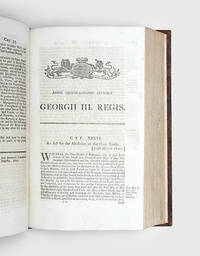
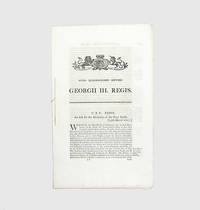
1807rif. 184142London: Printed by George Eyre and Andrew Strahan 1807. The African Slave Trade. is hereby utterly abolished prohibited and declared to be unlawful First edition of one of the most consequential acts of legislation in world history abolishing the slave trade within the British Empire. This copy is a well-preserved example of the separate folio printing. From 1807 enslaved persons could no longer be bought or sold within the British Empire while the Royal Navy was empowered to target vessels engaged in slave transportation a task it took up with vigour. Parliamentary acts were issued in collected annual volumes and as individual pamphlets all printed from the same type. As King's Printers Eyre & Strahan held the exclusive rights to publish and sell parliamentary statutes and this pamphlet would have been among those sold at their offices near Fleet Street. Folio 319 x 197 mm pp. 317-326 2. Woodcut headpiece. Stab-sewn as issued edges uncut. Minor offsetting else a near-fine copy. unknown
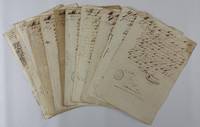
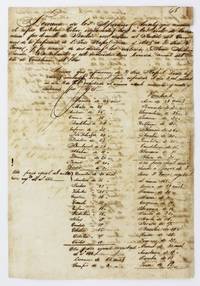
1873rif. 12720Cuba 1873. Twelve manuscript documents on folio sheets approximately 8.5 x 12.5 inches all with official rubber-stamped seal. Small pinholes along left margin light wear occasional chipping to edges some ink bleed and light damp staining. Overall very good. A collection of documents recording the liberation or attempted liberation of numerous men women teenagers and a child from enslavement. The child is but seven years old while the remaining slaves range from fifteen to fifty-seven years old. The slave trade ended in Cuba around 1867 but the practice of owning slaves remained legal until 1880 and then was abolished completely by Spanish decree in 1886. Cuba was the penultimate country to outlaw slavery in the western hemisphere beating Brazil to formal abolishment by two years. Even before the official abolition of slavery in Cuba African or criollo slaves were manumitted by a variety of owners and at various costs as evidenced here especially after the practice of importing Chinese indentured servants began. Each of the present documents names the slaveholder and the slave granted "libertad" along with the cost in escudos or pesetas of that liberty. The slaves liberated here are as follows: 1 Luis criollo 7 years old for the sum of 28 pesos 2 Maria Antonia part criolla 20 years old for the sum of 2500 pesetas 3 Catalina morena de Africa 41 years old for c.200 pesetas 4 Lorenzo moreno criollo 21 years old for 2500 pesetas 5 Lucia morena criolla 15 years old for 320 pesos or 1600 pesetas 6 Frigidae "negro.de Africae" 56 years old 7 Augusto criollo 19 years old for 1750 pesetas 8 Marta criolla 16 years old for 1621 pesetas 9 Gil moreno de Africa 57 years old for 1500 pesos 10 Carmita morena criolla 20 years old for 1750 pesetas 11 Augustina Prieto morena criolla 30 years old for 1750 pesetas 12 Edwigio 39 criolla; Lazara 36 criolla; and Maria Leoncia 15 criolla for 2000 pesetas. These Cuban slave manumissions are offered with one 1844 manumission document liberating a slave in Spain totaling two pages and measuring about 8.5 x 13.5 inches. The document also has three rubber-stamped official seals at the head noting Isabella II. This document appears to free slave Nicolas 25 years old for the sum of 400 pesos and is signed November 5 1844. unknown
1873rif. 12720Cuba 1873. Twelve manuscript documents on folio sheets approximately 8.5 x 12.5 inches all with official rubber-stamped seal. Small pinholes along left margin light wear occasional chipping to edges some ink bleed and light damp staining. Overall very good. A collection of documents recording the liberation or attempted liberation of numerous men women teenagers and a child from enslavement. The child is but seven years old while the remaining slaves range from fifteen to fifty-seven years old. The slave trade ended in Cuba around 1867 but the practice of owning slaves remained legal until 1880 and then was abolished completely by Spanish decree in 1886. Cuba was the penultimate country to outlaw slavery in the western hemisphere beating Brazil to formal abolishment by two years. Even before the official abolition of slavery in Cuba African or criollo slaves were manumitted by a variety of owners and at various costs as evidenced here especially after the practice of importing Chinese indentured servants began. Each of the present documents names the slaveholder and the slave granted "libertad" along with the cost in escudos or pesetas of that liberty. The slaves liberated here are as follows: 1 Luis criollo 7 years old for the sum of 28 pesos 2 Maria Antonia part criolla 20 years old for the sum of 2500 pesetas 3 Catalina morena de Africa 41 years old for c.200 pesetas 4 Lorenzo moreno criollo 21 years old for 2500 pesetas 5 Lucia morena criolla 15 years old for 320 pesos or 1600 pesetas 6 Frigidae "negro.de Africae" 56 years old 7 Augusto criollo 19 years old for 1750 pesetas 8 Marta criolla 16 years old for 1621 pesetas 9 Gil moreno de Africa 57 years old for 1500 pesos 10 Carmita morena criolla 20 years old for 1750 pesetas 11 Augustina Prieto morena criolla 30 years old for 1750 pesetas 12 Edwigio 39 criolla; Lazara 36 criolla; and Maria Leoncia 15 criolla for 2000 pesetas. These Cuban slave manumissions are offered with one 1844 manumission document liberating a slave in Spain totaling two pages and measuring about 8.5 x 13.5 inches. The document also has three rubber-stamped official seals at the head noting Isabella II. This document appears to free slave Nicolas 25 years old for the sum of 400 pesos and is signed November 5 1844. unknown books
1845rif. 24737Mary B. Selden was the grandmother of Eleanor Love Selden who married John Augustine Washington III in 1843. She regrets not being able to furnish Washington with the services of one of her slaves as a stacker for the upcoming wheat harvest. Still a faithful employee West Ford worked for the Washington family well into the nineteenth century including delivering this letter. The letter includes a list of two dozen slaves written in pencil by John Augustine Washington III. SLAVERY. MOUNT VERNON. WEST FORD. MARY BOWLES ARMISTEAD SELDEN. Autograph Letter Signed to John Augustine Washington III hand delivered by West Ford; JOHN AUGUSTINE WASHINGTON III. Autograph List of Slaves. Single folio leaf with autograph address on verso. Alexandria Virginia 1845. Complete Transcript My dear Augustine I am very sorry to be unable to render you the service you require. I have a very fine stacker but he is hired by the year to Mr Young as I did not expect to have employment enough for him at Mt Ida. Another year if you wish it you can have him I receive very small wages for him and as a stacker I have never known any one equal to him. I am very sorry to hear that Nelly is sick. I hope she will be well enough to come up and meet the bridal party on thursday. I received a letter from Eliza to day in which she says they will be at Mt Ida that day but will bring no company with them. It will give great pleasure to them and to me if Mrs Washington Nelly and yourself will come up on that day. Mrs Lippitt will have a room ready for any of the party that will favour her with their company she must by no means be left behind. Most truly and affectionately / yrs M. B. Selden <2> Address: John A. Washington Esq. / Mt Vernon / By West Ford Docketing by John Augustine Washington III: Mrs. M. B. Selden List of slaves in pencil by John Augustine Washington III: Phil b. 1790 Hannah b. 1826 Gabe b. 1820 Eliza b. 1811 Ned b. 1827 Jim Michum b. 1795 Edmund b. 1827 John b. 1833 Betty b. 1833 Mary b. 1819 West Fanny "Belongs to my wife" Sarah b. 1809 Dennis b. 1838 Hannah Nelly b. 1836 William b. 1830 Jim Starks b. 1805 Joe b. 1832 Sally b. 1827 Ephraim b. 1834 Tom b. 1835 "bound to me till Oct 1856" West b. 1838 Jesse b. 1785 Historical Background Farmers in mid-nineteenth-century Virginia typically planted winter wheat in September and October and harvested it in the following June. After wheat had been cut a stacker tied the wheat into bundles and piled the bundles in shocks to dry in the field. After the shocks dried they would be stored in a barn or carefully built stack capped with grass to shed the rain until threshing time. Even after Cyrus McCormick developed his mechanical grain reaper in the 1830s men needed to follow the machine to bundle and stack the wheat. Building a good stack was an important skill and those workers free or enslaved who knew how to do so were very valuable at harvest time. Mary Bowles Armistead Alexander Selden 1783-1846 was born in Hanover Virginia. She married Charles Alexander Jr. 1772-1812 with whom she had five children including Louisa Elizabeth Fontaine Alexander 1802-1827. After her first husband's death she married Dr. Wilson Cary Selden 1761-1835. She was his third wife and they had three children. By his first wife Dr. Selden was the father of Wilson Cary Selden Jr. 1796-1843. In 1822 Wilson Cary Selden Jr. married Louisa Elizabeth Fontaine Alexander and they became the parents of Eleanor Love Selden 1824-1860 who married John A. Washington III. Thus Mary Bowles Selden was both the grandmother and step-grandmother of Eleanor Nelly Washington. At the time she wrote this letter she was living at Mount Ida a 6000-acre plantation that stretched along two miles of the Potomac River north of Alexandria Virginia and fewer than ten miles from Mount Vernon. Her first husband built the neoclassical mansion of Mount Ida in 1808. John Augustine Washington III 1821-1861 was born in Blakeley West Virginia the son of John Augustine Washington II and Jane Charlotte Blackburn Washington and graduated from the University of Virginia in 1840. His father inherited George Washington's Mount Vernon estate in 1829 but it passed to his wife at his death in 1832. In 1841 Augustine Washington proposed to manage Mount Vernon for his mother. When she died in 1855 the plantation passed to him. In 1858 after offering the property to both the federal government and to the State of Virginia he sold 200 acres of the Mount Vernon estate including the mansion outbuildings and family tomb to the Mount Vernon Ladies' Association for $200000. Washington married Eleanor Nelly Love Selden 1824-1860 in 1843 and they had seven children. In 1860 he owned 22 slaves. In 1861 Washington joined the Confederate Army as a lieutenant colonel and served as an aide-de-camp to General Robert E. Lee. He was killed while conducting reconnaissance at the Battle of Cheat Mountain in September 1861. West Ford ca. 1784-1863 was born on the Bushfield Plantation in Westmoreland County Virginia to an enslaved woman owned by George Washington's brother John Augustine Washington. When George Washington visited West Ford was his personal attendant. When John Augustine Washington's widow Hannah died in 1802 she granted Ford his freedom at age 21. Bushrod Washington George Washington's nephew and heir to Mount Vernon freed Ford in 1806 and Ford continued working for the Washington family. According to family oral history Ford's mother Venus told her mistress Hannah Washington that he was George Washington's son. Nearly all historians doubt the claim though one of Washington's nephews certainly could have been the father. In 1812 West Ford married Priscella Bell a free woman. Their four children—William Daniel Jane and Julia—were educated on the Mount Vernon Plantation despite laws which restricted the instruction of African Americans. When Bushrod Washington died in 1829 he willed 160 acres of land adjacent to Mount Vernon to West Ford who continued to live on the Mount Vernon estate. Over the next several years West Ford was frequently highlighted in the media making his private life a matter of public record. In 1850 two Virginia newspapers—the Alexandria Gazette and the Virginia Advertiser—carried articles describing his prestigious position and authority at Mount Vernon. In 1857 an entry in the Fairfax County Deed Books noted that Ford divided his land among his four children. In 1858 Ford was sketched a second time this time by historian and artist Benson Lossing. In March 1859 Harper's New Monthly Magazine published Lossing's feature on Mount Vernon and included his sketch of Ford. Ford told the reporter of his property on Little Hunting Creek where he planned to retire after the Washington estate was no longer in the Washington family. In June 1863 an ailing West Ford was brought back to the Mount Vernon estate by the Mount Vernon Ladies' Association. The association cared for West Ford until his death on July 20 1863. Condition Foxing and show through particularly near the signature.
1845rif. 24737Mary B. Selden was the grandmother of Eleanor Love Selden who married John Augustine Washington III in 1843. She regrets not being able to furnish Washington with the services of one of her slaves as a stacker for the upcoming wheat harvest. Still a faithful employee West Ford worked for the Washington family well into the nineteenth century including delivering this letter. The letter includes a list of two dozen slaves written in pencil by John Augustine Washington III. SLAVERY. MOUNT VERNON. WEST FORD. MARY BOWLES ARMISTEAD SELDEN. Autograph Letter Signed to John Augustine Washington III hand delivered by West Ford; JOHN AUGUSTINE WASHINGTON III. Autograph List of Slaves. Single folio leaf with autograph address on verso. Alexandria Virginia 1845. Complete Transcript My dear Augustine I am very sorry to be unable to render you the service you require. I have a very fine stacker but he is hired by the year to Mr Young as I did not expect to have employment enough for him at Mt Ida. Another year if you wish it you can have him I receive very small wages for him and as a stacker I have never known any one equal to him. I am very sorry to hear that Nelly is sick. I hope she will be well enough to come up and meet the bridal party on thursday. I received a letter from Eliza to day in which she says they will be at Mt Ida that day but will bring no company with them. It will give great pleasure to them and to me if Mrs Washington Nelly and yourself will come up on that day. Mrs Lippitt will have a room ready for any of the party that will favour her with their company she must by no means be left behind. Most truly and affectionately / yrs M. B. Selden <2> Address: John A. Washington Esq. / Mt Vernon / By West Ford Docketing by John Augustine Washington III: Mrs. M. B. Selden List of slaves in pencil by John Augustine Washington III: Phil b. 1790 Hannah b. 1826 Gabe b. 1820 Eliza b. 1811 Ned b. 1827 Jim Michum b. 1795 Edmund b. 1827 John b. 1833 Betty b. 1833 Mary b. 1819 West Fanny "Belongs to my wife" Sarah b. 1809 Dennis b. 1838 Hannah Nelly b. 1836 William b. 1830 Jim Starks b. 1805 Joe b. 1832 Sally b. 1827 Ephraim b. 1834 Tom b. 1835 "bound to me till Oct 1856" West b. 1838 Jesse b. 1785 Historical Background Farmers in mid-nineteenth-century Virginia typically planted winter wheat in September and October and harvested it in the following June. After wheat had been cut a stacker tied the wheat into bundles and piled the bundles in shocks to dry in the field. After the shocks dried they would be stored in a barn or carefully built stack capped with grass to shed the rain until threshing time. Even after Cyrus McCormick developed his mechanical grain reaper in the 1830s men needed to follow the machine to bundle and stack the wheat. Building a good stack was an important skill and those workers free or enslaved who knew how to do so were very valuable at harvest time. Mary Bowles Armistead Alexander Selden 1783-1846 was born in Hanover Virginia. She married Charles Alexander Jr. 1772-1812 with whom she had five children including Louisa Elizabeth Fontaine Alexander 1802-1827. After her first husband's death she married Dr. Wilson Cary Selden 1761-1835. She was his third wife and they had three children. By his first wife Dr. Selden was the father of Wilson Cary Selden Jr. 1796-1843. In 1822 Wilson Cary Selden Jr. married Louisa Elizabeth Fontaine Alexander and they became the parents of Eleanor Love Selden 1824-1860 who married John A. Washington III. Thus Mary Bowles Selden was both the grandmother and step-grandmother of Eleanor Nelly Washington. At the time she wrote this letter she was living at Mount Ida a 6000-acre plantation that stretched along two miles of the Potomac River north of Alexandria Virginia and fewer than ten miles from Mount Vernon. Her first husband built the neoclassical mansion of Mount Ida in 1808. John Augustine Washington III 1821-1861 was born in Blakeley West Virginia the son of John Augustine Washington II and Jane Charlotte Blackburn Washington and graduated from the University of Virginia in 1840. His father inherited George Washington's Mount Vernon estate in 1829 but it passed to his wife at his death in 1832. In 1841 Augustine Washington proposed to manage Mount Vernon for his mother. When she died in 1855 the plantation passed to him. In 1858 after offering the property to both the federal government and to the State of Virginia he sold 200 acres of the Mount Vernon estate including the mansion outbuildings and family tomb to the Mount Vernon Ladies' Association for $200000. Washington married Eleanor Nelly Love Selden 1824-1860 in 1843 and they had seven children. In 1860 he owned 22 slaves. In 1861 Washington joined the Confederate Army as a lieutenant colonel and served as an aide-de-camp to General Robert E. Lee. He was killed while conducting reconnaissance at the Battle of Cheat Mountain in September 1861. West Ford ca. 1784-1863 was born on the Bushfield Plantation in Westmoreland County Virginia to an enslaved woman owned by George Washington's brother John Augustine Washington. When George Washington visited West Ford was his personal attendant. When John Augustine Washington's widow Hannah died in 1802 she granted Ford his freedom at age 21. Bushrod Washington George Washington's nephew and heir to Mount Vernon freed Ford in 1806 and Ford continued working for the Washington family. According to family oral history Ford's mother Venus told her mistress Hannah Washington that he was George Washington's son. Nearly all historians doubt the claim though one of Washington's nephews certainly could have been the father. In 1812 West Ford married Priscella Bell a free woman. Their four children—William Daniel Jane and Julia—were educated on the Mount Vernon Plantation despite laws which restricted the instruction of African Americans. When Bushrod Washington died in 1829 he willed 160 acres of land adjacent to Mount Vernon to West Ford who continued to live on the Mount Vernon estate. Over the next several years West Ford was frequently highlighted in the media making his private life a matter of public record. In 1850 two Virginia newspapers—the Alexandria Gazette and the Virginia Advertiser—carried articles describing his prestigious position and authority at Mount Vernon. In 1857 an entry in the Fairfax County Deed Books noted that Ford divided his land among his four children. In 1858 Ford was sketched a second time this time by historian and artist Benson Lossing. In March 1859 Harper's New Monthly Magazine published Lossing's feature on Mount Vernon and included his sketch of Ford. Ford told the reporter of his property on Little Hunting Creek where he planned to retire after the Washington estate was no longer in the Washington family. In June 1863 an ailing West Ford was brought back to the Mount Vernon estate by the Mount Vernon Ladies' Association. The association cared for West Ford until his death on July 20 1863. Condition Foxing and show through particularly near the signature. books
1786rif. 43537Bergerac, J. B. Puynesge, 1786. 2 vol. in-4 de XXV-(1)-553-(1) pp. et XVIII-401-(1)-40 pp., demi-basane brune, dos lisse orné (relié vers 1820).
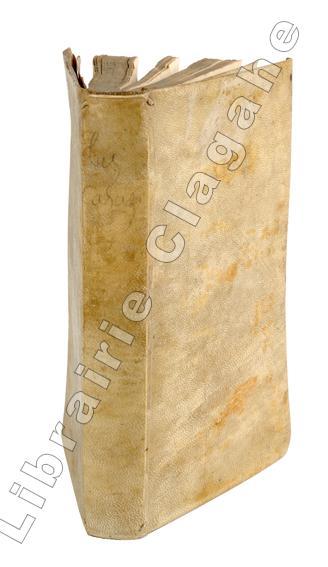
1642rif. 19929Lyon, Jean Caffin et F. Plaignard, 1642 ; in 8, vélin rigide de l’époque ; [8], 299 pp, [5] pp. bl., (signatures : â4, A-T8) le dernier f. blanc est collé au contreplat de la reliure.
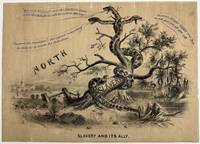
1864rif. 12816N.p. 1864. Lithograph 14.5 x 20.5 inches. Noticeable toning small areas of light discoloration along top margin short closed tear to left edge minor dust-soiling numerous creases and wrinkles. About very good. A dramatic political cartoon issued during the Civil War and satirizing the dangerous influence of those who argue a compromise on slavery or an easy solution to the war. The work was likely issued in the midst of the 1860 but more likely the 1864 presidential election campaign. The central image of the lithograph involves a three-headed snake -- labeled "The People's Party" and emerging from the American "South" personified by a moss-covered swamp -- which is wrapped around the length of a large tree labeled "Slavery." Each snake vocalizes a different misleading message about the issue of slavery and compromise seemingly aligned with political entities such as the Peace Party and the Copperheads. The messages from each snake head read respectively "Extend Slavery over the Northern States and the Rebellion will be over in 60 days;" "Persevere till after election and then we will give you all you ask;" and "'Support the President' - but oppose everything he may do to crush the Rebellion." This latter message indicates the author of the work supported President Lincoln. The North is personified in the background at left by a depiction of the U.S. Capitol Building. The central image of the lithograph carries echoes of the story of the Book of Genesis with the involvement of a deceptive serpent amid the tree of life. The lithograph is signed in the stone at bottom right reading simply "Brooks." Though the work came to us proposing the identify of the artist as Reuben Brooks 1794-1870 we were ultimately unable to confirm this authorship. The lack of an imprint in the lithograph also precludes easy research and identification. In fact the rarity of the lithograph makes it difficult to expound much more about it at all. OCLC reports just a single copy at the Peabody Essex Museum and it is not listed in Weitenkampf or Reilly. Given its rarity and content the present lithograph offers an outstanding opportunity for further research and contextualization. unknown
1864rif. 12816N.p. 1864. Lithograph 14.5 x 20.5 inches. Noticeable toning small areas of light discoloration along top margin short closed tear to left edge minor dust-soiling numerous creases and wrinkles. About very good. A dramatic political cartoon issued during the Civil War and satirizing the dangerous influence of those who argue a compromise on slavery or an easy solution to the war. The work was likely issued in the midst of the 1860 but more likely the 1864 presidential election campaign. The central image of the lithograph involves a three-headed snake -- labeled "The People's Party" and emerging from the American "South" personified by a moss-covered swamp -- which is wrapped around the length of a large tree labeled "Slavery." Each snake vocalizes a different misleading message about the issue of slavery and compromise seemingly aligned with political entities such as the Peace Party and the Copperheads. The messages from each snake head read respectively "Extend Slavery over the Northern States and the Rebellion will be over in 60 days;" "Persevere till after election and then we will give you all you ask;" and "'Support the President' - but oppose everything he may do to crush the Rebellion." This latter message indicates the author of the work supported President Lincoln. The North is personified in the background at left by a depiction of the U.S. Capitol Building. The central image of the lithograph carries echoes of the story of the Book of Genesis with the involvement of a deceptive serpent amid the tree of life. The lithograph is signed in the stone at bottom right reading simply "Brooks." Though the work came to us proposing the identify of the artist as Reuben Brooks 1794-1870 we were ultimately unable to confirm this authorship. The lack of an imprint in the lithograph also precludes easy research and identification. In fact the rarity of the lithograph makes it difficult to expound much more about it at all. OCLC reports just a single copy at the Peabody Essex Museum and it is not listed in Weitenkampf or Reilly. Given its rarity and content the present lithograph offers an outstanding opportunity for further research and contextualization. unknown books
1418rif. 106697Letter Signed 2 pp. folio letter sheet stampless address leaf. Two full pages of text. Folds with a couple of small tears or holes at folds normal aging and browning; otherwise very good.The letter is by Caroline F.R. Morgan to A.J.Walker in Milton North Carolina. Probably written in another hand but apparently her own verbiage with underlinings for emphasis and corrections. A strong legal statement by the widow Morgan of her rights as administrator of the Estate of her "late lamented husband" and his father responding to a Doctor's claim in a property sale in Milton North Carolina. Stating equivocally that "I administered his estate" with "Double powers of attorney if I may so express myself" and refusing to send a copy of her husband's will which "I consider a foolish request" and "would not do…for only the small amount of property in Milton but not for the whole of Milton."Most slave-owning women in the antebellum South were the widows of slave plantation owners who relied on overseers to manage often distant estates. A very few were more actively involved in the business affairs of the estates they had inherited. In Yalobusha County Mississippi two widows owned plantations with hundreds of slaves. One of these was Sarah Childress Polk of Tennessee widow of the 11th President of the United States. But her slave-holdings were exceeded by those of 42 year-old Caroline Fitz Randolph Morford Morgan of Lynchburg Virginia. Born in New Jersey to the grandson of a Quaker founder of Princeton University she had married a Virginia medical student whose father owned much of the city of Lynchburg as well as having real estate and slave holdings throughout the South. When he died in March 1847 she was left with three children and vast property in which she took an active interest not common "for a woman of her time and station." While she had many charitable interests – she was a charter member of a Female Missionary Society – records indicate that she personally bought and sold slaves both for the Morgavin Plantation in Mississippi and for her Virginia properties owning more than 100 African-American men and women including one "Aunt Sally" aged 104. She remained a widow for two years until she re-married to a younger man a Doctor who had come to Lynchburg to treat her family and slaves during an epidemic of yellow fever. That marriage ended contentiously in the 1850s and by the start of the Civil War she resumed her legal status as an independent woman ahead of her time. Apparently impoverished by the War she died in 1883. gavegarden.org
1418rif. 106697Letter Signed 2 pp. folio letter sheet stampless address leaf. Two full pages of text. Folds with a couple of small tears or holes at folds normal aging and browning; otherwise very good.The letter is by Caroline F.R. Morgan to A.J.Walker in Milton North Carolina. Probably written in another hand but apparently her own verbiage with underlinings for emphasis and corrections. A strong legal statement by the widow Morgan of her rights as administrator of the Estate of her "late lamented husband" and his father responding to a Doctor's claim in a property sale in Milton North Carolina. Stating equivocally that "I administered his estate" with "Double powers of attorney if I may so express myself" and refusing to send a copy of her husband's will which "I consider a foolish request" and "would not do…for only the small amount of property in Milton but not for the whole of Milton."Most slave-owning women in the antebellum South were the widows of slave plantation owners who relied on overseers to manage often distant estates. A very few were more actively involved in the business affairs of the estates they had inherited. In Yalobusha County Mississippi two widows owned plantations with hundreds of slaves. One of these was Sarah Childress Polk of Tennessee widow of the 11th President of the United States. But her slave-holdings were exceeded by those of 42 year-old Caroline Fitz Randolph Morford Morgan of Lynchburg Virginia. Born in New Jersey to the grandson of a Quaker founder of Princeton University she had married a Virginia medical student whose father owned much of the city of Lynchburg as well as having real estate and slave holdings throughout the South. When he died in March 1847 she was left with three children and vast property in which she took an active interest not common "for a woman of her time and station." While she had many charitable interests – she was a charter member of a Female Missionary Society – records indicate that she personally bought and sold slaves both for the Morgavin Plantation in Mississippi and for her Virginia properties owning more than 100 African-American men and women including one "Aunt Sally" aged 104. She remained a widow for two years until she re-married to a younger man a Doctor who had come to Lynchburg to treat her family and slaves during an epidemic of yellow fever. That marriage ended contentiously in the 1850s and by the start of the Civil War she resumed her legal status as an independent woman ahead of her time. Apparently impoverished by the War she died in 1883. gavegarden.org books
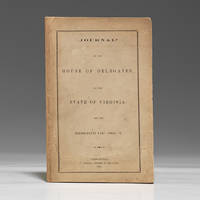
1865rif. 1260191865. First Edition. CONSTITUTION. Journal of the House of Delegates of the State of Virginia. for the Session of 1864Ñ5. Alexandria: D. Turner 1865. Octavo original front printed wrapper respined renewed rear wrapper original string stitching; pp. 1-3 4-83 1. Housed in a custom chemise and clamshell box. $4500.First edition one of 500 copies of the momentous Journal featuring its February 9 1865 entry on the Alexandria Virginia government's passage of the 13th Amendment mere days after the U.S. Congress the first of the four Unionist southern states to pass the Amendment also featuring the governor's Message noting: ""though we have in inherited from our fathers of the revolution the blessings of a great nation yet they also left to us an inheritance of African slavery which has proved a bitter dreg in our cup of freedom"" a vital record of forces for constitutional change near the end of the Civil War.Soon after the 1860 election amidst southern secession ""the great questions of union or disunion war or peace hung in the balance. Probably the crucial weight on the scale was VirginiaÉ as long as the federal government did not seek to coerce the states Virginia secessionists were unable to achieve a majority. When Lincoln responded with force to the attack on Fort Sumter however the vote in Virginia went in favor of secession."" Subsequently a Virginia convention ""met in Wheeling on May 13 1861É it elected as Governor Francis Pierpont a western Virginian and ardent Unionist and arranged for the creation of a legislature to replace the body sitting in RichmondÉ in July 1861 the new legislature met at the 'Restored Virginia' capital of Wheeling in a special session called by Pierpont."" Against its ""claim to represent a majority of Virginians"" a new state of West Virginia was created in 1863 and Pierpont's government moved to Alexandria to govern areas of Virginia under Union occupation Harrison Lawfulness of the Reconstruction Amendments 380-83.Scholars observe that the 13th Amendment its fellow amendments and Reconstruction as ""both a political process made possible by military successes and constitutional thought grew from wartime as well as post-Appomattox developments"" Hyman and Wiecek Equal Justice 247. This rare first edition of Journal of the House of Delegates substantiates that in documenting passage of the 13th Amendment by Pierpont's Virginia government mere days after the U.S. Congress passed the Amendment on January 31 1865. With that Virginia became the first of the four Unionist southern states that ratified the 13th Amendment. Of those Louisiana followed on February 17 with Arkansas and Tennessee that April. The 13th Amendment is the focus of the Journal's entry for February 9 1865 which states: ""Mr. Brownley called up Senate bill No. 12 entitled 'An Act to ratify the joint resolution of Congress passed January 31 1865 proposing an amendment to the Constitution of the United States.' The bill was read the first and second timeÉ and the rules were suspended and the bill read the third timeÉ and the bill passed."" Also notable herein is the complete printing of Governor Pierpont's opening Message where he notes: ""though we inherited from our fathers of the revolution the blessings of a great nation yet they also left to us an inheritance of African slavery which has proved a bitter dreg in our cup of freedom."" He speaks at length of the rights due people of color and the abolition of laws such as those that prohibit ""negro testimony"" or proscribe a ""different punishmentÉ for persons of African dissent"" from that of ""white persons.""""The legislature met for its second session on December 5 1864É The governor's message was a long and important document and indicated the changes of opinion that the war was bringing about. Pierpont gave his views upon the all-important negro question. He congratulated the constitutional convention which had met in the spring on the abolition of slavery in Virginia and advocated sweeping changes in the laws concerning negroes. The act prescribing different punishments for blacks should he said be altered in accordance with the amended constitution as well as the law for apprenticing them. The law prohibiting the education of negroes should be abolishedÉ His language was on the whole very moderate. He advised the legalizing of the marital relations of negroes and most important the establishment of public schoolsÉ Notwithstanding the governor's advice no acts of great importance passed the legislatureÉ On February 9 1865 the assembly ratified the 13th Amendment to the Constitution of the United States. It adjourned on March 7"" Eckenrode Political History of Virginia During the Reconstruction. Faint ""U.N.C. Duplicate"" stamp to front wrapper.Text fine; just a bit of faint soiling and a tide line to fragile front wrapper. An excellent copy of this elusive item. unknown
1865rif. 1260191865. First Edition. CONSTITUTION. Journal of the House of Delegates of the State of Virginia. for the Session of 1864Ñ5. Alexandria: D. Turner 1865. Octavo original front printed wrapper respined renewed rear wrapper original string stitching; pp. 1-3 4-83 1. Housed in a custom chemise and clamshell box. $4500.First edition one of 500 copies of the momentous Journal featuring its February 9 1865 entry on the Alexandria Virginia government's passage of the 13th Amendment mere days after the U.S. Congress the first of the four Unionist southern states to pass the Amendment also featuring the governor's Message noting: ""though we have in inherited from our fathers of the revolution the blessings of a great nation yet they also left to us an inheritance of African slavery which has proved a bitter dreg in our cup of freedom"" a vital record of forces for constitutional change near the end of the Civil War.Soon after the 1860 election amidst southern secession ""the great questions of union or disunion war or peace hung in the balance. Probably the crucial weight on the scale was VirginiaÉ as long as the federal government did not seek to coerce the states Virginia secessionists were unable to achieve a majority. When Lincoln responded with force to the attack on Fort Sumter however the vote in Virginia went in favor of secession."" Subsequently a Virginia convention ""met in Wheeling on May 13 1861É it elected as Governor Francis Pierpont a western Virginian and ardent Unionist and arranged for the creation of a legislature to replace the body sitting in RichmondÉ in July 1861 the new legislature met at the 'Restored Virginia' capital of Wheeling in a special session called by Pierpont."" Against its ""claim to represent a majority of Virginians"" a new state of West Virginia was created in 1863 and Pierpont's government moved to Alexandria to govern areas of Virginia under Union occupation Harrison Lawfulness of the Reconstruction Amendments 380-83.Scholars observe that the 13th Amendment its fellow amendments and Reconstruction as ""both a political process made possible by military successes and constitutional thought grew from wartime as well as post-Appomattox developments"" Hyman and Wiecek Equal Justice 247. This rare first edition of Journal of the House of Delegates substantiates that in documenting passage of the 13th Amendment by Pierpont's Virginia government mere days after the U.S. Congress passed the Amendment on January 31 1865. With that Virginia became the first of the four Unionist southern states that ratified the 13th Amendment. Of those Louisiana followed on February 17 with Arkansas and Tennessee that April. The 13th Amendment is the focus of the Journal's entry for February 9 1865 which states: ""Mr. Brownley called up Senate bill No. 12 entitled 'An Act to ratify the joint resolution of Congress passed January 31 1865 proposing an amendment to the Constitution of the United States.' The bill was read the first and second timeÉ and the rules were suspended and the bill read the third timeÉ and the bill passed."" Also notable herein is the complete printing of Governor Pierpont's opening Message where he notes: ""though we inherited from our fathers of the revolution the blessings of a great nation yet they also left to us an inheritance of African slavery which has proved a bitter dreg in our cup of freedom."" He speaks at length of the rights due people of color and the abolition of laws such as those that prohibit ""negro testimony"" or proscribe a ""different punishmentÉ for persons of African dissent"" from that of ""white persons.""""The legislature met for its second session on December 5 1864É The governor's message was a long and important document and indicated the changes of opinion that the war was bringing about. Pierpont gave his views upon the all-important negro question. He congratulated the constitutional convention which had met in the spring on the abolition of slavery in Virginia and advocated sweeping changes in the laws concerning negroes. The act prescribing different punishments for blacks should he said be altered in accordance with the amended constitution as well as the law for apprenticing them. The law prohibiting the education of negroes should be abolishedÉ His language was on the whole very moderate. He advised the legalizing of the marital relations of negroes and most important the establishment of public schoolsÉ Notwithstanding the governor's advice no acts of great importance passed the legislatureÉ On February 9 1865 the assembly ratified the 13th Amendment to the Constitution of the United States. It adjourned on March 7"" Eckenrode Political History of Virginia During the Reconstruction. Faint ""U.N.C. Duplicate"" stamp to front wrapper.Text fine; just a bit of faint soiling and a tide line to fragile front wrapper. An excellent copy of this elusive item. unknown books
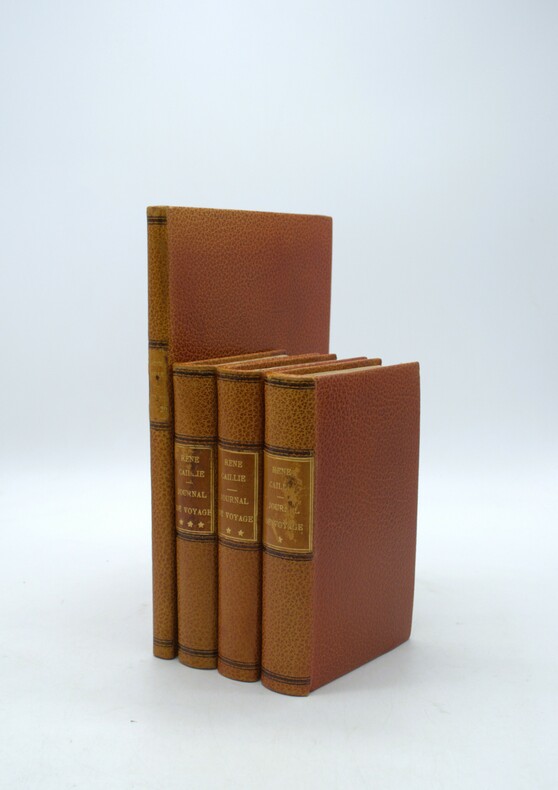
1830rif. PHO-21101830, à Paris, Imprimerie Royale, 3 volumes in-8° et 1 atlas ,1 portrait-frontispice ,5 planches et 1 carte et itinéraire dépliante (900x 650mm). 3 fnch-xii-475pp,426pp,404pp., Très rare et complet- très bel exemplaire sans rousseurs, relié plein cuir orange, imitation écailles, dos lisse avec pièce d’auteur et titre, tomaison (frottements aux pièces). Dans l’Atlas : 5 planches et 1 grande carte repliée par Jomard (Gay. 243 Numa Broc Afrique pp 64-65).
1807rif. 182125London: printed by George Eyre and Andrew Strahan 1807. The African Slave Trade. is hereby utterly abolished prohibited and declared to be unlawful First edition of one of the most consequential acts of legislation in world history abolishing the slave trade within the British Empire. The Act the culmination of many years of campaigning by British abolitionists ended two centuries in which Britain took the pre-eminent role in the transatlantic slave traffic. The act paved the way for other European empires to abolish the trade and for Britain to use its navy to intercept slave ships which effectively ended the transatlantic slave trade by the latter half of the century. However the act did not end slavery in the British Empire which did not follow until 1833. Parliamentary acts were issued individually and in collected format printed from the same type. This copy includes the full acts for 1807 comprising the only session of the Third Parliament with the first session of the Fourth the second session was held in 1808 together with the separately published report on vaccination. It was bound for use by the civic authorities of the town of Elgin in Scotland. 3 parts in 1 vol. folio 289 x 181 mm pp. 16 466 1; 14 578 2 blank; 16. Contemporary sprinkled calf twin red and green morocco labels "Town of Elgin Acts of Parliament / 1807" edges speckled blue. Pencilled notation at head of title page. Neatly restored at extremities very minor foxing and finger-soiling to contents. A very good copy. unknown
178011 voll. cartonato azzurro della epoca. 10 voll. in-8. un vol. in-4 Atlas. Ritratto inciso 9 frontespizi incisi 50 mappe 23 tabelle ripiegate.Economics india arabia gulf africa america diderot rigobert bonne maps atlas arabic indian travels slavery colonialism Diderot
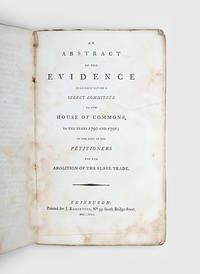
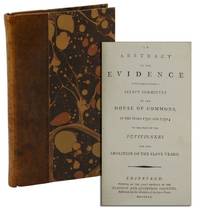
1791rif. 180598Edinburgh: Printed for J. Robertson 1791. Stepping up the campaign against slavery Second Edinburgh edition of this best-selling report on the colonial slave trade including a version of among the most famous abolitionist images the cross-section depicting the enslaved individuals transported aboard the Brookes. The Abstract is the first abolitionist work to ground its arguments not on biblical appeals or forceful rhetoric but on documented eyewitness accounts. Until 1790 the abolitionist campaign had been channelled through pamphlet and pulpit. After 1790 abolitionists turned to the new technique of mass petition campaigns against Parliament. The Abstract publishes the testimonies of the witnesses called by the petitioners arranging them thematically by chapter. Among others the select committee called planters traders naval officers and doctors. "The abolitionist petition campaign reached an apex during 1791-1792 where an unprecedented 519 abolitionist petitions coming from all over Britain were delivered to Parliament. Some 400000 persons signed these petitions 1 out of every 11 adults with Manchester alone contributing 20000 names from an adult population of about 30000" Fogel p. 212. Octavo pp. iv 128. Large folding plan of a slave ship folding map of the western coast of Africa tables in the text. Original paper wrappers spine lettered in manuscript ink edges uncut. Housed in custom orange cloth box. Contemporary presentation inscription from "Mr. Campbell" to "John White" on the front cover. Rubbing and chipping minor loss to spine and extremities browning and foxing to contents slight offsetting to plates folding plan loose: just about a very good fragile copy. ESTC N29168. William Fogel Without Consent or Contract 1989. hardcover
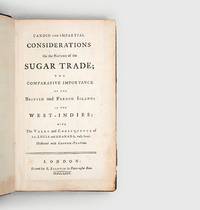
1763rif. 132583London: R. Baldwin 1763. A classic of in the field of colonial and Caribbean literature First edition of the first-named fourth of the second which was first published in Antigua 1750 under the pseudonym of "An Old Planter". John Campbell 1708-1775 was a highly successful historian and miscellaneous author Johnson thought well of him and praised the usefulness of his knowledge also describing him as "the richest author that ever grazed the common of literature" ODNB. The present work was commissioned by Lord Bute to rebut criticism of the Treaty of Paris by demonstrating "the value of colonial holdings in general and of sugar islands in particular" Ragatz. That is was felt to have done its job is perhaps confirmed by Campbell's appointment in 1765 as king's agent to Georgia. Considered by Ragatz to be a "classic of in the field of colonial and Caribbean literature embodying as it does one of the clearest statements of eighteenth-century philosophy regarding the relations that should exist between the metropole and its outlying possessions". This copy has additional material bound in: Bew's map of St Christopher's a 2-page manuscript index and bound at the rear a copy of Martin's practical essay on plantation management. Samuel Martin 1694/5-1776 had been born on Antigua but spent some considerable time thereafter in Britain on his full-time return to the island he found the family estates much run down and "embarked on a rigourous policy of reconstruction. Although he helped to pioneer improvements at most of the key stages in sugar-making and rum distillation his interests focused mainly on the non-manufacturing side of production. He was a firm advocate of crop rotation followed by marling in order to improve soil fertility. He was also instrumental in developing more effective systems of drainage and utilising windmills rather than animals for crushing the cane. By the standards of his contemporaries Martin was an enlightened slave owner. He advocated the provision of adequate supplies of food clothing shelter and medical facilities for slaves and ground for the cultivation of their own food" ODNB. His methods made him Antigua's leading and most progressive planter and during his own lifetime he certainly "succeeded in making sugar production a moderately profitable enterprise on his own estates". Both titles are moderately well-represented institutionally but neither appear with any great frequency at auction just a handful of copies of Campbell in the last fifty years and no copy of the Essay upon Plantership in any edition has passed through the rooms since 1951. Two works bound in a single vol. octavo 196 x 120 mm. Both bound without half-titles. 4 folding maps to the first-named 3 as called for; Caribbee Islands and Guyanna coloured in outline; The Harbour of Calivenie. Island of Grenada. Drawn by John Powell Topographer; and Plan of Fort Royal in the Island of Grenada and additionally a map of St. Christophers by J. Bew dated 1782 coloured. Contemporary streaked calf flat spine ruled gilt red morocco label single gilt rule to board edges Dahlia marbled endpapers. A little rubbed particularly on the joints label chipped no loss of lettering corners through small patch of insect damage to the lower board pastedowns lifting at the lower corners front free endpaper torn without loss slight erosion at the lower corner of the text-block for the first thirty pages or so mild worming to the fore-margin pp. 39-176 some small splits and closed tears to the maps no losses; overall very good. Campbell: ESTC T65879; Ragatz p. 284; Kress 6081; Sabin 10232. Martin: ESTC T81835; Sabin 44920 hardcover
1866rif. 4747Havana: July 10 1866. Good. 3pp. on a bifolium. Separated at fold. Some wear to edge of first leaf cause some minor loss to text. A few scattered tape repairs and reattachments. Some offsetting. A colonial Spanish manuscript slave manifest for the steamship Cristobal Colon carrying dozens of enslaved Africans from Bailen to Partido del Cano both in Cuba. The text at the head reads as follows: "Nomina de los Africano bozales que conducten el vapor Cristobol Colon embarcado hoy a las siete de la mañana por el muelle de Bailen con destino al Partido del Cano unos de la propridad de D. José Rafael Diaz y otros de D. José Garcia y por encargo de sus dueños los custodia D. Juan Antonio Sanchez Bustamante y este individuo tiene biencia annal del Partido de Consolacion del Sur." Bailen is on the southern coast of Cuba north of the Isle of Pines; "El Cano" seems to have been a plantation outside of Havana while Consolacion del Sur is coastal town in the Pinar del Rio region of Cuba. The manifest lists 133 "Africanos bozales" that is slaves who could not speak Spanish in two or three columns separated between men "varones" and women "hembras" - their assigned names are given generally of Christian origin but with some range e.g "Ciforiana" "Liborio" and "Dionisia." Their ages are given one as young as nine several in their late thirties but most in their teens to early thirties. An additional leaf signed from Manila and dated July 10 1866 notes that although 133 people were sent only 115 survived the journey and lists the names of those who perished. July 10
1866rif. 4747Havana: July 10 1866. Good. 3pp. on a bifolium. Separated at fold. Some wear to edge of first leaf cause some minor loss to text. A few scattered tape repairs and reattachments. Some offsetting. A colonial Spanish manuscript slave manifest for the steamship Cristobal Colon carrying dozens of enslaved Africans from Bailen to Partido del Cano both in Cuba. The text at the head reads as follows: "Nomina de los Africano bozales que conducten el vapor Cristobol Colon embarcado hoy a las siete de la mañana por el muelle de Bailen con destino al Partido del Cano unos de la propridad de D. José Rafael Diaz y otros de D. José Garcia y por encargo de sus dueños los custodia D. Juan Antonio Sanchez Bustamante y este individuo tiene biencia annal del Partido de Consolacion del Sur." Bailen is on the southern coast of Cuba north of the Isle of Pines; "El Cano" seems to have been a plantation outside of Havana while Consolacion del Sur is coastal town in the Pinar del Rio region of Cuba. The manifest lists 133 "Africanos bozales" that is slaves who could not speak Spanish in two or three columns separated between men "varones" and women "hembras" - their assigned names are given generally of Christian origin but with some range e.g "Ciforiana" "Liborio" and "Dionisia." Their ages are given one as young as nine several in their late thirties but most in their teens to early thirties. An additional leaf signed from Manila and dated July 10 1866 notes that although 133 people were sent only 115 survived the journey and lists the names of those who perished. July 10 books
1791rif. 44994Paris, Moreau de Saint-Méry, Ponce, Phelipeau, 1791. Grand in-folio (48 x 34 cm), titre et 30 planches gravées, cartonnage bleu de l'époque.
1759rif. ST19900Philadelphia and Germantown: Benjamin. Franklin and David. Hall or Christopher Sower 1759-60. 192 x 130 mm. 7 1/2 x 5". 1 p.l. collection title 47 1 71 4 76-168 iv 5-43 1 55 1 64 16 pp. Contemporary blind-ruled sheep nicely rebacked to style raised bands. Verso of front flyleaf inscribed in ink in the recipient's hand: "This Book is the Gift of Mr. Anthony Benezett sic to William Anderson October 14th 1760"; front pastedown with ink inscription: "The holy Book To Be Read"; title page with signature of William Anderson dated 1760; front flyleaf and both free endpapers with additional 19th century owner inscriptions. Miller 730; Smith Friends' Books I p. 240. For "Observations": Sabin 4676; Evans 8542. Boards a little dried and scuffed with a couple of small stains text variably toned because of colonial paper quality perhaps a fifth of the text rather browned dampstaining in the upper margin in the middle part of the volume mostly unobtrusive but darker and extending downward on a few leaves. The texts in the kind of problematic condition expected with early American imprints but the binding much better than is normally seen. This is a presentation copy of an important published collection of Quaker texts that includes four works printed by Benjamin Franklin as well as an early significant abolitionist tract that delivers a powerful condemnation of the slave trade. The collection title page lists nine tracts in total six of which were issued with separate title pages comprising: "An Extract from the Spirit of Prayer" by W. Law; "A Discourse on Mistakes concerning Religion" by Thomas Hartley; "Christ's Spirit or a Christian's Strength" "The Stumbling Stone" "The Doctrine of Baptism" and "The Trial of Spirits" all by William Dell; "The Liberty of Flesh and Spirit Distinguished" by J. Rutty; and "Observations on Enslaving Importing and Purchasing of Negroes &c." followed by "The Uncertainty of a Death-bed Repentance" both by Anthony Benezet. Miller asserts that "the first fifth sixth and seventh had previously been printed by Benjamin Franklin and David Hall all in Caslon type. The remainder had been printed by Christopher Saur who owned no Caslon letter." The volume title also in Calson type is attributed to the press of Franklin and Hall for the same reason. According to Miller Anthony Benezet put together this collection of Quaker material in the spring of 1760 in an edition of 500 copies with the hope of reaching those living "in ye back Parts of Maryland Virginia & N. Carolina . . . and Connecticut." First printed in 1759 Benezet's forceful denunciation of the slave trade is notable for using eyewitness accounts from people actually involved with the trade recounting the horrific practices and conditions that were realities of the system. Citing various lines of scripture Benezet argues that slavery runs contrary to Christian teachings and Mosaic law and that those who purchase and keep slaves bear as much guilt as the traders themselves. Born in France to Huguenot parents Benezet 1713-84 was a Quaker abolitionist educator and writer who became one of the earliest and most outspoken advocates against slavery in colonial America. He emigrated to Philadelphia by way of Rotterdam and London in 1731 where he founded Pennsylvania's first secondary school for girls and later opened one of the first schools to welcome black students. ANB says that "Although Benezet is recognized as the most prolific antislavery propagandist of the eighteenth century throughout his lifetime he supported and wrote about a wide variety of causes and topics including assistance for Acadian refugees temperance peace fair treatment of Native Americans religion educational reform and poor relief." His wife Joyce Benezet d. 1786 née Marriott was a preacher in the faith herself. According to Waldstreicher Franklin maintained a "lifelong friendship with Quaker politicians merchants and scientists. . . . He admired Quakerism because of its affirmation of simplicity frugality anti-slavery and humanitarianism." Franklin also saw the possibility of profit in printing for the considerable Quaker population of his colony. Hall 1714-72 came to Philadelphia from London in 1744 to work for Franklin and became a partner in the firm in 1748. As a considerable mark of his regard for Hall Franklin drew up a contract whereby his partner would over an 18-year period buy him out. It is a further sign of Franklin's regard for Hall that the printer is buried beside Franklin and his wife. As to contemporaneous provenance we can speculate with some degree of certainty that our William Anderson was the person of that name who was a Quaker preacher from Haverford near Philadelphia. His wife Margaret--like Benezet's wife Joyce--was also a preacher and these two husband-and-wife teams are dealt with in Rebecca Larson's "Daughter of Light: Quaker Women Preaching and Prophesying in the Colonies and Abroad 1700-1775" 1999 Appendix 2. . B[enjamin]. Franklin and D[avid]. Hall or Christopher Sower unknown
1759rif. ST19900Philadelphia and Germantown: Benjamin. Franklin and David. Hall or Christopher Sower 1759-60. 192 x 130 mm. 7 1/2 x 5". 1 p.l. collection title 47 1 71 4 76-168 iv 5-43 1 55 1 64 16 pp. Contemporary blind-ruled sheep nicely rebacked to style raised bands. Verso of front flyleaf inscribed in ink in the recipient's hand: "This Book is the Gift of Mr. Anthony Benezett sic to William Anderson October 14th 1760"; front pastedown with ink inscription: "The holy Book To Be Read"; title page with signature of William Anderson dated 1760; front flyleaf and both free endpapers with additional 19th century owner inscriptions. Miller 730; Smith Friends' Books I p. 240. For "Observations": Sabin 4676; Evans 8542. Boards a little dried and scuffed with a couple of small stains text variably toned because of colonial paper quality perhaps a fifth of the text rather browned dampstaining in the upper margin in the middle part of the volume mostly unobtrusive but darker and extending downward on a few leaves. The texts in the kind of problematic condition expected with early American imprints but the binding much better than is normally seen. This is a presentation copy of an important published collection of Quaker texts that includes four works printed by Benjamin Franklin as well as an early significant abolitionist tract that delivers a powerful condemnation of the slave trade. The collection title page lists nine tracts in total six of which were issued with separate title pages comprising: "An Extract from the Spirit of Prayer" by W. Law; "A Discourse on Mistakes concerning Religion" by Thomas Hartley; "Christ's Spirit or a Christian's Strength" "The Stumbling Stone" "The Doctrine of Baptism" and "The Trial of Spirits" all by William Dell; "The Liberty of Flesh and Spirit Distinguished" by J. Rutty; and "Observations on Enslaving Importing and Purchasing of Negroes &c." followed by "The Uncertainty of a Death-bed Repentance" both by Anthony Benezet. Miller asserts that "the first fifth sixth and seventh had previously been printed by Benjamin Franklin and David Hall all in Caslon type. The remainder had been printed by Christopher Saur who owned no Caslon letter." The volume title also in Calson type is attributed to the press of Franklin and Hall for the same reason. According to Miller Anthony Benezet put together this collection of Quaker material in the spring of 1760 in an edition of 500 copies with the hope of reaching those living "in ye back Parts of Maryland Virginia & N. Carolina . . . and Connecticut." First printed in 1759 Benezet's forceful denunciation of the slave trade is notable for using eyewitness accounts from people actually involved with the trade recounting the horrific practices and conditions that were realities of the system. Citing various lines of scripture Benezet argues that slavery runs contrary to Christian teachings and Mosaic law and that those who purchase and keep slaves bear as much guilt as the traders themselves. Born in France to Huguenot parents Benezet 1713-84 was a Quaker abolitionist educator and writer who became one of the earliest and most outspoken advocates against slavery in colonial America. He emigrated to Philadelphia by way of Rotterdam and London in 1731 where he founded Pennsylvania's first secondary school for girls and later opened one of the first schools to welcome black students. ANB says that "Although Benezet is recognized as the most prolific antislavery propagandist of the eighteenth century throughout his lifetime he supported and wrote about a wide variety of causes and topics including assistance for Acadian refugees temperance peace fair treatment of Native Americans religion educational reform and poor relief." His wife Joyce Benezet d. 1786 née Marriott was a preacher in the faith herself. According to Waldstreicher Franklin maintained a "lifelong friendship with Quaker politicians merchants and scientists. . . . He admired Quakerism because of its affirmation of simplicity frugality anti-slavery and humanitarianism." Franklin also saw the possibility of profit in printing for the considerable Quaker population of his colony. Hall 1714-72 came to Philadelphia from London in 1744 to work for Franklin and became a partner in the firm in 1748. As a considerable mark of his regard for Hall Franklin drew up a contract whereby his partner would over an 18-year period buy him out. It is a further sign of Franklin's regard for Hall that the printer is buried beside Franklin and his wife. As to contemporaneous provenance we can speculate with some degree of certainty that our William Anderson was the person of that name who was a Quaker preacher from Haverford near Philadelphia. His wife Margaret--like Benezet's wife Joyce--was also a preacher and these two husband-and-wife teams are dealt with in Rebecca Larson's "Daughter of Light: Quaker Women Preaching and Prophesying in the Colonies and Abroad 1700-1775" 1999 Appendix 2. . B[enjamin]. Franklin and D[avid]. Hall or Christopher Sower unknown books
1801rif. 58147ELOQUENT ARGUMENT FOR ABOLITION OF THE SLAVE TRADE BY A WEST INDIES SLAVE OWNER - WITH A DESCRIPTION OF SUGAR PLANTATIONS Full title: 'Letters on the Cultivation of the Otaheite Cane; the Manufacture of Sugar and Rum; the Saving of Molasses; the Care and Preservation of Stock; with the Attention and Anxiety which is due to Negroes. To these Topics are added a few other Particulars analogous to the Subject of the Letters; and also Speech on the Slave Trade the most important Feature in West Indian Cultivation.' first edition 8vo. xvi 248 248 1 blank 249-290 291-301 prospectus with detailed contents for book on Leeward Islands 1 blankpp large folding table at p.247 modern quarter rich tan calf spine panelled by raised bands with the panels richly gilt tooled red morocco title label marbled sides scattered foxing some light old water staining to lower and fore margins most noticeable in gatherings B and L and never obtrusive else a nice copy in a very handsome binding. SABIN 9850 Goldsmiths'-Kress no. 18156.4 Rare Books Hub records none at auction. Clement Caines d. 1817-1822 trained as a barrister in London inherited his family's sugar plantations in St. Kitts around 1778 and became the largest slave owner in the island. In the General Assembly of the Leeward Islands in 1798 he advocated the abolition of the slave trade better treatment for enslaved workers and an end to the slave trade. He wrote extensively on the desirability of humane treatment for plantation slaves and the abolition of the slave trade as well as political topics including his support for the Embargo. The first part of this book effectively a detailed description the workings of a West Indian sugar cane plantation benefits from Caines's first hand experience of the topic. The second part p.249-288 contains his 'Speech on the Slave Trade' delivered to the General Assembly of the Leeward Islands in March 1798 which was discussing a resolution that the abolition of slave trade 'would be oppressive to the British planter destructive to the sugar colonies and consequently to the British Revenue and of no benefit to the Africans themselves'. Caines unambiguously stated "the slave-trade ought to be abolished. It ought to be abolished immediately. It ought immediately to be abolished for the sake and benefit of the planter". Caines argued that the slave trade was injurious not only to the slaves but to their owners. Having observed the death rates from exposure overwork and disease involved in forest clearing he bluntly stated that slave labour "cements with blood the walls of every sugar-work that is raised where forests grew". He stated that his business had "never been delegated to others. The slaves who were committed to my care performed their work under my own eyes. My time was passed with them and my attention devoted to them and their condition. I could not fail then to become acquainted with their wants and sufferings - to remark their sickness disability and premature decay: - the diseases among their men the sterility of their women and the death among their children". He directly challenged his hearers for their calculation "that a hardy African can be purchased for less than a Creole infant can be reared" and their consequent failure to provide adequate housing for mothers and children. He reports that about a quarter of newly arrived slaves on discovering their situation "pine and droop linger rather than live and shortly sink into the grave". Only an end to the importation of new slaves could disrupt the planters' callous calculation that they could "run our Negroes for two or three years" in the certainty that they could be then be replaced. Caines's familiarity with the actuality of slave life and his eloquent and direct illustration of it give this work an especial power. Interestingly in 1811 Caines wrote to both Thomas Jefferson and James Madison sending copies of his publications vide https://founders.archives.gov/documents/Jefferson/03-03-02-0394 . Printed for Messrs Robinson hardcover
1791rif. 140945477Printed at the Joint Expence of the Glasgow and Edinburgh Societies instituted for the Abolition of the Slave Trade: Edinburgh 1791. First Edinburgh Edition. Very Good. Rare first Edinburgh edition published same year as the London edition of eye-witness testimony on the horrors of the British slave trade containing a very early engraving of the famous large folding plate of slaves packed into the hold of the slave-ship Brookes. The famous engraving is one of the most powerful and influential images in the history of social justice and the fight to abolish slavery. It served as a gruesome test of the Britain's "humane" Slave Trade Act of 1788 also known as Dolben's Act which limited the number of enslaved people that British slave ships could transport based on the ships' tons burthen. Very Good. Small 8vo bound in somewhat recent quarter calf and marbled boards with light fading to the spine. Folding frontispiece map of the west coast of Africa in with 2 x 0.5" loss along one edge neatly restored. Large folding woodcut 16.25 x 15.5" of a slave ship based on the engraving W. Elford published in a pamphlet in London in 1789 is excellent and bright with several repairs made to the verso mending tears. The print now an iconic symbol of the Middle Passage was so visually arresting that William Wilbeforce created a scale model of the Brookes making it a central part of his presentation before the House of Commons. His abolition bill did not garner enough support to pass and it was not until 1807 that England succeeded in abolishing slavery. Edinburgh unknown