[SLAVERY AND ABOLITION — NEW YORK STATE]Biblio.com

1857rif. 23389.07Rare New York Senate Print of Proposed State Law to Combat the Dred Scott Decision "Every slave … who shall come or be brought or be involuntarily in this state shall be free." SLAVERY AND ABOLITION—NEW YORK STATE. New York Senate. "An Act To secure Freedom to all persons within this State" Edward M. Madden April 9 1857 Passed the Assembly on April 17; failed in the Senate. Printed with numbered lines for the use of the Senate. 1 p. 6.5 x 11.5 in. Excerpts "Neither descent near or remote from an African…nor color of skin shall disqualify any person for being or prevent any person from becoming a citizen of this state; nor deprive such person of the rights and privileges of a citizen thereof." "Every person who shall hold or attempt to hold in this state in slavery…under any pretence or for any time however short shall be deemed guilty of felony and on conviction thereof shall be confined in the state prison at hard labor for a term not less than two nor more than ten years." Historical Background In 1799 the New York legislature passed "An Act for the gradual abolition of slavery" that indentured and would eventually free slave children born after July 4 1799. In 1817 it passed a law freeing those slaves in 1827. But non-residents and part-time residents could still bring their slaves into the state temporarily. On March 14 1857 New York Assemblyman Samuel A. Foot introduced resolutions declaring that the U.S. Supreme Court through its decision in Dred Scott v. Sanford "has in effect declared slavery to be national" and calling for the creation of a joint committee of three senators and five assemblymen to "consider and report what measures if any the Legislature of this State ought to adopt to protect the constitutional rights of her citizens." The resolution passed by a vote of 49-24 and the Senate concurred on April 2. On April 9 Edward M. Madden introduced this bill in the Senate. Simultaneously Foot introduced this bill #24129 and three resolutions #23389.08 in the Assembly. Eight days later the Assembly with 81 Republicans 38 Democrats and 8 American Party members passed the bill 72 to 38. In the Senate with 17 Republicans 9 American Party members Know Nothings and 4 Democrats attempts to move the bill to the Committee of the Whole were evenly divided. Lacking the two-thirds majority required for this procedure the bill died. Very similar language appeared in an 1859 bill which also failed; New York passed no new Personal Liberty Law during the decade before the Civil War. The New York Senate had thirty-two members in 1857 so it is likely no more than fifty copies of this bill were printed for Senate consideration. We can find no evidence that any other copies have survived. Edward M. Madden 1818-1885 was born in Orange County New York and began work at a cotton factory at age nine. He worked as a merchant and then opened a saw factory in Middletown. He entered politics as a Democrat and was a delegate to the 1852 Democratic state convention. He joined the new Republican Party and served as a member of the New York Senate in 1856-1857 1872-1873 1875 and 1880-1881. He also served as a delegate to the 1864 and 1876 Republican National Conventions.
1845rif. 24737Mary B. Selden was the grandmother of Eleanor Love Selden who married John Augustine Washington III in 1843. She regrets not being able to furnish Washington with the services of one of her slaves as a stacker for the upcoming wheat harvest. Still a faithful employee West Ford worked for the Washington family well into the nineteenth century including delivering this letter. The letter includes a list of two dozen slaves written in pencil by John Augustine Washington III. SLAVERY. MOUNT VERNON. WEST FORD. MARY BOWLES ARMISTEAD SELDEN. Autograph Letter Signed to John Augustine Washington III hand delivered by West Ford; JOHN AUGUSTINE WASHINGTON III. Autograph List of Slaves. Single folio leaf with autograph address on verso. Alexandria Virginia 1845. Complete Transcript My dear Augustine I am very sorry to be unable to render you the service you require. I have a very fine stacker but he is hired by the year to Mr Young as I did not expect to have employment enough for him at Mt Ida. Another year if you wish it you can have him I receive very small wages for him and as a stacker I have never known any one equal to him. I am very sorry to hear that Nelly is sick. I hope she will be well enough to come up and meet the bridal party on thursday. I received a letter from Eliza to day in which she says they will be at Mt Ida that day but will bring no company with them. It will give great pleasure to them and to me if Mrs Washington Nelly and yourself will come up on that day. Mrs Lippitt will have a room ready for any of the party that will favour her with their company she must by no means be left behind. Most truly and affectionately / yrs M. B. Selden <2> Address: John A. Washington Esq. / Mt Vernon / By West Ford Docketing by John Augustine Washington III: Mrs. M. B. Selden List of slaves in pencil by John Augustine Washington III: Phil b. 1790 Hannah b. 1826 Gabe b. 1820 Eliza b. 1811 Ned b. 1827 Jim Michum b. 1795 Edmund b. 1827 John b. 1833 Betty b. 1833 Mary b. 1819 West Fanny "Belongs to my wife" Sarah b. 1809 Dennis b. 1838 Hannah Nelly b. 1836 William b. 1830 Jim Starks b. 1805 Joe b. 1832 Sally b. 1827 Ephraim b. 1834 Tom b. 1835 "bound to me till Oct 1856" West b. 1838 Jesse b. 1785 Historical Background Farmers in mid-nineteenth-century Virginia typically planted winter wheat in September and October and harvested it in the following June. After wheat had been cut a stacker tied the wheat into bundles and piled the bundles in shocks to dry in the field. After the shocks dried they would be stored in a barn or carefully built stack capped with grass to shed the rain until threshing time. Even after Cyrus McCormick developed his mechanical grain reaper in the 1830s men needed to follow the machine to bundle and stack the wheat. Building a good stack was an important skill and those workers free or enslaved who knew how to do so were very valuable at harvest time. Mary Bowles Armistead Alexander Selden 1783-1846 was born in Hanover Virginia. She married Charles Alexander Jr. 1772-1812 with whom she had five children including Louisa Elizabeth Fontaine Alexander 1802-1827. After her first husband's death she married Dr. Wilson Cary Selden 1761-1835. She was his third wife and they had three children. By his first wife Dr. Selden was the father of Wilson Cary Selden Jr. 1796-1843. In 1822 Wilson Cary Selden Jr. married Louisa Elizabeth Fontaine Alexander and they became the parents of Eleanor Love Selden 1824-1860 who married John A. Washington III. Thus Mary Bowles Selden was both the grandmother and step-grandmother of Eleanor Nelly Washington. At the time she wrote this letter she was living at Mount Ida a 6000-acre plantation that stretched along two miles of the Potomac River north of Alexandria Virginia and fewer than ten miles from Mount Vernon. Her first husband built the neoclassical mansion of Mount Ida in 1808. John Augustine Washington III 1821-1861 was born in Blakeley West Virginia the son of John Augustine Washington II and Jane Charlotte Blackburn Washington and graduated from the University of Virginia in 1840. His father inherited George Washington's Mount Vernon estate in 1829 but it passed to his wife at his death in 1832. In 1841 Augustine Washington proposed to manage Mount Vernon for his mother. When she died in 1855 the plantation passed to him. In 1858 after offering the property to both the federal government and to the State of Virginia he sold 200 acres of the Mount Vernon estate including the mansion outbuildings and family tomb to the Mount Vernon Ladies' Association for $200000. Washington married Eleanor Nelly Love Selden 1824-1860 in 1843 and they had seven children. In 1860 he owned 22 slaves. In 1861 Washington joined the Confederate Army as a lieutenant colonel and served as an aide-de-camp to General Robert E. Lee. He was killed while conducting reconnaissance at the Battle of Cheat Mountain in September 1861. West Ford ca. 1784-1863 was born on the Bushfield Plantation in Westmoreland County Virginia to an enslaved woman owned by George Washington's brother John Augustine Washington. When George Washington visited West Ford was his personal attendant. When John Augustine Washington's widow Hannah died in 1802 she granted Ford his freedom at age 21. Bushrod Washington George Washington's nephew and heir to Mount Vernon freed Ford in 1806 and Ford continued working for the Washington family. According to family oral history Ford's mother Venus told her mistress Hannah Washington that he was George Washington's son. Nearly all historians doubt the claim though one of Washington's nephews certainly could have been the father. In 1812 West Ford married Priscella Bell a free woman. Their four children—William Daniel Jane and Julia—were educated on the Mount Vernon Plantation despite laws which restricted the instruction of African Americans. When Bushrod Washington died in 1829 he willed 160 acres of land adjacent to Mount Vernon to West Ford who continued to live on the Mount Vernon estate. Over the next several years West Ford was frequently highlighted in the media making his private life a matter of public record. In 1850 two Virginia newspapers—the Alexandria Gazette and the Virginia Advertiser—carried articles describing his prestigious position and authority at Mount Vernon. In 1857 an entry in the Fairfax County Deed Books noted that Ford divided his land among his four children. In 1858 Ford was sketched a second time this time by historian and artist Benson Lossing. In March 1859 Harper's New Monthly Magazine published Lossing's feature on Mount Vernon and included his sketch of Ford. Ford told the reporter of his property on Little Hunting Creek where he planned to retire after the Washington estate was no longer in the Washington family. In June 1863 an ailing West Ford was brought back to the Mount Vernon estate by the Mount Vernon Ladies' Association. The association cared for West Ford until his death on July 20 1863. Condition Foxing and show through particularly near the signature.
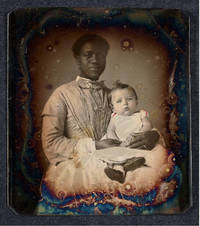
1853rif. 32820729Two sixth-plate daguerreotypes cased together. Left: nurse and child "Bradford & Ellen Sherwood his nurse" right: parents "Jonathan P. Harrison & his wife Caroline Denny Harrison". White family's cheeks are hand-tinted and the baby's dress is hand-colored. Some spots edges tarnished. A tremendous pair. Jonathan P. Harrison born 23 December 1829 and his wife Caroline Denny Harrison born c. 1834 are in one portrait while their son Bradford born c. 1853 and his black nurse Ellen Sherwood are in the other. The Harrison family moved from Talbot County on Maryland's Eastern Shore to Texas in the 1850s to pursue ranching and farming opportunities. According to the U.S. Census in 1860 the family lived in Corpus Christi Texas with Jonathan reported as 29 years old Caroline 26 and Bradford 7 indicating a date of 1853 for this photograph. The Harrisons and Dennys were prominent Maryland and Texas families. Jonathan served with the 1st Texas Cavalry during the Civil War. Identified daguerreotype portraits of slaves are rare and linked pairs such as this set are very rare. It is conceivable that Ellen Sherwood was a free black but given the status of the Harrison and Denny families it seems probable that she was a slave. This splendid pair of photographs vividly demonstrates the complexity of black-white relationships in the antebellum South. Provenance: "Jonathan P. Harrison & his wife Caroline Denny Harrison / Their child Bradford & Ellen Sherwood his nurse" identified in a manuscript note beneath the right daguerreotype in the hand of Jonathan's niece Patty Belle Tilghman 1851-1931. See Hanson Old Kent: The Eastern Shore of Maryland p. 96.
1970rif. z015630Westport CT: Negro Universities Press 1970. Reprint. Very Good. Facsimile reprint. 8vo. in black cloth. Varying internal paginations. Very good. Boards and top edge foxed. Light penciling to contents else internally unmarked in a sound binding. Negro Universities Press unknown
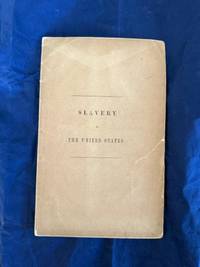
1851rif. 106835Pamphlet 8vo wrappers 36 pp. Archival tape repair to back of front cover slight edgeware normal aging and browning; otherwise very good. Follows the general tone of a good deal of the abolitionist literature of the period. However while the author acknowledges the critical importance of slavery to America he suggests the issue needs to be debated with "calmness and candor" interestingly he indicates that the climate for these discussions appears to be improving. Charles C. Little and James Brown,
1839rif. 106839Pamphlet 8vo original blue wrappers 40 viii 7 1 pp. Very slight edgewear normal aging otherwise excellent condition. The Massachusetts Anti-Slavery Society was founded in 1835 but it appears to be the successor to the New England Anti-Slavery Society founded a few years earlier in 1831. This installment gives a glimpse of the organization's membership and finances. The pamphlet also presents some of the group's resolutions including their strong rejection of the Colonization Society which wanted to send slaves back to Africa. Interestingly the society discusses "the women question" which appears to have been settled by a vote to include women as members. Isaac Knapp,
1840rif. 100899Pamphlet leaflet 8vo 4 33-36 pp. Some aging and browning and a small stain at the bottom let margin; otherwise very good plus. Basically this short pamphlet provides "abridged selections" of various slave statutes from states around the country prior to the Civil War .The statutes consistently explain that a slave should be considered a thing not a person and of course has no right to own property. It also outlines various punishments such as 25 lashes for riding a horse without permission 21 lashes if more than six slaves meet together and death for striking a white person 3rd offense. The Anti-Slavery Bugle,
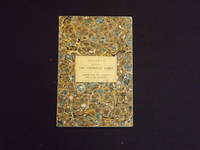
1836rif. 1005398vo pamphlet marbeled wrappers with printed label on front cover 32 pp.some minor spine snd edge wear slight aging; very good or better.The work begins with the original source of funds for its "Charitable Fund" which began with estate of Robert Boyle in 1691. Since the 500000 Negro Slaves in the West Indies were mostly "infidels and heathens" converting them to Christianity would be doing them a favor and help the empire.Converting the slaves to Christianity would make them more virtuous more comfortable offer them a prospect of eternall happines and even make them better servants. Richard Clay,
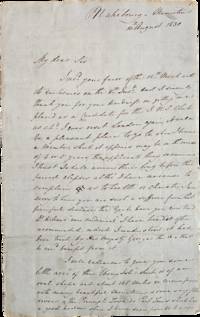
1830rif. List2931Mahébourg Mauritius 1830. Single unsigned fourteen-page letter measuring 8 x 12 ¾ inches. Folded with some stains and pencil marks. Overall near fine. In 1830 Mauritius was a British colony captured from the French in 1810 during the Napoleonic Wars. It was originally a Dutch colony and the Dutch had introduced enslaved labor to the islands. Enslaved people were imported from Madagascar India and Southeast Asia to harvest the valuable ebony trees and later to farm sugarcane. It became a French colony in 1715 and among other provisions the French government awarded upper-class colonists large land grants each with twenty enslaved people to work them. Slavery was abolished in 1835 under British rule after which the planters still farming sugarcane turned to indentured servant labor from India and China alongside illegal slavery.1 Offered here is a lengthy single letter written by an unknown author to an unknown recipient from Mahébourg in 1830 shortly before this radical change. The letter describes the lives and economic circumstances of the planters and merchants and of the non-white population particularly Malabar people and free and enslaved Black people. Noting that “every inch of ground that will produce sugar cane is planted with it” including “the former fine gardens to some of the Habitations” the author reports on the situation for sugar planters: “The price of sugar here is not more than 20/per Cwt. for the best quality which does not now remunerate the Planter as his expenses are becoming every day more heavy in consequence of their slaves diminishing . The want of Slaves induced many of the Planters to send for Chinese Labourers and several hundreds were imported at a great expense but unfortunately they did not answer and were obliged to be reshipped for their native Country again at the charge of those who sent for them.” The author later notes that “nearly everyone of the Planters have heavy mortgages on their Estates and are obliged to pay this immense Interest which keeps them poor and will I fear ultimately ruin them”. In fact the planters in British Mauritius had extra duties on their sugar exports compared with their Caribbean counterparts. The shopkeepers on the other hand “calculate on retiring with a fortune in five years– therefore you will fancy what must be their prices also their profits.” Though writing from Mahébourg the author describes the capital city of Port Louis at length especially its Malabar Indian and free Black residents—the lives of the latter particularly the free Black women seem especially grim. They write: “The Centre of Port Louis is inhabited by all the respectable people and many most excellent houses buildings– the Catholic Chapel the English Church amongst the number. The Suburbs to the West is the part occupied by about 3000 Malabars called ‘Malabar Town.’ – They are dressed mostly in white with Turbans ear rings c c and the females with ornaments in their noses and on their Toes as they generally go bare foot. – Once a year they have what is called a ‘Yamsee’ or a festival in honor of Mehomet which lasts for about a fortnight during which time they seem to get no sleep a continual beating of tom toms – jingling of bells – carrying pagodas which are made of various coloured paper and most richly ornamented followed by all the population of their Caste with their faces daubed with red white c and which has a most ludicrous appearance. The Suburbs to the South is called ‘black Camp’ – the Houses being very small and poor and inhabited by all the free blacks as well as many Mulattoes. – Also a certain class of females of the population of colour – who are visited immediately on the Arrival of a Ship the Crews soon enquiring the way to the ‘Camp.’” As regards relations between the races the author recounts an incident that followed the 1828 abolition of the color bar which would ostensibly give the free non-white population the same rights as the whites: “The Theatre is a very good one but has been closed for several months past the Actors Actresses gone to Bourbon in consequence of the promulgation of the act ‘causing all free people of the population of Colour’ to have the same laws – the same privileges as the Whites’ fearing they ought come to the Theatre which they had hitherto been forbidden thereby cause disturbances as the French Whites detest them wd. not sit in the same box it was considered best to shut the Theatre which is a great loss to the Place it being the chief public amusement and indeed the only one we have here.” Overall a detailed letter giving insight into life in a slave colony at a time when significant changes were on the horizon. Of interest to scholars of the colonial history of Mauritius and the second wave of British colonialism. 1 Truth and Justice Commission Report of the Truth and Justice Commission Vol. 1 Mauritius: Government Printing 2011. unknown
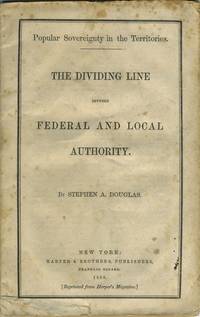
1859rif. 27949New York: Harper & Brothers 1859. Paperback. Good overall. The United States will forever be in this struggle between the rights of the States vs. the rights of the Federal Government. In this case the question is slavery. One of Douglas' papers promoting 'Popular Sovereignty" or the right of the people of a state or territory to decide the slavery question for themselves-as a Union-saving formula. 8vo 40pp publisher's paper wraps slt foxed still very readable. Harper & Brothers paperback
1786rif. 40654Philadelphia: London printed: Philadelphia: re-printed by Joseph Crukshank 1786. 8vo. 8 1/2 x 5 inches. xix 2 22-155 pp. Publisher's advertisement at rear. Original blue paper wrappers Exceedingly rare first American edition of Clarkson's first work. A landmark work by the writer who helped abolish slavery in the British Empire. First American edition of Clarkson's rare first published work preceded by the same years first English edition his famous prize essay on the abolition of slavery igniting the campaign for one of the fundamental rights of man PMM 232. In 1770s England as "rebellious Americans were severing ties with their former British motherland a strenuous battle occurred that spawned the noble civil- and human-rights fight that eventually ended Britain's participation in the African slave trade." With this Essay on the Slavery and Commerce of the Human Species Thomas Clarkson "became the official whistle-blower of the horrors of transatlantic slavery the driving force behind the abolition of African slavery and the slave trade" Smith Thomas Clarkson 17. Clarkson's "famous prize essay was the prelude to parliamentary action" on the abolition of slavery. Clarkson together with William Wilberforce led the "campaign carried on by word of mouth and by means of the printing press for one of the fundamental rights of man" PMM 232. Clarkson had been completing his studies at Cambridge when he entered an essay competition and came across an "advertisement for Benezet's Historical Account of Guinea. He was profoundly struck by the title and 'hastened to London to buy it'. Overwhelmed by the horror and brutality of transatlantic slavery his goal of merely winning the prize for its own sake" shifted to creating a work of wider impact. On winning the 1785 Cambridge prize Clarkson translated the essay his Latin dissertation into English for publication. He documents the long history of slavery the devastating Middle Passage and the inhumanity of slavery in the colonies. Clarkson is renowned as "the man who spawned the British Abolitionist Movement and the first Briton to devote his entire adult life to ending African slavery… the moral conscience of American slavery proponents well into the 19th century" Smith 9-30 43. "He never ceased to work for anti-slavery lending his pen and his prestige particularly to the cause of abolition in the United States" DNB. Evans 19561; Library Company of Philadelphia. Afro-Americana 1553-1906 2nd ed. 2384; Kress B1028; ESTC W32021; PMM 232a; Sabin 13484. London, printed: Philadelphia: re-printed by Joseph Crukshank unknown
1865rif. 39270Boston: Geo. C. Rand & Avery 1865. 8vo. 8 1/2 x 5 3/4 inches. 16pp. With the author's compliments. Disbound. First edition of this powerful and timely address delivered just three months after the end of the American Civil War. A respected classicist professor and public intellectual Alpheus Crosby offers a sober and principled argument concerning the reintegration of the Southern states into the Union. Rejecting both harsh retribution and passive leniency Crosby emphasizes the constitutional and moral responsibilities of the federal government in the aftermath of rebellion. Framed by the ideals of Phi Beta Kappa and the liberal education it promotes Crosby's speech calls for a just and sustainable reconstruction policy underscoring the need for national unity grounded in legal equity and civic virtue. A revealing document of Northern intellectual engagement with the dilemmas of Reconstruction at its inception. Sabin 17626. Geo. C. Rand & Avery unknown
1834rif. 31598Philadelphia 1834. 3pp. Later annotation at head of first page. Scarce letter on the Liberian colonization movement by one of its founders. Writing to Hawes a member of Parliament and a committee member of the Society for the Extinction of the Slave Trade Cresson wishes for success in the British anti-slavery action off the coast of Sierra Leone writing "I hope that you may yet enjoy the satisfaction of crushing one of the worst & most unacceptable of the slave markets in existence that at Gallinas." After mentioning the travels of the colonial governor of Liberia he writes: ". I have been gratified to learn from several highly respectable sources that such a Colony as you propose located either at the mouth of the Cape Mount River or even a little more to the Northward say at Sugaree & provided with a good supply of trade goods to exchange with the natives would have a powerful tendency to break up the monopoly now enjoyed by the Spanish Slavers. My letters from Africa state that the demand is so great in Cuba from the ravages of Cholera among their ill-fed human cattle as to have rendered the shipments from the Gallinas during the past year almost unprecedented. It appears that the benevolent efforts of your Govt. are not likely to extirpate the evil until commercial & agricultural colonies shall be substituted for cruisers." The letter continues with news from their consul at Liberia before turning to American politics: ". political affairs engrossing the entire energies of the nation. The excitement is painfully great . Our military chieftan Jackson by his acts of unauthorized assumption has called forth a burst of indignation which cannot subside until we get rid of the offender." The letter concludes with an introduction for Gerard Ralston. Cresson a noted Philadelphia businessman and philanthropist was among the most ardent supports of colonization the movement to relocate former slaves and free African Americans to colonies in Liberia. In 1833 Cresson and the Philadelphia Young Men's Colonization Society a branch of the American Colonization Society founded Port Cresson in Liberia. However the colony was attacked in 1835 by Bassa tribesmen incited by Spanish slave traders and destroyed. unknown
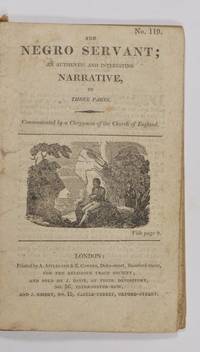
rif. 41475London: Printed by A. Applegath & E. Cooper for the Religious Tract Society c. 1825. 12mo 24pp. woodcut vignette to title-page disbound. London: Printed by A. Applegath & E. Cooper, for the Religious Tract Society, [c. 1825.] unknown
rif. 33966London: John Murray Albemarle Street 1826. First edition 2 78 2pp. slight foxing of first few leaves folding table disbound. In reply to "An Address to the Members of the New Parliament on the proceedings of the Colonial Department." which held that if slaves were freed they would not work and as a consequence the colonialist's properties would fall into decay through lack of labourers. This pamphlet denies that the proceedings of the Colonial Department on the matter of Caribbean slavery had been injudicious and unauthorised. Ragatz p.451; Sabin 69410. London: John Murray, Albemarle Street, 1826 unknown
rif. 2499523 November 1939. On letterhead of the National Council for Civil Liberties London. See his entry in the Oxford DNB. 1p 4to. A very good facsimile of a typed letter with the main text in black some in red and the facsimile signature 'Henry W. Nevinson' in light blue. Names of Nevinson as President E. M. Forster as Past-President and dozens of Vice-Presidents in left-hand margin including Aldous Huxley A. A. Milne J. B. Priestley H. G. Wells and Rebecca West. Addressed to 'Dear Sir' the letter sets out the history of the organization appealing for 'support for its activities'. In sending a copy of its monthly journal 'the Council makes an appeal not only because it stands for all those things upon which we as a free people pride ourselves but also because it is a live energetic body and shows practical results'. There is a reference to 'these critical days' and the letter ends by stating that 'it is in your interest to use its services and to see that it is strong and efficient to protect your liberties'. 23 November 1939. On letterhead of the National Council for Civil Liberties, London. unknown
1833rif. 31599England: Elliott Cresson 1833. Bi-folded folio. 3 pp. 12 1/3 x 7 1/2 inches. Important autograph letter from Elliott Cresson one of the foremost proponents of the American Colonization Society and its colony in Liberia to Member of Parliament Benjamin Hawes presenting a resolution to found the British African Colonization Society. Discusses the famed abolitionist William Lloyd Garrison's opposition to the colonization movement. The letter begins with the two-page text of a resolution to establish the British African Colonization Society under the patronage of the Duke of Sussex: "That Colonies composed of fair settlers of African race established on judicious principles on the Coast of Africa appear calculated beyond any other plan to put an effectual stop to the slave trade . . . Resolved that a Society be formed to be called the British African Colonization Society and that its objects be to cooperate with the American Colonization Society and with the several missionaries and other religious and charitable societies in Great Britain and the United States of America in such measures as may promote the total abolition of the slave trade and the establishment of Christianity and Civilization among the Natives of Africa chiefly by the employment of Free Persons of African birth or descent . . ." In the letter which follows Cresson writes of William Lloyd Garrison's opposition to the colonization movement: "I send the list of officers as far as accepted several others have not yet answered but I trust we shall present a bold front. I have just heard thru his Chaplain from the Duke. Garrison has written to poison his mind and probably will annoy our meeting. I trust that as the notice has been so short our friends will bring many with them . . . My letter to the Times in answer to Garrison they have not yet noticed so that it will be put in the Globe whose Editor has offered it a place in his columns." Cresson a noted Philadelphia businessman and philanthropist was among the most ardent supporters of colonization the movement to relocate formerly enslaved people and free black Americans to colonies in Liberia. In 1832 he traveled to England to promote international support for the movement. The following year Cresson and the Philadelphia Young Men's Colonization Society a branch of the American Colonization Society founded Port Cresson in Liberia. However the colony was attacked in 1835 by Bassa tribesmen incited by Spanish slave traders and destroyed. Although initially in favor of colonization William Lloyd Garrison changed his mind and decried the efforts of the American Colonization Society as a perpetuation of slavery. For Garrison's 28 June 1833 letter to the Duke of Sussex referenced above see The Letters of William Lloyd Garrison I:107. Elliott Cresson unknown
rif. 44503 and 6 March 1917 and 31 January and 25 March 1918; all four on letterhead of the Anti-Slavery and Aborigines Protection Society. Campaigner against slavery and colonial exploitation in Africa 1874-1940 and Liberal MP for North Hackney 1923-24. All four items one page quarto. All in good condition though on somewhat discoloured paper. Two items docketed in pencil and two bearing the Society's stamp. ITEM ONE: He hopes to be present at Dr. Max Horn's lecture and wants to know whether the Society is 'publishing the lecture by Mr. Wilson Fox on Imperial Resources'. He thinks he should join the Society 'if not now soon after the war' and asks to be sent the conditions of membership. ITEM TWO: Acknowledges receipt of the Society's journal containing Fox's paper and copy of the Society's prospectus. ITEM THREE: He is disappointed as he 'particularly wished to be present' at the lecture but will not be able to get back from Winchester in time. Asks for copy of paper. ITEM FOUR: 'I enclose herewith corrected proof of the few remarks I made at the meeting of the Society of Arts.' not present All four items signed 'John H Harris'. 3 and 6 March 1917, and 31 January and 25 March 1918; all four on letterhead of the Anti-Slavery and Aborigines Protection Socie unknown
1837rif. 101441Pamphlet small 8vo removed dbd 11 pp. Removed some minor foxing normal aging and browning; otherwise very good. This pamphlet was prepared for the New York chapter of the Religious Society of Friends Quakers for their annual meeting to oppose slavery. Not surprisingly this tract encourages people to help end "this stain upon our national character." While there are religious sentiments in this work much of the discussion relates to social injustice and morality. Mahlon Day (and New York Quakers),
rif. 23092Without date or place. 3pp. 12mo. Bifolium on ruled laid paper. Fair: aged with a 12.5 x 5 cm section cut away from the top of the first leaf before the writing out of the poem. 63 lines divided into six nine-line stanzas. The stanzas are numbered and the poem is complete. The stanzas are numbered and the poem is complete. Written from the slave's point of view with the first stanza reading: 'I'm weary yet I cannot sleep Dark thoughts of morning make me weep For at the rising Sun I'm told I'll be converted into gold There's no escape I must be sold Because my master wants the gold And I'm his Slave yes I'm his Slave Because my master wants the gold And I'm his slave'. Last stanza describing the slave's flight to Canada: 'At last my dreadful journeys o'er I'm safe upon the farther shore St Georges cross floats over me I've found the land of Liberty. My youths renewed no more I'm old That fear is gone of being sold For now I'm Free Yes now I'm Free The fear is gone of being sold For now I'm Free.' No indication has been found that the poem was ever published. Without date or place. unknown
1880rif. 37129Circa 1880. 1880. Good. - A slip of paper 2-3/8 inches high by 4-3/8 inches wide is inscribed & signed in black ink: "Let us thank God for the Saxon Grit / Robert Collyer". The paper is mounted on a piece of cream-colored card of approximately the same size. The card is unevenly cut & both paper & card are slightly rippled from the mounting. Good. "Saxon Grit" is the title of an 1880 poem by Collyer about the Norman conquest of England in which the phrase recurs in each verse. Robert Collyer 1823-1912 was an English-born American Unitarian clergyman. He became a Methodist minister in England in 1849. Emigrating to The United States in the following year he found employment as a hammer maker in Pennsylvania and soon began preaching on Sundays while still employed at the factory. His earnest rugged simple style of oratory won him great popularity but his advocacy for the antislavery cause then frowned upon by the Methodist authorities aroused opposition. He was tried for heresy and his license was revoked. Continuing as an independent preacher he joined the Unitarian Church in 1859. In 1860 he organized and became pastor of the Unity Church the second Unitarian Church in Chicago. The church grew to become one of the strongest Unitarian churches in the West and Collyer was regarded as one of the foremost pulpit orators in the country. He left Chicago in 1879 and became pastor of the Church of the Messiah now renamed the Community Church in New York City. In 1883 he was a featured speaker at the convention of the American Woman Suffrage Association where he spoke movingly about his deceased wife and their struggles over "the woman question". Circa [1880]. unknown
rif. 28345Confidant of Missouri pioneer Jonathan Bryan 1759-1846 of the noted St. Charles family whose relatives included their neighbor Daniel Boone. DS 1p 7½" X 12" St. Charles County MO 1847 February 2. Near fine. Acknowledgment that Tuter who signs himself as "Administrator of the Estate of Johnathan Bryan" has had a writ of replevin made out and issued to the St. Charles sheriff Edward C. Cunningham 1809-65 for delivery to an unnamed offender. The writ seeks to recover the following property apparently wrongfully taken from Jonathan Bryan's estate: "one negro man a Slave named Heney one Two horse waggon and one pair of Briches Two Black horses one Lorrel horse with bold face one walnut Cupboard one clock one Bureau one bedstead and bedding one walnut Table one Trunk one Bible." In other words everything but the kitchen sink. Signed at the conclusion by Tater in his definitely untutored hand. Tales of slaves are found in the Bryan family lore such as: "Mrs. Jonathan Bryan a kinswoman of Daniel Boone was working in her yard with a slave woman when a boy slave screamed. She saw an Indian warrior heading for them with a tomahawk in one hand and a gun in the other. The women ran for the house. Just as they were slamming the door they caught the warrior's head and right arm between the door and facing. The slave woman grabbed the hatchet from his hand and killed him with a sharp blow. The women had barely recovered from their fright when the boy shouted again." Could the slave boy in this old family legend by none less than the "Slave named Heney" whose return is demanded in this replevin suit Quite unusual slavery item with an intriguing history. unknown
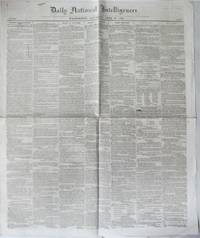
1859rif. 017039Washington DC: Gales and Seaton 1859. Tabloid. Good. Side folding large tabloid newspaper. A single issue of this long running newspaper published in Washington DC first published in 1800 and publishing until 1870 with an eventual bias toward conservative Whig policies. Besides the usual ads and political news this issue contains two "Was Committed" notices last page bottom right one pertaining to Mary Norris George Park and Sally King the other pertaining to Lewis West. All four were African-Americans with Mary Norris George Park and Lewis West being enslaved people from enslaver Robert E. Lee. According to the US National Park Service website devoted to Robert E. Lee's Arlington House Memorial Mary Norris George Parks and another man Wesley Norris believed they were free based on a provision in the will of George Washington Custis. Based on this knowledge the three emancipated themselves traveling to Pennsylvania. They were all captured in Maryland. According to contemporary newspaper accounts New York Tribune in June 1859 Lee had the re-captured African-Americans whipped. Wesley Norris himself wrote an article in the Anti-Slavery Standard in 1866 which provides his account of the whipping. Early historians and biographers dismissed both accounts considering them to be accounts used for anti-slavery propaganda. Lee himself was silent on the subject with many of his contemporaries and historians taking his silence as a denial. However modern research suggests the accounts of Wesley Norris and others were true dispelling the myth of Lee as benevolent enslaver perpetuated by earlier historians. The first notice states that Norris Park and West were committed to jail on May 26th and that "George and Mary say they belong to Col. Robert Lee of Fairfax County Virginia." The complexion and height of all three are given as well as descriptions of the clothing they wore. Sally King asserted that she was free living in Washington with a Mrs. D. Bread. According to the piece they all initially left Washington on May 22nd 1859. The second notice contains the same information as the first although it appears Lewis West was jailed on May 27th but also asserted he "belongs to Col. Robert Lee." Both notices request that the "owner or owners" come forward and pay all charges due. Also present is a notice of "young servants for sale" indicating the availability of several girls from ages 11 to 15 as well as young men from 21 to 25 years old. All were apparently located in Georgetown. The newspaper is in GOOD condition. Paper split chipped and deteriorating along the spine with very slight loss of letters to some of the "was committed" ads. Horizontal and vertical fold creases present. Moderate toning along the spine edge. Small hole worn through at the intersection of the fold creases. Some wrinkling and creasing to the paper. Several small tears along the extremities. Gales and Seaton unknown
1830rif. 94792Circa 1830s. 1830s. Good . - The close of a letter on a 3-1/4 inch high by approximately 6 inch wide piece of note paper is signed "Geo Thompson". The paper is darkened with some staining not affecting the signature. The paper is mounted on a sheet of yellow paper and has been folded twice for mailing. Good. The British antislavery orator and activist George Donisthorpe Thompson 1804-1878 worked toward the abolition of slavery through lecture tours and by introducing legislation while serving as a member of Parliament. An able orator he was hired by the London Anti-Slavery Society in 1831. While in Scotland in 1832 where he became interested in abolishing slavery in the United States as well as other parts of the world he met William Lloyd Garrison and the African-American abolitionist Nathaniel Paul. Invited to visit New England by Garrison he traveled to the US in 1834 where he drew the attention of pro-slavery supporters and was forced to flee for his life. The Hobart Town Courier later printed a letter in which Thompson stated that he had ".left the United Sates to escape the assassins knife." the editor noting that attempts had been made to "burn and murder" him in several US towns. He returned to the US following the passing of the Fugitive Slave Law in 1850. By then the abolitionist movement having substantially grown and gained in influence Thompson found a warmer welcome. Returning to London he and his son founded the London Emancipation Society which supported the Union during the Civil War. Returning to America he allied himself with William Wells Brown and met President Abraham Lincoln. Throughout his life Thompson was a powerful voice for emancipation. He supported East Indian reform free trade Chartism non-resistance and the peace movement often protesting legislation that offered only limited restrictions on slavery. RARE. Circa [1830s]. unknown
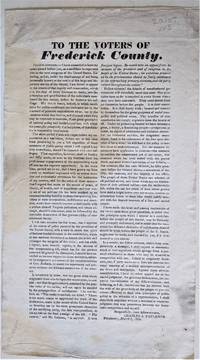
1833rif. 713Winchester Va. 1833. Broadside 4to. 290 x 160 mm. 11 ¼ x 6 ¼ inches. Printed in two columns signed in type by Charles J. Faulkner at Winchester dated March 8 1833 at conclusion. Lightly dust-soiled pale stain affecting perhaps one-third of the left-hand margin and column of text. Neatly silked on verso. Withal about very good. Following the August 1831 Nat Turner rebellion in Southampton County a last effort was made by moderate Virginians to gradually abolish slavery. Faulkner a 26-year-old lawyer and assemblyman along with Thomas Jefferson Randolph sponsored legislation to free all children born of slave parents after July 4 1840. His speech emphasized the evil of slavery for Southern white labor noting that slavery "converts the energy of the community into indolence--its power into imbecility--its efficiency into weakness.Shall society suffer that the slave-holder may continue to gather his crop of human flesh" As the Assembly was malapportioned in favor of the Tidewater slaveocracy the proposal lost rather narrowly and nearly thirty years later the Confederacy was assured of Virginia's succession. It is perhaps not surprising that Faulkner "comparatively a stranger" to the county but a member of the Virginia House of Delegates at this time 1831-34 was not successful in his campaign to represent Virginia in the U.S. Senate. However Faulkner was elected to three terms in Congress from Virginia in the 1850s. He was elected to Congress from West Virginia after the Civil War. In the interim he served as Minister to France during the Buchanan administration and on the staff of Stonewall Jackson. Dictionary of American Biography. Not in Hummel. Not found in American Imprints for 1833 and not in the 1830-1839 title index. OCLC records four copies at The Library of Virginia University of Virginia Virginia Historical Society and American Antiquarian Society. unknown