1 586 résultats
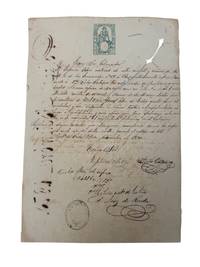
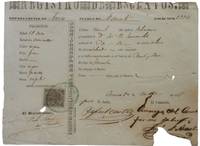
1871réf. 237101871. Slavery Black Labor Puerto Rico This official Puerto Rican slave registry document issued in Manatí in 1871 under Spanish colonial administration represents the bureaucratic infrastructure of slavery in the Caribbean at the precise moment preceding abolition. Titled within the printed form as part of the "Registro de Esclavos - Isla de Puerto Rico" the document records the forced legal identity of an identified enslaved man. Single sheet slave registry document "Empadronamiento General de esclavos" from Manatí Puerto Rico dated 20 de Mayo de 1871. Measuring 6.25" x 8.5". This document was registered by "Don Manuel María Monserrate" for the enslaved person "Feliciano." Document bears official signatures from the local authorities. The enslaved person is listed by their age stature "color" hair color beard eyes nose and mouth. The person is listed as 18 years old and the "color" of this individual is listed as "negro". The physical list of classifications functioned as mechanisms of surveillance control and verification within the colonial slave system. Inclusion of official signatures from both the "dueño" and "comisario" along with a stamped fiscal seal en verso. Produced just under two years prior to the 1873 abolition of slavery in Puerto Rico the document reflects the transitional legal environment in which enslaved individuals were increasingly catalogued in anticipation of emancipation policies that would in practice impose systems of forced apprenticeship and indemnification to former enslavers. Tape was previously applied to the bottom right of the document; some minor wormholes and occasional spotting. Overall good condition. The document stands as evidence of how emancipation in Spanish territories was mediated through administrative control prolonging coercive labor conditions even as slavery was formally dismantled. unknown books
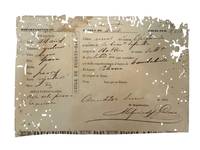
1873réf. 238001873. Puerto Rican slave registration document from January 1873 recording the legal identity ownership agricultural occupation parentage and physical classification of Epifanio a forty four year old enslaved Black man in Arecibo less than three months before slavery was abolished in Puerto Rico. Issued after Spain's 1870 Moret Law had initiated a limited process of emancipation but before the abolition law of March 22 1873 the cédula placed Epifanio within a registration system designed to record enslaved people by name family relations occupation owner residence civil status and identifying physical characteristics. The January 20 date makes the document especially closely situated to abolition recording Epifanio as legally enslaved only weeks before the Spanish National Assembly dismantled the legal institution under which the certificate had been issued. Registro de Esclavos Isla de Puerto Rico. Arecibo Puerto Rico January 20 1873. Single printed and manuscript cédula folio no. 7215. The document identifies "Epifanio" as an enslaved man "propiedad de la Sucn. Tafarella" forty four years old a native of Puerto Rico single and "de oficio labrador." He is recorded as "no está coartado" and as registered in the barrio of Cambalache with his mother identified as "Petrona." The printed "Filiacion" column subjects his body to a standardized identifying description: regular stature "Color negro" sparse hair sparse beard brown eyes and a regular nose. Under "Señas particulares" the manuscript records "Cojo de la pierna izquierda" identifying him as lame in the left leg and incorporating a physical disability into the identifying data maintained by the slave registry. The lower portion differs from the earlier 1871 forms in carrying a prominent signature beneath "El Registrador" while extensive insect damage has removed portions of the printed heading and margins. The verso bears manuscript offsetting and additional evidence of administrative handling. Epifanio's cédula was produced at the endpoint of Puerto Rico's rapidly changing legal regime. The Moret Law of 1870 had granted freedom to specified categories of enslaved people including those aged sixty and older those belonging to the state and children born after September 17 1868 while leaving a forty four year old man such as Epifanio legally enslaved. His notation as "no está coartado" further records that he had not entered coartación the mechanism through which an enslaved person could make payments toward self purchase. His recorded occupation as "labrador" placed him within Puerto Rico's agricultural labor economy while "Cojo de la pierna izquierda" shows how the registry extended beyond racial and occupational classification to bodily characteristics capable of distinguishing one enslaved person from another. On March 22 1873 only about two months after this cédula was dated the Spanish National Assembly abolished slavery in Puerto Rico compensating former enslavers while requiring the emancipated population to enter labor contracts for an additional three years. Extensive insect damage with numerous wormholes and substantial losses along the upper and side margins affecting portions of the printed heading and several fields; moderate toning and staining with principal manuscript entries and the registrar's signature remaining legible. Overall fair condition. An individually named record of the administrative system that converted Epifanio's race body physical disability agricultural labor parentage residence and legal ownership into the identifying data of slavery during the final months before abolition in Puerto Rico. unknown books
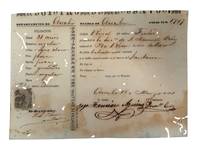
1871réf. 237981871. Puerto Rican slave registration document from 1871 recording the legal identity ownership agricultural occupation and physical classification of a named thirty one year old enslaved man in Arecibo during the final years of slavery under Spanish colonial rule. Issued after Spain's 1870 Moret Law had initiated a limited process of emancipation but nearly two years before abolition in Puerto Rico the cédula placed Fruto within a registration system designed to record enslaved people by name occupation owner residence civil status and identifying physical characteristics. His classification as "negro claro" his occupation as "labrador" and his ownership by the succession of D. Manuel Ortiz place racial designation agricultural labor and property status together within the administrative machinery of colonial slavery. Registro de Esclavos Isla de Puerto Rico. Arecibo Puerto Rico March 15 1871. Single printed and manuscript cédula folio no. 1747. The document identifies this enslaved man "propiedad de la Sucn. de D. Manuel Ortiz" thirty one years old a native of Puerto Rico single and "de oficio labrador." He is recorded as "no está coartado" and as residing in the barrio of Santana. The fields for parents spouse and children are left blank. The printed "Filiacion" column subjects his body to a standardized identifying description: regular stature "Color negro claro" sparse hair sparse beard large eyes a regular nose and a further description of the mouth partially obscured by worming. A one peseta fiscal stamp at lower left is cancelled by an official marking. The lower portion carries the signatures or attestations of the "Registrador" "El dueño" and "El Comisario" with the owner's portion apparently signed on behalf of the succession by Francisco Aguirre. The verso bears ink offsetting and staining associated with subsequent administrative handling. This man's cédula was produced within a rapidly changing legal regime. The Moret Law of 1870 granted freedom to specified categories of enslaved people including those aged sixty and older those belonging to the state and children born after September 17 1868 while leaving many others including a thirty one year old agricultural laborer such as this individual legally enslaved. His notation as "no está coartado" further records that he had not entered coartación the mechanism through which an enslaved person could purchase freedom incrementally. The document's ownership by the "Sucn. de D. Manuel Ortiz" also records the treatment of an enslaved person as property within an estate with his legal ownership continuing through the succession rather than ending with the death of the named enslaver. On March 22 1873 the Spanish National Assembly abolished slavery in Puerto Rico compensating former enslavers while requiring the emancipated population to enter labor contracts for an additional three years. Moderate toning and staining scattered wormholes with small losses affecting several manuscript entries minor edge losses and a larger loss at the lower right edge; principal manuscript information and signatures remain legible. Overall good condition. An individually named record of the administrative system that converted this individuals race body agricultural labor residence civil status and legal ownership into the identifying data of slavery less than two years before abolition in Puerto Rico. unknown books
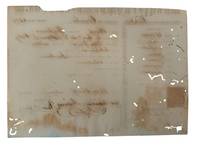
1871réf. 237971871. Puerto Rican slave registration document from 1871 recording the legal identity ownership agricultural occupation and physical classification of Eleuterio a twenty six year old enslaved man in Arecibo during the final years of slavery under Spanish colonial rule. Issued after Spain's 1870 Moret Law had initiated a limited process of emancipation but nearly two years before abolition in Puerto Rico the cédula placed Eleuterio within a registration system designed to record enslaved people by name family relations occupation owner residence and identifying physical characteristics. His classification as "mulato" his occupation as "labrador" and his ownership by the succession of D. Manuel Ortiz place racial designation agricultural labor and property status together within the administrative machinery of colonial slavery. Registro de Esclavos Isla de Puerto Rico. Arecibo Puerto Rico May 15 1871. Single printed and manuscript cédula folio no. 1740. The document identifies "Eleuterio" as an enslaved man "propiedad de la Sucn. de D. Manuel Ortiz" twenty six years old a native of Puerto Rico single and "de oficio labrador." He is recorded as "no está coartado" and as residing in the barrio of Santana with his mother identified as "Valentina." The printed "Filiacion" column subjects his body to a standardized identifying description: tall stature "Color mulato" sparse hair sparse beard black eyes a regular nose and a further description of the mouth partially affected by loss. The lower portion carries the signatures or attestations of the "Registrador" "El dueño" and "El Comisario" with the owner's portion apparently signed on behalf of the succession by Francisco Aguirre. A one peseta fiscal stamp appears at lower left beneath the physical description. The verso bears manuscript docketing and staining associated with subsequent administrative handling. Eleuterio's cédula was produced within a rapidly changing legal regime. The Moret Law of 1870 granted freedom to specified categories of enslaved people including those aged sixty and older those belonging to the state and children born after September 17 1868 while leaving many others including a twenty five six old agricultural laborer such as Eleuterio legally enslaved. His notation as "no está coartado" further records that he had not entered the system of coartación through which an enslaved person could make payments toward self purchase. On March 22 1873 the Spanish National Assembly abolished slavery in Puerto Rico compensating former enslavers while requiring the emancipated population to enter labor contracts for an additional three years. Moderate toning and staining scattered wormholes with small losses affecting several manuscript entries loss along the upper edge affecting part of the printed heading and additional minor edge losses; principal manuscript information and signatures remain legible. Overall good condition. An individually named record of the administrative system that converted Eleuterio's race body family relationship agricultural labor residence and legal ownership into the identifying data of slavery less than two years before abolition in Puerto Rico. unknown books
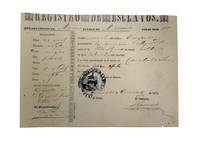
1872réf. 237961872. Puerto Rican slave registration document from January 1872 recording the legal status ownership labor residence parentage and physical identification of Eugenio a twenty year old enslaved Black man in Arecibo during the final fourteen months of slavery on the island. The cédula was issued within the registration system expanded following the Moret Law of 1870 which freed specified categories of enslaved people while leaving young adults such as Eugenio in bondage and led to the preparation of Puerto Rico's central slave register. Surviving 1872 schedules record the same categories present here including name origin residence parents marital status occupation age physical description and enslaver. Registro de Esclavos Isla de Puerto Rico. Arecibo Puerto Rico January 20 1872. Single printed and manuscript slave registration cédula folio no. 119. The document identifies "Eugenio" as twenty years old "Color negro" single and employed "de oficio labrador" placing agricultural labor directly within his official identification. He is recorded as a native of Puerto Rico and registered in the barrio of Cambalache. His ownership entry appears to read "propiedad de la sucesión ." indicating ownership by an estate or succession although the following name is difficult to establish confidently from the manuscript hand. The "Filiacion" column records his stature as "regular" black hair sparse beard brown eyes a regular nose and additional identifying information; under "Señas particulares" a manuscript notation appears to record a defect involving the right foot though the exact wording is partially unclear. The document carries the signatures or attestations of the "Registrador" and "El Comisario" together with a fiscal stamp heavily cancelled by an official circular handstamp. The verso bears additional official stamps and manuscript markings associated with the document's administrative use. Eugenio was registered at a moment when Spanish policy had begun dismantling slavery selectively while continuing to document and regulate those excluded from immediate freedom. The Moret Law granted freedom to people over sixty enslaved people belonging to the state and children born after September 17 1868; at twenty Eugenio fell outside its principal age based provisions. Puerto Rico's surviving 1872 Registro Central de Esclavos is preserved in eight rolls of National Archives microfilm and comparable original Arecibo cédulas survive institutionally including a January 1872 folio at the University of Florida that likewise records an enslaved man's age physical description ownership and official signatures. On March 22 1873 slavery was abolished in Puerto Rico terminating the legal status under which Eugenio had been entered on this form. Light toning and spotting several small wormholes and minor edge losses; stamps printed text and principal manuscript entries remain legible. Overall good condition. An individually named record of how Spanish colonial authorities reduced Eugenio's legal status agricultural occupation ancestry residence and bodily characteristics to standardized identifying data during Puerto Rico's final full year of slavery. unknown books
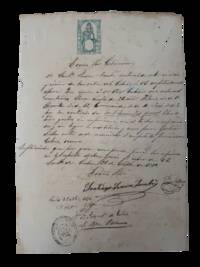
1870réf. 231221870. Slavery Cuba Spanish colonial slave sale manuscript recording the transfer of four enslaved individuals in Cuba in 1870. Produced within the official bureaucratic framework of Spanish colonial governance the document reflects the legal normalization of slavery in Cuba even as abolitionist pressures mounted across the Atlantic world. The document records the sale of four enslaved people described as "criollos" and African-born individuals situating the transaction within a labor system that combined locally born and imported enslaved populations. Created at a time when Spain had formally restricted the transatlantic slave trade but continued to permit slavery itself the manuscript demonstrates the persistence of legalized human commodification and the integration of enslaved labor into the island's economic structure sixteen years prior to abolition in 1886. Official Cuban slave contract documenting the sale of four enslaved individuals to Don Pedro Catasús by Don Enfemia Ochoa for the sum of 1100 pesos on November 29 1870. Single manuscript leaf written in Spanish cursive in black ink measuring 8.25" x 12". A green "50 cs de escudo" revenue stamp is affixed at the top center with a blind embossed Spanish crest at the upper left and a circular black ink government seal impressed at the lower left. Large vertical docketing appears on the verso. A stylized watermark is visible within the paper. The text organizes the enslaved individuals within a standardized transactional structure while the signatures of Enfemia Ochoa Pedro Catasús and A. Díaz de Rada authenticate the exchange and identify participants within the slaveholding economy. By 1870 Cuba remained a central node in the late Atlantic slave system with plantation agriculture especially sugar dependent on enslaved labor despite mounting abolitionist pressure. Although Spain had curtailed official slave imports earlier in the century illegal trafficking persisted into the 1860s and other coerced labor systems including the importation of Chinese indentured workers overlapped with slavery into the 1870s. The presence of both Creole and African individuals in this document reflects the layered composition of the enslaved population during this period. Light toning scattered foxing and edge wear visible. A closed wormhole extends from the upper right margin approximately five inches into the sheet resulting in partial loss of text. Evidence of prior tape reinforcement visible on the verso along with offsetting from previously adjacent material. Overall in very good condition. This document provides named transactional evidence of late-period slavery in Cuba offering concrete material for examining race labor and legal practice within Spanish colonial society. unknown books
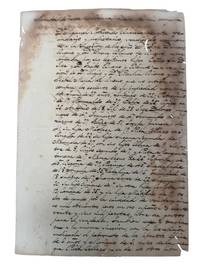
1875réf. 231241875. Slavery Cuba Spanish colonial slave sale manuscript recording the transfer of thirty-eight enslaved individuals in Cuba in 1875 materializing the sheer scale and organization of enslaved labor within the island's plantation economy during the final decade before abolition. The document enumerates a large group of enslaved people including multiple family units with young children demonstrating how slavery functioned as both an economic system and a hereditary condition sustained through the sale and reproduction of enslaved populations. Created eleven years prior to the abolition of slavery in Cuba in 1886 the manuscript documents the continued legality and normalization of large-scale slave transactions despite decades of international pressure and earlier prohibitions on the transatlantic trade offering concrete evidence of how internal markets sustained the institution in its final phase. Official Cuban slave contract documenting the sale of thirty-eight enslaved individuals for the sum of 126000 pesetas formalized before a public notary or legal authority. Single manuscript leaf written in Spanish cursive in black ink on both recto and verso densely filled with names ages and relational identifiers. Measures 8.5" x 12.25". The text lists individuals sequentially including men women and children with repeated references to kinship structures such as mothers with multiple children indicating the sale of family groupings rather than isolated individuals. The script reflects extended passages detailing ownership exclusions and conditions of transfer. A partial watermark of the official coat of arms of Cuba is visible. By 1875 Cuba remained one of the last major slave societies in the Atlantic world with sugar production driving demand for large controlled labor forces. Even after Spain curtailed the official slave trade earlier in the century illegal importation persisted into the 1860s and alternative systems of coerced labor including Chinese indenture supplemented plantation workforces. The scale of this transaction demonstrates the consolidation and redistribution of enslaved labor within domestic markets while the inclusion of children underscores the long-term economic logic of slavery as a self-reproducing system. Moderate toning and foxing concentrated along the edges with numerous small closed wormholes a few affecting portions of the text. Light edge wear present. Overall in good condition. This document provides unusually extensive nominal data on a large enslaved population encompassing the roles of kinship valuation and labor organization in late Spanish colonial Cuba. unknown books
1870réf. 231191870. Slavery Cuba Spanish colonial manuscript documenting the late persistence of slavery in Cuba recording the sale of five enslaved Creole individuals including women and children 1870. Produced within the official bureaucratic framework of Spanish colonial governance the document reflects the legal normalization of slavery in Cuba even as abolitionist pressures mounted across the Atlantic world. The presence of multiple children within the transaction underscores the hereditary nature of enslavement and the commodification of family units offering direct material evidence of how slavery functioned socially and economically in its final decades on the island. Although Spain had formally ended the transatlantic slave trade earlier in the century illegal trafficking and internal slave markets persisted and slavery itself would not be abolished in Cuba until 1886 placing this document within a crucial transitional period marked by reform debates gradual emancipation laws and continued exploitation. Official Cuban slave contract recording the sale of five enslaved individuals identified as "criollos" including one adult woman and four children from Santiago Simón Fambi to Don Pedro Catasús for the sum of 1200 pesos on November 21 1870. Single page manuscript leaf measuring 8.25" x 12". The manuscript is written in Spanish cursive hand in black ink. The upper left bears a blind embossed crest of Spain while a circular black ink government seal is impressed at the lower left partially overlapping the text. The text enumerates the enslaved individuals with ages and names embedding human lives within the formulaic language of sale and valuation while the bold signatures of both seller Santiago Simón Fambi and buyer Pedro Catasús anchor the transaction in identifiable actors within the colonial economy. By 1870 slavery in Spanish Cuba remained central to the island's plantation economy particularly in sugar production which had expanded rapidly in the mid-19th century with industrialized mills and global demand. Enslaved people were primarily forced into agricultural labor under highly regimented and brutal conditions though others were used in urban domestic service skilled trades or as hired laborers generating income for their owners. This document exhibits light toning edge wear and scattered foxing throughout. A closed wormhole extends approximately two inches from the upper right margin inward not affecting legibility of the text. Minor losses and small tears along the edges. Overall in very good condition. Given that this document records a woman and four children the family was likely intended for a combination of field labor and domestic or auxiliary work with the children gradually incorporated into plantation labor as they aged reflecting the system's reliance on both immediate exploitation and the reproduction of enslaved labor over time. unknown books
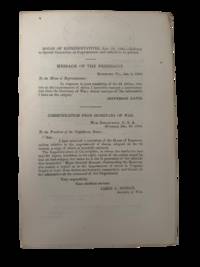
1865réf. 231171865. Civil War Black Military Slavery Virginia Confederate government pamphlet on the impressment of enslaved men for military labor January 1865 one of the clearest bureaucratic efforts to formalize the use of enslaved labor in support of the Confederate war effort. The document responds to a congressional inquiry into the impressment of enslaved people explicitly acknowledging state-directed seizure of enslaved men for military labor. Within the text the Confederate state attempts to regulate this extraction noting limits such as "no more than one out of five male slaves between the ages specified. from any one owner" while simultaneously confirming large-scale requisitions including "5000 slaves from the State of Virginia for service with the army of Northern Virginia." The language reveals both the administrative reach of the Confederate state and its dependence on enslaved labor as a logistical backbone in the war's final phase. Octavo pamphlet measuring 9.5" x 6" 5 pages printed in Richmond Virginia January 1865. Printed for the Confederate House of Representatives and comprising the titled sections "Message of the President" "Communication from Secretary of War" "Resolution of House of Representatives" and "Response of Superintendent of Conscription" with official correspondence dated from December 1864 through January 1865. The exchange includes communications from Brig. Gen. Jno. S. Preston and Major Gen. J. L. Kemper concerning the mechanics of requisition the proportional distribution of impressed labor among slaveholders and errors in previous impressments including the improper inclusion of enslaved people outside the categories prescribed by Confederate authority. While the Confederacy had long resisted arming or formally incorporating enslaved people fearing empowering Black men with weapons and military responsibility would destabilize slavery this document demonstrates a late-war shift toward coercive mobilization framed as "employment" to "increase the efficiency of the army." Additional correspondence from Brig. Gen. Jno. S. Preston and Major Gen. J. L. Kemper details the mechanics of requisition emphasizing proportional seizure across slaveholders and acknowledging prior errors in impressment including the improper inclusion of enslaved people outside prescribed categories. Condition shows light toning minor spotting and edge wear consistent with age; paper remains stable with clear legible text throughout; faint institutional stamp present on front. Overall very good condition. This document underscores how the Confederate war effort relied on systems of exploitation applied to enslaved African American men. unknown books
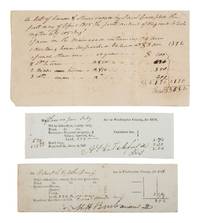
1815réf. 201561815. Manuscript fiscal records from antebellum Virginia documenting the taxation and valuation of enslaved African Americans as property within the legal and economic system of slavery. Dating from 1815 to 1854 the records span nearly four decades and demonstrate the routine bureaucratic mechanisms through which enslaved people were enumerated assigned monetary value and incorporated into county and state taxation alongside land horses clocks and other forms of personal property. The documents provide direct evidence of the administrative infrastructure underlying slavery in Virginia during the decades preceding the Civil War. The earliest record dated April 1 1815 concerns the property of Jacob Campbell and is headed "A list of land & slaves owned by Jacob Campbell the first day of April 1815." An associated receipt provides a particularly stark example of the economic treatment of enslaved people enumerating eight individuals according to gender and age categories and assigning them monetary values totaling $2170. Rather than identifying the individuals as members of families or communities the fiscal record reduces them to demographic classifications and assessed financial values for purposes of property accounting. A later tax receipt for Robert L. Berry and John Berry of Washington County Virginia dated 1848 similarly includes "Slaves" among taxable "Revenue" categories alongside horses clocks and land. The juxtaposition illustrates the legal status imposed upon enslaved African Americans: human beings were entered into the same fiscal accounting system used for other forms of privately held property. The final record a Washington County tax receipt issued to Miss Francis Jane Irby in 1854 includes "Black" titheables among taxable categories together with personal property salary land and a road levy. Virginia's system of tithables had long provided a mechanism for counting certain members of the population for taxation including enslaved African Americans. The terminology and structure of the receipt demonstrate how racial classification was embedded directly within ordinary local fiscal administration. Taken together the records trace the persistence of this system from the aftermath of the War of 1812 through the decade immediately preceding the Civil War. They document slavery not through political argument or retrospective testimony but through the ordinary paperwork of government and property ownership: lists valuations assessments and receipts. Particularly significant is the 1815 valuation of eight enslaved people at a combined $2170 providing direct evidence of the conversion of individual human lives into quantified financial assets. Virginia was central to the development and expansion of slavery in British North America and the early United States. The arrival of Africans at Point Comfort in Virginia in 1619 marked an early and consequential moment in the history of Africans in English North America while slavery subsequently became deeply embedded in the colony and state's economic and legal institutions. By the 1860 federal census more than one-third of Virginia's population was enslaved. Records such as these reveal the administrative dimension of that system: local authorities and property owners routinely recorded enslaved African Americans as taxable economic assets making racial slavery part of the ordinary machinery of government. Group of manuscript fiscal records from Washington County Virginia 1815-1854 ranging in size from approximately 6.75 x 2 inches to standard letter size. Includes the 1815 Jacob Campbell list and associated valuation receipt the 1848 Robert L. and John Berry tax receipt and the 1854 Francis Jane Irby tax receipt. Original folds and creasing minor foxing and a small chip to the lower left corner of one document; docketing on versos. Text remains clear and legible. Overall very good condition. unknown books
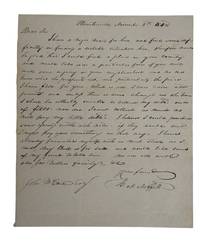
1842réf. 209651842. Slavery North Carolina Letter signed offering a "negro man" to settle debts. Letter signed by "H.M. Moffett" of Huntersville Virginia now West Virginia. Dated November 8th 1842. Measures 9.5" by 7.75". The letter reads in full: "Dear Sir I have a negro man for hire and find some difficulty in finding a suitable situation here therefore would be glad that I could find a place in your country and would take in as a particular favor if you will make some inquiring in your neighborhood and let me know what the prospects are and particularly the price- I have $200 for you which is all I can raise at present and unless their is some change in the times I shall be utterly unable to collect my debts of $1600 now due. I can't collect as much as will pay my little debts. I believe I could purchase some young cattle with notes if they would . I might pay you something in that negro sic. I have already furnished myself with as much stock as I need my Bull is for sale and would like some of my friends to take him. We are all well also Jan sic Millers family - . -- your friend H.M. Moffett." The letter was likely penned by Henry Hiller Moffett second Clerk of Pocahontas county Virginia present day West Virginia. Moffett is listed in the 1850 census with eight enslaved persons. Original folds some minor foxing. Overall very good condition. unknown books
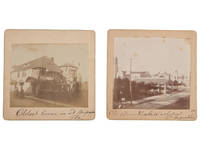
1897réf. 185871897. Albumen photographs of slavery-related sites circa 1890s document physical locations tied to the sale and habitation of enslaved people in the United States and the persistence of those sites in post-Emancipation visual culture. The images include a pavilion in St. Augustine Florida identified in contemporary sources as a site where enslaved Africans were bought and sold a photographic negative depicting outbuildings identified as Mississippi slave quarters and a mounted view of the González Alvarez House a colonial structure associated with early settlement in St. Augustine. Together the photographs provide material evidence of how spaces connected to slavery were recorded labeled and circulated in the late nineteenth century linking architectural survival to the historical memory of enslavement in both the Southeast and the Gulf South. Collection of three albumen photographs. United States circa 1890s. One mounted photograph approximately 3 3/16 x 3 inches bears the ink inscription "Old Slave Market Cathedral St. Augustine Fla." and depicts the waterfront pavilion constructed in the early nineteenth century originally used as a commercial market and identified in local records as a site of slave trading. One photographic negative approximately 3 1/2 x 3 3/4 inches shows three small structures identified as Mississippi slave quarters. One mounted photograph approximately 3 1/8 x 2 5/8 inches is inscribed "Oldest house in St. Augustine Fla. Built in the early 1700s" depicting the González Alvarez House. Mounts and inscriptions indicate a documentary intent linking the images to historically significant sites. By the late nineteenth century sites associated with slavery were being reframed within local historical narratives often presented as landmarks while still retaining traces of their earlier function within systems of forced labor and sale. The identification of the St. Augustine pavilion as a slave market in inscription and record aligns the image with documented urban sites of sale in Spanish and later American Florida while the Mississippi quarters image extends the archive into the plantation landscape of the postbellum South. The grouping provides a concise visual record of how structures tied to enslavement were preserved interpreted and circulated in photographic form decades after abolition. Minor adhesive residue to one mount small tear to negative and light toning and staining to mounts; overall good condition. unknown books
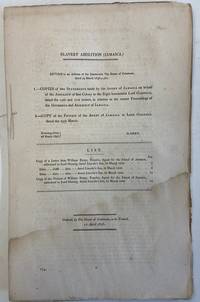
1836réf. 175381836. This pamphlet is a return to an Address of the House of Commons from March 25 1836 whereby the Agent of Jamaica William Burge protests against the unilateral abolition of slavery in the British Empire. Ordered to be printed by the House of Commons in London April 1836. 13 pages. 13" x 8.25" inches. Included within is a copy of three letters from the Agent to Lord Glenelg the British colonial secretary as well Burge's protest to Glenelg. Burge states: He is desirous that His Majesty's Government should understand that this Protest is made not as the performance of a formal act of official duty but from his conviction that the proposed legislation for Jamaica is a direct violation of the constitutional rights of that Colony rights coeval with its establishment and which have hitherto been respected." The Agent was a colonial official who was the official representative of a British colony who was based in London and acted as lobbyists and trade negotiators for the affairs of the colony. While Burge had at other times claimed to "hate" slavery he employs the British analogue of the "states rights'" argument that many moderate politicians in the United States used to signal personal distaste for slavery but to nonetheless protect the institution's existence on the basis of constitutionality. When the institution of slavery died out in the British Empire after 1836 the abolitionist movement in the US gained tremendous momentum despite the protests of our own William Burge's. This piece is overall in very good condition. unknown books
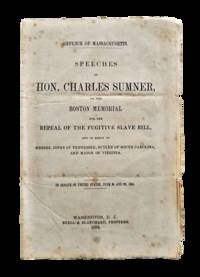
1854réf. 176351854. Abolition African Americana SUMNER Charles. Defence of Massachusetts. Speeches of Hon. Charles Sumner on the Boston Memorial for the Repeal of the Fugitive Slave Bill and in Reply To Messrs. Jones of Tennessee Butler of South Carolina And Mason of Virginia in the Senate of the United States June 26 and 28 1854. Washington D.C.: Buell & Blanchard Printers 1854. At the time that this description is being written just three copies are recorded in American institutions. OCLC search results are at best an estimate and can vary over time. The Memorial referred to in the title was a request by 2900 undersigners chiefly men of Boston Mass. to repeal the Fugitive Slave Bill of 1850. What follows is a transcription of Massachusetts Senator and famous abolitionist Charles Sumner's speeches in the ensuing debate: "Mr Jones. asks 'Can anyone suppose that if the Fugitive Slave Act be repealed this Union can exist' To which I reply at once that if the Union in any way be dependent on an Act-- I cannot call it a law-- so revolting in every regard as to that which he refers then it ought not to exist." Sumner goes on to argue amongst other things that the Fugitive Slave Act is parallel to the hated Stamp Act that sparked the Revolutionary War as well as to make spirited rebukes against the pro-slavery Senators Butler Mason and Jones: "The veteran Senator from Virginia Mr. Mason complained that I had characterized one of his "constituents" a person who went all the way from Virginia to Boston in pursuit of a slave as a Slave-Hunter. Sire I choose to call things by their right names. White I call white and black I call black. And where a person degrades himself to the work of chasing a fellow man who under the guidance of the north star has saught a freeman's home far away from the cofle and the chain that person whomsoever he may be I call a Slave-Hunter." Eight sheets folded to make one sixteen-page signature which is stitched along the left edge. Foxing throguhout pages chipped along margins. Dampstaining along two page edges. Delicate but in good condition. Charles Sumner January 6 1811 - March 11 1874 was an American statesman and United States Senator from Massachusetts. As an academic lawyer and a powerful orator Sumner was the leader of the anti-slavery forces in the state and a leader of the Radical Republicans in the U.S. Senate during the American Civil War. During Reconstruction he fought to minimize the power of the ex-Confederates and guarantee equal rights to the freedmen. During the war he was a leader of the Radical Republican faction that criticized President Lincoln for being too moderate on the South. Sumner specialized in foreign affairs and worked closely with Lincoln to ensure the British and the French refrained from intervening on the side of the Confederacy during the Civil War. As the chief Radical leader in the Senate during Reconstruction Sumner fought hard to provide equal civil and voting rights for the freedmen on the grounds that "consent of the governed" was a basic principle of American republicanism and to block ex-Confederates from power so they would not reverse the gains made from the Union's victory in the Civil War. unknown books
1862réf. 127191862. The Detroit Free Press April 12 1862 reports House passage of legislation abolishing slavery in the District of Columbia one of the first major federal emancipation measures enacted during the Civil War. The bill preceded the Emancipation Proclamation and applied directly to the national capital where slavery remained legal despite Washington's position as the seat of the federal government. The issue records the congressional process behind the measure through detailed debate and proposed amendments preserving contemporary political arguments over federal authority emancipation and slavery during the second year of the war. The Detroit Free Press. Detroit Michigan. April 12 1862. Two pages measuring 19 × 26 inches. The front-page headline reads "The Bill Abolishing Slavery in the District of Columbia Passed the House." Coverage provides a blow-by-blow account of debate among House members and the various amendments considered with the bill concluding "The bill was passed 93 agains 39." The issue also contains local national and international reporting including a section headed "News From the South." Congressional passage placed the District of Columbia on a distinct path toward emancipation before Lincoln issued the preliminary Emancipation Proclamation later in 1862. Because the newspaper records both the vote and the legislative arguments surrounding the measure it documents emancipation as a contested act of federal lawmaking rather than solely as a presidential policy. Small tears at the left margin do not affect the text. A diagonal crease crosses the upper half of the paper and a small piece of yellow tape is adhered to the top margin. Very good condition overall. unknown books
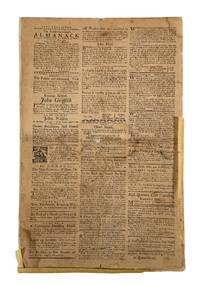
1771réf. 143781771. The Almanack 1771 contains an advertisement offering a fourteen-year-old enslaved Black boy for sale in Boston documenting the commercial trafficking of enslaved children in colonial Massachusetts only five years before the Declaration of Independence. The notice states: "To be sold for want of employment a likely Negro Boy that won't drink rum he is about 14 years old." Its language reduces the unnamed child to age perceived suitability and drinking habits before offering him for sale preserving direct evidence of how slavery entered the ordinary commercial language and newspaper economy of eighteenth-century Boston. A second advertisement relating to slavery appears in the same issue. The Almanack. Boston 1771. Folio newspaper approximately 15 x 10 inches. The sale notice was printed among the newspaper's advertisements rather than as a report or editorial discussion of slavery placing the transaction within the periodical's routine marketplace of property labor and services. Particularly revealing is the seller's stated reason "for want of employment" which explicitly connects the proposed sale of the fourteen-year-old boy to the enslaver's assessment of his economic utility. Slavery remained legal in Massachusetts in 1771 even as the political disputes that would culminate in the American Revolution intensified in Boston. The advertisement predates the 1780 Massachusetts Constitution and the early 1780s freedom suits associated with the effective end of slavery in the Commonwealth. As a Boston notice offering an enslaved child for sale it provides specific evidence that human bondage and its newspaper marketplace formed part of New England life during the generation that articulated revolutionary claims concerning liberty. Overall foxing scattered soiling and several small edge tears; otherwise very good condition. unknown books
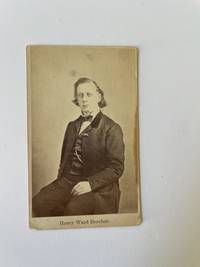
1861réf. 156211861. Beecher Henry Ward circa 1860s carte-de-visite portrait depicts the Congregationalist minister and abolitionist during the decade in which the national conflict over slavery culminated in the Civil War and emancipation. The Library of Congress identifies Beecher as an abolitionist author and Congregationalist clergyman with the bulk of his surviving papers dating from 1840 to 1865. As pastor of Plymouth Church in Brooklyn Beecher opposed the Fugitive Slave Law encouraged resistance to slavery supported Free-State settlers in Kansas and used his pulpit to raise money to purchase enslaved people from bondage. His association with antislavery rifles sent to Kansas also produced the widely used term "Beecher's Bibles." Albumen print carte de visite circa 1860s. 2½ x 4 inches. Sepia-toned image showing Beecher formally dressed and seated presented as a head-and-shoulders portrait. The small photographic format dates from a period when Beecher was nationally prominent as a clergyman and antislavery speaker. His abolitionist activity immediately preceding the Civil War included opposition to the Compromise of 1850 and Fugitive Slave Law and support for antislavery settlement in Kansas; in February 1860 he used Plymouth Church to raise the purchase price required to free a ten-year-old enslaved girl known as Pinky. The portrait dates to the decade in which Beecher's antislavery advocacy became connected to the Civil War itself. At the April 1865 flag-raising ceremony at Fort Sumter following the Union victory Beecher delivered an address condemning slavery after Robert Anderson raised the United States flag over the fort. The carte de visite is in excellent condition. A contemporary photographic portrait of one of the nineteenth century's prominent abolitionist clergymen dating from the period encompassing the Civil War and the abolition of slavery in the United States. unknown books
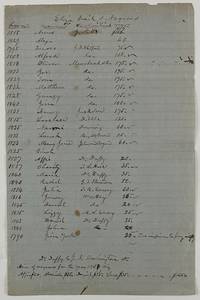
1857réf. 13322N.p. but near New Bern NC 1857. 1p. on a folio sheet docketed on verso. Old folds minor spotting toning and edge wear. Overall very good condition. An extraordinary manuscript document listing the names birth dates hire information and annual cost of hire for twenty-seven enslaved men women and children in antebellum North Carolina all owned by the same woman. The slaves were the property of Eliza Vail 1783-1853 who died in New Bern North Carolina about four years before the document was produced. Apparently her surviving family hired out her slaves to themselves and a number of neighbors. Among the names on the document are some of Eliza's family members mentioned in her will in ancestry records online including her grandsons John Nicholson Washington who later served as the mayor of New Bern and Thomas Reed Emery and her granddaughter-in-law Mary L. Emery. The document also includes some of the slaves mentioned in her will including Juoco Affie and Amos. The preponderance of the document is a four-column list beginning with the birth date then name then "To whom hired" and finally the cost of hire for each slave in 1857. For instance Amos born in 1818 was hired to "J.N.W." John Nicholson Washington for $150 in 1857. The birth dates of the slaves range from 1790 to 1848 making them between 67 and 9 at the time the document was written. The annual hiring costs range between zero for the nine-year-old and $175 for some of the younger men with the oldest man Jim York costing only $20 as he is "Too infirm to pay much." The names of various family members are listed as the parties currently hiring the slaves along with other citizens of the New Bern area such as "Dr. Duffy" "Rev. Mr. Greene" and J.D. Whitford President of the Atlantic & North Carolina Railroad among others. Additionally a note at the bottom records the hiring costs of four slaves being sent from Dr. Duffy to J.N. Washington. An extraordinary record of female ownership of enslaved peoples and the economics involved in mid-19th-century North Carolina. unknown books
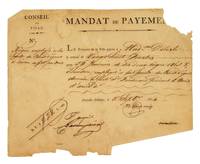
1914réf. 1272741914. New Orleans: September 1 1814. Single sheet 242 x 197 mm printed and manuscript document age-toned with considerable edgewear and the loss of two corners affecting only two characters of the title and with no loss of sense. Good. § Municipal payment order issued by the New Orleans City Council to its treasurer to pay for the hire of two enslaved men Abel and Theodore to work on the drainage canal at Fort St. Ferdinand. The document is dated a few months before the Battle of New Orleans and likely concerns improvement to the city's defensive works. Nicholas Girod was mayor of New Orleans from 1812 to 1815. He was the first regularly elected mayor after Louisiana's admission to the Union and did much to prepare the city against the British invasion force. The text of the document reads: Conseil de Ville. Mandat de Payement Le Trésorier de la Ville payera à Madame Delisle la somme de Vingt huit Piastres pour 56 journées de ses deux nègres Abel & Théodore employés à la fouille du Canal d'égout derrière le Fort Saint Ferdinand pendant le mois d'août dernier. Nouvelle-Orléans le 1er Septembre 1814. signature N. Girod Maire Par le Maire struck through A marginal note adds "Nègres employés à la fouille du Canal d'égout à raison de $15 par mois. unknown books
1833réf. 84791Lexington KY: Abraham Skillman 1833. First Edition. First printing. 12mo 18.5cm; original brown cloth-covered boards; viii207pp. Respined to style with facsimile printed spine label; Bookplate of the Young Men's Christian Institute New Haven to front pastedown; bookseller's ticket Williams' Bookstore Under the Old South Meeting House Boston at base of front flyleaf; pencil signature faded and illegible to front endpaper. Complete sound and Good. One of a tiny number of pre-Civil War abolitionist texts to have been written by a Virginia author. Paxton 1784-1868 was a Presbyterian minister born in Rockbridge County Virginia and educated at Princeton Theological Seminary; it is likely his mentorship there under Charles Hodge helped develop Paxton's antislavery sentiments. In 1826 after publishing an essay asserting the institution of slavery to be incompatible with the teachings of the Bible Paxton was expelled from his pastorship of Cumberland Presbyterian Church near Farmville in south-central Virginia. The present text addressed to his former congregation recounts the events of his expulsion reprints the essay in question and adds a series of epistolary essays supporting his theological position in oppostion to slavery. The existence of any abolitionist sentiment during this period in Virginia's history is remarkable in itself. For a native-born minister to willfully preach the gospel of antislavery even the relatively conservative version of abolitionism professed by Paxton before a congregation whose sentiments on the subject would have been diametrically opposed - and which doubtless included a number of slaveholding families - must have amounted to apostasy in some congregants' eyes. By publishing the present work Paxton essentially doubled down on his unpopular beliefs making him in this cataloguer's eyes a rather remarkable figure. We find it surprising that so little biographical information exists regarding Paxton. His name barely appears in the scholarly literature on the period; perhaps because no mention of abolition is made in either the title nor the sub-title of his book the work is rarely discussed in articles on the antebellum southern antislavery movement. Though reasonably available institutionally Letters on Slavery is perenially scarce in commerce having appeared at auction only three times in the current century. This a quite decent copy in a discreetly restored binding. SABIN 59264. DUMOND Antislavery Bibliography p.89. LCP AFRO-AMERICANA 7501. Abraham Skillman unknown books
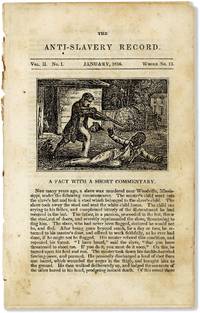
1836réf. 82919New York: American Anti-Slavery Society 1836. 12mo 19cm. Stitched self-wrappers; pp.1-12. Removed; first and final leaves detached but present; light soil scattered faint foxing; tear to bottom inch of bound edge away from text; complete and Good. Woodcut decoration at head of text a strikingly violent image depicting the murder of a Black man by his enslaver in Woolville Mississippi. Single issue of this monthly abolitionist periodical that ran from 1835 to 1837 published by the American Anti-Slavery Society under the direction of Elizur Wright. It was "a small magazine with excellent woodcuts containing principally extracts from other publications" that was "distributed freely without charge" and "found its way into the schools and colleges everywhere" Dumond p.267. Wright stated that in September 1835 the Society published 25000 copies of the Record p.267. BLOCKSON 9174. LCP AFRO-AMERICANA 622. American Anti-Slavery Society unknown books
1865réf. 81012New York: American News Company 1865. First Edition. First printing. Octavo. Sewn printed wrappers; 76pp. Brief closed tear to title page margin; bit of wear at upper fore-corner of text block well away from text else a clean fresh copy in the original printed wraps; Very Good or better. Includes text of letters written to various colleagues in the antislavery ranks including Elizabeth Cady Stanton Charles Sumner and others. The first volume taking in the year 1863 was printed a year earlier. SABIN 82664. American News Company unknown books
1860réf. 63532New York: Published and for sale at 5 Beekman Street 1860. First Edition. 12mo. 20th-c. binding of tan calf over paper-covered boards; marbled page edges; 951pp. About fine and complete; the pamphlet appears to have been offered without cover wrappers in any case not noted by Blanck. Uncommon first edition of this late tract by the important abolitionist and feminist Lydia Maria Child 1802-1880. Child's intention with this work was to make a direct case to southern slaveholders based not on any moral grounds but purely on business hoping that the Caribbean example would convince southerners that abolition could be achieved without wrecking their economy. "Child suggested to Samuel B. May the publisher .that the title page omit any mention of the American Anti-slavery Society giving only an address but no publisher. She even considered issuing the tract anyonymously but decided that her notoriety would probably help rather than hinder its circulation" see Karcher The First Woman in the Republic: a Cultural Biography of Lydia Maria Child. Durham 1994; p.428ff. Blanck notes two editions in 1860 as well as a reissue in 1862; this with verso of the final leaf unprinted is the first. Rarely encountered in commerce. BAL 3189. Published and for sale at 5 Beekman Street unknown books
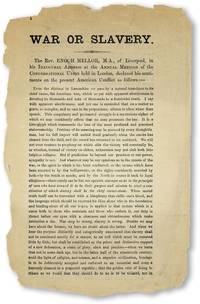
1863réf. 46597Manchester: Union and Emancipation Society n.d. ca. 1863. First Edition. Original broadsheet handbill 22x13.5cm.; extremities chipped with shallow losses not approaching text the whole rather dust-soiled and unevenly toned else Good or better overall. Text reproduces an address delivered by the Rev. Enoch Mellor of Liverpool "in his INAUGURAL ADDRESS at the ANNUAL MEETING of the CONGREGATIONAL UNION held in London" in which he "declared his sentiments on the present American Conflict." Mellor 1823-1881 was the life-long minister of the non-conformist Square Congregational Church in Halifax West Yorkshire with the exception of a five-year period coinciding with this address when he succeeded the abolitionist Congregational minister Thomas Raffles 1788-1863. Mellor's argument begins with reference to the Lancashire Cotton Panic an economic depression caused by a dearth of baled cotton imports following the start of the American Civil War. Mellr goes on to say that "War /may/ be wrong slavery /is/ wrong" comparing its presence on the American continent with that of the propagation of polygamy "carefully and resolutely laid as a foundation-stone in the territory of Utah. Union and Emancipation Society unknown books
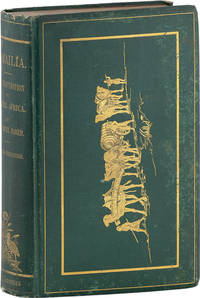
1875réf. 61084New York: Harper and Brothers 1875. First American Edition. Octavo 24cm. Green cloth stamped in gilt; brown coated endpapers; 542pp; steel-engraved frontispiece 2 wood-enraved frontispieces 2 color maps 1 folding and 48 wood-engraved plates all with tissue guards. Inscribed "Charles V. Payne from his friend M. R. E. Christmas 1874" on front free endpaper; the same inscription is repeated with the date 1875 on a front flyleaf. A sound copy externally rubbed with superficial silverfishing to both boards internally clean with two central gatherings pulled but not fully detached short tear to folding map at gutter: just Very Good. Samuel Baker 1821-1893 was a noted British explorer of Africa. In 1860 he was appointed "governor-general of the equatorial Nile basin" by the Khedive Ismail of Egypt with duties including "annexing the equatorial Nile basin establishing Egyptian authority over the region south of Gondokoro suppressing the slave trade" and more ODNB. His success was mixed: he successfully annexed Gondokoro and did suppress the slave trade but failed to establish secure control of the region ODNB. This account published after his return to England details how he "raised and trained a fighting force.to crush" the slave trade Czech. CZECH p.11. Harper and Brothers unknown books