RAYNAL, Guillaume Thomas.Livre Rare Book
1 720 résultats
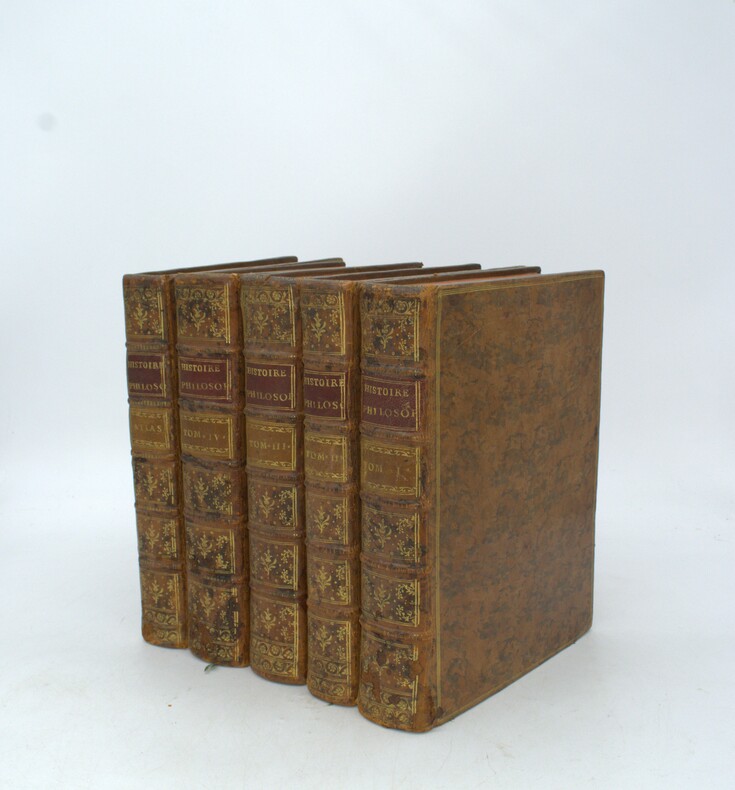
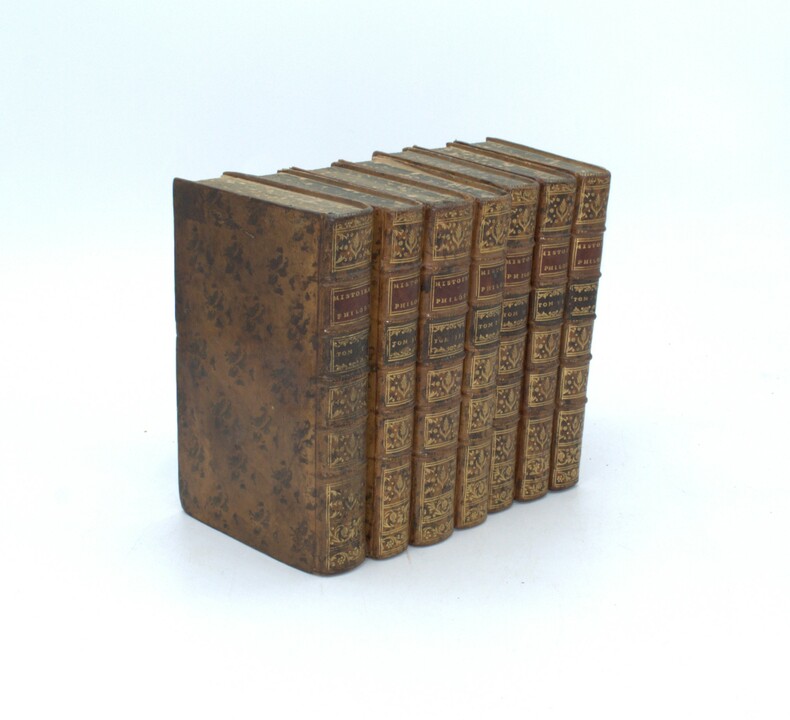
1774réf. PHO-1489La Haye, Gosse, 1774, 7 volumes in 8°, XII-585, XII-386, XIII-586, XII-508, XII-407, VI-375 (1), XI-430 pages, chaque volume comporte une gravure en frontispice d'après Eisen et une grande carte dépliante, relié plein veau tacheté époque, dos à nerfs ornés avec pièce de titre rouge et tomaison noire, tranches tachetées bleues, exlibris manuscrit aux titres, quelques coins usés, petits accrocs, reliure en bel état, texte seul.
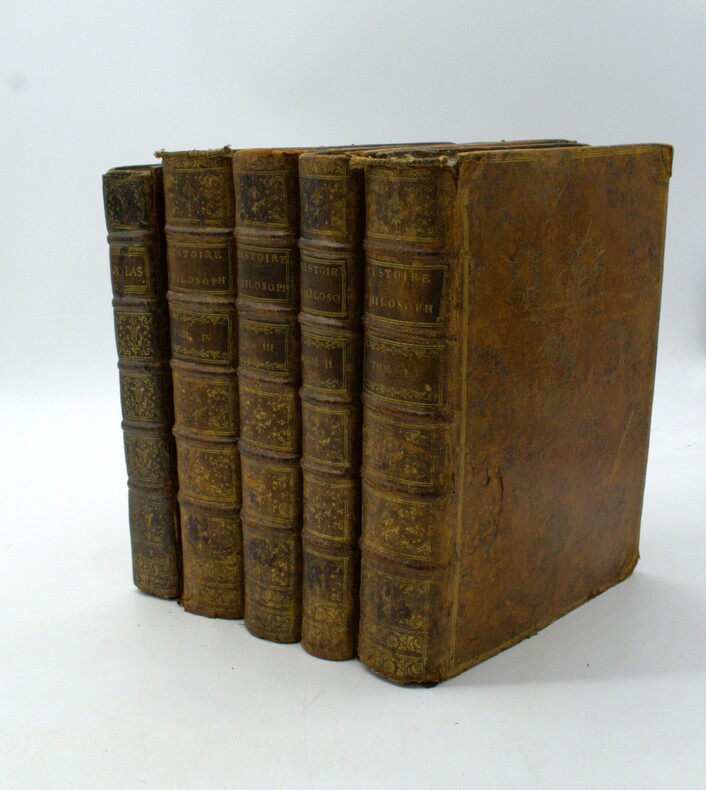
1780réf. PHO-1926Genève, Pellet, 1780, 5 volumes in-4, 4 de texte et un atlas in-4, Texte ; portrait, XVI, 741 pp., 1 pl.; front., (2 ff.), VIII, 485 pp.; front., XV, 629 pp.; front., (2 ff.), VIII, 770 pp., (1 f.), Atlas ; 2f., 28pp. ; illustré complet des 50 cartes (chiffrées 1-49 et 17 bis) ; quelques cartes mal chiffrées et 23 tableaux de statistiques in fine, la plupart dépliants. Rousseurs éparses, feuillets légèrement brunis par places. Tampons humides "Bibliothèque populaire de Bordeaux". Reliure Texte ; Basane fauve marbrée de l'époque, dos à nerfs ornés, triple filet doré encadrant les plats, Atlas ; veau brun marbré de l'époque, dos à nerfs orné, fleurons tulipes entre caissons, tranches marbrées, filet à froid encadrant les plats, double filet doré sur coupes 2 coiffes arasées, une arrachée, petits chocs à 2 autres, frottements et épidermures, coins très émoussés, mors fendillés aux entrées, coins émoussés, tranches marbrées (atlas).
1780réf. PHO-2003Genève, Jean-Léonard Pellet, 1780. 5 volumes in-4, 4 volumes de texte (25,5x20cm) et 1 Atlas (25,5x22cm), portrait, XVI, front.,741 pp., front., (2 ff.), VIII, 485 pp.; front., XV, 629 pp.; front., (2 ff.), VIII, 770 pp., (1 f.); 22 pp., (1 f. bl.), 50 cartes (49+17bis) et 23 tableaux. Relié plein veau marbré époque, dos à nerfs orné avec tomaison et pièce de titre grenat, filets aux plats, tranches rouges, frottements aux charnières, petites épidermures au dos, qlqs feuillets légèrement brunis. Bel exemplaire en reliure uniforme
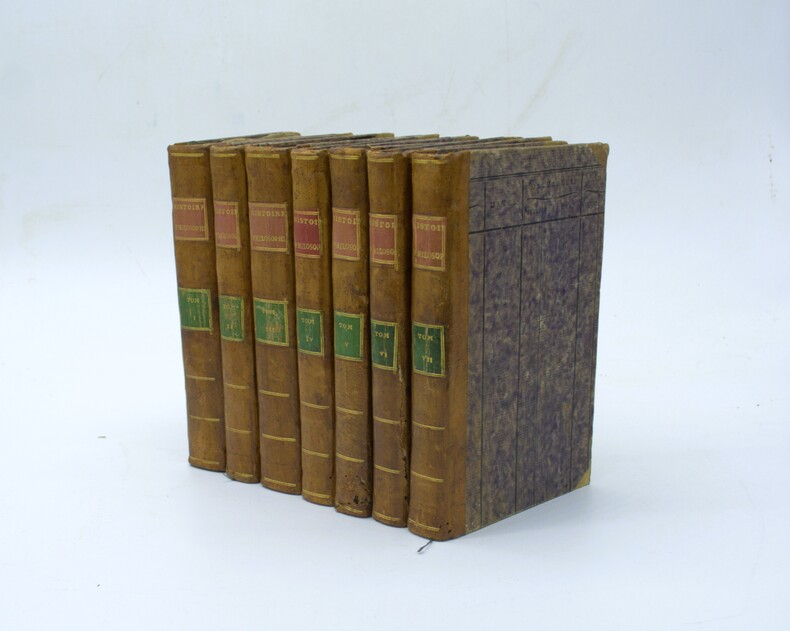
1776réf. PHO-2265La Haye ; Libraires Associés, 1776, 7 volumes In-8°(200x12,5cm), Portrait-frontispice- xii-482pp.- 1 carte, frontispice-viii-448pp.- 1 carte, frontispice-xii-468pp., frontispice-viii-311pp.- 1 carte, frontispice-311pp.-1 carte, frontispice-viii-290pp.-1 carte, frontispice-iv-331pp.-1 carte, demi basane époque, dos lisse avec pièce de titre brune et tomaison verte. Petits frottements, 2 feuillets détachés, déchirure sans manque (page 468 tome 3), petite fente et petit accroc au dos. 7 frontispices gravés majoritairement d'après Eisen et 6 grandes cartes dépliantes gravées.
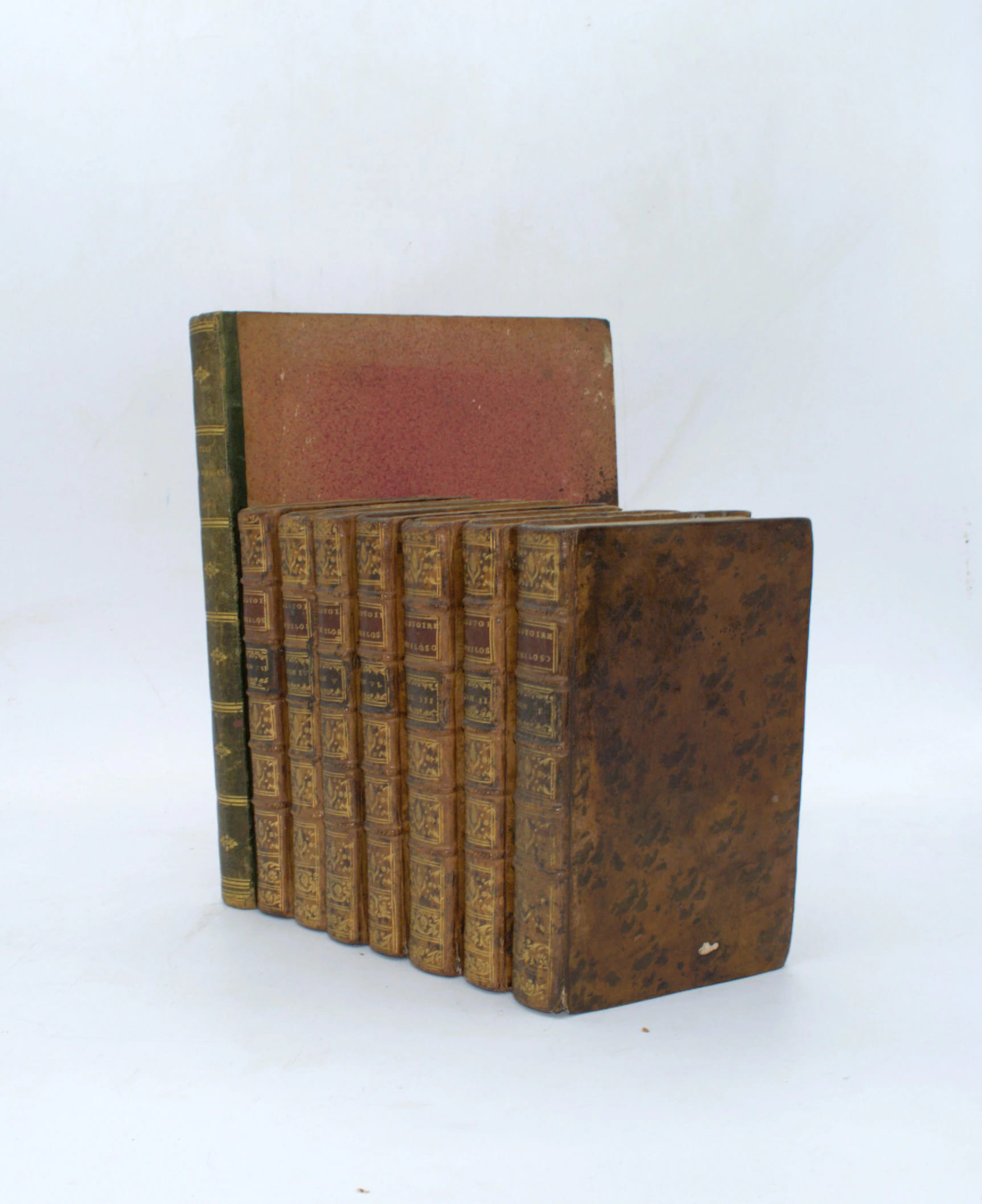
1774réf. PHO-2651La Haye & s.l., Gosse & s.e., 1774 (et circa 1780), 8 Volumes. TEXTE : 7 volumes in 8°, XII-585, XII-386, XIII-586, XII-508, XII-407, VI-375 (1), XI-430 pages, chaque volume comporte une gravure en frontispice d'après Eisen et une grande carte dépliante, relié plein veau tacheté époque, dos à nerfs ornés avec pièce de titre rouge et tomaison noire, tranches tachetées bleues, exlibris manuscrit aux titres, quelques coins usés, petits accrocs, reliure en bel état. ATLAS in-4 (29x26cm) de 50 cartes numérotées 1 à 49 (avec une 17 bis.). Exemplaire à grandes marges, demi reliure, dos lisse avec titre (Atlas des voyages de Cook) au dos, tache d’encre au plat et sur la tranche sans atteinte.
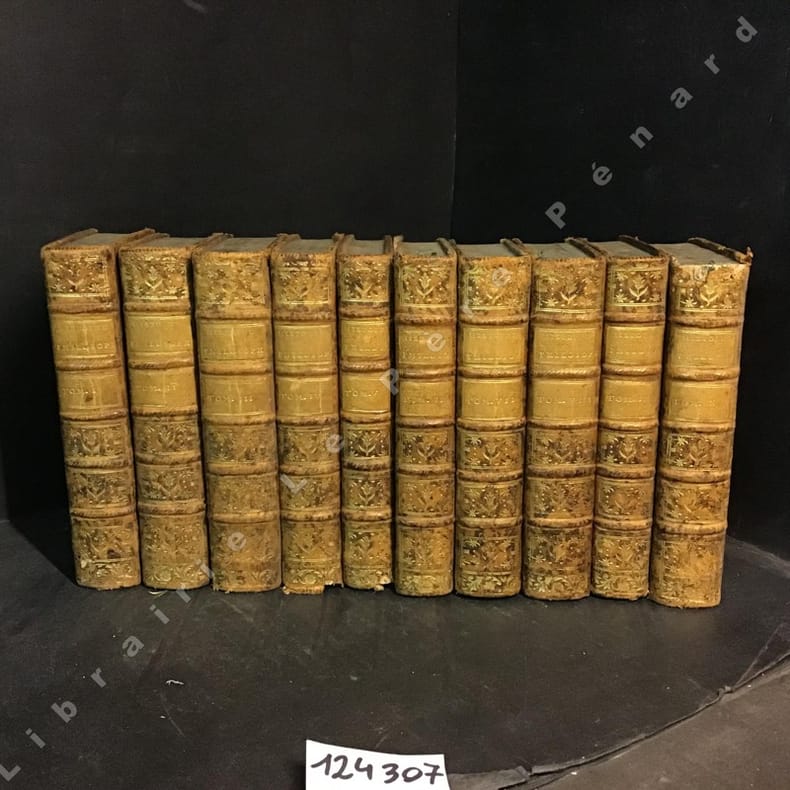
1780réf. 1243071780 A Genève, Chez Jean-Léonard Pellet, Imprimeur de la Ville & de l'Académie - M. DCC. LXXX. (1780) - Dix volumes In-12, reliures pleine peau marbrée d'époque, dos à 5 nerfs avec pièce de titre et de tomaison sur fond marron clair, caissons ornés de fleurons en doré, toutes tranches marbrées, signet vert - xij-571 + 624 + 608 + 500 + 425 + 511 + 589 + 599 + 431 + 564 pages - Sans le volume d'Atlas
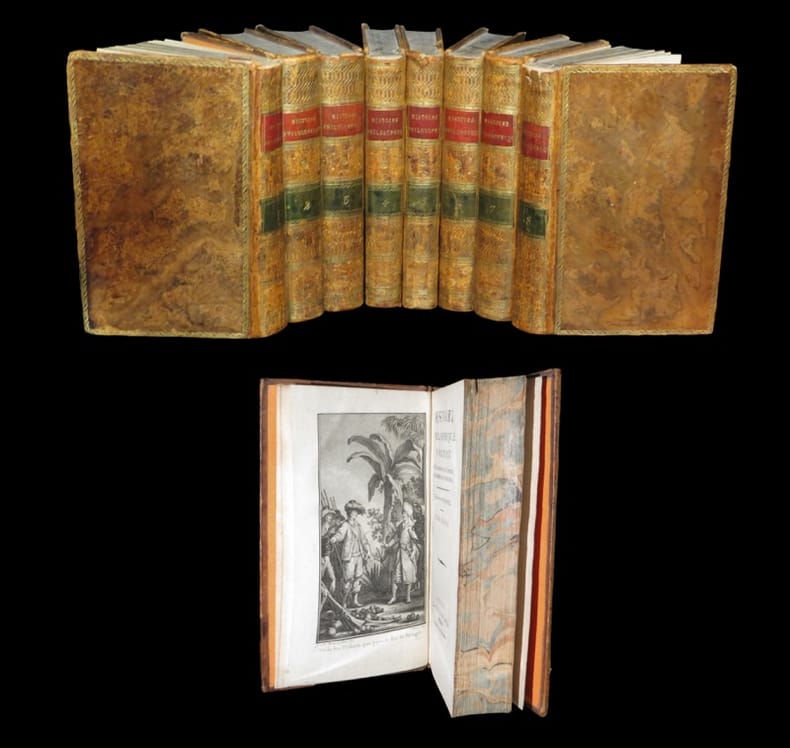
1781réf. 0042251781 Genève, Pellet, 1781. Dix volumes in-8 (130 X 207 mm) basane fauve marbrée, dos lisse orné à la grotesque de motifs dorés, pièces de titre et de tomaison grenat et vert, coupes ornées d'une guirlande dorée, coiffes filetées, tranches jaspées (reliure de l'époque). Tome I : portrait, XVI pages de faux-titre, titre, avertissement et table, 348 pages, (1) f. d'errata, (2) tableaux dépliants ; Tome II : frontispice, XII pages de faux-titre, titre et table, 378 pages, (1) f. d'errata, (4) tableaux dépliants ; Tome III : frontispice, VII pages de faux-titre, titre et table, 372 pages, (1) f. d'errata ; Tome IV : frontispice, XII pages de faux-titre, titre et table, 308 pages, (1) f. d'errata, (3) tableaux dépliants ; Tome V : frontispice, VII pages de faux-titre, titre et table, 259 pages, (1) f. d'errata, (1) tableau dépliant ; Tome VI : frontispice, XII pages de faux-titre, titre et table, 308 pages, (1) f. d'errata ; Tome VII : frontispice, XVI pages de faux-titre, titre et table, 359 pages, (1) page d'errata, (5) tableaux dépliants ; Tome VIII : frontispice, XII pages de faux-titre, titre et table, 352 pages ; Tome IX : frontispice, VIII pages de faux-titre, titre et table, 262 pages, (1) f. blanc, (1) f. d'errata, (9) tableaux dépliants ; Tome X : frontispice, V pages de faux-titre, titre et table, 348 pages, (1) f. d'errata. Quelques petites restaurations à la reliure.
1775réf. 31351A Paris, chez Berry, 3ème année de l'ère Républicaine [1795]. 8 vol. au format in-8 (203 x 130 mm) de 2 ff. n.fol., 1 frontispice gravé n.fol., iv, iv - 500 pp. ; 1 frontispice gravé n.fol. et 548 pp. ; 2 ff. n.fol., 1 frontispice gravé n.fol. et 536 pp. ; 2 ff. n.fol., 1 frontispice gravé n.fol. et 447 pp. ; 2 ff. n.fol., 1 frontispice gravé n.fol. et 383 pp. ; 1 frontispice gravé n.fol. et 456 pp. ; 1 frontispice gravé n.fol. et 531 pp. ; 2 ff. n.fol., 1 frontispice gravé n.fol. et 516 pp. Reliures uniformes de l'époque de plein veau flammé blond, double filet doré et frise dorés encadrant chacun des plats, dos lisses ornés d'un double filet d'encadrement doré, filets gras dorés, doubles filets maigres dorés, entrelacs de filets gras et maigres dorés formant croisillons, fleurons dorés, semis de petits fleurons trapézoïdaux dorés, entrelacs de filets maigres dorés formant chaînettes, pièces de titre de maroquin vieux-rouge, pièces de tomaison de maroquin émeraude, titre doré, tomaison dorée, palette dorée en queue, filet doré sur les coupes, tranches jaspées.
1954réf. LITT3050MPréface ("Du Bonheur dans l'esclavage") de Jean Paulhan. Sceaux, J.-J. Pauvert, juin 1954. In-8°. 245 pp.
réf. 13974798Paris: Payot, 1959 in-8, 248 pages, bibliographie. Broché. (Bibliothèque historique).
réf. 13978605Paris: Pagnerre Editeur, 1847 in-8, 486 pages. Demi basane dos à nerfs orné de caisson, coiffes usées, qq. rousseurs, autrement bon état. Edition originale.
1959réf. 171828Payot Payot, 1959. In-8 broché, 248 pages. Très bon état.
1973réf. 185133Editions Désormeaux Editions Désormeaux, 1973. 2 volumes In-8 pleine reliure éditeur, plats estampés, titres dorés. La dorure s'efface; 576 + 483 pages. Bon état
1807réf. 144451807 br. sans couvertures (débroché d'un recueil) in-8, 95pp., P. Léopold Collin 1807
1978réf. 203274Couverture rigide. Cartonné. 250 pages. Légères rousseurs.
réf. 12801Robert Laffont Collection Bouquins, 1988 - Fort violume broché au format In-8, 1101 pages, ensemble un peu fané et en très bon état.
2020réf. 800842020 Paris, La Découverte, 2020, in 8° broché, 286 pages ; couvetrure illustrée.
réf. 237736Paris, Hachette et Cie, 1879 3 vol. in-8, CLXVII-487 pp., 517 pp. et 559 pp., demi-chagrin vert, dos à nerfs orné de fleurons dorés (reliure de l'époque). Quelques rousseurs.
1978réf. R160114278LE CERCLE DES BIBLIOPHILES CONTEMPORAINS. 1978. In-12. Cartonnage d'éditeurs. Bon état, Couv. convenable, Dos satisfaisant, Intérieur frais. 249 pages. Nombreuses planches illustrées en noir et blanc.. . . . Classification Dewey : 326-Esclavage
1845réf. 24737Mary B. Selden was the grandmother of Eleanor Love Selden who married John Augustine Washington III in 1843. She regrets not being able to furnish Washington with the services of one of her slaves as a stacker for the upcoming wheat harvest. Still a faithful employee West Ford worked for the Washington family well into the nineteenth century including delivering this letter. The letter includes a list of two dozen slaves written in pencil by John Augustine Washington III. SLAVERY. MOUNT VERNON. WEST FORD. MARY BOWLES ARMISTEAD SELDEN. Autograph Letter Signed to John Augustine Washington III hand delivered by West Ford; JOHN AUGUSTINE WASHINGTON III. Autograph List of Slaves. Single folio leaf with autograph address on verso. Alexandria Virginia 1845. Complete Transcript My dear Augustine I am very sorry to be unable to render you the service you require. I have a very fine stacker but he is hired by the year to Mr Young as I did not expect to have employment enough for him at Mt Ida. Another year if you wish it you can have him I receive very small wages for him and as a stacker I have never known any one equal to him. I am very sorry to hear that Nelly is sick. I hope she will be well enough to come up and meet the bridal party on thursday. I received a letter from Eliza to day in which she says they will be at Mt Ida that day but will bring no company with them. It will give great pleasure to them and to me if Mrs Washington Nelly and yourself will come up on that day. Mrs Lippitt will have a room ready for any of the party that will favour her with their company she must by no means be left behind. Most truly and affectionately / yrs M. B. Selden <2> Address: John A. Washington Esq. / Mt Vernon / By West Ford Docketing by John Augustine Washington III: Mrs. M. B. Selden List of slaves in pencil by John Augustine Washington III: Phil b. 1790 Hannah b. 1826 Gabe b. 1820 Eliza b. 1811 Ned b. 1827 Jim Michum b. 1795 Edmund b. 1827 John b. 1833 Betty b. 1833 Mary b. 1819 West Fanny "Belongs to my wife" Sarah b. 1809 Dennis b. 1838 Hannah Nelly b. 1836 William b. 1830 Jim Starks b. 1805 Joe b. 1832 Sally b. 1827 Ephraim b. 1834 Tom b. 1835 "bound to me till Oct 1856" West b. 1838 Jesse b. 1785 Historical Background Farmers in mid-nineteenth-century Virginia typically planted winter wheat in September and October and harvested it in the following June. After wheat had been cut a stacker tied the wheat into bundles and piled the bundles in shocks to dry in the field. After the shocks dried they would be stored in a barn or carefully built stack capped with grass to shed the rain until threshing time. Even after Cyrus McCormick developed his mechanical grain reaper in the 1830s men needed to follow the machine to bundle and stack the wheat. Building a good stack was an important skill and those workers free or enslaved who knew how to do so were very valuable at harvest time. Mary Bowles Armistead Alexander Selden 1783-1846 was born in Hanover Virginia. She married Charles Alexander Jr. 1772-1812 with whom she had five children including Louisa Elizabeth Fontaine Alexander 1802-1827. After her first husband's death she married Dr. Wilson Cary Selden 1761-1835. She was his third wife and they had three children. By his first wife Dr. Selden was the father of Wilson Cary Selden Jr. 1796-1843. In 1822 Wilson Cary Selden Jr. married Louisa Elizabeth Fontaine Alexander and they became the parents of Eleanor Love Selden 1824-1860 who married John A. Washington III. Thus Mary Bowles Selden was both the grandmother and step-grandmother of Eleanor Nelly Washington. At the time she wrote this letter she was living at Mount Ida a 6000-acre plantation that stretched along two miles of the Potomac River north of Alexandria Virginia and fewer than ten miles from Mount Vernon. Her first husband built the neoclassical mansion of Mount Ida in 1808. John Augustine Washington III 1821-1861 was born in Blakeley West Virginia the son of John Augustine Washington II and Jane Charlotte Blackburn Washington and graduated from the University of Virginia in 1840. His father inherited George Washington's Mount Vernon estate in 1829 but it passed to his wife at his death in 1832. In 1841 Augustine Washington proposed to manage Mount Vernon for his mother. When she died in 1855 the plantation passed to him. In 1858 after offering the property to both the federal government and to the State of Virginia he sold 200 acres of the Mount Vernon estate including the mansion outbuildings and family tomb to the Mount Vernon Ladies' Association for $200000. Washington married Eleanor Nelly Love Selden 1824-1860 in 1843 and they had seven children. In 1860 he owned 22 slaves. In 1861 Washington joined the Confederate Army as a lieutenant colonel and served as an aide-de-camp to General Robert E. Lee. He was killed while conducting reconnaissance at the Battle of Cheat Mountain in September 1861. West Ford ca. 1784-1863 was born on the Bushfield Plantation in Westmoreland County Virginia to an enslaved woman owned by George Washington's brother John Augustine Washington. When George Washington visited West Ford was his personal attendant. When John Augustine Washington's widow Hannah died in 1802 she granted Ford his freedom at age 21. Bushrod Washington George Washington's nephew and heir to Mount Vernon freed Ford in 1806 and Ford continued working for the Washington family. According to family oral history Ford's mother Venus told her mistress Hannah Washington that he was George Washington's son. Nearly all historians doubt the claim though one of Washington's nephews certainly could have been the father. In 1812 West Ford married Priscella Bell a free woman. Their four children—William Daniel Jane and Julia—were educated on the Mount Vernon Plantation despite laws which restricted the instruction of African Americans. When Bushrod Washington died in 1829 he willed 160 acres of land adjacent to Mount Vernon to West Ford who continued to live on the Mount Vernon estate. Over the next several years West Ford was frequently highlighted in the media making his private life a matter of public record. In 1850 two Virginia newspapers—the Alexandria Gazette and the Virginia Advertiser—carried articles describing his prestigious position and authority at Mount Vernon. In 1857 an entry in the Fairfax County Deed Books noted that Ford divided his land among his four children. In 1858 Ford was sketched a second time this time by historian and artist Benson Lossing. In March 1859 Harper's New Monthly Magazine published Lossing's feature on Mount Vernon and included his sketch of Ford. Ford told the reporter of his property on Little Hunting Creek where he planned to retire after the Washington estate was no longer in the Washington family. In June 1863 an ailing West Ford was brought back to the Mount Vernon estate by the Mount Vernon Ladies' Association. The association cared for West Ford until his death on July 20 1863. Condition Foxing and show through particularly near the signature.
1845réf. 24737Mary B. Selden was the grandmother of Eleanor Love Selden who married John Augustine Washington III in 1843. She regrets not being able to furnish Washington with the services of one of her slaves as a stacker for the upcoming wheat harvest. Still a faithful employee West Ford worked for the Washington family well into the nineteenth century including delivering this letter. The letter includes a list of two dozen slaves written in pencil by John Augustine Washington III. SLAVERY. MOUNT VERNON. WEST FORD. MARY BOWLES ARMISTEAD SELDEN. Autograph Letter Signed to John Augustine Washington III hand delivered by West Ford; JOHN AUGUSTINE WASHINGTON III. Autograph List of Slaves. Single folio leaf with autograph address on verso. Alexandria Virginia 1845. Complete Transcript My dear Augustine I am very sorry to be unable to render you the service you require. I have a very fine stacker but he is hired by the year to Mr Young as I did not expect to have employment enough for him at Mt Ida. Another year if you wish it you can have him I receive very small wages for him and as a stacker I have never known any one equal to him. I am very sorry to hear that Nelly is sick. I hope she will be well enough to come up and meet the bridal party on thursday. I received a letter from Eliza to day in which she says they will be at Mt Ida that day but will bring no company with them. It will give great pleasure to them and to me if Mrs Washington Nelly and yourself will come up on that day. Mrs Lippitt will have a room ready for any of the party that will favour her with their company she must by no means be left behind. Most truly and affectionately / yrs M. B. Selden <2> Address: John A. Washington Esq. / Mt Vernon / By West Ford Docketing by John Augustine Washington III: Mrs. M. B. Selden List of slaves in pencil by John Augustine Washington III: Phil b. 1790 Hannah b. 1826 Gabe b. 1820 Eliza b. 1811 Ned b. 1827 Jim Michum b. 1795 Edmund b. 1827 John b. 1833 Betty b. 1833 Mary b. 1819 West Fanny "Belongs to my wife" Sarah b. 1809 Dennis b. 1838 Hannah Nelly b. 1836 William b. 1830 Jim Starks b. 1805 Joe b. 1832 Sally b. 1827 Ephraim b. 1834 Tom b. 1835 "bound to me till Oct 1856" West b. 1838 Jesse b. 1785 Historical Background Farmers in mid-nineteenth-century Virginia typically planted winter wheat in September and October and harvested it in the following June. After wheat had been cut a stacker tied the wheat into bundles and piled the bundles in shocks to dry in the field. After the shocks dried they would be stored in a barn or carefully built stack capped with grass to shed the rain until threshing time. Even after Cyrus McCormick developed his mechanical grain reaper in the 1830s men needed to follow the machine to bundle and stack the wheat. Building a good stack was an important skill and those workers free or enslaved who knew how to do so were very valuable at harvest time. Mary Bowles Armistead Alexander Selden 1783-1846 was born in Hanover Virginia. She married Charles Alexander Jr. 1772-1812 with whom she had five children including Louisa Elizabeth Fontaine Alexander 1802-1827. After her first husband's death she married Dr. Wilson Cary Selden 1761-1835. She was his third wife and they had three children. By his first wife Dr. Selden was the father of Wilson Cary Selden Jr. 1796-1843. In 1822 Wilson Cary Selden Jr. married Louisa Elizabeth Fontaine Alexander and they became the parents of Eleanor Love Selden 1824-1860 who married John A. Washington III. Thus Mary Bowles Selden was both the grandmother and step-grandmother of Eleanor Nelly Washington. At the time she wrote this letter she was living at Mount Ida a 6000-acre plantation that stretched along two miles of the Potomac River north of Alexandria Virginia and fewer than ten miles from Mount Vernon. Her first husband built the neoclassical mansion of Mount Ida in 1808. John Augustine Washington III 1821-1861 was born in Blakeley West Virginia the son of John Augustine Washington II and Jane Charlotte Blackburn Washington and graduated from the University of Virginia in 1840. His father inherited George Washington's Mount Vernon estate in 1829 but it passed to his wife at his death in 1832. In 1841 Augustine Washington proposed to manage Mount Vernon for his mother. When she died in 1855 the plantation passed to him. In 1858 after offering the property to both the federal government and to the State of Virginia he sold 200 acres of the Mount Vernon estate including the mansion outbuildings and family tomb to the Mount Vernon Ladies' Association for $200000. Washington married Eleanor Nelly Love Selden 1824-1860 in 1843 and they had seven children. In 1860 he owned 22 slaves. In 1861 Washington joined the Confederate Army as a lieutenant colonel and served as an aide-de-camp to General Robert E. Lee. He was killed while conducting reconnaissance at the Battle of Cheat Mountain in September 1861. West Ford ca. 1784-1863 was born on the Bushfield Plantation in Westmoreland County Virginia to an enslaved woman owned by George Washington's brother John Augustine Washington. When George Washington visited West Ford was his personal attendant. When John Augustine Washington's widow Hannah died in 1802 she granted Ford his freedom at age 21. Bushrod Washington George Washington's nephew and heir to Mount Vernon freed Ford in 1806 and Ford continued working for the Washington family. According to family oral history Ford's mother Venus told her mistress Hannah Washington that he was George Washington's son. Nearly all historians doubt the claim though one of Washington's nephews certainly could have been the father. In 1812 West Ford married Priscella Bell a free woman. Their four children—William Daniel Jane and Julia—were educated on the Mount Vernon Plantation despite laws which restricted the instruction of African Americans. When Bushrod Washington died in 1829 he willed 160 acres of land adjacent to Mount Vernon to West Ford who continued to live on the Mount Vernon estate. Over the next several years West Ford was frequently highlighted in the media making his private life a matter of public record. In 1850 two Virginia newspapers—the Alexandria Gazette and the Virginia Advertiser—carried articles describing his prestigious position and authority at Mount Vernon. In 1857 an entry in the Fairfax County Deed Books noted that Ford divided his land among his four children. In 1858 Ford was sketched a second time this time by historian and artist Benson Lossing. In March 1859 Harper's New Monthly Magazine published Lossing's feature on Mount Vernon and included his sketch of Ford. Ford told the reporter of his property on Little Hunting Creek where he planned to retire after the Washington estate was no longer in the Washington family. In June 1863 an ailing West Ford was brought back to the Mount Vernon estate by the Mount Vernon Ladies' Association. The association cared for West Ford until his death on July 20 1863. Condition Foxing and show through particularly near the signature. books
in-8, 338 p., cartes, broché, couverture illustrée Bel exemplaire. [CA33-5]
2002Paris, Perrin 2002. In-8 broché, de 423 pages. Photos hors-texte. Très bon état
1780A Genêve, Chez Jean Leonard Pellet 1780, imprimeur de la Ville et de l'Académie. 10 volumes In-8 plein veau brun. Dos lisses très ornés à motifs dorés,pièces de titres vertes et de tomaison rouges, tranches marbrées, gardes de papier marbré, triples filets dorés en encadrement sur les plats, filet doré sur les coupes. Bien complet des gravures en frontispice à chaque volume dont le portrait de Raynal dessiné par Cochin, gravé par De Launay. Table des matières en-tête de chaque volume et table alphabétique en fin de chaque. XVI + 532,VIII + 582, VII + 580, VIII + 472, VII + 405, VII + 484, XVI + 558, VIII + 547, VIII + 412, VI + 538 pages. Complet des tableaux dépliants. Coiffe du tome 10 très légérement arasée sans aucune gravité et léger manque de papier en marge de la dernière page (table alphabétique) du tome 8 avec petite perte de texte. Intérieur des volumes en très bel état. Titres des gravures : Portrait de Raynal (Cochin) - Les Anglais demandent pardon à Aurengzeb qu'ils ont offensé (Moreau le Jeune) - Les Espagnols se rendent maîtres de Montezuma dans Mexico même (Moreau le Jeune) - François Pizarre assassiné par une troupe de Conjurés (Moreau le Jeune) - Voilà les tributs que paye le Roi de Portugal (Moreau le Jeune) - Ouragan aux Antilles (Moreau le Jeune) - Un Anglais de la Barbade vend sa maitresse (Moreau le Jeune) - Bienfaisance d'une famille sauvage du Canada envers des Français (Moreau le Jeune) - Penn achète des sauvages le pays qu'il veut occuper (Moreau le Jeune) - Esclaves conduits par des marchands (Moreau le Jeune). Bel exemplaire.
178011 voll. cartonato azzurro della epoca. 10 voll. in-8. un vol. in-4 Atlas. Ritratto inciso 9 frontespizi incisi 50 mappe 23 tabelle ripiegate.Economics india arabia gulf africa america diderot rigobert bonne maps atlas arabic indian travels slavery colonialism Diderot