5 731 résultats
réf. SONG0764368524Used: Good unknown
réf. SONG0548183406Used: Good unknown
1966réf. 375944Washington D.C. 1966. 8vo. Single sheet Vice Presidential stationery signed in black ink recto only with small yellow/brown stains; stapled to a copy of a letter from the Treasury Department on copy paper recto only. With a franked envelope Vice Presidential stationery also with small yellow/brown stain. 8vo. Humphrey's letter reads "Dear Mr. Neufeld: With reference to your letter of October 11 I now have a reply from the Bureau of Customs a copy of which is enclosed. Best wishes. Sincerely Hubert Humphrey." The copied letter regards the "unpleasant experience" Mace Neufeld had when clearing customs at Los Angeles. PhotoNYC unknown
réf. SONG0548150117Used: Good unknown
réf. SONG0548004250Used: Good unknown
réf. SONG1138742260Used: Good unknown
réf. DADAX3849138240New unknown
réf. DADAX0199756120New unknown
réf. 1330211014.Gpaperback. Good. Access codes and supplements are not guaranteed with used items. May be an ex-library book. paperback
réf. DADAX1931503095New unknown
réf. 1082283Encuadernación de tapa dura. Aceptable. . Edición del texto original catalán Madrid 1791 y traducción castellana de Antonio de Capmany. Estudio preliminar de J. M.ª Font Rius. Revisión y anotación por A. M.ª de Saavedra. Epílogo de José Morro Cerdá. Barcelona. Edit. Cámara Oficial de Comercio y Navegación. Imp. Teide. 1965. 27x19 cm. LXIV 767 págs. Texto a dos columnas. Encuadernado en pleno Pergamino a la Romana Corte superior Planos y lomo con hierros dorados y escudo de Barcelona. # derecho hardcover
réf. SONG0750992158Used: Good unknown
réf. SONG113802533XUsed: Good unknown
réf. SONG1298708796Used: Good unknown
réf. DADAX0761400427New unknown
réf. DADAX0240821335New unknown
1888réf. 145681888. Collection of 3 chromolithographic prints from The Illustrated History of Costume : period styles and accessories by Albert Racinet published by Firmin Didot & Cie in Paris in 1888. Titled: PERSIA - PERSE- PERSIEN. 7 ½" x 8 ¾". These lithographs beautifully depict Persian costumes and interior décor from Iran. In the first lithograph we can see 10 men and one woman dressed in the various traditional Qajar attires of Iran. The second lithograph shows the beautiful interior décor including very intercate and vibrant Persian rugs elaborately scrolled door and window frames of a Kajar residence. The third lithograph captures five musicians playing various instruments and four women dancers. In very good condition. unknown
1864réf. 145861864. Two original antique steel costume engravings of a Persian Iran Royal Officer and Noble woman printed in 1864. Overall size: 9" x 12.5." The plate illustrations are brightly colored and intricately detailed characterization of the traditional costumes of a Persian Royal Officer and Noble woman. In the engraving of the Royal Officer titled "Khatchadour D'hohannes: Officier du Prince Royal de Perse" his attire entails a vibrant green coat with gold trimmings which covers a gold-colored ensemble with a purple sash that stores his dagger. In the engraving of the Persian Woman titled "Dame Persane" she is depicted in traditional costume as imagined by Europeans in the 1800's. The woman is shown leaning against a banister wearing an embroidered white satin gown with a pink silk and fur trimmed coat and a feathered headdress. General age related toning. Overall both prints are in very good condition. unknown
1748réf. 143711748. Mallet Allain Manesson. "Arabes" 1748 presents two male figures identified as Arabs through the conventions of European geographical and costume illustration derived from Mallet's Description de l'Univers. Mallet's original work first published in Paris in 1683 combined maps city views portraits and images of dress with accounts of the customs religions and governments attributed to different nations; its second volume treated Asia. The engraving records the visual vocabulary through which Arab clothing and appearance were presented to European readers within this encyclopedic geographical tradition. Mallet Allain Manesson. "Arabes." 1748. Engraving. Overall page 10" x 7.25"; image 5.5" x 7.5". Beneath a decorative banner lettered "Arabes" two standing men wear contrasting garments against a mountainous landscape. One wears a buttoned tunic overcoat pointed shoes and a large turban; he holds a decorative cane while resting his other hand at his belt. The second wears a decorated collared tunic beneath an overcoat pointed shoes and a tall head covering from which a long length of fabric descends. The paired figures allow differences in headwear garment ornament and accessories to be compared within a single composition. The plate derives from an illustrated geographical work conceived by Mallet a French military engineer and mathematics teacher whose Description de l'Univers organized contemporary geographical knowledge alongside images of the "divers habillemens" of different peoples. The "Arabes" composition therefore records an eighteenth-century European printed conception of Arab dress rather than serving as direct ethnographic documentation of a specific Arab population or locality. Overall very good condition. The combination of costume detail and explicit ethnic captioning documents how Arab peoples were visually categorized for European audiences in early modern geographical publishing. unknown
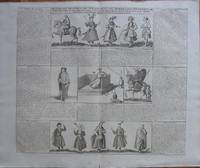
1720réf. 143601720. Atlas historique engraving of Persian costume and customs 1720 records an early eighteenth-century European presentation of dress military equipment horsemanship and tobacco use in Persia during the late Safavid period. Rather than presenting a single landscape or event the plate assembles male and female costume hairstyles turbans footwear weapons armor horses and smoking implements into a comparative visual survey. Its attention to cavalry equipment and what the accompanying description calls the "militia and their weapons" and the "offensive and defensive" equipment worn by soldiers at war documents the categories through which European geographical publications described Persian society and military culture. Atlas historique. Description of Persia and Persian costumes. 1720. Sheet size 51 x 43 cm. The engraving contains numerous individual figures and objects arranged for comparison including four men in different Persian costumes women in period dress examples of female hairstyles turbans and shoes and representations of tobacco smoking and pipes including a hookah. Military subjects include armor weapons cavalry horses an elaborate bow and equestrian equipment. The combination of human figures with separately illustrated articles of clothing arms and personal equipment allows individual elements of Persian dress and material culture to be examined across the sheet. Published in 1720 the engraving dates to the final years of Safavid rule when European atlases and geographical compilations increasingly combined maps with images and written accounts of the peoples clothing military practices and customs of regions beyond Europe. Here Persian men and women cavalry weapons tobacco consumption and dress are organized as subjects of geographical and ethnographic description providing evidence of how Persia was visually classified for an early eighteenth-century European audience. The detailed renderings of costume armor weapons horses hairstyles and smoking implements also preserve period representations of material culture associated with Safavid Persia. Very good condition. unknown
1853réf. 54091James' Town St. Helena: printed at the Government Office by Geo. Gibb 1853. Broadside approx. 12¾" x 8" printed on blue paper; lengthy text in a single column beneath a cut of the Royal Arms at the top; very slight spotting else a fine copy of a rare South Atlantic imprint. The regulations 15 in all outline manifest requirements customs fees and charges quarantines dockage and launch services and charges etc. Also the times draw bridges are raised and lowered the town gates closed and the latitude and longitude of the islands. Also information regarding the "Time Ball." The time ball a visual signaling device meant to be observed by ships at sea for calibrating chronometers was first successfully tested by the Royal Navy at Portsmouth in 1829. Among the first time balls constructed was that at St. Helena Observatory in 1834. The white canvas ball dropped precisely at noon while a time gun positioned on the High Knoll fired the signal. The procedure was repeated at one o'clock to coincide with Greenwich mean time. Not in OCLC and unlocated bibliographically. printed at the Government Office, by Geo. Gibb unknown
réf. DADAX0313339341New unknown
réf. DADAX0911954228New unknown
réf. DADAX0958435367New unknown
réf. DADAX1558684204New unknown