2.333 Ergebnisse
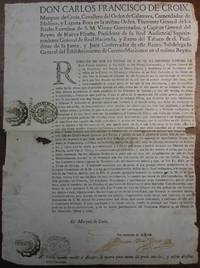
1768Best.-Nr. 230014Mexico 1768. unbound. 2 pages in Spanish roughly translated 16.5 x 12 inches A Royal Proclamation: El Marquis de Croix March 9 1768 ordering the mine owners to make concessions and increase wages in small part: ".A decline in mining.the mines have the common enemy of water which has flooded them.the excessive construction cost of which the Kingdom has no wealth. Is the relief moderation the price you ask as the best mines are completely uninhabited and desolate Send my fatherly love to my vassals subjects.I'll strive by all means.that they are fruitful. I've visited the Council of the Indies. Faith issued.and the moderate price of quicksilver.which is distributed to the miners a part of the quarto has so far been given for relief to support the work.I command you with consequences that you publish and carefully observe that the above ceiling of a fourth part of the price at which would have been taken in quicksilver.be given to the miners.ending the embargo. Also by Royal Proclamation inserted within it is free of tax." Also signed by Manuel Rodriguez 1697 - 1772 -- military leader on the Coahuila-Texas frontier esteemed explorer and one of the greatest Indian fighters from Texas. After the departure of Jacinto de Barrios y Jaurequi in February of 1768 he became brief interim governor and military commandant of the Province. Rare signature as Commandant and Governor of the Province. According to the Texas State Historical Association "It was not until recently that archivists were aware that Rodriguez was a Governor.a fact scarcely noted by historians. Horizontal fold; two holes; smudges in the left margin. Very good- condition. De Croix 1699 - 1786 was the Viceroy of New Spain Mexico who served during the period of Great Turbulence. The sole purpose of his five-year administration 1766 - 1771 was absolute obedience to the king whom he always referred to as "Mi amo." In 1767 he expelled the Jesuits from the colony removing them from their Monasteries and Colleges allowing them to leave with scarcely the clothes on their backs. These measures provoked a rebellion in which the Viceroy dealt severely with the rebels proclaiming censorship of literary and scientific publications 1768 and hanging the leaders of the uprising. No sooner had opposition been eliminated de Croix turned his attention toward the war-seeking Apache and Comanche Indian tribes financing and authorizing an expedition led by Captain de Galvez into Nueva Vizcaya whereby the Indians were soundly defeated. In March 1768 following the slow-downs boycotts and disturbances in the mines of Guanajuato and Pachuca over the low wages paid to the miners de Croix stunned the Colony by siding with the miners and forcing the mine owners to agree to an increase in wages. His actions were deemed "one of the most significant social reforms in the New World" at that time. unknown books
1768Best.-Nr. 230014Mexico 1768. unbound. 2 pages in Spanish roughly translated 16.5 x 12 inches A Royal Proclamation: El Marquis de Croix March 9 1768 ordering the mine owners to make concessions and increase wages in small part: ".A decline in mining.the mines have the common enemy of water which has flooded them.the excessive construction cost of which the Kingdom has no wealth. Is the relief moderation the price you ask as the best mines are completely uninhabited and desolate Send my fatherly love to my vassals subjects.I'll strive by all means.that they are fruitful. I've visited the Council of the Indies. Faith issued.and the moderate price of quicksilver.which is distributed to the miners a part of the quarto has so far been given for relief to support the work.I command you with consequences that you publish and carefully observe that the above ceiling of a fourth part of the price at which would have been taken in quicksilver.be given to the miners.ending the embargo. Also by Royal Proclamation inserted within it is free of tax." Also signed by Manuel Rodriguez 1697 - 1772 -- military leader on the Coahuila-Texas frontier esteemed explorer and one of the greatest Indian fighters from Texas. After the departure of Jacinto de Barrios y Jaurequi in February of 1768 he became brief interim governor and military commandant of the Province. Rare signature as Commandant and Governor of the Province. According to the Texas State Historical Association "It was not until recently that archivists were aware that Rodriguez was a Governor.a fact scarcely noted by historians. Horizontal fold; two holes; smudges in the left margin. Very good- condition. De Croix 1699 - 1786 was the Viceroy of New Spain Mexico who served during the period of Great Turbulence. The sole purpose of his five-year administration 1766 - 1771 was absolute obedience to the king whom he always referred to as "Mi amo." In 1767 he expelled the Jesuits from the colony removing them from their Monasteries and Colleges allowing them to leave with scarcely the clothes on their backs. These measures provoked a rebellion in which the Viceroy dealt severely with the rebels proclaiming censorship of literary and scientific publications 1768 and hanging the leaders of the uprising. No sooner had opposition been eliminated de Croix turned his attention toward the war-seeking Apache and Comanche Indian tribes financing and authorizing an expedition led by Captain de Galvez into Nueva Vizcaya whereby the Indians were soundly defeated. In March 1768 following the slow-downs boycotts and disturbances in the mines of Guanajuato and Pachuca over the low wages paid to the miners de Croix stunned the Colony by siding with the miners and forcing the mine owners to agree to an increase in wages. His actions were deemed "one of the most significant social reforms in the New World" at that time. unknown
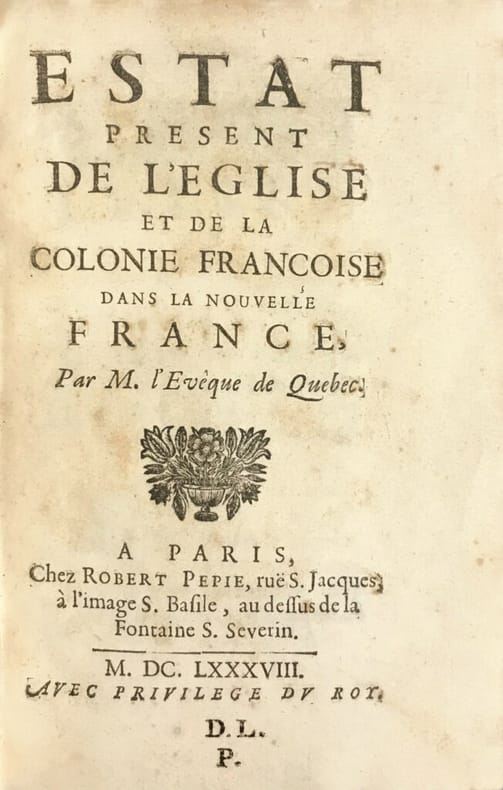
1688Best.-Nr. CAIla[SA43Paris: Robert Pepie 1688. 1688. 8vo. pp. 1 p.l. 267 1privilege. woodcut title vignette headpiece & initial. contemporary mottled calf gilt back rubbed several holes in front joint lower outer corner damaged ink stains to pp. 62-63 few other stains to last leaf & margins of some others upper outer corner of last leaf & rear endpaper singed. First Edition Second Issue with cancel title. Only two copies of this issue are located in the Amicus database of Canadian libraries. The more common first issue has the title Estat Présent De L'Église Et De La Colonie Françoise Dans La Nouvelle France. with identical imprint. Saint-Vallier was Laval's successor as Bishop of Quebec 1688-1727. The present work written in the form of a letter to an anonymous friend describes his trip to New France between May 1685 and January 1687 to survey the bishopric prior to his consecration. On the voyage out he sailed on board the same vessel as the Marquis de Denonville the newly appointed Governor of New France. Saint-Vallier first visited Quebec then all of the parishes along the St. Lawrence finally arriving at Montreal. Travelling along the inland waterways he made his way with a small escort to Acadia returning to Quebec in the fall of 1686. His informal account provides descriptive details respecting the native tribes and their relations with the white settlers specific reports on missionary activities and sketchy information regarding troubles with the Iroquois. "This is one of the rarest accounts of the missions published irregularly after the discontinuance of the annual Jesuit Relations with the one for 1671-72.It appeared in one edition only but with different title-pages.". Bell Bell S58. Church 707. European Americana 688/208. Howes S41. JCB p. 198. Sabin 66979. cfDionne II 218 cfGagnon I 1284 cfHarrisse NF 159 cfLande 773 cfStreeter VI 3632 cfTPL 98 and cfVlach 665 other issue. DCB II pp. 328-334. Story p. 743. Winsor IV pp. 315-16. 1st Edition. Hardcover. Good. Paris: Robert Pepie, 1688. Hardcover
1703Best.-Nr. B7089Paris: Chez Simon Langlois c 1703. near fine with text clean and crisp. . Edition: First Edition. Binding: Contemporary full paper boards expertly rebacked; raised spine with five 5 bands black ink title on vellum label on two; central black fleur de lis design on four. Notes: Provenance: Upper pasted endpaper with owner’s armorial bookplate: “Watkin Williams Esq of Penbedw // in the County of Denbigh”. Concerning this name Archaeologia Cambrensis states: “1789. Watkin Williams Esq. of Penbedw in the county of Denbigh but owner of property in the parishes of Mallwyd and Llan-y-mowddwy in the county of Merioneth M.P. first for Montgomeryshire and afterwards during nearly thirty years for the Flint contributary boroughs was appointed lieutenant and custos rotulorum for Merionethshire.” Final free endpaper watermarked. This edition of this Canadiana publication is unique in that we are not able to locate another copy of the same anywhere. The second last paragraph of the introduction to the priests clergy and missionaries in this edition states that this publication encloses at the end of the first part or 'Rituel' a second part entitled 'les Statuts Ordonnances & Mandemens.' instructions prepared at various times by the Church for the conduct of all including those entrusted to the clergy that these instructions may not be ignored. The recipient are advised that they are restatements of instructions previously given to be read often just as such given in the Ritual itself; they are to be followed with precisions including all the rules contained not to be lost sight of observed faithfully in all works and ones conduct. The inclusion of this paragraph is unlike the introduction of another edition published at the same time and same location but not including this paragraph or the 'Statuts.'. The present work describing festivals sacraments statutes and ordinances for the use by priests in Quebec is extremely rare and was immediately followed by a second edition published the same year: Gagnon reports that in a copy of the second edition of 1703 now at the Laval University library and previously owned by Abbé Plante a note says that the first edition “would have been almost completely destroyed by the sinking of the ship …carrying it to Canada and for this reason a second edition was immediately made.” On the “privilege” included as the final leaf in our first edition example it is stated that the work was registered on March 30 1703 and completed for print for the first time on March 31 1703; Saint-Valier was a supporter of the Counter Reformation. His initial intent in the New World was to engage in the conversion of the indigenous residents. He introduced Jesuits and Recollects in an attempt to evangelize New France. Many of these missions Illinois Louisiana and Mississippi resulted in conflicts between Bishop Saint-Vallier the Jesuits and the seminary of Quebec. His various construction projects reflect a desire to restore and renew the authority in the Catholic Church as the main institution of administrative organization. In 1697 Saint-Valier built a palace in Quebec for his clergy and as a place of hospitality. During the same year he also established a nuns monastery in Trois-Rivières Saint-Vallier’s zeal for religious activities and establishments stretched from Quebec Montreal Acadia and Louisiana. His way of life embodied that of the ideals of the Council of Trent. The Diocese of Quebec was vast and its population diverse and widespread. It included the whole of French North America or what was called New France divided in seven colonies: Newfoundland Acadia Île Royale Louisiana Illinois Upper Country and Canada inhabited by Indigenous people and the European settlers. During the tenure of Saint-Vallier immigration from France was mostly over; the European colonists were farmers fishermen sailors merchants and ‘coureurs des bois’ overseen by a small elite of aristocratic leaders but a great demographic explosion occurred between 1685 and 1730 the white population in New France jumping from c. 12000 inhabitants to c. 41500. During the same time the number of Amerindian fell from c. 163500 to c. 61500. That loss mainly in the tribes of Louisiana was attributed to warfare and diseases brought to the valley of the Mississippi. The number of Aboriginals compared to white settlers is one reason for the presence of so many religious orders in New France. The missions and conversions to Christianity were deemed very important. Priests of the Missions Étrangères of Paris the Jesuits the Recollets and the Sulpicians often worked in collaboration with the nuns from different orders like the Congrégation de Notre-Dame or the Canonesses of St. Augustine of the Mercy of Jesus at l’Hôtel-Dieu de Québec. The arrival of Saint-Vallier and his strong views on what should be the duties of the priests created a shock wave in the orders especially for the Seminary of Quebec newly founded by his predecessor Bishop Laval. … Saint-Vallier's tenure as bishop was defined by interminable quarrels with governmental and religious institutions in French North America. … his active leadership style brought him into conflict with various groups who perceived him as at times domineering and micromanaging. While subject to much criticism Saint-Vallier was also admired in his diocese for his dedication and self-sacrifice. Rather than staying in Quebec or Montreal he tirelessly traveled the back-country. The founding of the Hôpital Général and installation of Jesuits and Recollets at Montreal were also to his credit. There was a very strong suspicion in the colonies and in France that the Bishop of Quebec was in fact a follower of Jansenism. . In the beginning of the 18th century the Bishop wrote 3 books; the Ritual the Catechism and the ‘Statuts et ordonnances’ – two of which are bound in the present volume. …the Superior of the jesuite order decided to attack Saint-Vallier’s authority by writing a long critic of those three books seeing them as a "lapse into Arianism Pelagianism Jansenism Lutheranism and Calvinism". Father Bouvart based his accusations on different passages of the works of the Bishop … who eventually appealed to the Sorbonne to have his works rehabilitated. The doctors of the Faculty of Theology declared the Ritual and the Catechism perfectly orthodox and censured the critic of Bouvart. Nevertheless Saint-Vallier decided to re-edit in 1713 the Ritual so as to cast away all doubts about his pretended Jansenist ideas. This book remained in use in the parishes until the middle of the 19th century. The present work is the unedited original and first edition of his ritual and statuts. The disputes with the religious orders of New France the government and the merchants gave way to a more peaceful period that lasted until his death. Austere throughout his life he became more and more humble in his way of living and turned toward contemplation and simple duties. .He also took very seriously his duties of Bishop and developed parishes in the farthest corners of the diocese. Size: Octavo 213 x133mm. Illustration: Text in French; with some text in Latin Achevé d'imprimer pour la premiere fois ce 31 mars 1703. Relié avec le Rituel du même. Illustrated with two printer's devices representing the arms of the archdiocese of Quebec; various head and tail pieces incl. vignettes; in-text music notes on Qiiii-Si; Ggii-iiii. References: Philéas Gagnon: Essai de bibliographie canadienne: Inventaire d'une bibliothèque . Volume 1: 3138 & 3139 p.437; Archaeologia Cambrensis Volume 1 p.142. Pages: Ff. 2 bl. ill. title bl. author to priests on the use of the book 4 Fetes Observe’es 4 604 table 2 errata 3 bl.; ill. title bl. letter 3 8-146 table 2 privilege 2 bl.2; In leaf collation: bl. v A-Z8 Aa-Nn8 Oo-Rr4 iiiff. table; a1 a3-a8 e8 i8 o8 u8 aa8 ee8 ii2 oo8 uu8 aaa1 ii bl. Category: Book Canada; Book Religious Christianity; Chez Simon Langlois, hardcover
Best.-Nr. LCS-18423Exemplaire très pur et à belles marges conservé dans sa première reliure en veau de l’époque. Paris, chez Robert Pepie, 1688. In-8 de (1) f., titre, 267 pp., (1) p. Au bas de la dernière page on lit: “A Paris, de l’Imprimerie de la veuve Denis Langlois, 1688”. Cachet D.L.P. en bas du titre. Relié en veau brun granité de l’époque, dos à nerfs orné, coupes dorées, tranches dorées sur marbrures. Reliure de l’époque. 186 x 118 mm.
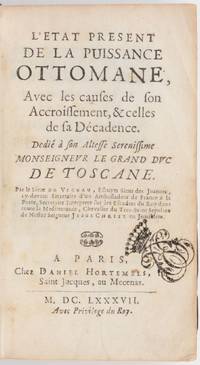
1687Best.-Nr. 1559A Paris: Chez Daniel Hortemels Saint Jacques au Mecenas 1687. First edition. In contemporary leather. Spine with five raised bands compartments gilt titled. Tinted edges. Bookplate and shelfmark on inner front panel. A different possessor’s inscription on flyleaf. Ownership stamp on title page. Spine with worm traces. Corners slightly bumped. Inside clean with occasional stains throughout. Overall in very good condition. First edition. In contemporary leather. Spine with five raised bands compartments gilt titled. Tinted edges. 30 370 4 p. Complete. First edition of Du Vignau’s important work dealing with the decline of the Ottoman Empire. L'état présent de la puissance Ottomane was written after the unsuccessful siege of Vienna by the Ottomans in 1683 and the following withdrawal. It deals with the possible reasons led to the decline of the Ottoman Empire and provides an overview of the period Ottoman power. The book gained interest throughout Europe and in the subsequent year a second edition was printed in the Hague and an English translation was also published. A year after the present work Du Vignau published another book Le Sécretaire turc. “In both works he described himself as a former secretary at the French embassy in Istanbul the ‘secrétaire-interprète’ to the King’s fleet in the Mediterranean and even a godson to Louis XVI. None of these claims appear to be true.” Ghobrial 2013 Sieur des Joanots Du Vignau was a pseudonym invented by Édouard de La Croix who was indeed a secretary in the French embassy in Istanbul between 1670 and 1680 and again between 1685–1686. La Croix published his Mémoires in 1684 and four other books between 1686 and his death in 1704 among them Le Sécretaire turc and the present book. “The reason for his having used a pseudonym remains unclear. Interestingly the two titles published under the name Du Vignau … are the only books written by La Croix that were not dedicated to Louis XVI but instead to the Grand Duke of Tuscany an indication perhaps of his attempts to cultivate a new patron in the person of Cosimo III de’ Medici.” Ghobrial 2013 Scarce we could trace only 3 copies in institutional holdings BL; BnF; Bibliothèque municipale de Lyon. Provenance: Bookplate: "De la bibliothèque du Comte Nicolas d’Eszterhazy”; ownership inscription in ink: “Clements”. Bibl.: Ghobrial J-P.: The Whispers of Cities: Information Flows in Istanbul London and Paris in the Age of William Trumball. Oxford: Oxford University Press 2013. pp. 1–7. . Chez Daniel Hortemels, Saint Jacques, au Mecenas unknown
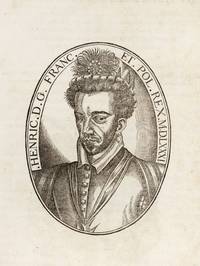
1584Best.-Nr. 79301584. Fine woodcut printer’s device on title woodcut port. on verso of the dedicatee Henri III & several woodcut illus. in the text. 22 p.l. 558 5 pp. Folio fine 18th-cent. marbled calf joints & ends of spine very carefully repaired arms in gilt on both covers of the great bibliophile. the duc d’Aumont triple gilt fillet round sides spine richly gilt red morocco lettering piece on spine a.e.g. Paris: A. l’Angelier 1584. First edition a fine copy from the library of the great bibliophile the duc d’Aumont 1709-82 one of the outstanding book and art collectors of his age with his arms in gilt on both covers. This is the first French national bibliography a monumental work of fundamental importance for the history of French literature and scholarship. It has remained an indispensable reference and source book to this day as attested by Brunet Petzholdt and Besterman. The roughly 3000 authors are arranged alphabetically by their given names and La Croix du Maine gives succinct bio-bibliographical information for each. Our edition contains a remarkable proposal not reprinted in the 18th-century edition for the formation of a French national royal library housed in about 100 “noble” bookcases of which a most attractive illustration is printed on p. 511. This woodcut appears to be the first illustration of library furniture in a printed book. La Croix du Maine also urges the arrangement of the books by a system that is quite close to a decimal classification. La Croix du Maine 1552-92 began this bibliography at the age of 17 and in the process accumulated a large library. A Protestant sympathizer he was assassinated at 40 and was therefore unable to issue further volumes as he had planned. A fine copy. This copy appeared in the auction lot 2977 of the library of the duc d’Aumont which was sold in January 1783 in Paris by De Bure. ⧠Besterman The Beginnings of Systematic Bibliography pp. 24-25. Grolier Club Bibliography 29. unknown
RENNES, Oberthur, 1896 - in-8 Reliure 1/2 chagrin marron, dos à 4 nerfs, décors, filets et titre dorés - Importante iconographie NB PP HT - Très bel Ex. JOINT : Lettre manucritede Charles GENIAUX