2 179 résultats
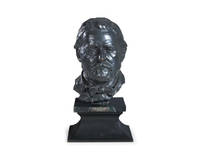
réf. 102885Original bronze bust of Ulysses S. Grant by Henry Shrady the famed sculptor of the Ulysses S. Grant Memorial on the west front of the United States Capitol in Washington D.C. Mounted on socle and base the entire piece measures 18.5 inches in height. In fine condition. An exceptional piece of Americana. Henry Merwin Shrady was an American sculptor known for the Ulysses S. Grant Memorial on the west front of the United States Capitol in Washington D.C. Shrady and architect Edward Pearce Casey won the competition to build the Ulysses S. Grant Memorial in 1902. In the twenty years Shrady spent executing its sculpture program he studied biology at the American Museum of Natural History and dissected horses to gain a better understanding of animal anatomy. The memorial was dedicated on April 27 1922 two weeks after Shrady's death. The Grant Memorial is described as "one of the most important sculptures in Washington" by James M. Goode in The Outdoor Sculpture of Washington D.C. It consists of a colossal equestrian statue of Grant atop a marble pedestal with bas relief plaques guarded by four lions. unknown books
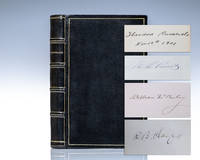
1872réf. 149519Philadelphia: J.B. Lippincott & Co 1872. Rare and remarkable autograph book compiled by West Virginia senator and industrialist Henry Gassaway Davis 1823-1916 containing 289 historic autographs including seven presidents seven vice presidents and scores of members of the Senate House of Representatives and presidential cabinets as well as a few other 19th-century notables. Octavo bound in full crushed levant morocco by the Harcourt Bindery with gilt titles and tooling to the spine in six compartments within raised gilt bands gilt ruling to the front and rear panels gilt-scrolled inner dentelles stamp-signed by the Harcourt Bindery all edges gilt title page printed in gilt. With Davis' ownership signature and subsequently that of his daughter to the title page "H. G . Davis 1872" and "Grace T. Davis 1887" Miss Davis was 18 in 1887. The book has approximately 300 unnumbered pages but only the first 144 which were numbered in pencil by hand at some point include the autographs generally three on each side of a page most often including the person's home state or in the case of cabinet members their office title. The highlights of the album are the signatures of seven presidents representing a half-century of American politics: U. S. Grant Rutherford B. Hayes James A. Garfield Grover Cleveland Benjamin Harrison twice William McKinley and Theodore Roosevelt. Also included are seven vice presidents - Hannibal Hamlin Schuyler Colfax Henry Wilson William A. Wheeler Levi P. Morton Garrett A. Hobart and Charles W. Fairbanks - and one first lady Frances F. Cleveland. With the later presidents' autographs are several examples of partial cabinets including: Harrison Secretary of the Treasury Charles Foster Secretary of War Stephen B. Elkins Attorney General William H. H. Miller Postmaster General John Wanamaker Secretary of the Navy Benjamin F. Tracy Secretary of the Interior John W. Noble and Secretary of Agriculture Jeremiah M. Rusk Cleveland Secretary of State Walter Q. Gresham Secretary of the Treasury John G. Carlisle Secretary of the Navy Daniel S. Lamont Attorney General Richard Olney Postmaster General Wilson S. Bissell Secretary of the Navy Hilary A. Herbert Secretary of the Interior Hoke Smith and Secretary of Agriculture J. Sterling Morton McKinley Secretary of State John Sherman Secretary of the Treasury Lyman J. Gage Secretary of War Russel A. Alger Attorney General Joseph McKenna Postmaster General James A. Gary Secretary of the Navy John D. Long Secretary of Agriculture James Wilson and Secretary of the Interior Cornelius N. Bliss and Roosevelt Secretary of State John Hay Attorney General Philander C. Knox Postmasters General Charles Emory Smith and Henry C. Payne and Secretary of the Interior Ethan A. Hitchcock. Others significant names include influential members of the House and Senate many of whom were celebrated veterans of the Civil War. These include: Hamilton Fish William M. Evarts Charles Sumner David Davis Simon Cameron James G. Blaine George S. Boutwell Augustus H. Garland Roscoe Conkling Ambrose Burnside John A. Logan John B. Gordon Carl Schurz Wade Hampton John T. Morgan Henry W. Slocum and William Mahone. Interestingly one page features the autographs of James Cardinal Gibbons Archbishop of Baltimore and famed agnostic lecturer Robert G. Ingersoll. In fine condition. A remarkable collection spanning half a century of American politics. J.B. Lippincott & Co unknown
1599réf. 007445Bologna Francesco De Franceschi, Baptista Ballagamba, Giovanni-Battista Ferroni, Nicolai Tebaldini 1599 in folio cuir Satisfaisant
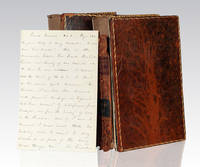
1885réf. 145720New York: Charles L. Webster & Company 1885-86. Exceedingly rare first edition of the autobiography of Ulysses S. Grant the 18th President of the United States which focusing mainly on his military career during the Mexican War and the Civil War entirely singular owned and annotated by Grant's close friend and most esteemed general: William Tecumseh Sherman. Octavo 2 volumes bound in the original full deluxe tree calf with gilt titles and elegant tooling to the spine gilt ruled borders to the front and rear panels gilt inner dentelles all edges gilt engraved portrait frontispieces illustrated with numerous facsimile letters 2 folding maps and wood engravings. William Tecumseh Sherman evidently read thes volumes in great detail making marginal notes on at least 18 pages in Vol. I several of them signed with his initials. On the last page of Vol. I Sherman wrote: "Read at St. Louis Mo. Dec 5 6 1885. This account of the Civil War is wonderfully accurate and him. W.T.S." Many of the notes are small corrections and additions by Sherman. On a passage regarding the Yazoo Pass Expedition on page 435 of Vol. I Sherman pointedly writes: "This conforms literally to my memoirs on the point most contested by Grant's pretended friends. W.T.S." He provides further thoughts regarding political interference on the next page: "If Grant had gone ahead living off the country we would have been inside of Vicksburg by Christmas 1862 the distance from Grenada to Vicksburg is little more than the circuit we afterward made from Bruinsberg via Jackson to Vicksburg --- This was my understanding when we parted at Oxford and the intervening country was better supplied with hay hominy. W.T.S." On p. 440-441 Grant wrote about the need to assign politically-connected John McClernand as Corps Commander: "I would have been glad to put Sherman in command to give him an opportunity to accomplish what he had failed in the December before; but there seemed no other way out of he difficulty for he was junior to McClernand. Sherman's failure needs no apology." In the margins Sherman's distinctive hand writes passionately: "because it was no failure at all." There is only one marginal annotation in Vol. II; however an autograph note is laid in at p. 123 supplying Sherman's recollection of Grant's first meeting with Lincoln which corroborates Grant's account. While Sherman was not present at the meeting between Grant and Lincoln he almost certainly heard about what transpired from Grant himself. The note reads in full: "Grants Memoirs Vol 2 Page 123 A good story is very correct. 'Si non vero ben trovalo.' Even if it is not true it is well conceived. This is the conversation between Genl. Grant President Lincoln and Secretary of War Stanton at the time he was addressed to command all the Armies of the U.S. Grant said in his usual quiet manner 'Mr. Lincoln I am told that several well planned campaigns in Virginia have been marred by interference from Washington viz from the Secretary of War or the President now if I am to command I must insist that no military order be issued to any detachment or part of the Army except through me' Mr. Lincoln in his inimitable way turning to Stanton said 'Stanton you and I have been running this machine for two years and have not made a brilliant success. I guess we had better trust this little man' Grant and then then and there the promise was made. And it is to the credit of Mr. Lincoln to say that he kept his word literally never interfering or making any order even when Washington was in real peril from Early's Army in 1865." Grant's insistence that there would be no political interference was likely particularly important to General Sherman who famously hated politicians. In good condition with detaching of the front boards and spines of each volume detaching of the rear board and separation of the folding facsimile letter at p. 312-313. Copies bound in highly polished gilt tree calf are extremely rare with only three other copies known. The first prospectus of Grant's Memoirs listed only 4 bindings: fine cloth full sheep fine half morocco and full Turkey morocco. The only other copy of Grant's Memoirs bound in tree calf was sold at auction - a copy presented to Mark Twain by Julia Grant and inscribed by both. Only two other known copies are located in private collections. To date no copies bound in the tree calf have been traced to institutional collections. As Grant died before publication was complete the only copy that he saw before his death was a prospectus bound in cloth; the extant tree calf copies suggest that the binding was perhaps reserved exclusively for presentations made by Julia Grant. Even the copies presented by publisher Mark Twain to his friends and colleagues were bound in one of the other available bindings. Though this copy bears no presentation inscription by Julia Grant Mark Twain or anyone else it is plausible that one of these figures would have sent the copy directly to General Sherman. After his second presidential term and world tour President Grant was stripped of nearly all of his life's earnings by conman Ferdinand Ward. Grant had forfeited his and his widow's military pension when he resigned as general to assume the presidency and his recent throat cancer diagnosis brought him deep concern about how his wife and family would manage financially after his death. In this moment of crisis Sherman rushed to Grant's aid and assisted him in restructuring his debt ensuring that Grant was able to keep his most prized possesions. Most importantly Sherman also encouraged Grant to do what he should have done years ago - write his memoirs. By June 1884 Grant had begun publishing articles on his major engagements of the Civil War for 'Century Magazine' which paid him $500 for each submission. The articles were received with great enthusiasm and Grant met with the magazine's representatives in early September to arrange for the publication of his memoirs. However when Samuel Clemens popularly Mark Twain learned of the potential arrangement with 'Century Magazine' he convinced Grant to sign with his own subscription publishing company which was able to offer Grant 70% of the net profit made from the sale of his memoirs. This rate was exorbitantly higher than what 'Century Magazine' had proposed. Grant began writing his memoirs in earnest racing against the illness to finish and ensure his family's financial stability. During this time Grant welcomed Sherman's repeated visits. On December 24 1884 Sherman wrote to his wife Ellen: "Grant says my visits have done him more good than all the doctors" Flood p.395. Grant with the moral support of Sherman lived to finish the memoir dying five days after its completion. Widely considered the finest military narrative ever published the memoirs were a national bestseller and Grant's widow Julia would eventually receive nearly $450000 about ~$14000000 today in royalties from their sale. Charles L. Webster & Company hardcover