2 969 résultats
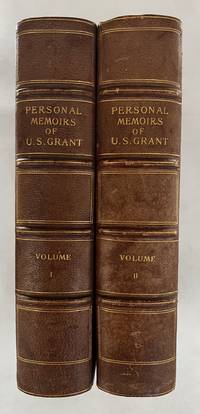
1895réf. 100887New York NY: Century Co 1895. Second edition Expanded. Hardcover. Fine with minor wear to exterior; very tight and clean. Complete in two quarto volumes in banded and gilt-stamped and gilt-titled leather and marbled paper-backed boards; frontispieces plates some folding portraits maps facsimiles; 24 cm. Approx 500 papges per volume. Index. A beautiful set in a high-quality custom leather tooled binding contemporary to date of publication. "The marginal annotation of this edition has been undertaken with a view to supplementing the personal narrative by references not only to some of the books with which the author refreshed his memory before entering upon and during his autobiographical labors but also to a limited extent to works in which fuller details may be found concerning incidents which were necessarily briefly treated by General Grant either by reason of his own connections with the action being limited to a small details as in some of the Mexican War scenes or on account of the haste with which the first edition of the book was perforce completed." --Frederick D. Grant Preface to the Second Edition.Frederick Dent Grant 1850-1912 was the eldest son of Ulysses S. Grant. / "Books reviews pamphlets etc. cited in the marginal annotation to this edition": v. 1 p. xviii-xix. ¶ Ulysses S. Grant 1822-1885 stands as a pivotal figure in American history known for his roles as a Union general during the Civil War and the 18th President of the United States. Born Hiram Ulysses Grant in Ohio he entered the U.S. Military Academy at West Point and served with distinction in the Mexican-American War. During the Civil War Grant's strategic acumen and tenacity led to key victories including the capture of Vicksburg a turning point in the war. His success on the battlefield led to his appointment as Commanding General in 1864 and he accepted the surrender of Confederate General Robert E. Lee at Appomattox in 1865 effectively ending the Civil War. Grant's presidency 1869-1877 was marked by efforts to ensure civil rights for newly freed African Americans including the enforcement of Radical Reconstruction in the South and the passage of the Fifteenth Amendment granting African American men the right to vote. His administration faced challenges including an economic depression and accusations of corruption. In his later years Grant penned his memoirs which have been praised for their insight and literary style. Despite the controversies of his presidency Grant is often celebrated for his unwavering commitment to equality and his military leadership during one of the most tumultuous periods in American history." --Bing. ¶ Guerre du Mexique 1846-1848 -- Récits personnels. Military campaigns. Personal narratives. Time: 1846-1865 Geographic: United States -- History -- Civil War 1861-1865 -- Campaigns. United States -- History -- War with Mexico 1845-1848 -- Personal narratives. États-Unis -- Histoire -- 1861-1865 Guerre de Sécession -- Campagnes et batailles. United States. Century Co hardcover
1954réf. List3210Greenville Illinois 1954. Two stapled packets of mimeographed typed pages eighty-seven and twenty-eight pages with one signed. Excellent to Near Fine. An autobiography and genealogy written by Ulysses S. DeMoulin 1871–1955 founder of DeMoulin Bros. a uniform manufacturing company which now mainly supplies marching band attire. The genealogy incorrectly traces the family’s history back to French Revolutionary figure Camille Desmoulins though it appears accurate otherwise. It includes a description of early Sebastopol Highland Illinois with a simple map. In the autobiography which is told in a large number of short anecdotes DeMoulin discusses his childhood and early life in Jamestown and Sebastopol and goes into detail about the early years of his company beginning with the formation of the Modern Woodmen of America fraternal organization for which the company supplied uniforms and items used in ‘rituals’. DeMoulin used the profits from this enterprise to invest in a number of others including a mine near Gold Hill Colorado and oil drilling land in Illinois. However the most interesting portions of the autobiography concern DeMoulin’s role in the development of agriculture in California’s Imperial Valley. DeMoulin first travels to southern California in 1903 happening to meet several engineers involved with the Imperial Irrigation System who take him to see the new town of Brawley: “Here by lantern light we sat around on the ground in the evening discussing many kinds of farm lands and if soft hard or sandy. We slept in ‘remadas’ made by setting posts to protrude about twelve feet above the ground which were then braced and divided into small box-like stalls. The remada was then covered with tree branches and a huge heavy taupalin sic curtain hung over the sides and front at night to keep out the dust of which you might find two or three inches at your door in the morning. A pitcher of water and a bowl were your only means of bathing. There were no streets in Brawley at this time only trails as the town had not yet been surveyed having only been founded in October 1902. People were living in tents while waiting for completion of hotel accommodations and other living quarters under construction.” DeMoulin begins buying land in the Brawley area to rent to farmers and traveling to the area regularly. He describes the building of the Laguna Dam spending a week at the workers’ camp “at which time I slept in the workmen’s crudely-built bunks and ate with them at the long rough pine tables”; and befriends author Harold Bell Wright. He also witnesses several conflicts with the IWW: “In 1908 there moved into Brawley about 200 International Workmen of the World or more familiarly known as ‘I.W.W.’s’ I won’t Work and in command was a Captain Stanley. However as most unwelcome guests they proceeded to join a strike in the cantaloupe sheds and inserting razor blades into apples the strikers threw them at workers. ‘Goons’ also tried to interfere with the trucking operations from the fields to the packing sheds. I recall of one driver telling a goon that if he even attempted to place a foot in his truck he would shoot him. And defying the driver the goon was instantly killed. Naturally this would cause a riot and they sent to El Centro for a tank such as it was in those days - a cannon and several machine guns. But soon after the Mayor had issued orders to shoot anyone getting out of hand an agreement was easily reached.” University of Washington’s IWW History Project documents two IWW actions in Brawley between 1905 and 1920 neither of which match DeMoulin’s description; nor does the event appear in newspapers. However “Captain” William Stanley was in the area serving as the secretary of the I.W.W.’s chapter in the Imperial Valley. In 1911 Stanley was killed in an early battle of the Mexican Revolution assisting Mexican Liberal Party fighters in occupying Mexicali. DeMoulin claims to have traveled with several others to watch the fighting that would end the occupation: “It was suddenly discovered one morning that Captain Stanley and his I.W.W.’s had disappeared during the night and word had gotten around they had settled in Mexicalo sic a Mexican border town and were so strong in number they overpowered the police pillaged the shops and stores defying the Mexican Government by taking over complete possession of Mexicalo. However after putting up with this condition for several months the Mexican Government sent in about 500 Infantrymen with orders to get rid of them immediately under any condition. . Stanley’s men had made a large opening in the river bank to a depth of about five feet which led through to the bank facing south. From this vantage point his men could fire their muskets when the Mexicans advanced towards them and soon took to their heels when Stanley’s men began firing. . Several of us had driven down to sic Brawley to witness the fighting and bullets had been spattered everywhere. Many of the people never thinking of danger stood out in the open so as not to miss what was going on but I was glad to stay in the back of the adobes at least where one was protected from stray bullets. And having heard rumors of their retreating possibly the next day which was Sunday we drove down again but all was quiet and we met with no resistance. Many of the men were swimming and others were entertaining their wives and families in one way or another. We didn’t stay too long on that trip as one never knew what might happen. But it wasn’t long before they disappeared from Mexicalo entirely for which everyone was most grateful and happy.” DeMoulin is none too fond of Mexican workers either describing how the 1928 construction of a primitive border wall “didn’t stop the wetbacks . from swimming across” and complaining that “regardless of having no sense nor education many were hired and the employers would hide them in groves because if they were arrested it would cost $160.00 including court and attorney fees to have each one returned to Mexico.” DeMoulin’s other targets for racial abuse include “a couple of crooked ‘Jewish Kikes’” who were “certainly professionals when it came to putting the money in their pockets” and several Black men who he claims steal from him. DeMoulin credits himself with bringing grapefruit production to the Imperial Valley and describes a scam by the area’s real estate agents to unload inferior farmland onto unsuspecting investors. He recounts his company making leather “‘Red Men’s’ costumes” for a “Chief Gray Eagle” in Oklahoma whose “squaws wouldn’t work for him any more.” Of interest to historians of the Imperial Valley’s development and especially of labor relations in the agriculture industry. unknown
réf. 6203585416.Gpaperback. Good. Access codes and supplements are not guaranteed with used items. May be an ex-library book. paperback
réf. 1423313356.GaudioCD. Good. Access codes and supplements are not guaranteed with used items. May be an ex-library book. unknown
réf. 1089086 1 p. 8vo 225 x 155 mm. orig. printed red semi-stiff wrappers title on spine. Cullompton Devon: Beau Geste Press 1973. First edition the deluxe version on vibrant multi-colored Strathmore Grandee paper of this scarce and early Carrión 1941-89 bookwork. Arguments was printed in a total edition of 400 copies 200 on Huntsman white cartridge and unsigned and 200 deluxe copies and signed on the verso of the title-page. Formed in 1970 by Felipe Ehrenberg Martha Hellion David Mayor Chris Welch and Madeleine Gallard the Beau Geste Press was instrumental in Carrión’s growing engagement with artists’ books. The scholar Zanna Gilbert recalls in the Beau Geste Press catalogue p. 405 that in 2017 Ehrenberg “commented that Carrión had never gotten his hands dirty with ink before visiting the Beau Geste Press.” In 1973 the Press published two of his books Arguments Autumn and Looking for Poetry/Tras la Poesía Winter. In the Getty Research Institute exhibition catalogue Artists and Their Books Books and Their Artists 2018 Gilbert describes the present bookwork: “Carrión humorously interrogates the structure and content of books and the literary devices used by authors and playwrights. The titular exchanges in Arguments are indicated only by the names of the participants with no reference to the actual content of their disagreements. The distinctly Anglophone names are arranged in various configurations on each page of the book leaving the reader to wonder about the substance of the disputes. Indeed as the ‘arguments’ play out across the gridded field of the typeset page the book increasingly becomes about the materiality of the text itself with Carrión adding symbols such as the ampersand or violating the names themselves—as when for example ‘Marion’ becomes ‘Mar ion’—resulting in ever more complex exchanges” p. 72. The book was beautifully typeset by Terry Wright a skilled printer who joined the Press in 1972; laid out by Mayor; and offset-printed by Ehrenberg. Each “Argument” is numbered by hand there are 25 in total with several misnumbered and corrected in this copy nos. 5 22 23 24. Carrión’s book concludes with an unnumbered page on translucent paper with the entreaty: “My name is Ulises / What’s yours ” A fine copy; spine a trifle sunned. ⧠Alice Motard ed. Beau Geste Press 2020 No. 48 pp. 186-91 illustrating both versions. J. J. Agius & R. Ocampo eds. Ulises Carrión: Books & More Catalogue Raisonné 2013 7. unknown
1959réf. 76150New York: Kraus Reprint Corporation 1959. publishers cloth with stamped gilt lettering. small 4to. publishers cloth with stamped gilt lettering. iv1592; iv1593-3384 columns two per page. Two volumes. This is a facsimile reprint of the 1894 edition that was published by the Société anonyme d'imprimerie montbéliardaise. Spines lightly faded else a near fine set. Biography and bibliography of sources and personages of the middle ages. Although published in France this is a source book for all of European medieval history. Besterman 2885-2886. Kraus Reprint Corporation unknown
réf. 11126Black & white illus. 51 pp. & colophon. 4to stamped softcover stapled with black cloth tape over spine. London: Royal College of Art 2010. The rare exhibition catalogue for an innovative presentation of Carrión’s work at the Showroom 12-26 June 2010 in London. Supervised by Clare Carolin it was organized by first-year MA Curating Contemporary Art students at the Royal College of Art and staged with the help of Martha Hellion a close friend of the artist In fine condition. Designed by Fraser Muggeridge. Edition of 500 copies. unknown
réf. 3368337734.Ghardcover. Good. Access codes and supplements are not guaranteed with used items. May be an ex-library book. hardcover
1879réf. 1404973Philadelphia: Hubbard Bros 1879. Hardcover. Octavo xxii 599 pages. In Fair condition. Spine is brown with gold print. Boards in brown cloth mitred edges gold print; tattering to spine caps and corners toning to spine peripheral toning light smudging/shelf wear. Text block has name in pencil on front flyleaf cracked hinges intermittent spine breaks. Illustrated: “Profusely illustrated”— title page; b&w frontispiece portrait and text drawings. NOTE: Shelved in Locked Annex Area ND-HV Section. 1404973. FP New Rockville Stock. Hubbard Bros hardcover
réf. 1988058732.Ghardcover. Good. Access codes and supplements are not guaranteed with used items. May be an ex-library book. hardcover
réf. 136544466X.Ghardcover. Good. Access codes and supplements are not guaranteed with used items. May be an ex-library book. hardcover
réf. 8536905247.Gpaperback. Good. Access codes and supplements are not guaranteed with used items. May be an ex-library book. paperback
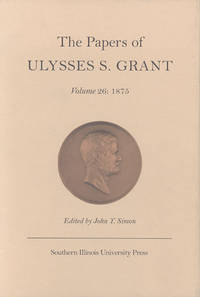
2003réf. 24415Chicago Illinois U.S.A.: Southern Illinois Univ Pr 2003. Hardback in near fine condition with fine dust jacket. Small remainder mark on bottom edge of pages. Volume 26: 1875. Hardcover. Near Fine/Fine. Chicago, Illinois, U.S.A.: Southern Illinois Univ Pr Hardcover
2003réf. 24417Chicago Illinois U.S.A.: Southern Illinois Univ Pr 2003. Hardback in near fine condition with very good dust jacket. Small remainder mark on bottom edge of pages. Volume 25: 1874. Hardcover. Near Fine/Very Good. Chicago, Illinois, U.S.A.: Southern Illinois Univ Pr Hardcover
2005réf. 6305Totowa New Jersey U.S.A.: Humana Pr Inc 2005. Hardback in very good condition. Book includes CD. Hardcover. Very Good. Totowa, New Jersey, U.S.A.: Humana Pr Inc Hardcover
1997réf. 8843Johns Hopkins University Press August 1997. HC. Very Good/Very Good. Johns Hopkins University Press hardcover
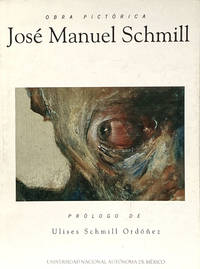
1991réf. 1002966Paintings by Mexican Jose Manuel Schmill whose attrative nudes and landscapes contrast with his images of ghoulish fiends in strange perspective. Includes a text by the artist a bibliography list of exhibitions. 64pp. Illus. color. En espanol / Spanish. New publication but has some minor shelf wear pencil price Alla stamp. In stock. Usually ships within three days. UNIVERSIDAD NACIONAL AUTONOMA DE MEXICO paperback
réf. 6206836177.Gpaperback. Good. Access codes and supplements are not guaranteed with used items. May be an ex-library book. paperback
réf. 6206829367.Gpaperback. Good. Access codes and supplements are not guaranteed with used items. May be an ex-library book. paperback
réf. 6206829359.Gpaperback. Good. Access codes and supplements are not guaranteed with used items. May be an ex-library book. paperback
réf. 6206836185.Gpaperback. Good. Access codes and supplements are not guaranteed with used items. May be an ex-library book. paperback
1876réf. 49942Washington: Government Printing Office 1876. 1876. First edition. First Edition. Disbound. 8pp. House of Representatives. 44th Congress 1st Session. Ex. Doc. No. 145. Merritt's report multiple causes starting with an under-allocation of actual needs combined with claims that the deficiency is caused by feeding visiting Indians who belong to other agencies and also some of the "northern wild tribes". Fine. [Government Printing Office], 1876. unknown
réf. 0816678995.Ghardcover. Good. Access codes and supplements are not guaranteed with used items. May be an ex-library book. hardcover
réf. 2598123 October no year. On letterhead of the Ulysses Bookshop 20 Bury Street London WC1. Several James Joyce scholars have turned their attention to Schwartz an early dealer in his books and manuscripts as well as publisher of a couple of pirated editions. See William S. Brockman 'Jacob Schwartz - "The Fly in the Honey"' in Joyce Studies Annual Summer 1998. 1p 4to. On the Ulysses Bookshop letterhead printed on green paper. Addressed to 'Dear Sir:' and with valediction 'Au Revoir / Dr J Schwartz / prop / Ulysses Books'. Begins: 'Im taking a chance sending them without inquiring about Flashers etc / You must pardon my damn timidness: but I just lost for good 4 valuable Norman Douglas manuscripts by being too trustful'. He states the amount of the bill adding: 'please remit at once as Im really hard up'. Ends: 'I hope you enjoyed reading the catalogue / The Leslie item was sold'. See Image. 23 October [no year]. On letterhead of the Ulysses Bookshop, 20 Bury Street, London WC1. unknown
réf. 1312293276.Ghardcover. Good. Access codes and supplements are not guaranteed with used items. May be an ex-library book. hardcover