(Fenelon, Francois)Antiquariat.de
2 179 résultats
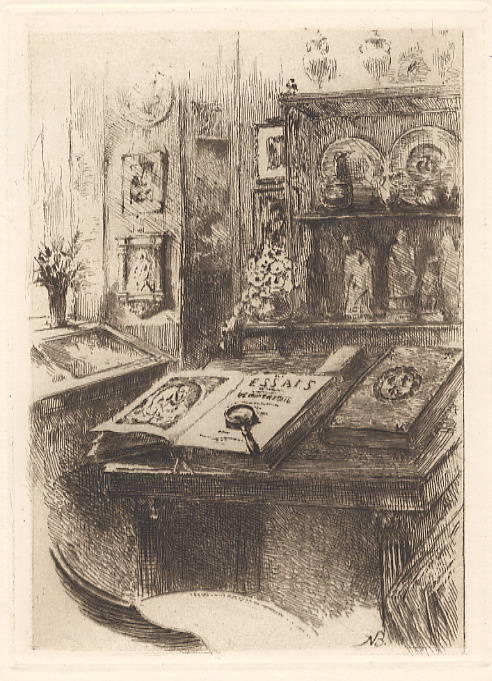
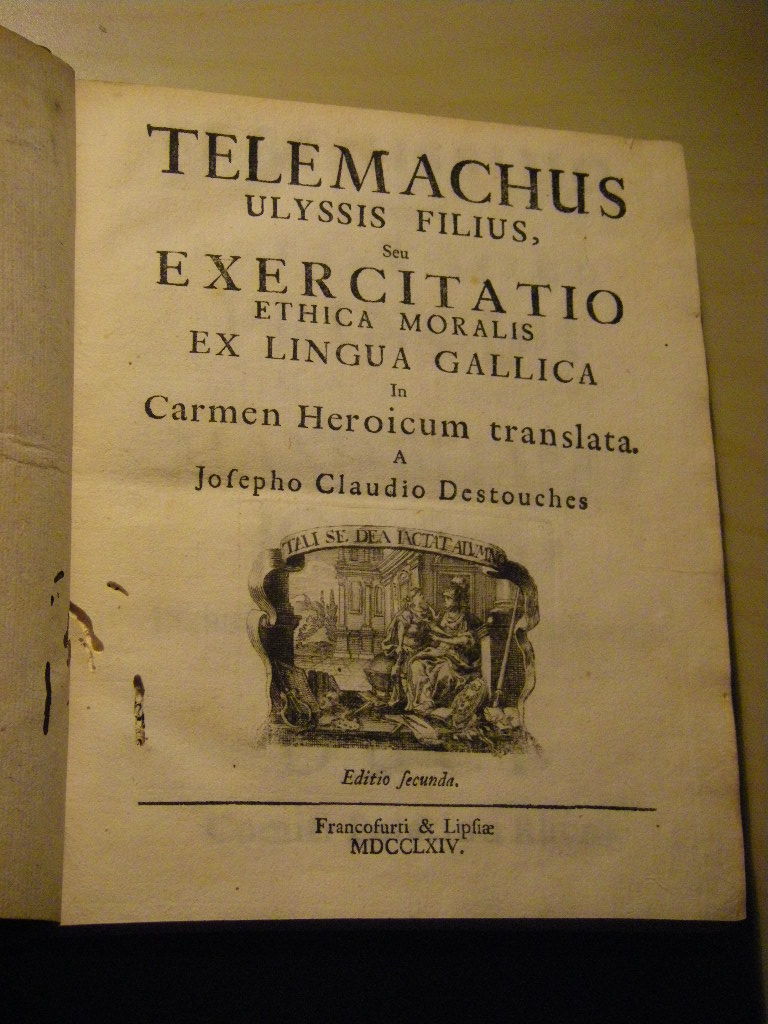
1764réf. 041064Frankfurt Leipzig, ohne Verlagsangabe, 1764. (9 Bl.); 262 S., (1 Bl.); mit 1 gestochenen Titelvignette, 2 Kupfern von G. S. Rösch u. 10 gest., meist floralen Textvignetten; schöner Ganzledereinband neuerer Zeit; Innendeckel u. fliegendes Bl. mit altem bzw. neuem Exlibris, fliegendes Blatt mit Besitzervermerk von alter Hand, Einband mit geringen Kratzern, erste 15 u. letzte 25 Bl. teils mit größeren Wurmgängen, kaum Textverlust; schönes Expl. Leder 19,2 cm Befriedigend [6 Warenabbildungen]
1864réf. b22423New York: Harper & Brothers 1864. First Edition . Disbound. Fine. Complete original disbound issue is in fine condition. Harper & Brothers unknown
réf. 34228N.p.: N.p. n.y. Hardcover. Small 4to. Full green calf with gilt spine lettering. Pp. 681-696 rectos only. 12 steel engravings 1 map. Very good. Mildly edgeworn with spine and binding edges irregularlysunned to golden brown. Bibliographically cryptic but clearly relatively recent i.e. post-WW2 facsimile reprint of this 16-page extract from the May 1866 issue of "Harper's New Monthly Magazine" Vol. XXXII No. CXCII -- an article that follows up on U.S. Grant's postwar fame profiling the famed lead mining town in northwest Illinois that had become his home just prior to the Civil War. Front wrapper engraving depicts Galena's Main Street bulging with people assembled to hear the returning hero. A massive banner spans the street proclaiming "Hail to the Chief Who in Triumph Advances." Though an extract it is self-contained and sought after in its own right. This undated reprint circa 1970 is printed on an off-white stock artificially age toned to lend it a period feel. It's also slightly enlarged from the original. Scarce. N.p. hardcover
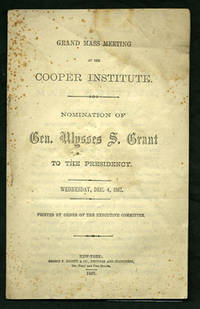
1867réf. 27894New York: Printed by Order of the Executive Committee George F. Nesbitt & Co. Printers 1867. First edition. Stitched. Title paged foxed at the edges dampstain to upper front corner; a good copy. 40 pp. 8vo. They were all there Astor to Vanderbilt to give the Republican nomination to Grant. Printed by Order of the Executive Committee, George F. Nesbitt & Co., Printers unknown
1868réf. 000016794Washington D.C.: Government Printing Office 1868. hardcover. Very Good. Octavo textured brown cloth covers with gilt titles on top. New brown cloth spine and new endpapers. 324 pages. The top cover also includes the word "Abridgment". Presentation copy with: "Compliments of L. H. Pelouze A.A.G" on a preliminary blank in pencil. On the title page is the penciled name of General Augur. Lieutenant-Colonel Pelouze was Assistant Adjutant General and recorder of the court. Includes reports from Lieutenant General Sherman Brevet Major Terry Brevet Major General Augur Major General Halleck Brevet Major General Steele Brevet Major General McDowell Major General Meade Brevet Major General Robinson Major General Thomas Letter of General Duncan Extract of message of Governor of West Virginia Brevet Major General Emory Brevet Major General Schofield Brevet Major General Canby Brevet Major General Pope Brevet Major General Ord Major General Sheridan Adjutant General Inspector General and others. 040414A Government Printing Office hardcover
1868réf. 263392np 1868. Two portraits. 8 pp. 8vo. Self wrappers. VG. Two portraits. 8 pp. 8vo. With autograph of Colfax on card dated South Bend Ind Nov. 1881. unknown
1897réf. 251581Np: Tiffany & Co 1897. 64mm. in diameter. Copper medal. No scuffs or scratches. Very good. 64mm. in diameter. An attractive well preserved example of this medal which was commissioned by the American Numismatic and Archaeological Society by Tiffany & Co. in conjunction with the dedication of the Grant Memorial in New York City on April 27 1897. A lovely medal with design elements that were struck in high relief. Tiffany & Co unknown
1862réf. 19530Towanda: Printed at the Office of the Bradford Reporter 1862. First edition. 1 vols. 8vo. Black sheep-backed marbled boards. Interleaved. Rubbed some chipping of spine. Interleaved some manuscript additions of changes up to 1876 on interleaves and with a document from Montrose Penn. 1884 regarding the courts laid in some spotting and leaves loosened but generally a very good copy of a well-used reference work. With the signature and notation of William H. Jessup attorney of W. & W. H. Jessup. First edition. 1 vols. 8vo. William Jessup graduate of Yale was a"pioneer in the cause of education and temperance in northern Pennsylvania and the chief founder of the County agricultural society." Appleton He was a presiding judge of the 11th judicial district of Pennsylvania from 1838 until 1851and one of the three representitives sent to discuss with Lincoln the military quota he had requested of New York Pennsylvania and Ohio. Two of his sons became noted missionaries William H. obviously followed him into his law firm. Printed at the Office of the Bradford Reporter hardcover
réf. 119222aafO. Verlag, O. Dr., MDCCLXIV, 1764, in-4to, 82 S. + 1 S. (Druckfehler), Autorenname hs. auf Titelbl., Rez. Pappband.
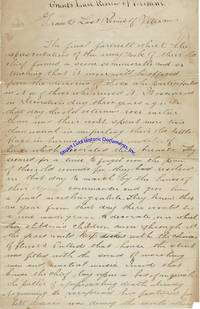
réf. 4510ULYSSES S. GRANT 1822-1885. Grant was the Eighteenth President and the head of the Union Army during the Civil War. Manuscript. 3pg. 8 x 12 . No date circa 1888. No place likely New York. A lengthy manuscript entitled Grants Last Review of Veterans done by an unknown soldier. He wrote The final farewell which the representatives of the Army took other old chief for the scene so memorable and so touching that it will never be if faced from the memories of those who participated in it or of those who viewed it. It occurred on decoration day three years ago. On that day the old veterans rose earlier than was there want spent more time than usual in unfurling their old battle flags in burnishing their metals of honor which decorated their breasts. They seem for time to forget ever the pain of their old wounds for they had resolved on that day to March by the house of their dying commander give a final marching salute the knew that one year from that day there would be a new made grave to decorate one which their children's children down through all the years would keep decked with the choicest of flowers. Outside that house the street was filled with the sound of marching men and martial music. Inside that house the chief lay upon a bed of anguish the power of approaching death already beginning to His features for his disease with doing the work which even the enemies bullets had shrunk from. The hand which it sees the surrender sounds of countless thousands was scarcely able to return the pressure of a friendly grasp. The voice which had cheered on to triumph and victory the legions of American manhood was no longer able to call for the cooling draft which lacked the thirst of a fever tongue and prostrate upon that bed of suffering lay the form which is the New World had written at the head of concrete columns in the old world had marched through the palaces of crown heads with the descendants of a line of kings rising and standing uncovered before him. His ears caught the sound of the movement of marching men. The bands were playing the grand strains which had mingled with the echo of his guns at Vicksburg playing the same quick steps to which his men had stepped in hot haste in pressuring Lee through Virginia and there came the measured tread swinging past of trained men which seem to shake the earth. He understood it all then it was the approaching tread of the old veterans. He seized his crutch with his little remaining strength and dragged himself painfully and slowly to the window. And as he gazed upon those banners bullet ridden battle stained those kindled in his eyes the flame which had lit them at Chattanooga at the Wilderness and amid the glories of Appomattox. And as he gazed upon those banners dipping to him in the salute he once more drew himself into the position of a soldier. And as they saw him standing cheeks which had been bronzed by Southern suns and begrimed with powder were now bathed in the tears of a manly grief. And then they saw a rising hand which had so often pointed out to them the path of victory he raises slowly and feebly to his head in acknowledgment of their salutations. The last the column had passed. The hand fellto his side. It was his last military salute. In late May 1885 the Union veterans knowing that Grant was dying had a military parade outside his 66th Street home. The document has light staining and chipping; the two pages have some separation and the lower right corner of the third page is missing but it affects no text. A fine firsthand account of the love the troops had for their general. unknown
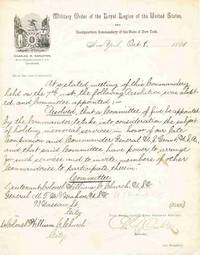
réf. 2665D. 2pg. 8 x 10. October 8 1885. New York. A document regarding a memorial service for President Grant not long after he died. It is on Military Order of the Loyal Legion of the United States letterhead and reads: At a stated meeting of the Commandery held on the 7th inst the following Resolution was adopted and Committee appointed: Resolved that a Committee of five be appointed by the Commander to take into consideration the subject of holding memorial services in honor of our late Companion and Commander General U.S. Grant U.S.A. and that said Committee have power to arrange for such services and to invite members of other Commanderies to participate therein. The document then lists the five members of the committee; Church General M.T. McMahon General Israel Vogdes Commander Edward Hooker and Colonel H.C. King. The document has light soiling and smudges and is in fine condition. unknown
réf. 1313878413.Gpaperback. Good. Access codes and supplements are not guaranteed with used items. May be an ex-library book. paperback
2005réf. UEPILET00AFBarnes & Noble 2005. Very Good. . Letters and Sayings of Epicurus. Makridis Translator Odysseus. NY: Barnes & Noble 2005. 100pp. Indexed. 8vo. Mass Market. Book condition: Very good with former owner's name and date on first leaf. Slightly rubbed soiled and bumped wraps. Barnes & Noble paperback books
1950réf. 774311950 Le Puy, Imprimerie Jeanne d'Arc, sans date (vers 1950), plaquette petit in 8° brochée, 40 pages ; couverture ; jaquette.
1921réf. 2114Paris, Les Amis des livres, 1921; in-8, broché sous étui muet en papier bleu avec motifs géométriques ; (7) ff., 99 pp., (3) ff. ; 37 eaux-fortes in et hors-texte d'Armand Berton, la plupart en couleurs, protégées par des serpentes ; couverture beige imprimée à rabats.
1878réf. _201800850Paris, Chez Alphonse Picard, Libraire, 1878 ; in-8 (183 x 232 mm), VIII-108-2-12-2, broché, couverture d'attente avec manque, dos muet (quelques rousseurs). Extrait du «Cabinet historique», Tome XXIII, Catalogue; p. 126 à 235. Tiré à 350 exemplaires.
1954réf. List3210Greenville Illinois 1954. Two stapled packets of mimeographed typed pages eighty-seven and twenty-eight pages with one signed. Excellent to Near Fine. An autobiography and genealogy written by Ulysses S. DeMoulin 1871–1955 founder of DeMoulin Bros. a uniform manufacturing company which now mainly supplies marching band attire. The genealogy incorrectly traces the family’s history back to French Revolutionary figure Camille Desmoulins though it appears accurate otherwise. It includes a description of early Sebastopol Highland Illinois with a simple map. In the autobiography which is told in a large number of short anecdotes DeMoulin discusses his childhood and early life in Jamestown and Sebastopol and goes into detail about the early years of his company beginning with the formation of the Modern Woodmen of America fraternal organization for which the company supplied uniforms and items used in ‘rituals’. DeMoulin used the profits from this enterprise to invest in a number of others including a mine near Gold Hill Colorado and oil drilling land in Illinois. However the most interesting portions of the autobiography concern DeMoulin’s role in the development of agriculture in California’s Imperial Valley. DeMoulin first travels to southern California in 1903 happening to meet several engineers involved with the Imperial Irrigation System who take him to see the new town of Brawley: “Here by lantern light we sat around on the ground in the evening discussing many kinds of farm lands and if soft hard or sandy. We slept in ‘remadas’ made by setting posts to protrude about twelve feet above the ground which were then braced and divided into small box-like stalls. The remada was then covered with tree branches and a huge heavy taupalin sic curtain hung over the sides and front at night to keep out the dust of which you might find two or three inches at your door in the morning. A pitcher of water and a bowl were your only means of bathing. There were no streets in Brawley at this time only trails as the town had not yet been surveyed having only been founded in October 1902. People were living in tents while waiting for completion of hotel accommodations and other living quarters under construction.” DeMoulin begins buying land in the Brawley area to rent to farmers and traveling to the area regularly. He describes the building of the Laguna Dam spending a week at the workers’ camp “at which time I slept in the workmen’s crudely-built bunks and ate with them at the long rough pine tables”; and befriends author Harold Bell Wright. He also witnesses several conflicts with the IWW: “In 1908 there moved into Brawley about 200 International Workmen of the World or more familiarly known as ‘I.W.W.’s’ I won’t Work and in command was a Captain Stanley. However as most unwelcome guests they proceeded to join a strike in the cantaloupe sheds and inserting razor blades into apples the strikers threw them at workers. ‘Goons’ also tried to interfere with the trucking operations from the fields to the packing sheds. I recall of one driver telling a goon that if he even attempted to place a foot in his truck he would shoot him. And defying the driver the goon was instantly killed. Naturally this would cause a riot and they sent to El Centro for a tank such as it was in those days - a cannon and several machine guns. But soon after the Mayor had issued orders to shoot anyone getting out of hand an agreement was easily reached.” University of Washington’s IWW History Project documents two IWW actions in Brawley between 1905 and 1920 neither of which match DeMoulin’s description; nor does the event appear in newspapers. However “Captain” William Stanley was in the area serving as the secretary of the I.W.W.’s chapter in the Imperial Valley. In 1911 Stanley was killed in an early battle of the Mexican Revolution assisting Mexican Liberal Party fighters in occupying Mexicali. DeMoulin claims to have traveled with several others to watch the fighting that would end the occupation: “It was suddenly discovered one morning that Captain Stanley and his I.W.W.’s had disappeared during the night and word had gotten around they had settled in Mexicalo sic a Mexican border town and were so strong in number they overpowered the police pillaged the shops and stores defying the Mexican Government by taking over complete possession of Mexicalo. However after putting up with this condition for several months the Mexican Government sent in about 500 Infantrymen with orders to get rid of them immediately under any condition. . Stanley’s men had made a large opening in the river bank to a depth of about five feet which led through to the bank facing south. From this vantage point his men could fire their muskets when the Mexicans advanced towards them and soon took to their heels when Stanley’s men began firing. . Several of us had driven down to sic Brawley to witness the fighting and bullets had been spattered everywhere. Many of the people never thinking of danger stood out in the open so as not to miss what was going on but I was glad to stay in the back of the adobes at least where one was protected from stray bullets. And having heard rumors of their retreating possibly the next day which was Sunday we drove down again but all was quiet and we met with no resistance. Many of the men were swimming and others were entertaining their wives and families in one way or another. We didn’t stay too long on that trip as one never knew what might happen. But it wasn’t long before they disappeared from Mexicalo entirely for which everyone was most grateful and happy.” DeMoulin is none too fond of Mexican workers either describing how the 1928 construction of a primitive border wall “didn’t stop the wetbacks . from swimming across” and complaining that “regardless of having no sense nor education many were hired and the employers would hide them in groves because if they were arrested it would cost $160.00 including court and attorney fees to have each one returned to Mexico.” DeMoulin’s other targets for racial abuse include “a couple of crooked ‘Jewish Kikes’” who were “certainly professionals when it came to putting the money in their pockets” and several Black men who he claims steal from him. DeMoulin credits himself with bringing grapefruit production to the Imperial Valley and describes a scam by the area’s real estate agents to unload inferior farmland onto unsuspecting investors. He recounts his company making leather “‘Red Men’s’ costumes” for a “Chief Gray Eagle” in Oklahoma whose “squaws wouldn’t work for him any more.” Of interest to historians of the Imperial Valley’s development and especially of labor relations in the agriculture industry. unknown
1967réf. 63382Carbondale & Edwardsville IL: Southern Illinois University Press 1967- 1991. Eighteen vols. xxxix 1 458; xxxiii 1 399 1; xxv 1 479 1; xxv 1 520; xxv 1 458; xxiv 2 492; xxiv 588; xxiii 1 609 1; xxiv 700; xxv 1 618; xxvi 497 1; xxv 1 520; xxvi 599 1; xxvi 548; xxv 1 691 1; xxvi 635 1; xxiii 1 663 1; xxiii 1 661 1; xxiv 651 1 pp. With frontispiece’s photo illustrations facsimiles of letters maps. Uniformly bound in brick-red publisher’s cloth black & gilt spine labels minor bumping to upper right corner vol. 1 w/ d.j.’s from the Clark County Historical Society deaccessioning material. First editions of the first 18 volumes in this massive project encompassing Ulysses Grant’s letters and correspondence from his Prewar career through Reconstruction. Beginning with his 17-year-old cadet letters home at West Point and then service in Louisiana Texas the Mexican War and at Fort Vancouver entry into the Civil War the early campaigns of Fort Donelson Battles of Shiloh Corinth Vicksburg ascension to Lieutenant General the battles of Petersburg Cold Harbor & the Wilderness General Sherman’s March Appomattox assassination of President Lincoln the capture of Jefferson Davis and finally the disbanding of the immense Union Army. Simon d. 2008 drew upon a vast number of previously unpublished or unknown letters memorandum and writings of Grant and together with extensive notes and analysis offered an essential research tool for the study of American History the Civil War Reconstruction and the steps to the Grant Presidency. The set continues in production and Simon himself oversaw the first 31 annotated volumes. He also edited the memoirs of Julia Dent Grant. Southern Illinois University Press, hardcover
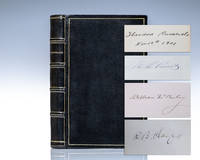
1872réf. 149519Philadelphia: J.B. Lippincott & Co 1872. Rare and remarkable autograph book compiled by West Virginia senator and industrialist Henry Gassaway Davis 1823-1916 containing 289 historic autographs including seven presidents seven vice presidents and scores of members of the Senate House of Representatives and presidential cabinets as well as a few other 19th-century notables. Octavo bound in full crushed levant morocco by the Harcourt Bindery with gilt titles and tooling to the spine in six compartments within raised gilt bands gilt ruling to the front and rear panels gilt-scrolled inner dentelles stamp-signed by the Harcourt Bindery all edges gilt title page printed in gilt. With Davis' ownership signature and subsequently that of his daughter to the title page "H. G . Davis 1872" and "Grace T. Davis 1887" Miss Davis was 18 in 1887. The book has approximately 300 unnumbered pages but only the first 144 which were numbered in pencil by hand at some point include the autographs generally three on each side of a page most often including the person's home state or in the case of cabinet members their office title. The highlights of the album are the signatures of seven presidents representing a half-century of American politics: U. S. Grant Rutherford B. Hayes James A. Garfield Grover Cleveland Benjamin Harrison twice William McKinley and Theodore Roosevelt. Also included are seven vice presidents - Hannibal Hamlin Schuyler Colfax Henry Wilson William A. Wheeler Levi P. Morton Garrett A. Hobart and Charles W. Fairbanks - and one first lady Frances F. Cleveland. With the later presidents' autographs are several examples of partial cabinets including: Harrison Secretary of the Treasury Charles Foster Secretary of War Stephen B. Elkins Attorney General William H. H. Miller Postmaster General John Wanamaker Secretary of the Navy Benjamin F. Tracy Secretary of the Interior John W. Noble and Secretary of Agriculture Jeremiah M. Rusk Cleveland Secretary of State Walter Q. Gresham Secretary of the Treasury John G. Carlisle Secretary of the Navy Daniel S. Lamont Attorney General Richard Olney Postmaster General Wilson S. Bissell Secretary of the Navy Hilary A. Herbert Secretary of the Interior Hoke Smith and Secretary of Agriculture J. Sterling Morton McKinley Secretary of State John Sherman Secretary of the Treasury Lyman J. Gage Secretary of War Russel A. Alger Attorney General Joseph McKenna Postmaster General James A. Gary Secretary of the Navy John D. Long Secretary of Agriculture James Wilson and Secretary of the Interior Cornelius N. Bliss and Roosevelt Secretary of State John Hay Attorney General Philander C. Knox Postmasters General Charles Emory Smith and Henry C. Payne and Secretary of the Interior Ethan A. Hitchcock. Others significant names include influential members of the House and Senate many of whom were celebrated veterans of the Civil War. These include: Hamilton Fish William M. Evarts Charles Sumner David Davis Simon Cameron James G. Blaine George S. Boutwell Augustus H. Garland Roscoe Conkling Ambrose Burnside John A. Logan John B. Gordon Carl Schurz Wade Hampton John T. Morgan Henry W. Slocum and William Mahone. Interestingly one page features the autographs of James Cardinal Gibbons Archbishop of Baltimore and famed agnostic lecturer Robert G. Ingersoll. In fine condition. A remarkable collection spanning half a century of American politics. J.B. Lippincott & Co unknown
1876réf. 10470Washington: Government Printing Office 1876. Hard Cover. Good binding. Octavo. 815 pp. First edition. In publisher cloth. Edgeworn with closed tear to the top of the spine; staining and discoloration to to the rear board as well as to the textblock edges; minor silverfishing to the front pastedown; contents evenly toned throughout. A fairly uncommon volume with General Alfred Terry's report of General Custer's defeat at the the Battle of Little Bighorn. Also reprinted is Major Marcus Reno's report. Both reports offer details related to the movement prior to the engagement information on which companies were involved and the losses. A larger than life individual Custer's mystique has been complicated and controversial in relation to the United States government's policies and actions related to the indigenous Americans throughout the 19th century. Government Printing Office unknown
réf. 25391Vienne, Martin, Editions de la Société des Amis de Vienne, 1922-23, 2 volumes grand in 8° brochés, IV-331 et 303pp. ; qq. rares passages soulignés au stylo bleu et qq. menus défauts ; couverture légèrement fanées.
1887réf. 769111887 Valence, Céas, 1887, plaquette grand in 8° brochée, 19-29 pages ; couverture imprimée (effrangée).
1999réf. LFA-126719705N° 246 (Septembre 1999): 88 pages, format 215 x 285 mm, illustré, broché couverture couleurs, bon état
1833réf. 20260Lausanne, Marc Ducloux, 1833. In-8 broché, couverture imprimée. Petits manques de papier au dos, nombreuses rousseurs.
2005réf. LFA016dc2005 : une revue de 144 pages, format 215 x 270 mm, illustrée, brochée couverture couleurs, bon état