SCHUBRING, Walther.Livre Rare Book
3.001 Ergebnisse
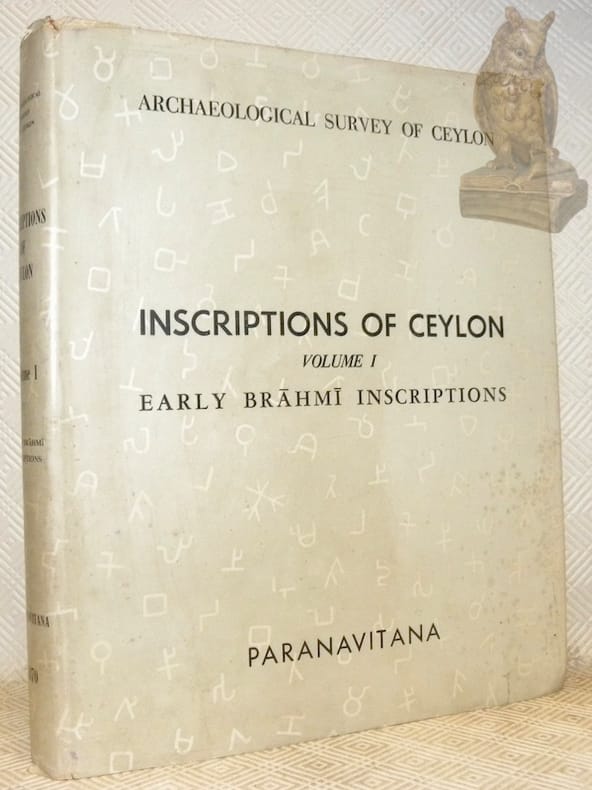
Best.-Nr. 119411Ceylon, Department of Archaeology 1970, 310x260mm, CXXIX - 136pages, editor's binding with jacket. Small tears on the dust jacket with small stains and the name and stamp of previous owners on the top of the upper flyleaf and on the title page, otherwise clean inside. Book in good condition.
1991Mm 170x240 "Collection de l'Ecole Française de Rome, 143". Brossura editoriale con bandelle, x-760 pagine con figure in nero comprese nel testo. Atti del convegno internazionale di Roma, 27-28 maggio 1988. Copia in perfette condizioni di nuovo. SPEDIZIONE IN 24 ORE DALLA CONFERMA DELL'ORDINE.
Best.-Nr. 601349Excavations of the Czech Institute of Egyptology. 2001. In-4, cartonnage de l'éd. sous jaquette ill. en coul., 211 pp., fig. in text, LXXXIX pl. en noir et en coul., index. Texte en anglais.
Best.-Nr. 600880Le Caire, IFAO, 2010. In-4, cartonnage éd. illus., XXII- 298 pp., nbses pl. paléogr.
1982bross. edit. con titoli a due colori. pp. 486 (2), lieve scoloritura da sole e minime tracce d'uso in cop.
1894Fascicolo in folio, brossura muta, estratto di 42 pp., contenente la "memoria" del Socio Corrispondente Elia Lattes, approvata nell'adunanza del 22 aprile 1894: "nessuna parte delle Fasce monumentali più di quella che prendo qui a studiare minutamente, mi sembra adatta a mostrarne la struttura grammaticale e a servire d'introduzione all'indice morfologico e fonetico che dell'intero testo, e, per occasione di questo, delle altre iscrizioni etrusche, si viene preparando.". Molto interessante ed ovviamente molto raro a reperirsi. Lievissima brunitura della carta, ottimo stato, intonso.
1914in-8 gr., pp. 215, bross. edit. Prima rara ediz. di opera che raccoglie epigrafi, iscrizioni sepolcrali e monumentali, composte dall'A. per varie occasioni ma molte dedicate al Risorgimento italiano, di soggetto storico o patriottico (anche Martiri di Belfiore, Giovanni Arrivabene, caduti di Libia, etc...). Si allega la locandina della casa editrice di promozione dell'opera, al cui verso compare una lunga nota manoscritta di anonimo e di argomento giuridico. Ottimo esempl. [158]
Best.-Nr. 152765Leiden (Lugduno Batavorum), Apud S. et J. Luchtmans, 1840.
Best.-Nr. 20998Lyon, Maison de l'Orient, 1986, grand et fort in 8° broché, 663 pages ; illustrations.
1983xvii + 218pp.+ 47 plates out of text, hardcover (publisher's green cloth), 25cm., in the series "Orientalia Lovaniensia Analecta" volume 11, fine condition (as new), text in French (texte en français), ISBN 978-90-70192-08-2, C80284
Best.-Nr. 601345P. Paul Geuthner, 1951. In-4 br., en partie non coupé, XIV-192 pp., nbr. fig., cartes et plans en noir in-t., XLVIII pl. d'ill. phot. en noir h.-t. in-fine, index.
1996Light knock near upper back corner else Fine/Fine. ; Dumbarton Oaks Studies XXXIV; 456 pages; For almost three centuries, scholars have debated the credibility of the information provided in the colophon of Codex Parisinus graecus 1115. According to this inscription, the manuscript was copied in the year 1276 from another manuscript dating back to the year 774/5; the archetype originated in the papal library at Rome and contains a partial record of the Greek holdings of the library. The majority of the texts included in the manuscript come from florilegia related to the ecumenical councils. This volume examines the use of florilegia—anthologies of earlier writings—by these councils. Analysis of the contents of the manuscript provides new information concerning, among other things, the beginning of the Filioque controversy and the use of Iconophile florilegia by the seventh ecumenical council in 787. Also revealed is the archetype's role in the negotiations between Rome and Constantinople that led to the Union of the Churches, proclaimed at the Council of Lyons II in 1274, and the indirect involvement of Thomas Aquinas through his Contra Errores Graecorurn.
1979Very light dust-soiling to top of textblock. ; Unchanged reprint of 1903 edition. ; Vol. 3; 278 pages
1976Book has minor shelfwear and scuffing. ; Systematic publication of ostraka. ; American Studies in Papyrology Volume Fifteen
1984Foxing/dustsoiling to top of textblock. Scholar's bookplate to inner cover (G. P. Goold). ; Toronto Medieval Bibliographies 8; 399 pages
1964Scholar's bookplate to inner cover (G. P. Goold). Faint dustsoiling else fine. ; Reprint of 1900 edition. ; Burt Franklin Research & Source Works Series 62; 234 pages
1964Scholar's bookplate to inner cover (G. P. Goold). Spine a bit sunned. ; 364 pages
2021New English Original bdg. HC. 4to. (29 x 22 cm). In English. 195 p., color and b/w plates. Roman archaeology in a South Anatolian landscape: The Via Sebaste, the Mansio in the Döseme Bogazi, and regional transhumance in Pamphylia and Pisidia. An investigation of a Roman road-station in its archaeological and geographical context that provides a new perspective on the historical landscape of southern Anatolia. This study is based on fieldwork carried out during the 1990s in southwest Turkey in the modern vilayets of Burdur and Antalya, and it focuses on the settlements associated with a Roman mansio located in the Döseme Bogazi, the pass that linked Pisidia with the coastal region of Pamphylia. The course of the road and the structures that emerged along it were defined not by the evolution of Pisidia's Hellenized indigenous culture but by the priorities of Roman rule, especially during late antiquity. Furthermore, the study of the road where the mansio was located raises fundamental questions about the role played by this mountain pass in the movement of people and animals between the lowlands and highlands of South-west Anatolia.
1961Light bump to top of book. Minor shelfwear to book. DJ has a few small tears and chipping along top edge. DJ has some foxing. ; Collection of inscriptions important for Mycenaean studies. Commentary is in Latin. ; Incunabula Graeca Vol. 1; 204 pages
1961Dustjacket is protected in mylar. Light edgewear along top edge of DJ. Ffep has wear along inner hinge exposing two small holes (does not extend into text). ; Collection of inscriptions important for Mycenaean studies. Commentary is in Latin. ; Incunabula Graeca Vol. 1; 204 pages
1982Examines the papal epitaphs covering the period betwen Martin V (d. 1431) and Paul III (d. 1549); Suomalaisen Tiedeakatemian Toimituksia : Sarja-Ser. B ; Nide-Tom. 222; 143 pages
1971Ex-library copy with usual stamps, call numbers and pocket. Top corner is bumped. Minor shelfwear. ; Introduction and indices by Shin Theke Kang. Contains six hundred and twenty-seven economic texts from the Drehem archive dating to the time of the Third Dynasty of Ur. Presents many additional materials for the study of the chronology, onomasticon, geography, religion, culture, and economic and social structure of the Ur III period. ; Babylonian Inscriptions in the Collection of James B. Nies; 0.77 x 11.78 x 8.78 Inches; 192 pages
2000Small blindstamp to titlepage (ex-institution). No other ex-library markings. Else fine. ; Caesarea Maritima, a port town on the Mediterranean coast about 40km north of modern Tel Aviv, was founded by King Herod theGreat sometime shortly after 22 BC and flourished as a major urban centre during the first six centuries C. E. The 411 inscriptions included in this volume represent the finds of a quarter of a century of investigation at the site and bear crucial testimony to the civil and military organization, urban construction, religion and funerary practices of an important Roman and Byzantine provincial centre. In addition, the language of the Greek and Latin inscriptions provides important insights into the evolution of those languages as well as information on the demographic, ethnic and social make-up of the population of Caesarea Maritima in the Roman and Late Antique Periods.; American Schools of Oriental Research; 11.4 X 8.7 X 1.5 inches; 301 pages
2020New Turkish Paperback. Roy. 8vo. (24 x 16 cm). In Turkish. 308 p., ills. Arkaik dönem Kilikia pismis toprak figürinleri Kilikia Kibris ve Ionia iliskileri.
2000Light shelfwear to book. Dustjacket has minor shelfwear and rubbing. ; Sandpiper Reprint of 1972 edition. ; The Lyell lectures; 361 pages; The central argument of Stanley Morison's work is that the development of script (inscriptional, calligraphic or typographical) has been the result of changes in religious or political environment, of friction between church and state, and of the schism between Eastern and Western Christendom. Morison begins with an example of alphabetic forms on a 6th century BC gravestone from Melos and proceeds through commentary on a notable collection of more than 180 illustrated specimens, to trace the career of the Graeco-Roman alphabet up to its use in newspaper typefaces of the 1950s. He also seeks to show that the most widely used printers' typefaces of the twentieth century owe more to their Greek than to their Roman antecedents.


