Antiquariat.de

122 resultados
1788ref. 97191CB[London?], 1788. 1 Blatt: 53,5 x 75,2 cm. [2 Warenabbildungen]
1823ref. 11828L. G. Michaud 1823 458 pages in8. 1823. reliure editeur plein veau dos orné. 458 pages.
1937ref. 98431937 London, Jonathan Cape, 1937, In huit, 318 pp, reliure toilée d'éditeur, bleu nuit, auteur et titre dorés sur dos lisse, tête bleutée, qqs rousseurs,
177816mo., First Edition, on laid paper; attractively bound in twentieth century grey boards, paper label lettered and ruled in black on upper board, small marginal chip in D4 (not affecting text), a remarkably bright, fresh, clean copy. Most attractive copy of a none-too-subtle satire on the supposed power of the Scots in the English establishment and society. The barb was evidently a popular one, for it reissued in the same year with a third printing in 1780. Rare.
19308vo., First Edition, on laid paper, with a portrait frontispiece (original tissue guard present); original red cloth, gilt back, uncut, top a little dust-soiled else a very good, bright, clean copy. Uncommon in this condition
19548vo., Second Impression, some moderate offsetting from fold-ins to free endpapers, neat contemporary signature on front free endpaper; blue cloth, gilt back, a bright, clean copy in unclipped dustwrapper, the latter browned at backstrip and extremities. Published a year after the first edition.
19988vo., First Edition, with plates; black cloth, pictorial endpapers, a fine copy in unclipped dustwrapper.
19578vo., First Edition, small neat signature on front free endpaper; green cloth, gilt back, a very good, bright copy in unclipped dustwrapper.
1935Biography of George IV, with eight illustrations. 301 pages. Index. ex-libris label on front pastedown, two creases on front free endpaper, spine faded and browned, covers faded in parts, particularly on back cover, light foxing to page edges.
198615 illustrations. 219 pages. Maroon cloth covers. Rubbing to surface of dust jacket. Dust jacket price clipped.
1776160 p. 16mo. Original full leather binding. With a contemporary (American?) printed label: "WILLIAM NICHOLS Requests any person who may borrow this Book, to return it as soon as possible." With Nichols' manuscript ownership and additional manuscript presentations of Dr. L. Armstrong. Mark Akenside was a famed English poet and physician. His chief literary work was the didactic poem The Pleasures of Imagination (1744). Among his other works are the neoclassical Odes on Various Subjects (1745) and the Epistle to Curio (1744), a vigorous political satire. Akenside's conversion to Tory principles at the accession of George III earned him the appointment of Physician to the Queen. The early ownerships and label are especially interesting. JUN2A/W140 RtStk
1969304 p. illus. (part col.), facsims., map, ports. (part col.) 26 cm. Hardcover Very good condition good
1767ref. 751631767. London: Printed by Mark & Robert Baskett 1767. London: Printed by Mark & Robert Baskett 1767. Regulation in Response to the "Turnpike Boom" Highways. Great Britain. George III 1738-1820 King of Great Britain. Anno Regni Georgii III Regis Magnae Britanniae Franciae & Hiberniae Septimo. At the Parliament Begun and Holden at Westminster The Nineteenth Day of May Anno Domini 1761 In the First Year of the Reign of Our Sovereign Lord George the Third By the Grace of God Of Great Britain France And Ireland King Defender of the Faith &c. And from thence Continued by Several Prorogations to the Eleventh Day of November 1766 Being the Sixth Session of the Twelfth Parliament of Great Britain. London: Printed by Mark Baskett and by the assigns of Robert Baskett 1767. ii 5-125 1 62 pp. Octavo 7" x 4-1/2". Contemporary calf blind rules to boards blind fillets along joints raised bands blind fillets and lettering piece to spine blind tooling to board edges. Light rubbing and a few very minor nicks and scratches to boards moderate rubbing to extremities front joint just starting at head corners bumped and lightly worn hinges starting early ink annotation to rear pastedown. Light toning negligible light foxing to a few pages internally clean. $750. Two acts of Parliament consolidating and regulating turnpike trusts in the wake of the "turnpike boom" of the late eighteenth century. Turnpike trusts established by individual acts of Parliament had the power to collect tolls that would be used for road maintenance. Before the widespread use of these trusts local parishes were responsible for raising revenue via taxation and repairing highways and often found the task difficult. The first act the Turnpike Act of 1766 established basic rules for drivers and provided for the erection of milestones to indicate the distance between towns. The second act the Highways Act 1766 expanded on provisions and standards for road repair. The volume includes a thorough 62 pp. index to both acts. The ESTC lists a 64 pp. index and an additional act from 1768. Our 62 pp. index appears complete and we have seen another copy without this additional act. As in the ESTC record our copy lacks leaf A1 which may have been blank or unissued. OCLC and the ESTC locate 2 copies of this title British Library Cardiff University. See English Short-Title Catalogue ESTC T2259. unknown books
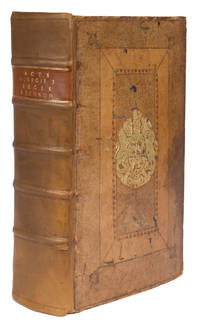
1761ref. 729481761. Public and Private Acts of Parliament 1761-1762 Great Britain. George III 1738-1820 King of Great Britain. Anno Regni Georgii III. Regis Magnae Britanniae Franciae & Hiberniae Secundo. At the Parliament Begun and Holden at Westminster The Ninth Day of May Anno Dom. 1761 In the First Year of the Reign of our Sovereign Lord George the Third By the Grace of God of Great Britain France and Ireland King Defender of the Faith &c. And from thence Continued by Several Prorogations to the Third Day of November Following; Being the First Session of the Twelfth Parliament of Great Britain. London: Printed by Mark Baskett 1761 i.e. 1762. 670 681-786 805-1026 16 pp. Lacking Acts XVIII and XXII and general title page of Act II. Same general title page preceding each act Acts VII-XXXVII dated 1762. Bound With An Abstract of the Publick Acts Passed in the First Session of the Twelfth Parliament of Great Britain And in the Second Year of the Reign of Our Most Gracious Sovereign Lord King George the Third. London: Printed by Mark Baskett 1762. 139 1 pp. With two folding tables. Folio 12" x 7-1/2". Contemporary paneled calf gilt royal arms to boards rebacked and recornered in period style with raised bands blind fillets and lettering piece to spine blind tooling to board edges edges rouged. Light rubbing to boards a few scuffs nicks and scratches moderate rubbing and light wear to board edges corners bumped hinges cracked single horizontal crease to front free endpaper. Light toning to interior light foxing in a few places. An appealing copy. $650. A collection of 86 acts passed in the first session of the tenth Parliament of Great Britain with tables listing the titles of the public acts including acts XXIX-LXXXVII which were not printed and summaries of 69 private acts. Some of the more interesting acts include several acts to do with commercial taxes and "An Act for Naturalizing Such Foreign Protestants as have Served or Shall Serve in His Majesty's Royal American Regiment Or as Engineers in America." Appended is the separately-issued volume of abstracts. Acts XVIII the Longitude Act of 1762 and XXII are lacking in full but present in the abstract volume; the first extended an act establishing a prize for the invention of a successful marine chronometer and th. unknown books
1770ref. 735651770. Includes the First Exception to the Currency Acts Great Britain. George III 1738-1820 King of Great Britain. Anno Regni Georgii III. Regis Magnae Britanniae Franciae & Hiberniae Decimo. At the Parliament Begun and Holden at Westminster the Tenth Day of May Anno Domini 1768 In the Eighth Year of the Reign of our Sovereign Lord George the Third By the Grace of God of Great Britain France and Ireland King Defender of the Faith &c. And From Thence Continued By Several Prorogations To the Ninth Day of January 1770. Being the Third Session of the Thirteenth Parliament of Great Britain. London: Printed by Charles Eyre and William Strahan 1770. 204 217-220 209-668 677-744 753-874 20 pp. Pp. 205-208 3F lacking pp. 217-220 3I repeated due to binder error. Text of Acts XXXIV and XLIV lacking along with general title page to Act X. Same general title page preceding each act Acts LIII-XCIV not printed but listed in table. Folio 12-1/4" x 7-1/2". Contemporary marbled boards rebacked in period-style calf with raised bands blind fillets and lettering piece to spine edges rouged. Light rubbing to boards more moderate rubbing and light wear to board edges corners bumped hinges cracked. Moderate toning to interior light foxing and soiling in a few places. $1000. A collection of 51 acts passed in the second session of the twelfth Parliament of Great Britain with tables listing the titles of the public acts and summaries of 96 private acts. Some of the more interesting acts include several acts regulating trade in America and an act allowing New York to pass an act "for the creating and issuing upon Loan Paper Bills of Credit to a certain Amount; and to make the same a Legal Tender." The right to issue paper money had been heavily restricted by the Currency Acts of 1751 and 1764 but after New York's government argued that these acts hindered full compliance with the Quartering Act Parliament relented and allowed New York to issue paper currency for public but not private debts. This concession was extended to the other colonies in 1773. Acts XXXIV dealing with the attempts to develop a successful marine chronometer and XLIV regulating mercantile fraud and hackney coaches are not present in our volume. English Short-Title Catalogue N57155. unknown books
1779ref. 34022London: Printed for the Editor; and sold by J. Bew 1779. First edition. Pp. iii-57. Lacking half-title. 1 vols. 8vo. Red morocco-backed green cloth spine lettered in gilt. Rubbed some light spotting. Bookplate of John Carter Brown ex-library with stamp on title else very good. First edition. Pp. iii-57. Lacking half-title. 1 vols. 8vo. A satire. Often attributed to Richard Tickell as it imitates the tone of Tickell's "Anticipation" published the year before. Purports to contains speeches made in the Houses responding to the King's speech on the war in America and his need for more monies to pay for it. Adams "American Controversy" 79-3a; Sabin 1685 Printed for the Editor; and sold by J. Bew unknown books
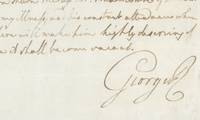
1701ref. 3775117/01/1801. A rare ALS of the King just weeks before yet another episode of his illness King George demonized in the New World for mental incapacity struggled throughout his life. He had experienced a poorly documented illness in 1765 but the episode beginning in 1788 was dramatically more serious. Earlier that year he suffered physical problems including jaundice or gall-duct trouble. After spending time recuperating at Cheltenham his behavior became increasingly abnormal. By October and November after returning to Windsor he was unmistakably suffering from a major psychiatric episode. Contemporary observers described a striking cluster of symptoms: extreme agitation extraordinarily rapid and incessant speech sleeplessness racing thoughts emotional volatility inappropriate familiarity delusions and at times violent or uncontrollable behavior. Treatments were typical of eighteenth-century medicine and could be brutal. The King was subjected to bloodletting blistering purgatives and emetics; some medicines contained substances such as antimony that could themselves produce serious side effects. In the interim he was unable to properly rule. This was a major English constitutional crisis with domestic issues playing out while a potential regency was being mapped out. What would they do with a living but ""mad"" King Parliament spent the winter of 1788–89 wrestling with the extraordinary question of how to create a regency when the monarch was alive but incapable of giving royal assent to the legislation establishing it. And then George recovered. By February 1789 his physicians were increasingly confident. On February 26 the medical bulletin announced the ""entire cessation of His Majesty's illness."" It was this illness that gave credence to the name ""mad King George."" Among the men at his bedside in 1788-9 was apothecary Robert Battiscombe. He had been treating members of the royal household since about 1780 and personally attended George during the King's famous 1788–89 episode of mental illness including cupping him applying and dressing blisters bleeding him and sitting regular watches over him. His surviving memorandum book records those encounters. In early 1801 the King's longtime apothecary John Devaynes died. For a time he wanted another apothecary Everard Augustus Brande to fill the role. He was a first-generation Englishman. But ultimately he wanted to reward Battiscombe. The Marquess of Salisbury is James Cecil 1st Marquess of Salisbury. He was a senior courtier and politician under George III and served as Lord Chamberlain of the Household from 1783 to 1804. Autograph letter signed January 17 1801 Queen's House to Salisbury. ""I am sensible of the Marquess of Salisbury's Attention in having immediately acquainted Me of the death of Mr Desvaines one of my Apothecaries. I as well as every one of my Predecessors have employed constantly Mr. Brande's Shop. I desire therefore that Mr. Brande Junior who is an Englishman may be appointed to succeed Mr. Desvaines. The other Apothecary is now an Old Man his employment less lucrative. The attention shewn me by Mr. Battiscombe of Windsor during my illness and his constant attendance when I am there will make him highly deserving of it when it shall it become vacant."" George suffered a serious recurrence of his mental illness in February 1801 less than a month after this letter was written. Beginning around February 12–13 the King became increasingly agitated talkative sleepless and eventually delirious at one point reportedly praying that God would either let him die or spare his reason. The attack coincided with an intense political crisis over Catholic emancipation: George believed granting political rights to Catholics would violate his Coronation Oath and the dispute contributed to William Pitt's resignation; George himself later blamed Pitt for having caused his illness. By February 22 the King was considered incapable of properly exercising his royal functions and members of the Willis family who had treated him during his famous 1788–89 breakdown were again summoned. Unlike that earlier crisis however the 1801 episode was comparatively brief and George had substantially recovered by early March. Battiscombe would in 1805 become apothecary of Windsor to the royal household. He stayed in that role for decades — he's the apothecary of Windsor recorded as handling the king's post-mortem preparations in 1820. <img class=""alignnone wp-image-25018 size-post-window"" src=""https://cdn.raabcollection.com/wp-content/uploads/20231204144051/Folder-site-11-1600x1327.jpg"" alt=""historical memorabilia dealer"" width=""1600"" height=""1327"" /> unknown books
1990ref. 2328013Dayton Nevada: Tree By the River Publishing 1990. Signed Copy. Soft Cover. Very Good. 6x0x9. Signed by author. Signed by author on title page without inscription. Minor wear to corners. 1990 Soft Cover. 197 pp. Though Americans usually associate Mark Twain with Tom Sawyer and the Mississippi River Samuel Clemens actually began his serious writing careers as a reporter for the Territorial Enterprise at Virginia City Nevada in 1862. Contrary to Clemens' well told story about his curious pen name "Mark Twain" had nothing to do with his life on the river and more to do with his drinking habits while in Virginia City. Having lost his high paying job as a river boat pilot on the Mississippi due to the outbreak of the Civil War in 1861 Clemens tags along with his brother Orion to Nevada Territory. For a year Clemens prospects at several mining camps trying to strike it rich. He fails and goes broke at Aurora Nevada. Having contributed a series of humorous letters to the Enterprise editor Joe Goodman offers Clemens a reporting post in the then booming silver mining town of Virginia City. It is Clemens' first full time paying writing job. Four months later Clemens is writing as Mark Twain.--rear cover Tree By the River Publishing paperback books
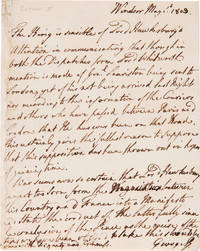
1803ref. 56968Windsor. May 12 1803. King George III Admits War with Napoleon "seems now so certain" A royal letter of profound import written entirely in the hand of King George III and signed "George R." Here the British King writes hastily to Lord Hawkesbury his Secretary of State outlining the lack of recent communications from his emissaries in Paris who were conducting peacetime negotiations with Napoleon after the failure of the Treaty of Amiens the year before. King George III mentions receiving dispatches from Lord Whitworth who was serving as the King's ambassador to France at the time; interestingly it was Whitworth to whom Napoleon threatened war if Great Britain did not evacuate Malta just a few months earlier in February 1803. Whitworth himself evacuated France the day after the present letter was written in full knowledge that peace negotiations were over. The King also relates the failure of French General Jacques Lauriston to arrive in London presumably for last-minute peace talks to prevent conflict. The King states that Lauriston's activities were likely intended to buy time for French negotiators. King George III then writes portentously beginning the second and final paragraph: "War seems now so certain that Lord Hawkesbury cannot too soon form the negotiations between this country and France into a Manifesto and state the conduct of the latter fully since the conclusion of the Peace as the cause of the steps we have been obliged to take." In other words the King is ordering his Secretary of State Lord Hawkesbury to state Great Britain's case for war with France. This is very likely the first admission by the King himself of the reality of impending war with France. Six days after the present letter was written Great Britain declared war on France sparking the long series of armed conflicts known as the Napoleonic Wars which would culminate a dozen years later at the Battle of Waterloo. Important letters signed by King George III are rarely offered in the market. Rarer still are letters composed entirely in his hand and signed by him as in the present example. Cheffin's Auctions in England sold a follow-up to the present letter also to Lord Hawkesbury and dated two days later on May 14 for £11430 in January 2019. That letter was bought for £55 in 1966. By comparison the present earlier letter was bought by H. Richard Dietrich for $92 at Parke Bernet's Fitzgerald sale on November 6 1963. It has remained part of the Dietrich American Foundation collection since then. A momentous political and diplomatic communication from the King of England to his Secretary of State resigned to the fact that war with Napoleon is at hand. 1p. on an 8¾ x 6¾-inch sheet. Left margin reinforced with thicker paper old folds. Mostly minor losses along left margin just touching first letters of several words. Very good. unknown books
1808ref. 6591London: George Eyre and Andrew Strahan 1808. Unbound. Good. 1 leaf. Extracted from Acts of Parliament 48th George III chapter 23. Trade protections for Great Britain from competitive goods made in Canada and the Caribbean. George Eyre and Andrew Strahan unknown books
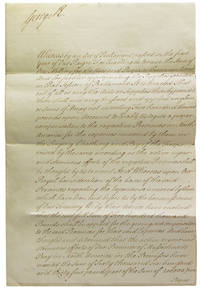
1761ref. 319882Great Britain 1761. 2pp. plus integral blank. Docketed on verso "King's Warrant / Province of Massachusetts / Bay £60634 in part / of £200000 Granted for / the North American / Provinces." Signed by George III at the head of the first page countersigned on the second page by William Wildman Barrington James Oswald and Gilbert Elliot. Folio 14 1/4 x 9 1/2 inches. Usual folds. 2pp. plus integral blank. Docketed on verso "King's Warrant / Province of Massachusetts / Bay £60634 in part / of £200000 Granted for / the North American / Provinces." Signed by George III at the head of the first page countersigned on the second page by William Wildman Barrington James Oswald and Gilbert Elliot. Folio 14 1/4 x 9 1/2 inches. Towards the end of the French and Indian War William Pitt started a specie grant program to reward colonies for raising troops thus putting the colonies in competition with each other for a share of an annual 200000 pounds. With specie scarce in the colonies the colonial assemblies were thus incentivized to raise troops to fight against the French. The present document authorizes Henry Fox to make payment to Massachusetts via their colonial agent William Bollan for their share of the annual grant. Although successful the policy was abandoned in favor of direct taxation after 1762 leading to the Sugar Act and most notably the Stamp Act. This undated document -- the space for the date being left blank suggesting it to possibly be a draft -- is countersigned by William Wildman Barrington Chancellor of the Exchequer 21 March 1761 to 8 May 1762; Sir Gilbert Elliot third Baron Minto Lord of the Treasury 1761-62 and James Oswald Commissioner of the Treasury 1759-63. The date would therefore appear to be 1761 or early in 1762. George III documents relating to North America from the early years of his reign are particularly scarce. unknown books
1968ref. 292031New York: Funk & Wagnalls 1968. hardcover. Ed. by Bonamy Dobree. Frontis. 8vo 1/2 black cloth d.w. New York: Funk & Wagnalls 1968. Near Fine Funk & Wagnalls unknown books
1820ref. 10251820. Mezzotint frontis. port. of George III a little foxed arms on each title & two engraved views of the library serving as head- & tailpieces. Five vols. Large folio cont. red straight-grained morocco minor scuffing panelled & tooled in gilt with centerpiece stamped monogram "GR" surmounted by a crown on covers spines gilt dentelles gilt a.e.g. London: W. Bulmer & W. Nicol 1820-29. The catalogue "sumptuously printed" by Bulmer of the magnificent library of King George III 1738-1820 donated to the nation by his son George IV. This is a royal copy having belonged to Ernest Augustus Duke of Cumberland and the fifth son of George III who became King of Hanover in 1837. It is superbly bound in red straight-grained morocco and printed on paper superior to other sets. "The kings of England had from the end of the fifteenth century always shown a certain taste for fine books especially for the handsomer volumes of their own day.A new library was started in 1765 by King George III when he purchased for 10000 pounds the valuable collection of incunabula with a few manuscripts brought together by Joseph Smith 1682-1770 the British Consul at Venice. "George III continued adding to his library for nearly fifty years buying with considerable discrimination at all the notable sales of the period; he secured the best books at the West Ratcliffe and Askew auctions built up a magnificent collection of English plays and kept on right up to the Roxburghe sale 1812. His usual agents were Messrs Nicol the booksellers but he seems to have obtained from the Continent some extremely valuable incunabula by the assistance of one Horn of Ratisbon a great despoiler of the German convents. "There is a sumptuously printed but hastily compiled catalogue of which copies are seldom met with."-De Ricci pp. 55-56. "As a boy George III had received an excellent education. He learned Latin well enough to be able to read the classics; French and German; history geography and the British political system; mathematics and elementary science; art architecture and music. After he left the schoolroom he continued his education under the Earl of Bute an inspiring if somewhat pedantic tutor.Under his tuition the King developed wide cultural interests a reverence for scholarship and the instinct of a collector. "The King's aim was.to acquire a library which contained every book which an eighteenth-century scholar could desire. It was a library to be used not simply to be admired.It was as far as it could be in the eighteenth century a universal library.It is rich in library catalogues. In addition to the catalogues of British libraries there are catalogues from France Italy Spain Portugal Germany Belgium Switzerland Sweden Poland and Russia. There are over five hundred sale catalogues most British and most with the prices marked. "It was the King's wish that a catalogue should be published but he postponed this as long as possible. When it became clear after 1812 that the King would never recover Queen Charlotte and the Prince Regent urged the preparation of a catalogue. It was compiled by Barnard and published between 1820 and 1829 in five folio volumes.It was never offered for sale but copies were presented to heads of state and the great libraries in the United Kingdom and on the Continent. It is today an extremely rare book."John Brooke "The Library of King George III" in The Yale University Library Gazette Vol. 52 No. 1 July 1977 pp. 33-45. "Frederick Barnard had begun the catalogue of the books and manuscripts of the King's Library while it was at Buckingham House. The catalogue was completed.by Barnard and his staff for the Trustees of the British Museum and printed in five volumes between 1820 and 1829.Very few copies were printed none for sale and they are now very rare."-Paintin The King's Library p. 22. This copy lacks the engraved frontispiece portrait of Bernard. A sixth volume issued separately in 1829 and not present here describes the maps prints and drawings. A magnificent set. From the library of Prince Ernest Augustus Duke of Cumberland and the subsequent Kings of Hanover. Miller That Noble Cabinet p. 125"one of the finest libraries ever created by one man.By the time of the King's death the collection amounted to 65250 volumes besides 19000 unbound tracts. unknown books
ref. 503685May 25 1801. Appointment of "Peter Ogier Gentleman as Clerk in the Office of Our Secretary." Signed by 3 officials and a witness November 24 1801. Printed document completed in a secretarial hand. Full vellum 16" x 15" with 2 blue wax seals and hand-colored portrait of George III folds and slight stains. Rare with seals. 22" x 20". Signed by Authors. F. Soft cover. hardcover books
ref. BN495130Cross Cult. Softcover. Star Trek - The Fall 1: Erkenntnisse aus Ruinen Star Trek - The Fall 1: Erkenntnisse aus Ruinen George III David R. Cross Cult paperback