3954 resultados
ref. 235705Paris, Debure l'aîné, 1759 in-12, xiv pp., 596 pp., [2] ff. n. ch. de privilège, veau fauve marbré, dos à nerfs cloisonné et fleuronné, simple filet doré sur les coupes, tranches rouges (reliure de l'époque). Bon exemplaire.
ref. 236991Paris, Rouff, 1881-1883 10 vol. in-12, fac-similé replié aux tomes 1, 7 et 8, portrait-frontispice au tome 10, demi-chagrin brun, dos à nerfs orné de caissons dorés (rel. de l'époque). Petites usures à certaines coiffes, ressauts de quelques cahiers, qqs rousseurs
ref. 22633Laboratoires Carnine Lefrancq, Romainville, 1910, 1911, 1912, 1914, 1920.
ref. 244272Paris, Marchant, 1840 4 vol. in-8, demi-veau blond, dos à faux nerfs, filets dorés et à froid (reliure de l'époque). Petit accroc en tête des tomes 2 et 3, dos un peu frotté.
ref. 214819Paris, Perrin et Clavreuil, 1908-1964 5 vol. gr. in-8, index, broché. Couv. muette au tome 1 (une partie de la couverture a été contrecollée sur le premier plat). Qss soulignures crayon.
ref. 13577Spécial Police n° 40 / Fleuve Noir (1953) - Edition originale - In-12 broché de 224 pages - Très belle couverture en couleurs de Michel Gourdon - Très bon état
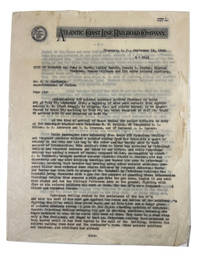
1944ref. 929931944. Good. Letter dated September 13 1946. 28 cm. Carbon copy on thin Atlantic Coast Line Railroad Company letterhead stationery. Substantial chipping around edges no loss of text on first leaf. Our unnamed Captain of Police reports on an incident which began when around 200 African American soldiers were changing trains. Local police arrested two of the soldiers for intoxication and took them to the local Police Station. When police returned to the railroad station they found six of the soldiers assaulting two military policemen and intervened to help the MPs using the butt end of a riot gun to break up the fight. When a large number of other soldiers came to join the fight they were stopped at gunpoint by the local policemen with assistance from the MPs and military officers. The African American soldiers marched in formation to local Police Headquarters where 133 soldiers were charged with disorderly conduct and five others differently charged. Almost all pleaded not guilty but all were found guilty the next day and remained in jail another night until their fines were paid -- $17 each for the 133 soldiers and up to $100 for the five who were differently charged. All 138 soldiers were then marched back the the train station and departed. One wonders how accurately the incident was described to our unnamed Captain by those he interviewed. There is nothing in his letter to suggest that he interviewed any of the African American soldiers. unknown
1944ref. 929931944. Good. Letter dated September 13 1946. 28 cm. Carbon copy on thin Atlantic Coast Line Railroad Company letterhead stationery. Substantial chipping around edges no loss of text on first leaf. Our unnamed Captain of Police reports on an incident which began when around 200 African American soldiers were changing trains. Local police arrested two of the soldiers for intoxication and took them to the local Police Station. When police returned to the railroad station they found six of the soldiers assaulting two military policemen and intervened to help the MPs using the butt end of a riot gun to break up the fight. When a large number of other soldiers came to join the fight they were stopped at gunpoint by the local policemen with assistance from the MPs and military officers. The African American soldiers marched in formation to local Police Headquarters where 133 soldiers were charged with disorderly conduct and five others differently charged. Almost all pleaded not guilty but all were found guilty the next day and remained in jail another night until their fines were paid -- $17 each for the 133 soldiers and up to $100 for the five who were differently charged. All 138 soldiers were then marched back the the train station and departed. One wonders how accurately the incident was described to our unnamed Captain by those he interviewed. There is nothing in his letter to suggest that he interviewed any of the African American soldiers. unknown books
ref. 2080202105000122Oita Police N.A. Soft Cover. Fine. Number of pages: 1130p Size: 22cm Number of books: 2 Oita Police paperback
2008ref. 2091502135703916Nobuyama-sha 2008. Soft Cover. Fine. The book is in fine condition. Nobuyama-sha paperback
1925ref. 2111902160603793Not Available 1925. Soft Cover. Fine. The book is in fine condition. Not Available paperback
1959ref. 2080402107100363Not Available 1959. Soft Cover. Fine. The book is in fine condition. Not Available paperback
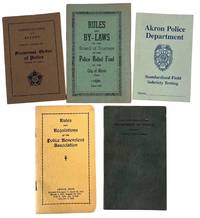
1924ref. 237811924. Akron police pocket manuals from c. 1924 documenting how officers in a major industrial city were governed by departmental rules while developing their own institutions for benefits fraternity and ultimately labor representation. The group centers on four closely related Akron institutions: the Police Department Police Relief Fund Police Benevolent Association and Akron Lodge No. 7 of the Fraternal Order of Police. The Police Benevolent Association rule book provides for membership of department personnel and a benefit fund while the FOP constitution records membership in an organization founded nationally in 1915 to organize policemen around working conditions and grievances and whose Akron lodge later became the collective bargaining representative for city officers. Five pocket booklets approximately 4 x 6 inches each Akron Ohio 1924 to twentieth century. 1 "General Rules and Regulations for the Government of the Police Department of the City of Akron." Akron 1924. Adopted July 1 1924 the manual was issued as city property and required officers to carry and know its contents. Beyond regulations for conduct and discipline it supplies a working criminal law catechism defining offenses including riot robbery arson adultery fornication and abortion and fixes grand larceny at $35. Departmental rules address officers' use of liquor cards and billiards entry into premises suspected of selling intoxicating liquor indebtedness disclosure of department affairs loss of a shield failure to discover crimes committed on an officer's post and the instruction that "Roughness shall not be tolerated." 2 "Rules and By Laws of the Board of Trustees of the Police Relief Fund." Akron July 1937. Rules governing the city's institutional benefit structure for police officers; Howard E. Turner appears as Secretary of its Board of Trustees. 3 "Rules and Regulations of the Police Benevolent Association." Akron revised through January 3 1938 with officers and membership roster for 1939. Defining itself as a "Social Benevolent and Fraternal Society of Policemen" the association provides for enrollment of department members a five dollar admission fee taken from the first paycheck and a benefit fund. Its approximately 225 name roster records the department's personnel including Howard E. Turner as Vice President and likely Paul Emmons marked "Retired" permitting the personnel represented here to be traced across the related organizations. 4 "Constitution and By Laws Akron Lodge No. 7 Fraternal Order of Police." Akron c. 1929. Constitution of the local FOP lodge with membership certificate with ownership inscription by Paul Emmons. The copy documents individual participation in the fraternal structure of an organization created nationally around police working conditions and grievances and later exercising formal collective bargaining rights in Akron. 5 Akron Police Department. "Standardized Field Sobriety Testing." Akron undated likely 2000s. Pocket field manual for qualifying someone's intoxication level. The 1924 regulations were issued as Akron's rubber industry had transformed the city's population and municipal institutions while Prohibition made liquor vice officer conduct and enforcement recurring questions of local government. Akron and Summit County were also centers of Ku Klux Klan political strength during the early 1920s placing the manual's rules concerning liquor public order riots and officer conduct within a particularly contested municipal environment; nothing in the material establishes Klan affiliation for the officers or officials named. More directly documented across the group is the development of police self organization: departmental employees participated in a benevolent association and municipal relief structure in the 1930s while Akron Lodge No. 7 belonged to the FOP tradition that began as fraternal organization around police working conditions and later acquired formal collective bargaining authority. The repeated names across the Relief Fund Benevolent Association and FOP material preserve these structures at the level of individual officers rather than administrative abstraction. Light to moderate rubbing and toning. Loose pages in the "Fraternal Order" booklet but remains complete; Overall good condition. unknown
1924ref. 237811924. Akron police pocket manuals from c. 1924 documenting how officers in a major industrial city were governed by departmental rules while developing their own institutions for benefits fraternity and ultimately labor representation. The group centers on four closely related Akron institutions: the Police Department Police Relief Fund Police Benevolent Association and Akron Lodge No. 7 of the Fraternal Order of Police. The Police Benevolent Association rule book provides for membership of department personnel and a benefit fund while the FOP constitution records membership in an organization founded nationally in 1915 to organize policemen around working conditions and grievances and whose Akron lodge later became the collective bargaining representative for city officers. Five pocket booklets approximately 4 x 6 inches each Akron Ohio 1924 to twentieth century. 1 "General Rules and Regulations for the Government of the Police Department of the City of Akron." Akron 1924. Adopted July 1 1924 the manual was issued as city property and required officers to carry and know its contents. Beyond regulations for conduct and discipline it supplies a working criminal law catechism defining offenses including riot robbery arson adultery fornication and abortion and fixes grand larceny at $35. Departmental rules address officers' use of liquor cards and billiards entry into premises suspected of selling intoxicating liquor indebtedness disclosure of department affairs loss of a shield failure to discover crimes committed on an officer's post and the instruction that "Roughness shall not be tolerated." 2 "Rules and By Laws of the Board of Trustees of the Police Relief Fund." Akron July 1937. Rules governing the city's institutional benefit structure for police officers; Howard E. Turner appears as Secretary of its Board of Trustees. 3 "Rules and Regulations of the Police Benevolent Association." Akron revised through January 3 1938 with officers and membership roster for 1939. Defining itself as a "Social Benevolent and Fraternal Society of Policemen" the association provides for enrollment of department members a five dollar admission fee taken from the first paycheck and a benefit fund. Its approximately 225 name roster records the department's personnel including Howard E. Turner as Vice President and likely Paul Emmons marked "Retired" permitting the personnel represented here to be traced across the related organizations. 4 "Constitution and By Laws Akron Lodge No. 7 Fraternal Order of Police." Akron c. 1929. Constitution of the local FOP lodge with membership certificate with ownership inscription by Paul Emmons. The copy documents individual participation in the fraternal structure of an organization created nationally around police working conditions and grievances and later exercising formal collective bargaining rights in Akron. 5 Akron Police Department. "Standardized Field Sobriety Testing." Akron undated likely 2000s. Pocket field manual for qualifying someone's intoxication level. The 1924 regulations were issued as Akron's rubber industry had transformed the city's population and municipal institutions while Prohibition made liquor vice officer conduct and enforcement recurring questions of local government. Akron and Summit County were also centers of Ku Klux Klan political strength during the early 1920s placing the manual's rules concerning liquor public order riots and officer conduct within a particularly contested municipal environment; nothing in the material establishes Klan affiliation for the officers or officials named. More directly documented across the group is the development of police self organization: departmental employees participated in a benevolent association and municipal relief structure in the 1930s while Akron Lodge No. 7 belonged to the FOP tradition that began as fraternal organization around police working conditions and later acquired formal collective bargaining authority. The repeated names across the Relief Fund Benevolent Association and FOP material preserve these structures at the level of individual officers rather than administrative abstraction. Light to moderate rubbing and toning. Loose pages in the "Fraternal Order" booklet but remains complete; Overall good condition. unknown books
ref. Z1-F-023-00874Police Complaints Authority. Used - Acceptable. Used - Acceptable. Sticker on cover. Ships from UK in 48 hours or less usually same day. Your purchase helps support Sri Lankan Children's Charity 'The Rainbow Centre'. Ex-library with wear and barcode page may have been removed. 100% money back guarantee. We are a world class secondhand bookstore based in Hertfordshire United Kingdom and specialize in high quality textbooks across an enormous variety of subjects. We aim to provide a vast range of textbooks rare and collectible books at a great price. Our donations to The Rainbow Centre have helped provide an education and a safe haven to hundreds of children who live in appalling conditions. We provide a 100% money back guarantee and are dedicated to providing our customers with the highest standards of service in the bookselling industry. Police Complaints Authority unknown
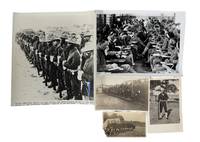
1910ref. 210211910. Archive of five photographs documenting African American military service from the Spanish-American War through World War II preserving visual evidence of Black participation in the United States armed forces across multiple generations of conflict and segregation. The material documents military systems of training deployment labor organization and wartime service through images of Black quartermasters sailors signal corps trainees and infantrymen revealing the varied roles occupied by African American servicemen within the segregated military structure of the United States. The photographs provide primary-source evidence for the study of Black military history racial integration and segregation within armed forces wartime labor divisions and the evolving visibility of African American soldiers from the late nineteenth century through the twentieth century. Archive consists of five silver gelatin photographs ranging in size from approximately 3.75 x 5.5 inches to 8 x 9 inches dating from the 1910s through the 1980s including original photographs real photo postcards and later documentary reprints. One World War I photograph depicts an integrated line of Black and white soldiers standing with cups and mess pans during food service documenting interracial proximity within military camp operations despite broader segregation policies. Another World War I image shows a large group of African American quartermasters posed before a tented encampment while wearing uniforms with insignia caps and holding swagger sticks emphasizing military discipline and organizational identity within support units. A World War II real photo postcard portrays a Black sailor in dress uniform with white cap and necktie posed formally before a training ground where additional servicemen appear in the background. Another mid-century reprint reproduces an image of African American World War I soldiers attending signal corps radio instruction while seated at desks wearing large headsets and making technical notations documenting specialized communications training available to Black troops during the war. The final image reprinted in 1983 for the PBS American Masters documentary The Different Drummer: Blacks in the Military reproduces an 1898 photograph of Black soldiers stationed in Havana Cuba during the Spanish-American War. The troops stand in formation wearing campaign hats and holding rifles upright with several soldiers gazing directly toward the camera. Together the photographs trace the changing but still restricted position of African Americans within the United States military from the era of overseas imperial expansion through the world wars of the twentieth century. Black soldiers served in segregated units for much of this period while simultaneously contributing to military logistics communications naval service and combat operations despite systemic discrimination within the armed forces. The inclusion of later documentary reproductions connected to public television programming further reflects growing efforts during the late twentieth century to recover and interpret African American military history for broader audiences. Some editor's markings on versos. Minor edge wear throughout with one photograph lacking lower left corner. Overall very good condition. Compact but historically substantial visual archive documenting African American military service across multiple major conflicts. unknown
1910ref. 210211910. Archive of five photographs documenting African American military service from the Spanish-American War through World War II preserving visual evidence of Black participation in the United States armed forces across multiple generations of conflict and segregation. The material documents military systems of training deployment labor organization and wartime service through images of Black quartermasters sailors signal corps trainees and infantrymen revealing the varied roles occupied by African American servicemen within the segregated military structure of the United States. The photographs provide primary-source evidence for the study of Black military history racial integration and segregation within armed forces wartime labor divisions and the evolving visibility of African American soldiers from the late nineteenth century through the twentieth century. Archive consists of five silver gelatin photographs ranging in size from approximately 3.75 x 5.5 inches to 8 x 9 inches dating from the 1910s through the 1980s including original photographs real photo postcards and later documentary reprints. One World War I photograph depicts an integrated line of Black and white soldiers standing with cups and mess pans during food service documenting interracial proximity within military camp operations despite broader segregation policies. Another World War I image shows a large group of African American quartermasters posed before a tented encampment while wearing uniforms with insignia caps and holding swagger sticks emphasizing military discipline and organizational identity within support units. A World War II real photo postcard portrays a Black sailor in dress uniform with white cap and necktie posed formally before a training ground where additional servicemen appear in the background. Another mid-century reprint reproduces an image of African American World War I soldiers attending signal corps radio instruction while seated at desks wearing large headsets and making technical notations documenting specialized communications training available to Black troops during the war. The final image reprinted in 1983 for the PBS American Masters documentary The Different Drummer: Blacks in the Military reproduces an 1898 photograph of Black soldiers stationed in Havana Cuba during the Spanish-American War. The troops stand in formation wearing campaign hats and holding rifles upright with several soldiers gazing directly toward the camera. Together the photographs trace the changing but still restricted position of African Americans within the United States military from the era of overseas imperial expansion through the world wars of the twentieth century. Black soldiers served in segregated units for much of this period while simultaneously contributing to military logistics communications naval service and combat operations despite systemic discrimination within the armed forces. The inclusion of later documentary reproductions connected to public television programming further reflects growing efforts during the late twentieth century to recover and interpret African American military history for broader audiences. Some editor's markings on versos. Minor edge wear throughout with one photograph lacking lower left corner. Overall very good condition. Compact but historically substantial visual archive documenting African American military service across multiple major conflicts. unknown books
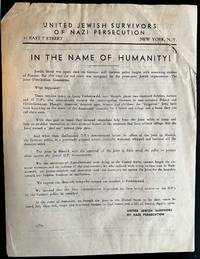
1947ref. 43409New York The Organization No Date 1947. 1st edition. Double-sided English-Yiddish leaflet 2 pages. The Yiddish header translates roughly as "An Announcement To the Jewish Public" Bilingual American Flyer condemning the Joint the American Joint Distribution Committee AJDC for not doing more to help the Jewish DPs and its "hiding" behind the German police when DP's demonstrated for more action on DP resettlement. The issuing organization the United Jewish Survivors of Nazi Persecution/Farband fun Geveyzene Yidishe Katsetler un Partizaner was the first survivor network founded in the US. Their Yiddish name translates as "The Association of Former Jewish Concentration Camp Inmates and Partisans." The word "Katsetler" in their name is a contraction of "kontsentratsyonslager-er" using the letters K and Z "ka" and "tset" and thus short for "kontsetratsyonslager" a concentration camp inmate or survivor sometimes also noted as a "katsetnik." The flyer announces: "Jewish blood was again shed on German soil! German police fought with remaining victims of Nazism. But this time the sad event was instigated by the prominent Jewish organization-The Joint Distribution Committee. What happened There remains today in Camp Foehrenwald near Munich about two thousand helpless forlorn and ill D.P's who miraculously escaped the extermination furnaces in nazi-occupied Poland and Hitler-Germany. Hungry desperate destitute men women and children the 'forgotten' Jews have been knocking at the doors of the democratic countries for a haven and refuge and a home they can call their own. With this goal in mind they demand immediate help from the Joint while in camp and help to establish themselves in their eventual homes in the countries that have offered refuge. But the Joint turned a 'deaf ear' toward their pleas. And when these disillusioned D.P.'s demonstrated before the offices of the Joint in Munich the German police in a previously planned attack critically wounded whipped and battered off the demonstrators. The Joint in Munich with the approval of the Joint in Paris asked the police to protect them against the Jewish D.P. demonstrators. We the survivors of Nazi-Germany now living in the United States cannot forget the extreme torments and the inferno of the nazi-torture; we who suffered with many victims now in Foch- renwald are horror-stricken and dismayed and our hearts cry out against the Joint for the brutality toward our helpless brethern in misfortune. We express our deep-felt sympathy toward our brothers in Foehrenwald. demand that the Joint representatives responsible for these brutal attacks on the D.P.'s by the German police be punished. In the name of humanity we beseech the Jews in the United States to let their voices be heard help these sick tragic and frustrated victims to find homes and a life of human dignity again" From the English side of the flyer. After World War II Munich served as a major center for Jewish Holocaust survivors the "Sh'erit ha-Pletah" who were living in DP camps. The "Joint" was the primary welfare organization providing aid clothing and food to these camps. While the Joint was a vital lifeline its Munich headquarters at Siebertstrasse 3 sometimes became the focal point for frustration regarding the pace of aid distribution or more frequently the slow pace of emigration to Palestine Aliyah and broader often frustrating postwar conditions. Following the 1947 Exodus ship incident where Jewish refugees were returned to Germany by the British Jewish DPs felt trapped and staged intense demonstrations including protests at the offices of international organizations like the Joint to highlight their despair. These demonstrations were part of a broader effort by survivors to assert their agency and demand rights during their time in Munich 1945-1951. For more on tensions between Munich's Jewish DPs and the Joint see www.juedisches-museum-muenchen.de/en/exhibitions/munich-displaced-online/moehlstrasse. Scholar David Slucki notes about the publishers of this leaflet that "Within months of arriving in the United States in 1946 Jewish Holocaust survivors began to organize themselves to help with the process of resettlement. The small band of socialists who established the Farband fun Geveyzene Yidishe Katsetler un Partizaner United Jewish Survivors of Nazi Persecution this group initiated a dual process of identity formation and memorialization of the Holocaust. The first survivor network founded in the United States the Katsetler Farband this group developed a memorial culture that included commemorations and publications replete with its own rituals and calendar. Moreover the organization was part of a broader process of defining what experiences constituted the Holocaust and who was to be considered a survivor. Ultimately they were among a host of survivor networks in the United States to lay the foundation for Holocaust memorialization" Slucki D. 2017. A Community of Suffering: Jewish Holocaust Survivor Networks in Postwar America. Jewish Social Studies 222 116-145. https://muse.jhu.edu/article/649094 We could locate no copies in OCLC-Worldcat Archive Grid nor using a google search. Touch of edgewear one diagonal fold paper generally bright and strong about Very Good- Condition. Holo2-163-28A. New York, The Organization, No Date unknown
1960ref. 2080402107100261Not Available 1960. Soft Cover. Fine. The book is in fine condition. Not Available paperback
1959ref. 2080402107100256Not Available 1959. Soft Cover. Fine. The book is in fine condition. Not Available paperback
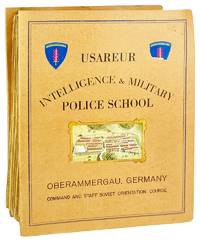
1954ref. 31165Oberammergau Germany: Intelligence and Military Police School 1954. Very Good. Oberammergau Germany: Intelligence and Military Police School 1954. Quarto; stiff illustrated covers with hundreds of pages of reports bound in. Includes charts and graphs of Soviet governmental and military organization. Additional monographs laid in include Armed Forces Talk's four-part Communism Series and three issues of the U.S. Constabulary School's Department of Geopolitics series covering German History up to the rise of the Nazi Party the United Nations and International Relations. Staining to rear cover; pages toned but largely unmarked; a Very Good copy. Binder prepared by the United States Army for training Cold War-era officers and staff on USSR history ideology and military capabilities. The trove of documents here covers nearly everything an early Cold War American military or intelligence officer would need to know at the time: a history of Marxist ideology and its development in the 19th-century; details on the physical geography of the USSR; an ethnography of Central Asia detailing the Turkomen Kazakhs and Tatars; as well as extended analyses on who the power players in the Communist Party were and what the capabilities of their rifle and artillery division might be. Logistics psychological warfare and the role of Communism in the Middle East are also covered with detailed but succinct chapters on each. An impressive array of information highlighting the early Cold War Western perspective. No copies in retail and three holdings found in OCLC at the US Army War College Georgetown University and the University of Iowa. Intelligence and Military Police School unknown
1954ref. 31165Oberammergau Germany: Intelligence and Military Police School 1954. Very Good. Oberammergau Germany: Intelligence and Military Police School 1954. Quarto; stiff illustrated covers with hundreds of pages of reports bound in. Includes charts and graphs of Soviet governmental and military organization. Additional monographs laid in include Armed Forces Talk's four-part Communism Series and three issues of the U.S. Constabulary School's Department of Geopolitics series covering German History up to the rise of the Nazi Party the United Nations and International Relations. Staining to rear cover; pages toned but largely unmarked; a Very Good copy. Binder prepared by the United States Army for training Cold War-era officers and staff on USSR history ideology and military capabilities. The trove of documents here covers nearly everything an early Cold War American military or intelligence officer would need to know at the time: a history of Marxist ideology and its development in the 19th-century; details on the physical geography of the USSR; an ethnography of Central Asia detailing the Turkomen Kazakhs and Tatars; as well as extended analyses on who the power players in the Communist Party were and what the capabilities of their rifle and artillery division might be. Logistics psychological warfare and the role of Communism in the Middle East are also covered with detailed but succinct chapters on each. An impressive array of information highlighting the early Cold War Western perspective. No copies in retail and three holdings found in OCLC at the US Army War College Georgetown University and the University of Iowa. Intelligence and Military Police School unknown books
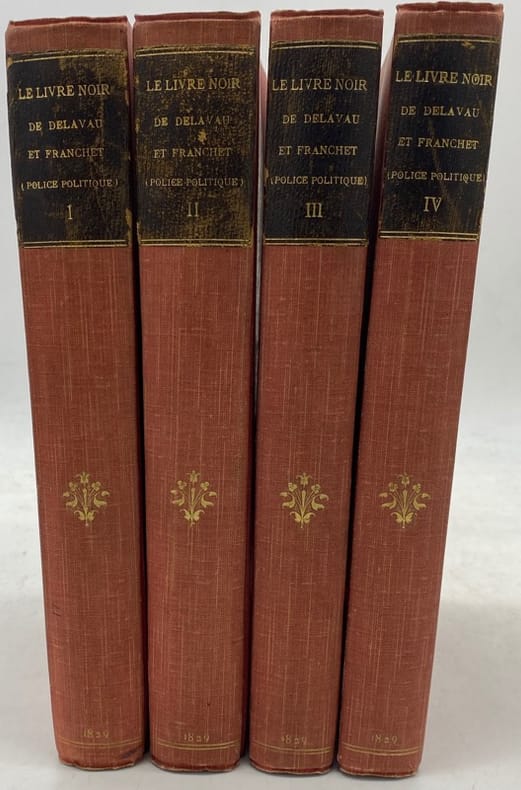
ref. 147935Paris, Moutardier, 1829 4 vol. in-8, bradel demi-percaline rose à coins, dos orné, couv. cons. (reliure postérieure).
1933ref. 016313Paris Vincent Fréal 1933 In-4 En feuilles, portfolio éditeur
ref. 2596Dessin original en noir et blanc, encre de chine et tipp-ex. 1994. Dim: 67 x 83 mm. Signé au dos par l'artiste.