1.015 resultados
1872ref. 712841872. Jealousy Fraud Accusations and Murder: The 1872 Assassination of "Jubilee Jim" Fisk Murder. Stokes Edward S. 1841-1901. Fisk James Jr. 1835-1872. Life Adventures Strange Career And Assassination of Col. James Fisk Jr. The Fisk-Stokes Tragedy. All about Miss Mansfield. Those Rich Rare And Racy Letters and Many Oddities Now for the First Time Made Public. Philadelphia: Published by Barclay & Co. 1872. First and Only Edition. ii 19-111 1 pp. 12 full-page engraved woodcuts. Complete. Octavo 9-1/4" x 5-3/4". Stab-stitched pamphlet in pictorial wrappers. Binding slightly cocked light soiling rubbing to corners with light wear spine ends abraded wrappers just beginning to detach at ends. Moderate toning light foxing to a few leaves. $1250. This sensational nineteenth-century sensationalized pamphlet details the infamous Gilded Age murder of "Jubilee Jim" Fisk a notorious financial speculator and robber baron who along with Jay Gould controlled the Erie Railroad. The narrative exposes the intricate love triangle and financial feud involving Fisk his associate Edward S. Stokes and Fisk's mistress Helen Josephine "Josie" Mansfield. Following a series of escalating legal battles over embezzlement and false imprisonment Mansfield threatened to publish extortionate letters revealing Fisk's illicit corporate transactions. After a humiliating courtroom cross-examination regarding her personal life on January 6 1872 an enraged Stokes tracked Fisk to New York's Broadway Central Hotel and shot him on the grand staircase. Following three high-profile trials Stokes was ultimately convicted of third-degree manslaughter. This work serves as an important primary artifact of Gilded Age public interest in white-collar corruption tabloid journalism and the volatile business culture of 1870s New York. OCLC locates 11 copies 2 in law libraries Library of Congress Yale. McDade The Annals of Murder 919. unknown books
1938Feature article by Albert Einstein entitled "Why Do They Hate The Jews?" offers his views on the subject and includes a large black and white profile photo of the man himself. Additional features include: Local Ghost Makes Good - Jesse James Makes Restitution in Pineville; Coach Ralph Furey explains why football stars are not born (article with several photos of football stars of the day); Speak No Evil (short story); Hangin' Crazy Benny (short story); Uncertain Wings (short story); Via All Oceans (short story); You Liked a Parade (short story); None But The Brave (part 5 of 6); Murder for Christmas - part 3 of 10 of this serial by Agatha Christie; Great cover art by Robert O. Reid features young lovely eyeing the dessert table; and more. 70 pages. Unmarked with average wear. Binding intact. Moderate evidence of moisture exposure. A sound vintage copy of this exceptional issue. Boni, Russ & Laurence 396. Magazine
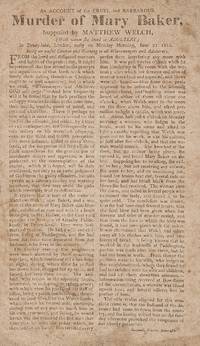
1813ref. 843901813. A Rare Regency Murder Broadside & Moral "Caution": OCLC and Library Hub Locate Only One Copy Broadside. Murder. Welch Matthew. An Account of the Cruel and Barbarous Murder of Mary Baker Supposed by Matthew Welch With Whom She Lived in Adultery In Drury-Lane London Early on Monday Morning June 21 1813. Being an Awful Caution and Warning to All Whoremongers and Adulterers. Newcastle: Marshall Printer 1813. 11-1/2" x 6-3/4" 29 x 17.3 cm broadside mounted to 13" x 10" 33 x 25.9 cm backing sheet. Moderate toning light foxing and soiling small tear and a few tiny holes to broadside without loss to text moderate toning and light foxing to backing sheet which was removed from an album. Rare. $1850. A remarkably rare luridly titled provincial broadside detailing a gruesome London murder. Mary Baker and Matthew Welch "cohabited as man and wife" in Drury Lane despite both being married to other people. Following a violent domestic quarrel that required the landlord's intervention Baker was discovered murdered with "her brains beat out several cuts on her head and her breast black from the blows she had received." According to this account the violence was triggered by jealousy after Baker paid a visit to her actual husband which "provoked the vengeance of her bloody paramour." While Regency-era street literature and true-crime broadsides typically balanced moral instruction with cheap titillation this Newcastle printing adopts an exceptionally strident fire-and-brimstone tone. Rather than casting Baker purely as a victim the text frames her horrific murder as a consequence of her own sins-calling it "not only.an awful judgment of God upon the guilty offenders but also.a salutary caution and warning to others that they may avoid the paths which inevitably lead to destruction." An exceptional survival of regional popular print culture capturing 19th-century attitudes toward domestic violence infidelity and divine retribution. Extremely rare. OCLC and Library Hub locate only one solitary copy globally held at the British Library. unknown
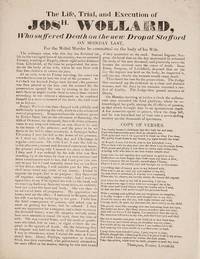
1832ref. 843911832. Murder in the Nineteenth-Century Domestic Sphere: A Rare Provincial Broadside Broadside. Execution. Wollard Joseph d.1832. The Life Trial And Execution of Josh. Wollard Who Suffered Death on the New Drop at Stafford on Monday Last For the Wilful Murder He Committed on the Body of His Wife. Litchfield England: Thompson Printer 1832. 9-3/4" x 7-1/2" 25 x 18.7 cm broadside mounted to 13" x 10" 33.2 x 25.3 cm backing sheet. Text in two columns below headline nine-stanza "Copy of Verses at foot of second column." Light toning and negligible light soiling to broadside small paper residue at its top-edge from mounting moderate toning to backing sheet which was removed from an album. Rare. $1850. This rare survival offers a grim unvarnished window into 19th-century domestic violence crime and the culture of public punishment in provincial England. The broadside details the argument the fatal assault the trial and Wollard's execution via the "New Drop" at Stafford. While historical accounts of the event vary in minor details this popular street literature piece focuses heavily on the pathos of the victim's condition noting she was "in a far advanced state of pregnancy." The execution ballads at the foot of the sheet amplify the husband's remorse and the dual nature of the homicide noting that "two lives at once" were taken. Street literature of this nature from regional presses like Thompson of Litchfield was printed on cheap paper sold for pennies and almost universally discarded. Completely unrecorded in OCLC and Library Hub. The only other known copy is housed at the New York State Library; missing from the British Library and Harvard. unknown
1813ref. 843901813. A Rare Regency Murder Broadside & Moral "Caution": OCLC and Library Hub Locate Only One Copy Broadside. Murder. Welch Matthew. An Account of the Cruel and Barbarous Murder of Mary Baker Supposed by Matthew Welch With Whom She Lived in Adultery In Drury-Lane London Early on Monday Morning June 21 1813. Being an Awful Caution and Warning to All Whoremongers and Adulterers. Newcastle: Marshall Printer 1813. 11-1/2" x 6-3/4" 29 x 17.3 cm broadside mounted to 13" x 10" 33 x 25.9 cm backing sheet. Moderate toning light foxing and soiling small tear and a few tiny holes to broadside without loss to text moderate toning and light foxing to backing sheet which was removed from an album. Rare. $1850. A remarkably rare luridly titled provincial broadside detailing a gruesome London murder. Mary Baker and Matthew Welch "cohabited as man and wife" in Drury Lane despite both being married to other people. Following a violent domestic quarrel that required the landlord's intervention Baker was discovered murdered with "her brains beat out several cuts on her head and her breast black from the blows she had received." According to this account the violence was triggered by jealousy after Baker paid a visit to her actual husband which "provoked the vengeance of her bloody paramour." While Regency-era street literature and true-crime broadsides typically balanced moral instruction with cheap titillation this Newcastle printing adopts an exceptionally strident fire-and-brimstone tone. Rather than casting Baker purely as a victim the text frames her horrific murder as a consequence of her own sins-calling it "not only.an awful judgment of God upon the guilty offenders but also.a salutary caution and warning to others that they may avoid the paths which inevitably lead to destruction." An exceptional survival of regional popular print culture capturing 19th-century attitudes toward domestic violence infidelity and divine retribution. Extremely rare. OCLC and Library Hub locate only one solitary copy globally held at the British Library. unknown books
1832ref. 843911832. Murder in the Nineteenth-Century Domestic Sphere: A Rare Provincial Broadside Broadside. Execution. Wollard Joseph d.1832. The Life Trial And Execution of Josh. Wollard Who Suffered Death on the New Drop at Stafford on Monday Last For the Wilful Murder He Committed on the Body of His Wife. Litchfield England: Thompson Printer 1832. 9-3/4" x 7-1/2" 25 x 18.7 cm broadside mounted to 13" x 10" 33.2 x 25.3 cm backing sheet. Text in two columns below headline nine-stanza "Copy of Verses at foot of second column." Light toning and negligible light soiling to broadside small paper residue at its top-edge from mounting moderate toning to backing sheet which was removed from an album. Rare. $1850. This rare survival offers a grim unvarnished window into 19th-century domestic violence crime and the culture of public punishment in provincial England. The broadside details the argument the fatal assault the trial and Wollard's execution via the "New Drop" at Stafford. While historical accounts of the event vary in minor details this popular street literature piece focuses heavily on the pathos of the victim's condition noting she was "in a far advanced state of pregnancy." The execution ballads at the foot of the sheet amplify the husband's remorse and the dual nature of the homicide noting that "two lives at once" were taken. Street literature of this nature from regional presses like Thompson of Litchfield was printed on cheap paper sold for pennies and almost universally discarded. Completely unrecorded in OCLC and Library Hub. The only other known copy is housed at the New York State Library; missing from the British Library and Harvard. unknown books
1836ref. 665381836. Concord NH 1836. Concord NH 1836. "Oh! Lust Accursed Lust! 'Twas This for Which I Did the Deed" Broadside. Murder. A Private Individual at the Bar. Abr'm Prescott's Confession Of the Murder of Mrs. Sally Cochran of Pembroke N.H.--June 23 1833. Concord NH.: S.n. 1836. 17" x 11-1/2" 43.2 x 29.2 cm broadside. Two columns of verse in twenty stanzas within woodcut ornamental border text headed by large woodcut vignette of a coffin. Light browning and a few minor stains faint horizontal and vertical fold line chipping to edges section lacking from bottom margin just touching bottom right corner of border a few tears along fold lines with no loss to text later repairs to verso. $1950. Abraham Prescott was convicted of the murder of Sally Cochran following two separate highly publicized trials held in Concord New Hampshire in September 1834 and September 1835. Despite a robust and well-crafted insanity defense mounted by his counsel Prescott was sentenced to death. Originally scheduled to be hanged in Hopkinton New Hampshire on December 23 1835 his execution was delayed and he was ultimately executed on January 6 1836. This rare broadside features a verse account that explicitly frames the murder as a crime of passion capturing the sensationalized public sentiment of the era: "Oh! lust accursed lust! 'twas this / For which I did the deed; / Forfeiting heaven and life and bliss / Forfeiting all I need." OCLC locates 7 copies American Antiquarian Society Brown Dartmouth Harvard Peabody Essex Museum University of Michigan Yale. See McDade The Annals of Murder 769. Burt American Murder Ballads 66-67. unknown
1836ref. 665381836. Concord NH 1836. Concord NH 1836. "Oh! Lust Accursed Lust! 'Twas This for Which I Did the Deed" Broadside. Murder. A Private Individual at the Bar. Abr'm Prescott's Confession Of the Murder of Mrs. Sally Cochran of Pembroke N.H.--June 23 1833. Concord NH.: S.n. 1836. 17" x 11-1/2" 43.2 x 29.2 cm broadside. Two columns of verse in twenty stanzas within woodcut ornamental border text headed by large woodcut vignette of a coffin. Light browning and a few minor stains faint horizontal and vertical fold line chipping to edges section lacking from bottom margin just touching bottom right corner of border a few tears along fold lines with no loss to text later repairs to verso. $1950. Abraham Prescott was convicted of the murder of Sally Cochran following two separate highly publicized trials held in Concord New Hampshire in September 1834 and September 1835. Despite a robust and well-crafted insanity defense mounted by his counsel Prescott was sentenced to death. Originally scheduled to be hanged in Hopkinton New Hampshire on December 23 1835 his execution was delayed and he was ultimately executed on January 6 1836. This rare broadside features a verse account that explicitly frames the murder as a crime of passion capturing the sensationalized public sentiment of the era: "Oh! lust accursed lust! 'twas this / For which I did the deed; / Forfeiting heaven and life and bliss / Forfeiting all I need." OCLC locates 7 copies American Antiquarian Society Brown Dartmouth Harvard Peabody Essex Museum University of Michigan Yale. See McDade The Annals of Murder 769. Burt American Murder Ballads 66-67. unknown books
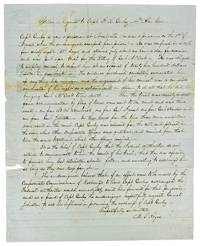
1864ref. 49788N.p. 1864. Very Good. N.p.: 1864. Manuscript letter written in ink signed by Royce at the end and on the verso. Single leaf 26.5x21cm; chips and rubbing; a few closed tears with archival tape repairs; Very Good. An unusual insightful document highlighting the laws of war and murder during the Civil War. Royce's petition seeks justice for Confederate Captain Frank R. Gurley sent to the Confederate Commission of Exchange. Its author Confederate Captain Moses Strong Royce was captured in Tennessee and imprisoned at Nashville. Gurley Royce's cell-mate had killed Union General Robert McCook of Ohio near Huntsville Alabama in August 1862. In October 1863 Union forces captured Gurley and charged him with murdering McCook. Gurley Union officials claimed was a guerrilla who shot McCook while the General was lying in an ambulance. Southerners claimed that Gurley was not a guerrilla but a regular soldier in the Confederacy's 4th Alabama Cavalry and that he killed McCook according to the laws of war. Harper's Weekly and Frank Leslie's Illustrated Newspaper fanned the flames claiming that lawless Confederate guerrillas murdered the general; feelings ran high. "US General Grant wrote CS General Hardee in December of 1863 and said that although Gurley was a member of the Confederate army that did not preclude him from being tried for having committed a foul murder" online Huntsville-Madison County Public Library essay 'Frank B. Gurley's 1866 Diary'. Having escaped from prison in March 1864 Royce plead Gurley's case. "He was confined in a cell for sixty-eight days and allowed only about one hour a day for exercise and was put upon trial for the killing of Genl. McCook. He was obliged to employ counsel to defend himself at an expense of 2500 dollars in greenbacks. The evidence produced completely exonerated him of anything like murder and the argument of his counsel was a complete vindication of his right as a soldier and an officer to do all that he did in bringing Genl. McCook to his death. "When the trial was nearly ended four communications by flag of truce were sent to the court and were there read - one from Lt. Col. Hambrick one from Genl. Forrest one from Genl. Hardee and one from Genl. Johnston" assuring that Gurley was not a guerrilla but a duly enrolled member of the Confederate military forces. Nevertheless Gurley was found guilty and sentenced to death. "The undersigned believes that if an effort were to be made by the Confederate Commission of Exchange to have Capt. Gurley exchanged the Federal authorities would immediately send him forward for that purpose and as a friend of Capt. Gurley the undersigned respectfully requests General Johnston to use his influence in procuring the exchange of Capt. Gurley. Respectfully submitted M. S. Royce." Even after War's end the dispute continued. Gurley having been released from prison in an administrative snafu was re-arrested charged but finally released and placed on parole in April 1866. . unknown
1864ref. 49788N.p. 1864. Very Good. N.p.: 1864. Manuscript letter written in ink signed by Royce at the end and on the verso. Single leaf 26.5x21cm; chips and rubbing; a few closed tears with archival tape repairs; Very Good. An unusual insightful document highlighting the laws of war and murder during the Civil War. Royce's petition seeks justice for Confederate Captain Frank R. Gurley sent to the Confederate Commission of Exchange. Its author Confederate Captain Moses Strong Royce was captured in Tennessee and imprisoned at Nashville. Gurley Royce's cell-mate had killed Union General Robert McCook of Ohio near Huntsville Alabama in August 1862. In October 1863 Union forces captured Gurley and charged him with murdering McCook. Gurley Union officials claimed was a guerrilla who shot McCook while the General was lying in an ambulance. Southerners claimed that Gurley was not a guerrilla but a regular soldier in the Confederacy's 4th Alabama Cavalry and that he killed McCook according to the laws of war. Harper's Weekly and Frank Leslie's Illustrated Newspaper fanned the flames claiming that lawless Confederate guerrillas murdered the general; feelings ran high. "US General Grant wrote CS General Hardee in December of 1863 and said that although Gurley was a member of the Confederate army that did not preclude him from being tried for having committed a foul murder" online Huntsville-Madison County Public Library essay 'Frank B. Gurley's 1866 Diary'. Having escaped from prison in March 1864 Royce plead Gurley's case. "He was confined in a cell for sixty-eight days and allowed only about one hour a day for exercise and was put upon trial for the killing of Genl. McCook. He was obliged to employ counsel to defend himself at an expense of 2500 dollars in greenbacks. The evidence produced completely exonerated him of anything like murder and the argument of his counsel was a complete vindication of his right as a soldier and an officer to do all that he did in bringing Genl. McCook to his death. "When the trial was nearly ended four communications by flag of truce were sent to the court and were there read - one from Lt. Col. Hambrick one from Genl. Forrest one from Genl. Hardee and one from Genl. Johnston" assuring that Gurley was not a guerrilla but a duly enrolled member of the Confederate military forces. Nevertheless Gurley was found guilty and sentenced to death. "The undersigned believes that if an effort were to be made by the Confederate Commission of Exchange to have Capt. Gurley exchanged the Federal authorities would immediately send him forward for that purpose and as a friend of Capt. Gurley the undersigned respectfully requests General Johnston to use his influence in procuring the exchange of Capt. Gurley. Respectfully submitted M. S. Royce." Even after War's end the dispute continued. Gurley having been released from prison in an administrative snafu was re-arrested charged but finally released and placed on parole in April 1866. . unknown books
1914ref. 659851914. New York 1912-1914. Image in 30-1/2" x 24" frame. New York 1912-1914. Image in 30-1/2" x 24" frame. "His Famous Wig Composed Entirely of Split Hairs and Adorned with the Ceremonial Crimson Tape" Robinson Boardman 1876-1952. Becker-Rosenthal Murder Trial. Mr. Justice Precedent. New York 1914. 21" x 15-1/2" 53.3 x 39.4 cm gouache image on 26" x 19-1/2" 66 x 49.5 cm sheet image signed twice and inscribed by Robinson caption in pencil below image most likely in another hand laid down on illustration board. Image in 30-1/2" x 24" 77.5 x 60.9 cm wooden frame glazed. Light soiling a few minor stains and four crop-marks to margins outside of image which could be covered with a matte image fine. Several minor scuffs and nicks to frame. An exceptional unique piece of original artwork capturing a defining moment in American legal and criminal history. $3500. This striking original gouache was created to illustrate "Leaden Footed Justice in New York State" a feature article published in the Special Feature section of the New York Tribune on Sunday March 1 1914. The penciled caption reads:"Mr. Justice Precedent wearing his famous wig composed entirely of split hairs and adorned with the ceremonial crimson tape." The caricature was a scathing commentary on the notoriously protracted bureaucratically tangled legal proceedings of the Becker-Rosenthal Murder case which centered on NYPD Police Lieutenant Charles Becker who ran a massive protection racket targeting illegal Manhattan casinos. When gambling house owner Herman Rosenthal threatened to expose Becker's corruption to District Attorney Charles S. Whitman Becker hired a gang of underworld executioners including "Gyp the Blood" and "Lefty Louie" to gun Rosenthal down outside the Hotel Metropole. The investigation and subsequent trials completely dominated New York front pages. Becker's first trial began on October 7 1912 resulting in a conviction that was subsequently overturned on appeal by the New York Court of Appeals due to judicial bias. His highly anticipated second trial began on May 6 1914 just over two months after this cartoon appeared. Becker was convicted a second time and after his appeals were exhausted in 1915 went to the electric chair at Sing Sing-marking the first time in U.S. history a police officer was executed for murder. The case profoundly shook the public psyche and entered the cultural lexicon most. unknown
1914ref. 659851914. New York 1912-1914. Image in 30-1/2" x 24" frame. New York 1912-1914. Image in 30-1/2" x 24" frame. "His Famous Wig Composed Entirely of Split Hairs and Adorned with the Ceremonial Crimson Tape" Robinson Boardman 1876-1952. Becker-Rosenthal Murder Trial. Mr. Justice Precedent. New York 1914. 21" x 15-1/2" 53.3 x 39.4 cm gouache image on 26" x 19-1/2" 66 x 49.5 cm sheet image signed twice and inscribed by Robinson caption in pencil below image most likely in another hand laid down on illustration board. Image in 30-1/2" x 24" 77.5 x 60.9 cm wooden frame glazed. Light soiling a few minor stains and four crop-marks to margins outside of image which could be covered with a matte image fine. Several minor scuffs and nicks to frame. An exceptional unique piece of original artwork capturing a defining moment in American legal and criminal history. $3500. This striking original gouache was created to illustrate "Leaden Footed Justice in New York State" a feature article published in the Special Feature section of the New York Tribune on Sunday March 1 1914. The penciled caption reads:"Mr. Justice Precedent wearing his famous wig composed entirely of split hairs and adorned with the ceremonial crimson tape." The caricature was a scathing commentary on the notoriously protracted bureaucratically tangled legal proceedings of the Becker-Rosenthal Murder case which centered on NYPD Police Lieutenant Charles Becker who ran a massive protection racket targeting illegal Manhattan casinos. When gambling house owner Herman Rosenthal threatened to expose Becker's corruption to District Attorney Charles S. Whitman Becker hired a gang of underworld executioners including "Gyp the Blood" and "Lefty Louie" to gun Rosenthal down outside the Hotel Metropole. The investigation and subsequent trials completely dominated New York front pages. Becker's first trial began on October 7 1912 resulting in a conviction that was subsequently overturned on appeal by the New York Court of Appeals due to judicial bias. His highly anticipated second trial began on May 6 1914 just over two months after this cartoon appeared. Becker was convicted a second time and after his appeals were exhausted in 1915 went to the electric chair at Sing Sing-marking the first time in U.S. history a police officer was executed for murder. The case profoundly shook the public psyche and entered the cultural lexicon most. unknown books
1849ref. 717871849. 14-1/2" x 10" 36.8 x 25.4 cm. 14-1/2" x 10" 36.8 x 25.4 cm. Unrecorded Oxfordshire Ephemera: A Graphic Mid-Victorian Murder Broadside Broadside. Murder. Great Britain. Attempted Murder of a Wife by Her Husband Near Banbury Oxfordshire. Reading: Jones Printer 1849. 14-1/2" x 10" 36.8 x 25.4 cm broadside triple-column text below headline and woodcut image of a man stabbing a woman flanked by six stanzas of verse. Light toning and edgewear vertical and horizontal folds the latter with early repair fold line to lower right-hand corner light foxing to margins negligible faint dampstain to left-hand margin touching a bit of text. A remarkably well-preserved example of fragile Victorian street literature. $3850. A chilling primary account of the case of James Layton. Driven by financial ruin and paranoid delusions Layton attacked his wife with both a pistol and a knife during a walk near Banbury. Despite the intervention of nearby laborers the victim eventually succumbed to her wounds. The case is a significant example of mid-19th-century forensic psychiatry; Layton was ultimately found "not guilty by reason of insanity" reflecting the evolving legal treatment of mental illness in the Victorian era. This rare broadside appears to be unrecorded. No copies located on OCLC or Library Hub. Not at the British Library or the university of Oxford. unknown
1849ref. 717871849. 14-1/2" x 10" 36.8 x 25.4 cm. 14-1/2" x 10" 36.8 x 25.4 cm. Unrecorded Oxfordshire Ephemera: A Graphic Mid-Victorian Murder Broadside Broadside. Murder. Great Britain. Attempted Murder of a Wife by Her Husband Near Banbury Oxfordshire. Reading: Jones Printer 1849. 14-1/2" x 10" 36.8 x 25.4 cm broadside triple-column text below headline and woodcut image of a man stabbing a woman flanked by six stanzas of verse. Light toning and edgewear vertical and horizontal folds the latter with early repair fold line to lower right-hand corner light foxing to margins negligible faint dampstain to left-hand margin touching a bit of text. A remarkably well-preserved example of fragile Victorian street literature. $3850. A chilling primary account of the case of James Layton. Driven by financial ruin and paranoid delusions Layton attacked his wife with both a pistol and a knife during a walk near Banbury. Despite the intervention of nearby laborers the victim eventually succumbed to her wounds. The case is a significant example of mid-19th-century forensic psychiatry; Layton was ultimately found "not guilty by reason of insanity" reflecting the evolving legal treatment of mental illness in the Victorian era. This rare broadside appears to be unrecorded. No copies located on OCLC or Library Hub. Not at the British Library or the university of Oxford. unknown books
1938First appearance of this prescient series of fictional letters, spanning sixteen months between 1932 and 1934, between a Jewish art dealer in San Francisco and his gentile business partner who has returned to Germany in the formative years of the Nazi regime. Simon & Schuster published the first book edition in 1939 and a film noir version followed in 1944. Subsequent stage play performances have continued globally until recent years. The magnum opus of Kathrine Kressmann Taylor [1903-1996], she was assigned the nom de plume Kressman Taylor by her husband and Story's editor Whit Burnett who, per an online reference, felt the concept of murder by mail was too strong to appear under the name of a woman. Occupies pages 20-32 of this 104 page magazine which is clean and unmarked with respectful wear. Front cover beginning to loosen and must be handled gently. Two-inch openings at head and foot of front cover at spine. A quality copy of this stunning literary achievement. Book