ref. 0107XKRRGLMGood. Farrar & Rinehart New York 1937. First Edition. Hard Cover. Very Good/Fine. About The Murder Of A Man Afraid Of Women. Anthony Abbot pseudonym for Charles Fulton Oursler Sixth mystery title out of eight Thatcher Colt titles with the first one being "About the Murder of Geraldine Foster". Condition is good with slightly bumped corners nice light green boards hinges starting . Our pics hardcover
1988285 pages, jacket artwork by Martin White. eng
19948vo, 448 pages, not illustrated. eng
2006As New English Paperback. Pbo. Mint. Demy 8vo. (21 x 15 cm). In Turkish. [iii], 364 p. B/w ills. Turkish Edition of Schechter and Everitt's 'The A to Z encyclopedia of serial killers'. A'dan Z'ye seri katiller ansiklopedisi. Translated by Sinan Güneyli.
ref. 12315- Le Club, 2001 Fort Volume au format 12.5 x19 cm, reliure pleine toile titrée en doré en creux sous jaquette jaune et noire, bel exemplaire, 1344 pages.Présentation de Jacques Baudou Bibliographie filmographie de Jean-Jacques Schléret. Volume 5 de la collection: « Les années 1936-1937 »
1836ref. 665381836. Concord NH 1836. Concord NH 1836. "Oh! Lust Accursed Lust! 'Twas This for Which I Did the Deed" Murder Broadside. Prescott Abraham d. 1836. A Private Individual at the Bar. Abr'm Prescott's Confession Of the Murder of Mrs. Sally Cochran of Pembroke N.H.--June 23 1833. Concord NH.: S.n. 1836. Single-sheet broadside measuring 17" x 11-1/2" 43.2 cm x 29.2 cm. Letterpress text in two columns containing twenty stanzas of verse enclosed within a decorative woodcut ornamental border; the text is surmounted by a large woodcut vignette of a coffin. Good condition. Light uniform browning with a few minor stains; original horizontal and vertical fold lines exhibit some small tears repaired on the verso without loss to text. Edges chipped with a notable section lacking from the bottom margin just touching the bottom right corner of the border but entirely clear of the letterpress verse. A remarkably well-preserved fragile survival of early New England street literature. $1950. This exceptionally rare execution broadside serves as a sensational artifact from one of the most legally significant criminal cases in early nineteenth-century New England. Abraham Prescott was convicted of the brutal June 1833 murder of his employer's wife Sally Cochran following two highly publicized trials held in Concord New Hampshire in 1834 and 1835. The case drew massive public interest and stands as a major landmark in American legal history due to the robust deeply sophisticated insanity defense mounted by Prescott's counsel a strategy that sparked intense contemporary debate regarding moral insanity somnambulism and criminal responsibility long before the modern legal standard was codified. Despite his lawyers' innovative defense Prescott was sentenced to death. After a temporary stay delayed his initial December 1835 execution date he was publicly hanged in Hopkinton New Hampshire on January 6 1836. Published immediately following his execution to satisfy a captivated public this broadside features a dramatic moralizing verse account that rejects the insanity defense entirely. Instead it explicitly frames the murder as a calculated crime of passion capturing the prevailing public sentiment and punitive theological views of the era with the striking verse: "Oh! lust accursed lust! 'twas this / For which I did the deed; / Forfeiting heaven a. unknown
1836ref. 665381836. Concord NH 1836. Concord NH 1836. "Oh! Lust Accursed Lust! 'Twas This for Which I Did the Deed" Murder Broadside. Prescott Abraham d. 1836. A Private Individual at the Bar. Abr'm Prescott's Confession Of the Murder of Mrs. Sally Cochran of Pembroke N.H.--June 23 1833. Concord NH.: S.n. 1836. Single-sheet broadside measuring 17" x 11-1/2" 43.2 cm x 29.2 cm. Letterpress text in two columns containing twenty stanzas of verse enclosed within a decorative woodcut ornamental border; the text is surmounted by a large woodcut vignette of a coffin. Good condition. Light uniform browning with a few minor stains; original horizontal and vertical fold lines exhibit some small tears repaired on the verso without loss to text. Edges chipped with a notable section lacking from the bottom margin just touching the bottom right corner of the border but entirely clear of the letterpress verse. A remarkably well-preserved fragile survival of early New England street literature. $1950. This exceptionally rare execution broadside serves as a sensational artifact from one of the most legally significant criminal cases in early nineteenth-century New England. Abraham Prescott was convicted of the brutal June 1833 murder of his employer's wife Sally Cochran following two highly publicized trials held in Concord New Hampshire in 1834 and 1835. The case drew massive public interest and stands as a major landmark in American legal history due to the robust deeply sophisticated insanity defense mounted by Prescott's counsel a strategy that sparked intense contemporary debate regarding moral insanity somnambulism and criminal responsibility long before the modern legal standard was codified. Despite his lawyers' innovative defense Prescott was sentenced to death. After a temporary stay delayed his initial December 1835 execution date he was publicly hanged in Hopkinton New Hampshire on January 6 1836. Published immediately following his execution to satisfy a captivated public this broadside features a dramatic moralizing verse account that rejects the insanity defense entirely. Instead it explicitly frames the murder as a calculated crime of passion capturing the prevailing public sentiment and punitive theological views of the era with the striking verse: "Oh! lust accursed lust! 'twas this / For which I did the deed; / Forfeiting heaven a. unknown books
1824ref. BB056Murder Trial Account of the Murder of the late Mr William Weare . the coroner's inquest the trials of the prisoners and the execution. By George Henry Jones. London 1824. With 3 landscapes 2 folding plates finely lithographed by C J Hullmandel. 8vo iv344pp; half-leather marbled boards spine label "Thurtell's Trial" lightly scuffed very solid and clean throughout. First edition. William Weare was a solicitor of Lyon's Inn and a gambler. His killer was John Thurtell 1794–1824 a sports promoter amateur boxer a former Royal Marine officer and a son of the Mayor of Norwich. Thurtell owed Weare a gambling debt of £300 an immense sum at the time equivalent to £24500 in 20151. Thurtell believed Weare had cheated him of the money. Whatever the truth when Weare demanded payment Thurtell murdered him rather than pay up. He invited Weare to join him and his friends – Joseph Hunt a tavern landlord and William Probert a former convict and alcohol merchant – for a weekend of gambling at Probert's cottage at the site of Oaks Close off Gills Hill Lane subsequently popularly known as Murder Lane23 Radlett. On 24 October 1823 they journeyed from London in Thurtell's horse-drawn gig but Weare was killed in a dark lane just short of their destination. The gruesome and callous events created such public sensation that it attracted numerous ballads and theatre shows at the time along with comment by the essayist Babington Macaulay and the crime used variously in the work of Sir Walter Scott William Hazllitt and Robert Louis Stevenson. After the trial one of the accused was hanged and another Joseph Hunt was transported to Botany Bay Australia. Charles Joseph Hullmandel 1789–1850 studied art and printmaking and is considered amongst the most important figures in the development of British lithography. He developed a method for reproducing gradations in tones and for creating the effect of soft color washes which enabled the reproduction of Romantic landscape paintings of the type made popular by J. M. W. Turner. Hullmandel's essay The Art of Drawing on Stone 1824 was an important handbook of lithography issued the same year as this account of the trial.
1824ref. BB056Murder Trial Account of the Murder of the late Mr William Weare . the coroner's inquest the trials of the prisoners and the execution. By George Henry Jones. London 1824. With 3 landscapes 2 folding plates finely lithographed by C J Hullmandel. 8vo iv344pp; half-leather marbled boards spine label "Thurtell's Trial" lightly scuffed very solid and clean throughout. First edition. William Weare was a solicitor of Lyon's Inn and a gambler. His killer was John Thurtell 1794–1824 a sports promoter amateur boxer a former Royal Marine officer and a son of the Mayor of Norwich. Thurtell owed Weare a gambling debt of £300 an immense sum at the time equivalent to £24500 in 20151. Thurtell believed Weare had cheated him of the money. Whatever the truth when Weare demanded payment Thurtell murdered him rather than pay up. He invited Weare to join him and his friends – Joseph Hunt a tavern landlord and William Probert a former convict and alcohol merchant – for a weekend of gambling at Probert's cottage at the site of Oaks Close off Gills Hill Lane subsequently popularly known as Murder Lane23 Radlett. On 24 October 1823 they journeyed from London in Thurtell's horse-drawn gig but Weare was killed in a dark lane just short of their destination. The gruesome and callous events created such public sensation that it attracted numerous ballads and theatre shows at the time along with comment by the essayist Babington Macaulay and the crime used variously in the work of Sir Walter Scott William Hazllitt and Robert Louis Stevenson. After the trial one of the accused was hanged and another Joseph Hunt was transported to Botany Bay Australia. Charles Joseph Hullmandel 1789–1850 studied art and printmaking and is considered amongst the most important figures in the development of British lithography. He developed a method for reproducing gradations in tones and for creating the effect of soft color washes which enabled the reproduction of Romantic landscape paintings of the type made popular by J. M. W. Turner. Hullmandel's essay The Art of Drawing on Stone 1824 was an important handbook of lithography issued the same year as this account of the trial. books
1973Book
2001344 pages. eng
198612mo, 227 pages, not illustrated. Previous owner's inscription on the inside front cover. eng
1938First appearance of this prescient series of fictional letters, spanning sixteen months between 1932 and 1934, between a Jewish art dealer in San Francisco and his gentile business partner who has returned to Germany in the formative years of the Nazi regime. Simon & Schuster published the first book edition in 1939 and a film noir version followed in 1944. Subsequent stage play performances have continued globally until recent years. The magnum opus of Kathrine Kressmann Taylor [1903-1996], she was assigned the nom de plume Kressman Taylor by her husband and Story's editor Whit Burnett who, per an online reference, felt the concept of murder by mail was too strong to appear under the name of a woman. Occupies pages 20-32 of this 104 page magazine which is clean and unmarked with respectful wear. Front cover beginning to loosen and must be handled gently. Two-inch openings at head and foot of front cover at spine. A quality copy of this stunning literary achievement. Book
19938vo, 192 pages, not illustrated. Ex library copy. eng
193896 pages. Features: Blood Money - A Swedish Mercinary in R.F.C. Uniform and the most merciless killer on the Western Front; Murder in the Mess - A modern R.A.F. Bomber Squadron is the setting of Murder in an Officer's Mess; Smoking Prohibited - Misadventure in the Fleet Air Arm; True Story - Continuing the Personal Narrative of a Young Airman who fought in Spanish War Skies; A Spot of Snooping - A Bristol Fighter and its mission where success meant a German Gaol and failure the annihilation of fifty thousand men; and more. Above-average wear. Unmarked. Binding intact. Book
193996 pages. Features: Palestine Party - The Air Fleet Arm is sent into action to meet the Greatest Menace of the Arab Rebellion; Masquerade Murder - the Squire's 'Ghost Plane'; Raiders Ride High - A Hybrid Monster bears a load of venomous purpose; True Narrative - The Conclusion of a British 'Ace' who served in the War in the Air from First to Last; The Bloke in the Bowler - When certain Brain Guys from the U.S.A decided to go into aviation, Flt.-Lt. Kinley of the Secret Service was bound for adventure; and more. Above-average wear. Binding intact. Unmarked. Upper right corner of front cover obscured. Book
1935Volume I, No. I of this publication. Contents include two long complete novels of war flying entitled "One Man's War", a tale of a Handley-Page night-bomber, and "Gas-Bag Aces", a tale of Seaplane and Blimp adventures of the Coast Defence Forces in the Great War; Terror in the Sky - A Pilotless R.A.F. Fighter crashes in the centre of New York; Murder in the Air - The Red Prop School trained the Foreign Legion of the Air; Cundall of the Camels - The remarkable life of a Camel pilot of the R.F.C. on the Western Front; Real Life Adventures - Crashing Aeroplanes for Movie Thrills and Thrills and Spills in Parachuting; and more. Interesting cover illustration depicts kilt-wearing machine-gunner. Above-average wear. Binding intact. Book
2003ref. 762002003 Editions Gallimard, Collection "Bibliothèque de la Pléiade" - 2003 - In-12, reliure pleine peau havane, dos lisse orné de titres et filets horizontaux dorés, signet jaune, rhodoïd et étui cartonné de l'éditeur illustré en couleurs - 318 pages - Iconographie en N&B et en couleurs (390 illustrations)
ref. 500353291Goldmann Taschen Sans date. Alibi est une pièce de théâtre policière de Michael Morton adaptée du roman 'Le Meurtre de Roger Ackroyd' d'Agatha Christie. Il s'agit de la première adaptation d'une œuvre de Christie tous médias confondus
1996468pp. 25 cm. Hardcover Very good condition good
200915th printing, 507 pages, light creasing to covers. eng
grand in-8, 429 pp., illustrations, broché, couv. Illustré Bon état [BAT-6]
ref. 500313438Harlequin Sans date. Le commissaire Jury enquête sur le meurtre de Mariah Cox une bibliothécaire discrète retrouvée en robe de haute couture derrière un pub de village. Un chat noir est le seul témoin potentiel de ce crime qui semble être lié à un autre assassinat à Londres. L'enquête mêle suspense et touches d'humour anglais
1987ref. 100149244Signet Mystery 1987 in12. 1987. Broché. L'inspecteur Andrew Dalziel et le sergent Peter Pascoe enquêtent sur un meurtre vieux de cinq ans dans un petit collège sur la côte anglaise après la découverte d'ossements sous une statue. L'enquête les plonge dans un milieu universitaire où se mêlent magie noire et relations douteuses entre enseignants et étudiants
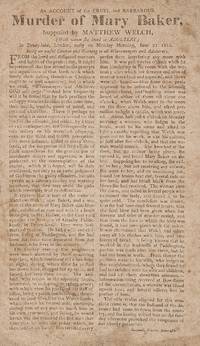
1813ref. 843901813. A Rare Regency Murder Broadside & Moral "Caution": OCLC and Library Hub Locate Only One Copy Broadside. Murder. Welch Matthew. An Account of the Cruel and Barbarous Murder of Mary Baker Supposed by Matthew Welch With Whom She Lived in Adultery In Drury-Lane London Early on Monday Morning June 21 1813. Being an Awful Caution and Warning to All Whoremongers and Adulterers. Newcastle: Marshall Printer 1813. 11-1/2" x 6-3/4" 29 x 17.3 cm broadside mounted to 13" x 10" 33 x 25.9 cm backing sheet. Moderate toning light foxing and soiling small tear and a few tiny holes to broadside without loss to text moderate toning and light foxing to backing sheet which was removed from an album. Rare. $1850. A remarkably rare luridly titled provincial broadside detailing a gruesome London murder. Mary Baker and Matthew Welch "cohabited as man and wife" in Drury Lane despite both being married to other people. Following a violent domestic quarrel that required the landlord's intervention Baker was discovered murdered with "her brains beat out several cuts on her head and her breast black from the blows she had received." According to this account the violence was triggered by jealousy after Baker paid a visit to her actual husband which "provoked the vengeance of her bloody paramour." While Regency-era street literature and true-crime broadsides typically balanced moral instruction with cheap titillation this Newcastle printing adopts an exceptionally strident fire-and-brimstone tone. Rather than casting Baker purely as a victim the text frames her horrific murder as a consequence of her own sins-calling it "not only.an awful judgment of God upon the guilty offenders but also.a salutary caution and warning to others that they may avoid the paths which inevitably lead to destruction." An exceptional survival of regional popular print culture capturing 19th-century attitudes toward domestic violence infidelity and divine retribution. Extremely rare. OCLC and Library Hub locate only one solitary copy globally held at the British Library. unknown