Broadside; Murder; New HamsphireBiblio.com

922 resultados
1836ref. 665381836. Concord NH 1836. Concord NH 1836. "Oh! Lust Accursed Lust! 'Twas This for Which I Did the Deed" Broadside. Murder. A Private Individual at the Bar. Abr'm Prescott's Confession Of the Murder of Mrs. Sally Cochran of Pembroke N.H.--June 23 1833. Concord NH.: S.n. 1836. 17" x 11-1/2" 43.2 x 29.2 cm broadside. Two columns of verse in twenty stanzas within woodcut ornamental border text headed by large woodcut vignette of a coffin. Light browning and a few minor stains faint horizontal and vertical fold line chipping to edges section lacking from bottom margin just touching bottom right corner of border a few tears along fold lines with no loss to text later repairs to verso. $1950. Abraham Prescott was convicted of the murder of Sally Cochran following two separate highly publicized trials held in Concord New Hampshire in September 1834 and September 1835. Despite a robust and well-crafted insanity defense mounted by his counsel Prescott was sentenced to death. Originally scheduled to be hanged in Hopkinton New Hampshire on December 23 1835 his execution was delayed and he was ultimately executed on January 6 1836. This rare broadside features a verse account that explicitly frames the murder as a crime of passion capturing the sensationalized public sentiment of the era: "Oh! lust accursed lust! 'twas this / For which I did the deed; / Forfeiting heaven and life and bliss / Forfeiting all I need." OCLC locates 7 copies American Antiquarian Society Brown Dartmouth Harvard Peabody Essex Museum University of Michigan Yale. See McDade The Annals of Murder 769. Burt American Murder Ballads 66-67. unknown
ref. 12315- Le Club, 2001 Fort Volume au format 12.5 x19 cm, reliure pleine toile titrée en doré en creux sous jaquette jaune et noire, bel exemplaire, 1344 pages.Présentation de Jacques Baudou Bibliographie filmographie de Jean-Jacques Schléret. Volume 5 de la collection: « Les années 1936-1937 »
2006As New English Paperback. Pbo. Mint. Demy 8vo. (21 x 15 cm). In Turkish. [iii], 364 p. B/w ills. Turkish Edition of Schechter and Everitt's 'The A to Z encyclopedia of serial killers'. A'dan Z'ye seri katiller ansiklopedisi. Translated by Sinan Güneyli.
19948vo, 448 pages, not illustrated. eng
1988285 pages, jacket artwork by Martin White. eng
ref. 0107XKRRGLMGood. Farrar & Rinehart New York 1937. First Edition. Hard Cover. Very Good/Fine. About The Murder Of A Man Afraid Of Women. Anthony Abbot pseudonym for Charles Fulton Oursler Sixth mystery title out of eight Thatcher Colt titles with the first one being "About the Murder of Geraldine Foster". Condition is good with slightly bumped corners nice light green boards hinges starting . Our pics hardcover
1969Book
183356p. Unbound Good condition, closed tears in margins repaired
199012mo, 150 pages, not illustrated. eng
First edition, [2], 57, [1]pp., with half-title, disbound. Formerly in the library of the Birmingham Medical Institute.
1966288p. Profusely illustrated with seven and fifty photographs and drawings. 4to. Original full cloth binding. Gilt lettered spine. Original dust jacket with small tear on top of spine. Hardbound. A pictorial history of crime from 1850 to 1966. Nice copy. CRIME BOX 1
ref. 110619025Script Format reprint. Like New. / EARLY 6/13/1995 REVISED DRAFT / I HAVE MORE TITLES LET ME KNOW IF YOU ARE LOOKING FOR OTHER TITLES /THE SCRIPT IS PRINTED ON THREE-HOLE PUNCHED PAPER AND BOUND WITH 2 BRASS BRADS /. unknown
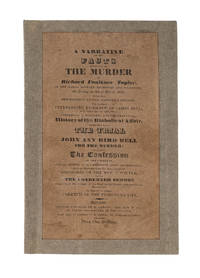
1831ref. 827581831. Rare Account of a 14-Year-Old Murderer Murder. Bell John Any Bird 1816-1831. A Narrative of the Facts Relative to the Murder of Richard Faulkner Taylor In the Woods Between Rochester and Maidstone On Friday the 4th of March 1831 With the Proceedings on the Coroner's Inquest: The Highly Interesting Evidence of James Bell Not Adduced on the Trial Comprising a Complete and Circumstantial History of the Diabolical Affair Together with the Trial of John Any Bird Bell for the Murder: Including the Confession of the Prisoner And an Account of His Behaviour After Condemnation: Also an Abstract from the Very Excellent Discourse of the Rev. J. Winter Being the Condemned Sermon Preached at the Chapel of the Gaol on the Sunday Previous to the Execution: To Which is Added A Sketch of the Prisoner's Life. Rochester England: Printed and Sold by S. Caddel; And May be Had of Every Bookseller in the County 1831. 42 pp. Lithograph portrait frontispiece of John and James Bell. Octavo 9" x 5-3/4". Stab-stitched pamphlet in recent wrappers incorporating front cover of original printed wrappers untrimmed edges. Negligible light edgewear and a few minor creases light soiling and a few faint spots to original wrapper. Moderate toning to interior light soiling and wear to outer edges of several leaves light foxing to a few leaves early owner signature J.S. Bullard dated August 1831 to head of title page. $500. The fourteen-year-old Bell confessed to killing Richard Faulkner Taylor 1817-1831 thirteen presumably for the small sum of money Taylor was carrying home. Any Bird Bell's name is sometimes given as James probably a result of confusion with his younger brother James Bell. The younger brother apparently a witness to the crime testified against him at trial where he was convicted of murder. Bell was the youngest person executed in England in the nineteenth century. Death sentences were often given to children and teenagers but they were usually commuted. He was also the first person hanged by William Calcraft 1800-1879 who went on to become one of the most prolific British executioners and something of a celebrity. An online search of Rochester genealogy resources locates a J.S. Bullard who was a solicitor's clerk during the 1830s. OCLC locates 4 copies British Library 2 copies Library of Cong. unknown books
1831ref. 827581831. Rare Account of a 14-Year-Old Murderer Murder. Bell John Any Bird 1816-1831. A Narrative of the Facts Relative to the Murder of Richard Faulkner Taylor In the Woods Between Rochester and Maidstone On Friday the 4th of March 1831 With the Proceedings on the Coroner's Inquest: The Highly Interesting Evidence of James Bell Not Adduced on the Trial Comprising a Complete and Circumstantial History of the Diabolical Affair Together with the Trial of John Any Bird Bell for the Murder: Including the Confession of the Prisoner And an Account of His Behaviour After Condemnation: Also an Abstract from the Very Excellent Discourse of the Rev. J. Winter Being the Condemned Sermon Preached at the Chapel of the Gaol on the Sunday Previous to the Execution: To Which is Added A Sketch of the Prisoner's Life. Rochester England: Printed and Sold by S. Caddel; And May be Had of Every Bookseller in the County 1831. 42 pp. Lithograph portrait frontispiece of John and James Bell. Octavo 9" x 5-3/4". Stab-stitched pamphlet in recent wrappers incorporating front cover of original printed wrappers untrimmed edges. Negligible light edgewear and a few minor creases light soiling and a few faint spots to original wrapper. Moderate toning to interior light soiling and wear to outer edges of several leaves light foxing to a few leaves early owner signature J.S. Bullard dated August 1831 to head of title page. $500. The fourteen-year-old Bell confessed to killing Richard Faulkner Taylor 1817-1831 thirteen presumably for the small sum of money Taylor was carrying home. Any Bird Bell's name is sometimes given as James probably a result of confusion with his younger brother James Bell. The younger brother apparently a witness to the crime testified against him at trial where he was convicted of murder. Bell was the youngest person executed in England in the nineteenth century. Death sentences were often given to children and teenagers but they were usually commuted. He was also the first person hanged by William Calcraft 1800-1879 who went on to become one of the most prolific British executioners and something of a celebrity. An online search of Rochester genealogy resources locates a J.S. Bullard who was a solicitor's clerk during the 1830s. OCLC locates 4 copies British Library 2 copies Library of Cong. unknown
2011ref. Q-1440525935Adams Media 2011-10-15. Paperback. New. In shrink wrap. Looks like an interesting title! Adams Media paperback
1985221 pages, page edges browned, light wear to covers. eng
1995Appears unread. No marks or inscriptions. No creasing to covers or to spine. A very clean very tight copy with bright unmarked boards, very slightly dusty page edges and no bumping to corners. 312pp. A Manchester Murder Mystery from Mike Hamer. Very scarce first edition.
2003ref. 11857Rageot / cascade 2003 154 pages in12. 2003. broché. 154 pages. Lors de la promenade du soir Jessica un labrador noir et son maître Médéric découvrent le cadavre d'un vieil homme près de la voie ferrée. L'enquête policière qui s'ensuit cherche à identifier l'assassin du maître de Bobby un autre chien
1961A clean, unmarked book with a tight binding. Very slight edge wear. Previous owner's name inside. 192 pages. "A hot draught of mad, primal fantasy and poetry."
19928vo, 248 pages, not illustrated. Former public library copy. Page edges browned. eng
Single sheet printed on one side only (214 x 135 mm), printed black on white fragile paper, mounted on card, soiled and creased. From the London Times, February 25, 1828, page 3, Column 1 : "It is this week our painful duty to record one of the most cold-blooded murders that ever darkened the annals of crime, a deed which has spread a wider gloom and deeper horror than any event which has occurred in this neighbourhood within the remembrances of the eldest inhabitants." John Dyon was the second son of a wealthy landowner in Yorkshire, England near Doncaster. He lived a hard working, respectable and quiet life. He married the lovely Betty Conway and together they had 3 daughters, Elizabeth (from whom we descend), Mary and Matilda. Working closely with his father, he often gained favors and gifts from the older man. In 1826 and 1827 alone, it is recorded that he received 63 acres of land and 300 pounds sterling. His older brother, William also received many gifts from their father as a young man, but the money was mostly squandered and drunk, and eventually the gifts stopped coming. So William struggled and John thrived? and William stewed, and his resentment grew. William frequently ranted of his anger to his son, John, poisoning the younger man's mind against his uncle. On Saturday, the 16th of February, 1828, John Dyon attended the market in Doncaster (12 miles away) with a couple of friends as was his custom. On his return home that evening, when he dismounted his horse to open the gate to his property, he was assaulted, shot, and left for dead. His wife, concerned when he didn't arrive home at the time he should, sent a servant to look for him. The servant found John's horse standing near the gate, but did not see John lying a few feet away. They found him in the morning lying where he had bled out. Mr. E. B. Denison, Esq. and the local constable rode out from Doncaster immediately upon receiving the news Sunday morning and began their investigation. Mr. Denison, a student of the new forensic sciences, was pleased to find the murder scene offered an abundance of clues. It had rained on Saturday and the ground was quite moist, then the temperature dropped below freezing overnight, capturing the escape route of the assailants. Mr. Denison observed that there were two attackers; one smaller and lighter than the other. He noted that these persons were relatively wealthy because they possessed a pair boots with both a right and left foot. He also noted that the larger footprints had a distinctive toe-out gait. An inquest was called by the coroner. After the presentation of evidence, the jury delivered a verdict of "Willful murder by person or persons unknown". Many in the area knew of the ill will that William Dyon and his son held for William's brother, John Dyon. By Thursday of the following week, both were arrested. They provided alibis, insisting that they had been nowhere near the scene of the crime. The magistrate felt he had to let them go. After his release by the authorities, William went to a pub in Gainesborough, and bragged there that he had "humbugged" the local magistrate, apparently disclosing further details of the crime. His brags were soon brought to the attention of Mr. Denison and additional inquiries were made. A farmer who had previously worked for William, but was now in John's employ, admitted that he knew of William and young John's plan to kill John Dyon. He also said that he had hidden the gun at his home for a week prior to the murder, and that William had bribed him and threatened him to keep quiet about the plan. Soon, William and his son, John were arrested. The constable searched their homes and found the boots, a pair having both right and left feet, and the gun. During the trial, the farmer, John White, testified to everything he knew, including the fact that William had showed up the evening of the killing to pick up his gun. Several witnesses came forward to testify to the ill will that William and his son bore for the deceased. They also testified that William had a distinctive gait, walking with his toes pointed outward. William Dyon and John, his son, were hanged for their crime on April 4, 1828. William staunchly declared his innocence throughout, but his son confessed to all as they placed the noose around his neck. No other copy located.
1979349 pages, jacket illustration by David Eastbury. eng
19791st edition. 8vo, 349 pages, not illustrated. Nr fine condition hardback in nr fine condition dust jacket which is sleeved. 39727. eng
1997211 pages. eng
1969"... a definitive study of the changing patterns of murder from Elizabethan and Victorian times to our contemporary age" 288-p. bibliography, index. Shadows of old tape marks on end papers, else fine. Book