4 113 résultats
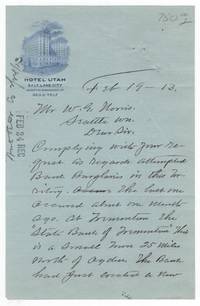
réf. 64479Handwritten letter on 4 pages measuring 5 1/2 x 8 1/2". With the letterhead "Hotel Utah Salt Lake City Under the Management of Geo. O. Relf." The letter is dated February 19 1913. The author writes: "Dear Sir "Complying with your request as regards attempted Bank Burglaries in this Territory. The last one occurred about one month ago. At Tremonton the “State Bank of Tremonton” This is a small town 25 miles north of Ogden. The bank had just located a new building and was ready to move in. They were using an old plate safe. But we sold them a new Manganese. The new safe was in the vault of the new bank while the old safe remained in the old building and vault. The bank had acknowledged they would move on Monday. On Sunday night the Burglers sic entered the old Bank and blew the old safe. But the Saturday evening previous the Cashier had transferred all the money to the new safe. So the yeggmen did not secure a cent and all the damage they did was to put the old safe out of use. The only other attempts I know of in the past six months was on a bank at Midvale Ut. and Murray Ut both small town south of Salt Lake about 15 and 25 miles. In both cases all they did was to punch the lock off the vault door. There was no attempt on either safe and the yeggs got nothing. "I presume you have heard of the First National at St. Anthony being entirely burned out as also the Commercial Bank at Burley Id. "Yours very truly " A letter with interesting content describing early twentieth century attempts at breaking open safes in small Utah towns which leave the yeggmen empty handed in the end. The letter is addressed to Mr. W. G. Norris of Seattle WA. William G. Norris was president of Norris Safe & Locke Co. which was a seller of safes. In 1904 the business occupied one of the first-floor storefronts of the Estabrook building at 1336 2nd Avenue. Perhaps Mr. Norris had queried the author of the letter as to how his safes were withstanding the occasional burglaries of the times. unknown
réf. 64479Handwritten letter on 4 pages measuring 5 1/2 x 8 1/2". With the letterhead "Hotel Utah Salt Lake City Under the Management of Geo. O. Relf." The letter is dated February 19 1913. The author writes: "Dear Sir "Complying with your request as regards attempted Bank Burglaries in this Territory. The last one occurred about one month ago. At Tremonton the “State Bank of Tremonton” This is a small town 25 miles north of Ogden. The bank had just located a new building and was ready to move in. They were using an old plate safe. But we sold them a new Manganese. The new safe was in the vault of the new bank while the old safe remained in the old building and vault. The bank had acknowledged they would move on Monday. On Sunday night the Burglers sic entered the old Bank and blew the old safe. But the Saturday evening previous the Cashier had transferred all the money to the new safe. So the yeggmen did not secure a cent and all the damage they did was to put the old safe out of use. The only other attempts I know of in the past six months was on a bank at Midvale Ut. and Murray Ut both small town south of Salt Lake about 15 and 25 miles. In both cases all they did was to punch the lock off the vault door. There was no attempt on either safe and the yeggs got nothing. "I presume you have heard of the First National at St. Anthony being entirely burned out as also the Commercial Bank at Burley Id. "Yours very truly " A letter with interesting content describing early twentieth century attempts at breaking open safes in small Utah towns which leave the yeggmen empty handed in the end. The letter is addressed to Mr. W. G. Norris of Seattle WA. William G. Norris was president of Norris Safe & Locke Co. which was a seller of safes. In 1904 the business occupied one of the first-floor storefronts of the Estabrook building at 1336 2nd Avenue. Perhaps Mr. Norris had queried the author of the letter as to how his safes were withstanding the occasional burglaries of the times. unknown books
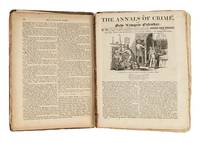
1833réf. 860791833. A Scarce and Short-Lived Crime Periodical from Late Georgian London Crime. Newgate Calendar. The Annals of Crime And Newgate Calendar. Vol. 1 Nos. 1-53 all published. London: Published every Saturday Morning for the Proprietor by Berger 1833-1834. 44 50-424 pp. Issue No. 6 incomplete but likely as-issued. Quarto 9-3/4" x 7-1/2"; 26 x 19 cm. Original plain publisher's boards text block edges untrimmed. Worn boards detached signatures loose first leaf rehinged onto front pastedown. Moderate toning to interior light browning in places chipping and edgewear to some leaves tears to leaf 2H4 pp. 239-240 with loss to text at upper left and lower right corners. Item housed in archival box. An interesting and scarce title. $750. A classic example of London's penny literature The Annals of Crime continues the tradition of Newgate calendars past and delivers florid accounts of treason murder robbery forgery piracy and many other crimes. Cheap and ubiquitous periodicals like this inspired and provided source material for Charles Dickens and many other novelists. The Annals was issued individually by number in parts of six numbers each and in a single bound volume. Based on the binding and condition the present copy is probably one of the single-volume issues; for this reason we believe the missing content from No. 6 is due to a contemporary error by the printer. Like all other issues in the volume it consists of 8 pp. but its account of the execution of Louis Mandrin is unfinished. We could not find a digital copy identical to ours for comparison. Issues of this short-lived periodical are scarce today. OCLC locates print copies at 6 institutions worldwide British Library Oxford SUNY-Binghamton University of California UCLA University of Minnesota. unknown
1833réf. 860791833. A Scarce and Short-Lived Crime Periodical from Late Georgian London Crime. Newgate Calendar. The Annals of Crime And Newgate Calendar. Vol. 1 Nos. 1-53 all published. London: Published every Saturday Morning for the Proprietor by Berger 1833-1834. 44 50-424 pp. Issue No. 6 incomplete but likely as-issued. Quarto 9-3/4" x 7-1/2"; 26 x 19 cm. Original plain publisher's boards text block edges untrimmed. Worn boards detached signatures loose first leaf rehinged onto front pastedown. Moderate toning to interior light browning in places chipping and edgewear to some leaves tears to leaf 2H4 pp. 239-240 with loss to text at upper left and lower right corners. Item housed in archival box. An interesting and scarce title. $750. A classic example of London's penny literature The Annals of Crime continues the tradition of Newgate calendars past and delivers florid accounts of treason murder robbery forgery piracy and many other crimes. Cheap and ubiquitous periodicals like this inspired and provided source material for Charles Dickens and many other novelists. The Annals was issued individually by number in parts of six numbers each and in a single bound volume. Based on the binding and condition the present copy is probably one of the single-volume issues; for this reason we believe the missing content from No. 6 is due to a contemporary error by the printer. Like all other issues in the volume it consists of 8 pp. but its account of the execution of Louis Mandrin is unfinished. We could not find a digital copy identical to ours for comparison. Issues of this short-lived periodical are scarce today. OCLC locates print copies at 6 institutions worldwide British Library Oxford SUNY-Binghamton University of California UCLA University of Minnesota. unknown books
1936If vintage true crime is your thing, you just hit the jackpot! 48 pages of fascinating cover-to-cover articles on sensational crimes of the day and related topics, all generously illustrated with quality black and white reproductions of photos. Features: Rehabilitation As I See It - by Richard E. Davis, Warden, Utah State Penitentiary; Inside Story of the Murder of Curtis W. Dobbins, brilliant young engineer of the RCA Victor Corporation, in the exclusive Camden suburb of Haddonfield; The Skull That Came Back To Life - the bones of Lillian White, murdered on Cheesecock Mountain near Haverstraw, New York, were used to reconstruct her identity and make possible a feverish manhunt; Sex Behind Bars - an expose of the ways of prison love and the unscrupulous "wolves" therein; The Most Wanted Man in Portland - Roy "Ted" Massey, alias Jack Henry, wanted for Hold-up and Murder Investigation; Rise and Fall of Racketeer Barons - Dossier of the Fabulous Volpe Brothers of Pittsburgh - they reached out for racketeer gold - and ruin; The Rape and Murder of pretty NYU student Helen Clevenger; What Happened to Vanished New York Supreme Court Judge Joseph Force Carter?; Sterilization - If legalized it could have prevented the heinous love racket killings of Harry F. Powers; Amazing photo of a portion of the throng of 20,000 souls who turned out to witness the hanging of 'Negro rapist' Rainey Bethea in Owensboro, KY; Brief write-ups (with small photos) of the murders of Japanese actress Neda Taka in Los Angeles, and Louise Trammell in Chicago; San Quentin Penitentiary Inmates caught operating a counterfeiting plant that circulated queer money from Canada to Mexico!; Modern Science in Crime Detection - fingerprints at the scene; Spicy color-illustrated back cover ad for the next issue features young lady being whipped; Somewhat above-average external soiling, otherwise unmarked with average wear. Binding intact. A sound copy of this outstanding vintage issue. Book
1969158 pages. Author wrote the manuscript for this work from memory in 1918 but it was not published until 1969. Dedicated it to "the thousands of innocent Armenian men, women and children of Ourfa, Turkey, who perished amid the horrors of the infamous genocide of 1915-18". Documents the experiences of a civil prisoner in Turkey during the Great War. In 1914 he was deported from Beirut to the interior of Turkey where he remained until his release in 1918. Average wear to clean and unmarked book. Binding sound. Above-average wear and soiling to dust jacket. A worthy copy of this important eye-witness account. Book
19538vo., First Edition thus; handsomely bound in full burgundy crushed morocco, sides with gilt frame border, back with raised bands, second and fourth compartments lettered and ruled in gilt, all other compartments tooled in gilt, gilt top, hand-made endpapers, ribbon marker, original backstrip mounted on new leaf at front, a most attractive copy ideal as a gift or for presentation. The UK edition precedes the US edition which was published in the following year.
First edition, [4], 288, 149, [1]pp., folding engraved map, Birmingham Law Society stamp on title, recent half calf, marbled boards, spine gilt, red morocco title label. The Appin Murder occurred on 14 May 1752 near Appin in the west of Scotland, and it resulted in what is often held to be a notorious miscarriage of justice. It occurred in the tumultuous aftermath of the Jacobite Rising of 1745. The murder inspired events in Robert Louis Stevenson's novel Kidnapped.
1951[4], 5-398 pp. "The latest in the series of books about our times which this political pilgrim began with Insanity Fair in 1938, this is the story of a journey of discovery, geographical, social and political, in America. Readers know it is Douglas Reed's theory that the war which started in 1914 still goes on, embroiling all the Western world in a grand design for the reshaping of the globe, the final failure or success of which will determine the ultimate shape of the Twentieth Century." - dust jacket. Book unmarked with respectful wear to publisher's red cloth lettered in gilt. Slight lean to spine. Front free endpaper neatly removed. Above-average wear to price-clipped dust jacket now preserved in glossy new archival-grade Brodart. A sound vintage copy of this fascinating study. 20 x 14cm. Singerman 845. Book
18411st edition. Original period boards. 8vo. 328 pages, 21 cm. In German. Includes a 107-page dictionary of Jewish Criminals slang at rear. Title translates to The Jewish Crooks in Germany: Their Tactics, Peculiarities, and Language, along with Detailed News About the Most Notorious Jewish Criminals Staying in Germany and at its Borders. Thiele was a German court clerk in the criminal court in Berlin (Kierkegaard, 2015) . SUBJECTS: Jewish criminals. Jews -- Germany. Cant -- Dictionaries -- German. OCLC lists 19 copies worldwide (OCLC: 1423903) , most are in Europe. Spine is chipping. Some pages are lightly soiled, but no loss to text. Overall good condition. Important. (GER-54-4)
2009Paperback Pls. note that this is a newly released book ship from publishers directly. Pls. wait at least 6 weeks delivery from publishers.
1918Abundant black and white illustrations and reproductions of photos. Features: Beyond the Law - Part II of the first true account of the exploits of the world's most outlaws, The Dalton Gang, written by their only survivor, Emmett Dalton; A Concert Party In the Desert - The "Roosters" Concert Party entertain troops in the Sinai Desert (with photos); Exploring the Ice-Wilds of Eastern Karakoram - Part II of Fanny and William Workman's exploration of the Himalayas (with photos); The Cruise of the Cowboys - several men are Shanghaied at San Francisco but manage to escape on a small boat and get their revenge; The Hundredth Chance - illicit whisky distillers create major problems for Custom-house officer Alan Temple; ; Our Adventures in Sicily - travel adventures of Penelope and her husband; Boss of the Lava Walls - fight for dominance between two wallaroos; Children's Fight With a Panther - Anthony Farrer and Doreen Ashburnham, both of Cowichan Lake, British Columbia, fight off a panther and are awarded the Albert Medal by the King; A Woman's Journey Across Africa - Part III - Eva Jordan continues her 4,000 mile trek through the great Equatorial Forest of Central Africa; The Mad Druid - a young French girl, Aline Etieve, falls into the hands of a madman thinking himself to be the last Druid, and plotting to offer her as a human sacrifice; The Romance of Platinum-Mining - Ashmore Russan provides a striking account of this much-sought metal - article with photos of related activity on the Rio Opogodo, including a large dredge under construction; My Wanderings Through Texas - a breezy and fascinating pen-picture of a tramp through Texas; How We Outwitted the Bandits - two hostages eventually escape from bandits in Patagonia, South America; Wonders of British Guinana - E.C. Stembridge is enthusiastic over the future of this, the only possession of Great Britain on the mainland of South America; and more. pp. 8 [ads], [3], 90-176, 9-16 [ads]. Clean and unmarked with moderate wear. A quality vintage copy of this wonderful issue. Book
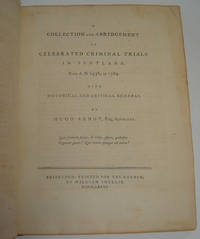
1785réf. 14122Edinburgh: William Smellie 1785. First Edition . Hardcover. Good. First Edition printed for author Arnot 1749-1786 by Smellie; 4to rebacked new leather spine and hinges strengthened with red cloth with original boards and endpapers; good leather on boards scraped chipped scratched stained worn and discolored; edges of boards worn to boards in spot very bottom edge of rear board almost completely worn to board; edges toned and soiled; brown stain spot to top edge affects pp141-74; eps toned and discolored; top corner of ffep chipped off and creased; owner's name in pen and pencil on verso of ffep; top corner of first blank flyleaf creased worn and torn off; crease to top corners of first twenty pages; word crossed out and name written in ink on page vi; pencil note and underline to p55; pencil notation to margin of p57; brown streaks to pp141-58 and 337-49; stain to side edge affects edges of pp339-93; two tears and crease to side edge of rfep; light foxing and soiling to pages; pages wavy with darkening to textblock; 440pp with List of Subscribers and Index. Contents are divided into genre crimes: Treason Parricide Murder Tumult within Burgh etc.; our copy identical in content to copy in National Library of Scotland with the exception that our copy lacks the 'Subscribers omitted' page inserted between pages xiv and xv. William Smellie hardcover
1905réf. biblio1465This is the extremely rare 1905 FIRST brought to you by short-lived Chicago publishers Thompson & Thomas and by Joseph B. Bowles who shepherded PECK'S BAD BOY and who partnered with author Johnston on this one. Book is in decent condition complete and VERY collectible as to rarity and subject matter. This copy resided in the archives of a Christian Missionary Convention cared for by Archivist C.C. Ware of Wilson NC then marked as his personal copy. Illustrated by Frank Baum illustrator Howard Heath. Photos on request. Thompson & Thomas hardcover
réf. 13477GIUSSANI Angela et Luciana. DIABOLIK n°19"Terreur" Gouache originale pour la couverture du n°16 de la première série. Format de la gouache 168x172mm contrecollée sur carton fort. Pour le n°19 de la première série :" Terreur". Très bon état. Personnage crée par les sœurs Luciana et Angela GUISSANI, en1962.Série éditée à Milan au format poche, par les éditions, ASTORINA. De nombreux dessinateurs, se sont succédés GinoMARCHESI, Paolo OUNGARO, Alarico GATTIA, Floriano BOZZI, franco PALUDATT, Edgardo DELL’ACQUIA, Line JEVA etc.
1928Generously illustrated with black and white photos and illustrations. Features: Bill Carlisle, Train Robber - An account of the amazing exploits of a man described as "the last of the train-robbers", who would notify officials when he was about to rob a train!; In Quest of the Dragon Lizards - Part I - A thrilling account of adventures on a remote Dutch East Indies island in pursuit of prehistoric flesh-eating lizards (the Komodo dragon) - with photos; The City of Golden Geese - A lively photo-illustrated account of the foie gras industry in the old city of Strasburg in Alsace; Mungoro Meets His Match - A Rhodesian tale; The End of the Chase - A hunt for a monstrous elephant near Lake Nyasa; Photo of a Kentish stilt-walker in field of hops; The Man in No. 35 - How a British officer discovered, in a Russian prison, Julius Weinberg, a Jewish banker who had actually handed Lenin and his accomplices ten million marks from the German Government in order to finance the Bolshevik revolution that destroyed Russia as a fighting force - the little man knew too much, and paid with his life for his refusal to surrender the incriminating receipts; Cycling Round the World - Part II - Kai Thorenfeldt spent over two years riding over 20,00 miles! - with photos; The bachelor Homesteaders of British Columbia - A breezy photo-illustrated account of the adventures and hardships of this cheery, happy-go-lucky class of men; The Girl Stowaway of the Cecilie - Part II - Jeanne Day snuck aboard the Herzogin Cecilie before it departed Australia for Falmouth - with photos; A Ride in the Night - An officer of the King's African Rifles falls ill on the Abyssinian frontier of Kenya Colony; The Chief's Gift - A tale from a New Zealand sheep farmer; Teddy Murphy's Close Call - A child disappears into a well in Moose Jaw, Saskatchewan. 84 pages plus 12 pages of nice vintage ads. Unmarked with average wear. A sound copy of this nice vintage issue. Book
1967Silver print cm 23 x 23. Stampa vintage. Piccola mancanza all'angolo inferiore ds. Al verso didascalia impressa con caratteri tampone. Graziano Mesina intento a caricare il fucile mitragliatore fotografato durante l'incontro che Gabriele Milani e il giornalista Vittorio Lojacono ebbero nella primavera del 1967 con il bandito di Orgosolo. Dopo settimane di tentativi andati a vuoto, i due inviati del Corriere della sera riuscirono a ottenere un'intervista con il latitante piu' ricercato d'Italia. Su Mesina pendeva una taglia di 10 milioni di lire. Questa intervista e' considerata come uno dei piu' importanti scoop giornalistici di tutti i tempi. Il reportage venne pubblicato sulla Domenica del Corriere del 2 aprile 1967.
1663réf. 000243Leiden Salomon Vaguenaer 1663
2008Hardcover Like New. Ships directly from publishers being a new release book . Pls. allow a minimum of 25 business days delivery time.
2008Paperback No expedite shipping. Pls. allow 4 - 6 weeks delivery being a newly release book from publishers. Ships from publishers directly.
1781réf. 302787In Venezia ed in Torino: Per il Giuliano 1781. 4 pp. 8vo. Later drab boards. Some foxing and staining to text paper repair to lower corner of second leaf. 4 pp. 8vo. An apparently unrecorded work on the grisly murder of Francis Cestonaro in 1779 by his wife Veneranda Porta and her lover Stefano Fantini. Cestonaro's body was cut up and the various parts dumped in the Venice canals. The murderers were hanged and Fantini was fittingly drawn and quartered. The story has passed into Venetian legend - William Dean Howells recounts it in Venetian Life as one of the three quintessential Venetian tragic legends that every gondolier has at the ready to recount. Not in OCLC Per il Giuliano unknown
1781réf. 302787In Venezia ed in Torino: Per il Giuliano 1781. 4 pp. 8vo. Later drab boards. Some foxing and staining to text paper repair to lower corner of second leaf. 4 pp. 8vo. An apparently unrecorded work on the grisly murder of Francis Cestonaro in 1779 by his wife Veneranda Porta and her lover Stefano Fantini. Cestonaro's body was cut up and the various parts dumped in the Venice canals. The murderers were hanged and Fantini was fittingly drawn and quartered. The story has passed into Venetian legend - William Dean Howells recounts it in Venetian Life as one of the three quintessential Venetian tragic legends that every gondolier has at the ready to recount. Not in OCLC Per il Giuliano unknown books
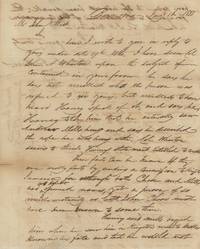
1838réf. List2426Republic of Texas 1838. Stampless letter folded with red two-line handstamp of Steam Packet Columbia on January 16 1838 from Brazoria Tex. to New Orleans. Fine condition. Fine. An intriguing letter written by Edmund Andrews a judge in Brazoria Texas who had arrived in Stephen Austin’s colony eight years before he penned this in 1830. The letter is written to John K. West the New Orleans attorney who was an original member of the notorious “New Orleans Associates.” Andrews discusses a conversation he had on behalf of West with John Austin Wharton who would die later in 1838 relating that Andrews had a conversation with Wharton on West’s behalf. The conversation with Wharton revolved around a man with the last name Chase and Andrew Mills who had both left Texas presumably and traveled to Kingston Jamaica where Mills was hanged for an undisclosed crime. Andrews writes that Wharton related that that Mills told him he “would not have done it if he had not been drunk” presumably talking about the crime for which he was hanged. Overall a very intriguing letter relating to crime exile and misdeeds in the Republic of Texas which should be of interest to scholars of the Republic. Full text follows: Brazoria Jan'y 16 1838 Mr. John K. West Sir Since I wrote to you in reply to yours under date 19th ulto. I have seen Col. John A. Wharton upon the subject contained in your favor. He says he does not recollect who the person was referred to in yours but recollects to have heard Haney speak of it and says he Haney told him that he actually saw Andrew Mills hung and says he described the rope he was hung with. Col. Wharton seems to think Haney's statement entitled to credit. These facts can be known if they are really facts by sending a commission to Kingston Jamaica for although both Chase and Mills had no doubt assumed names yet a person of so much notoriety as Capt. John Chase must have been known to some there. Haney said Mills begged him when he saw him in Kingston never to make known his fate and that he would not have done it if he had not been drunk. The foregoing is the substance of the conversation held with Col. J. A. Wharton. I am yours truly Edmund Andrews. unknown
1838réf. List2426Republic of Texas 1838. Stampless letter folded with red two-line handstamp of Steam Packet Columbia on January 16 1838 from Brazoria Tex. to New Orleans. Fine condition. Fine. An intriguing letter written by Edmund Andrews a judge in Brazoria Texas who had arrived in Stephen Austin’s colony eight years before he penned this in 1830. The letter is written to John K. West the New Orleans attorney who was an original member of the notorious “New Orleans Associates.” Andrews discusses a conversation he had on behalf of West with John Austin Wharton who would die later in 1838 relating that Andrews had a conversation with Wharton on West’s behalf. The conversation with Wharton revolved around a man with the last name Chase and Andrew Mills who had both left Texas presumably and traveled to Kingston Jamaica where Mills was hanged for an undisclosed crime. Andrews writes that Wharton related that that Mills told him he “would not have done it if he had not been drunk” presumably talking about the crime for which he was hanged. Overall a very intriguing letter relating to crime exile and misdeeds in the Republic of Texas which should be of interest to scholars of the Republic. Full text follows: Brazoria Jan'y 16 1838 Mr. John K. West Sir Since I wrote to you in reply to yours under date 19th ulto. I have seen Col. John A. Wharton upon the subject contained in your favor. He says he does not recollect who the person was referred to in yours but recollects to have heard Haney speak of it and says he Haney told him that he actually saw Andrew Mills hung and says he described the rope he was hung with. Col. Wharton seems to think Haney's statement entitled to credit. These facts can be known if they are really facts by sending a commission to Kingston Jamaica for although both Chase and Mills had no doubt assumed names yet a person of so much notoriety as Capt. John Chase must have been known to some there. Haney said Mills begged him when he saw him in Kingston never to make known his fate and that he would not have done it if he had not been drunk. The foregoing is the substance of the conversation held with Col. J. A. Wharton. I am yours truly Edmund Andrews. unknown books
1733réf. 27715Namur Belgium 1733. Ephemera. Very good condition. An unusual survival of an 18th century swindle and subsequent execution. The manuscript letter is written by Mme de Douglas to an unknown "Monsieur" from Namur Belgium dated early January 1733. Mme Douglas was the widow of one of two brothers who inherited their fathers' rich estate from the East Indies. Upon the brothers' death in order to prevent the estate being distributed to the daughter of her brother in law she paid a wet nurse and others to falsify testimony implying that the daughter was illegitimate. The daughter was imprisoned but later found to be not guilty and the courts in Holland Belgium indicted Mme Douglas. Ultimately "The verdict was that she be hanged and that her 80 year old father be brought onto the scaffoled in order to watch the execution; and her 300000 florin fortune is not sufficient to save her from her fate." Translation of an article in "Kurz-gefaßter historischer Nachrichten zum Behuf der neuern Europäischen Begebenheiten auf das Jahr 1735" vol. 45 November p. 893. Written in unaccomplished French bifold 7 1/4 x 6" 4pp. Translation from French: From Namur the 1st of Jan 1733 As I learned a few days ago that you also took possession of all the property of your father-in-law by agreement with your brother-in-law I have the honor to write you these lines to know if your intention to lodge with me was false as you assured me of demonstrating the desire if it were up to you and I assured Monsieur Questand also agreeable that you appeared to me that we could easily arrange for your interests and mine. If you come to Namur it would require us to confer together. I am lodging at the moment with Mr Canon Paradis near St. Aubain I shall await a response to this letter my compliments if you please to Madame your wife and I wish you both all good wishes in this year that we are beginning according to your desires having the honor to be with a perfect esteem Sir your very humble and very obedient Countess of Douglas In 1717 Veselovsky one of Peter the Great's entourage on his second visit to the Low Countries lodged in Namur 'chez M. le chanoine Paradis.' See Charles Maroy 'Les voyages de Pierre le Grand' L'Expansion Belge 6/4 1913: 209 199-211. Further reference to this case is made in a European history published in Nurnberg in 1744 summarizing important events in European history from 1734 to 1744 Ref. below. 'How sharply dishonesty is treated in Holland is illustrated by an example in the person of Madame Douglas. There were two Douglas brothers both married who received a rich inheritance from the East Indies. One questioned the legitimacy of the inheritance the other accepted it. The two were so hostile towards each other that guardians had to be appointed. After awhile both brothers died one of whom was survived by a daughter. Because however the other widow wanted the entire fortune for herself and her children she corrupted a wet-nurse and other witnesses who finally testified that the child presumably of the dead brother was illegitimate. The mother of the child was put in jail and the sister-in-law received the entire inheritance. After further investigation the imprisoned woman was found not guilty and the lying of the widow and her false witnesses was exposed. She the widow was prepared to pay 300000 guilders for her life but Madame Douglas ended up having to pay far more. Her 80 year old father was forced to watch the execution of her daughter on the scaffold because he had given his daughter the offending attorney Streich. Nine of the false witnesses were beaten with a broom and seven were branded.' Translation of a passage on pp. 638-639 in Andreas Lazarus von Imhof Des Neu-eröffneten historischen Bilder-Saals Zehender Theil. Nürnberg 1744. unknown