4 332 résultats
194750 pages. Great cover photo of Dusty Anderson; Features: My Toughest Fight - Boxer Joe Louis tells what it means to have a black skin and be champion of the world - major article with many great photos; No Wonder They Dropped Dead - modern marksmen say the old bad men of the saloon wars could only hit opponents at point-blank range; He Keeps Broadway On Its Feet - Dr. Horace Worrell takes care of the feet of dancers; We Almost Lost the Air War - photo-illustrated revelations of the handicaps our airmen had to overcome to make daylight bombing a success; New Yorkers are Nuts; Insurgent Senator - Republican Wayne Morse confounds his Oregon constituents by voting like a New Deal Democrat; How to Live with a Pregnant Woman; Colorado's "Atom-Proof" Canyon - great photo-illustrated article on Dr. M. Doreal and the Brotherhood of the White Temple, 35 miles southwest of Denver; If You Have To Get a Job - tips to help you get a job; Basketball's Babe Ruth - Super photo-illustrated article on Joe Fulks of Philadelphia; The Readjustment of Winnie - Vic Herman's cartoon cutie is now a civilian; Gertie (Gertrude Niesen) - Broadway's most fascinating fixture; London's Crime Wave - Eugene Messina is finally caught/London Police still refuse to carry gund; Sightless Swordsmen - photo-illustrated article on blind fencers; There's No Business Like Band Business - to become a singer with a name band you need a voice and a low-cut evening gown; Mr. Lewis' Miners; Movie of the Month - "Green Dolphin Street"; The Great Gibberisher - Tobacco Auctioneer Edgar A. Boone of Lexington, Kentucky; Frauleins as Cops - Germany trains female law-enforcement corps; Meet the Winner of Salute's Beauty Contest - 19-year-old Pat Geraghty of Houston, Texas; Coal miner cartoons by Tom Flannery; Speaking of Parties - photos from events organized by Atwater Kent and Earl Carroll; Gorgeous photo of Margaret Stohn, with zanies Vic Herman and Leisentritt in background; Handsome color back cover ad for Hammonton Park men's clothing; and more. Moderate wear. Unmarked. Light age-toning to contents. A nice vintage copy. Book
1922Abundant black and white illustrations and reproductions of photos. Features: The Last Fight of the Great Green Eel - three-day battle with a Conger eel in Trinidad; De Rougemont Right After All! - Shortly after his passing, the incredible stories by Louis de Rougement of adventures with the wild blacks (aborigines) of Australia are proven true! - article with great photos; The Lure of the Jewel - The Forcing of the Duke of Brunswick's safe; Crossed Trails - A remarkable tale of linked lives; The Midnight Visitor - A grim tale of the famous North-West Mounted Police of Canada; Trapped in a Well - two men in Nebraska set out to deepen a well; The Moffat County Mystery - an odd tale from Colorado; A Film-Hunter on the Amazon - Part II - Probably the most adventurous expedition ever undertaken in the interest of film-making - article with interesting photos; A Christmas Hunt in East Africa - sometimes 'exiles' can have a good Christmas; A Double Escape a thrilling royal tiger hunt in India; A Man's Luck - Part V - the true story of a man who set out to build an Alaskan home for the girl of his dream but kept being jailed; The Accursed Lake - The strange story of David Burton and Charles Snisted in New Zealand; The Living Death - an explorer's grim story from the South American jungle; Anthropop - Apology; and more. pp. 8 [ads], [2] 268-351, 9-16 [ads]. Clean and unmarked with light wear. A quality vintage copy of this wonderful issue. Book
193184 pages. Features: Nice mini-golf cover illustration; Heinz vinegar and olive oil colour ad inside front cover; Nice vintage full-page photo ad for Clark's Tomato Ketchup features grocer behind counter speaking with lady customer dressed in contemporary fashion; Miss Anne Morgan, daughter of the late J.Pierpont Morgan - discusses modern women - ad with photo of Miss Morgan as part of Pond's ad; Some Truths about Wheat - W.W. Swanson argues that there has been no "foolish overproduction of wheat"; Backstage at Ottawa; The Dark Road (fiction); Pigeons on Patrol - the story of the Royal Canadian Air Force pigeon service whose winged messengers have pulled many a pilot out of a tight hole; The Hyams Twins Case - Did the Hyams brothers kill Willie Wells in Toronto in 1893?; Barry's Clarissa (fiction); The Silver Scale (fiction); Patrick "Pat" Burns - One of the West's Dominant Business Figures; Bonds of Danger - the story of "Surge" the steelhead; Canadians in Hollywood - great article with five nice photos of stars Fifi Dorsay, Walter Huston, Fay Wray, Mary Pickford, Marie Dressler, and Norma Shearer (photo of Pauline Garon appears later); The Devil in the Jade - a strange tale of mysterious Burma; The Western Mennonites - a graphic description of life among a group of New Canadians now in the throes of the conflict between orthodoxy and modernism - with photos; Sir Oswald Mosley and his New Party cause stir in Britain; Nice full-page photo ad for Kraft cheese and Velveeta; Nice full-page ad for the Chrysler Eight De Luxe; Nice full-page illustrated ad for REO speed wagons and trucks; The Brome Lake Duck Farm of Knowlton, Quebec - article with photos; Nice full-page colour ad for Swift's bacon; Great colour full-page art deco ad for Calay soap; Full-page illustrated ad for Studebaker Trucks features a 2-ton model for $1125; Nice photo ad for Spud cigarettes features a pilot lighting up; Fashionable full-page ad for Penmans new silk hosiery; Excellent full-page colour ad for International Harvester commemorates the centennial of the McCormick reaper; Nice colour full-page ad for Keen's mustard; Woodward's "Gripe Water" ad; Excellent two-colour full-page ad for Dodge Trucks shows row of trucks backed up to loading gates; Nice full-page two-colour ad for the book Murder at Belly Butte; Humour; Nice full-page ad for the Graham Prosperity Six car; Lux soap ad features photos of Clara Bow, Nancy Carroll, June Collyer, Mary Brian, Lillian Roth, and William Powell; Hot weather supper dishes - recipes; Nuce full-page ad for the new Chevrolet Convertible Cabriolet; Outdoor furniture; Colour ad for Parker pens on back cover. Unmarked. Somewhat above-average wear and soiling. A worthy vintage copy of this excellent issue. Book
1929Generously illustrated with black and white photos and illustrations. Features: The Man Who Fought a Regiment - Bandit, murderer and escaped felon, "human monster" Paul Jawarski was pursued by over 250 heavily-armed policemen; The Optimist - The moving story of a gentleman who thought he could make a profitable living out of elephant-hunting; The Longest Canoe Voyage on Record - Part I - Robert Copeman and John H.E. Nolan set out from Edmonton for the Gulf of Mexico over 6,000 miles away! - article with photos; A Fool Afoot in France - Part III - The continued misadventures of John Gibbons as he tramps from the French coast to Lourdes; "Hitch-Hiking" Across the United States - Alfred Batson hitch-hiked from New York to San Francisco and had some very odd and exciting adventures - includes map and photo; Byways of Old Pekin [Peking / Beijing] - A wonderfully photo-illustrated presentation of the quaint street-life of the unspoiled native quarters of the Chinese capital, where things still go on much as they did in the Middle Ages; What Happened at "Warne's Folly" - A prospector's terrible predicament in an abandoned Queensland mineshaft; The Horns of a Dilemma - A Queensland bushman's amusing account of an argument with a bad-tempered old cow; Saved By Man-Eating Sharks - A deep-sea diver's terrifying experience in the Sulu Sea; "The White Brother of the Sheik" - Part II of W.B. Seabrook's adventurous trip to meet Mitkhal Pasha, Sheik of Sheiks of the Beni Sakhr, with photos; Photo and bried write-up of a large sink hole near Sharon Springs, Kansas; The Mystery of Crocodile Pool - A weird adventure that befell a young police corporal who is now one of the leading officers of the South African C.I.D. 84 pages plus 12 pages of great ads. Unmarked with average wear. A sound vintage copy of this fascinating issue. Book
1955réf. ZB393271National Council on Crime and Delinquency 1955-1974. volumes 1-20 partly bound library markings else texts clean & bindings tight. - If you are reading this this item is actually physically in our stock and ready for shipment once ordered. We are not bookjackers. Buyer is responsible for any additional duties taxes or fees required by recipient's country. Photos available upon request. National Council on Crime and Delinquency unknown
1901réf. 001952Berlin - Dahlem: J. Guttentag 1901. SEE PHOTOS. Very Good condition. Bright clean square tight and unmarked. Handsomely bound with cream cloth spine and corners over marbled-paper covered boards. Decorated endpapers. Page edges are also attractively marbled. No underlining. No margin notes. Text in German. Hans Gustav Adolf Gross 1847 - 1915 is considered the 'father of criminalistics.' Dr. Gross was Examining Magistrate and Professor of Penal Law at the Universities of Czernowitz and Graz. Gross's work was based on the practical application of scientific techniques. His book HANDBUCH FÜR UNTERSUCHUNGSRICTER ALS SYSTEM DER KRIMINALISTIK was published in 1893 and translated into English as CRIMINAL INVESTIGATION in 1907 See p. 222 in THE ENCYCLOPEDIA OF FORENSIC SCIENCE by Brian Lane Headline Book Publishing PLC 1992. Keywords: Criminal Psychology. Criminalistics. Fingerprinting. Art Forgery. Kriminalpsychologie. Psychische Kriminalistik. Verbrechensbekämpfung. Strafrecht. Strafpolitik. First Edition 1. Auflage. Hardcover. Very Good condition. Illus. by NOT a library discard. 8vo. viii 288pp. Great Packaging Fast Shipping. J. Guttentag Hardcover
19498vo., First Edition thus; elegantly bound in full dark green crushed morocco, sides with gilt frame border, back with raised bands, second and fourth compartments lettered and ruled in gilt, all other compartments tooled in gilt, gilt top, hand-made endpapers, ribbon marker, a most attractive copy ideal as a gift or for presentation. Chandler's penultimate Marlowe novel. The UK first edition precedes the US edition. SCARCE IN THIS CONDITION
1971réf. 382242Washington: Government Printing Office 1971. Hardcover. Near Fine. First edition. Multiple Special House Reports 91st Congress 2d Session bound in one volume. Thick octavo. Complete as issued in the original publisher's cloth. Some toning near fine. Contains two important investigative reports by the Committee on Internal Security i.e. the renamed House Un-American Activities Committee: Anatomy of a Revolutionary Movement: "Students for a Democratic Society" No. 1565: vii 175 xiii pp. with photographs; and Report of Inquiry Concerning Speakers' Honoraria at Colleges and Universities No. 1732: xii 52pp. Both were conducted under the direction of Richard H. Ichord the Committee's Chairman a fervent anti-Communist who crusaded against the Peace Movement during the Vietnam War. The report on Students for a Democratic Society and associated New Left groups includes an illustration of FBI Wanted Poster for William Charles "Bill" Ayers that was used by House Republicans to discredit President Barack Obama. The report on Speakers' Honoraria undertaken to investigate the possibility that New Left radical groups and organizations were financing their activities through speaking engagements includes the Dissenting View of African-American Congressman Louis Stokes of Ohio. Also included in this volume are three timely reports by the Select Committee on Crime on drug use and related criminal activities among urban and counterculture youth: Juvenile Justice and Corrections No. 1806: v 85pp.; Amphetamines No. 1807: v 44pp.; and Heroin and Heroin Paraphernalia: Second Report by the Select Committee on Crime No. 1808: v 83pp. A nice copy scarce in the trade. Government Printing Office hardcover
1971réf. 382242Washington: Government Printing Office 1971. Hardcover. Near Fine. First edition. Multiple Special House Reports 91st Congress 2d Session bound in one volume. Thick octavo. Complete as issued in the original publisher's cloth. Some toning near fine. Contains two important investigative reports by the Committee on Internal Security i.e. the renamed House Un-American Activities Committee: Anatomy of a Revolutionary Movement: "Students for a Democratic Society" No. 1565: vii 175 xiii pp. with photographs; and Report of Inquiry Concerning Speakers' Honoraria at Colleges and Universities No. 1732: xii 52pp. Both were conducted under the direction of Richard H. Ichord the Committee's Chairman a fervent anti-Communist who crusaded against the Peace Movement during the Vietnam War. The report on Students for a Democratic Society and associated New Left groups includes an illustration of FBI Wanted Poster for William Charles "Bill" Ayers that was used by House Republicans to discredit President Barack Obama. The report on Speakers' Honoraria undertaken to investigate the possibility that New Left radical groups and organizations were financing their activities through speaking engagements includes the Dissenting View of African-American Congressman Louis Stokes of Ohio. Also included in this volume are three timely reports by the Select Committee on Crime on drug use and related criminal activities among urban and counterculture youth: Juvenile Justice and Corrections No. 1806: v 85pp.; Amphetamines No. 1807: v 44pp.; and Heroin and Heroin Paraphernalia: Second Report by the Select Committee on Crime No. 1808: v 83pp. A nice copy scarce in the trade. Government Printing Office hardcover books
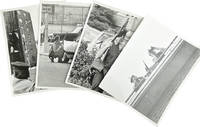
1974réf. 21567Queens NY 1974. Very Good . Queens NY: 1974. Thirty original press photographs measuring ca. 23.5x18cm. to 28x18cm. or the inverse some with snipe in image or mounted to verso; occasional color pencil annotations to versos one piece of snipe separated else a Very Good collection images all quite sharp. Substantial archive of press photographs covering a thirty-hour hostage situation that took place at the South Jamaica Houses in Queens New York. Floyd Steele recently on parole from the Matteawan State Hospital for the Criminally Insane was the tenant of Fred and Peggy Dalton Kinsler living in their apartment with Peggy's five-year-old daughter Avril. Steele had already been convicted twice for manslaughter charges including the 1963 fire arm death of his girl friend. Late on the evening of June 10th 1974 Steele allegedly made an unwanted advance at Peggy threatening the family with a loaded gun when she rebuffed him. Peggy managed to lock herself in a bedroom and used a sheet to climb out of the third story window to alert the police. According to Cecil Mackey a member of the Housing Authority Police and one of the lead negotiators during the following thirty-three hour stand off an early attempt to break open the door to the apartment found Steele pointing the gun at young Avril's head threatening to shoot if they did not shut the door. Mackey and the newly-formed hostage negotiation team developed by Simon Eisdorfer in the wake of the deadly attack on the 1972 Olympics employed the latter's negotiation techniques which according to a 2005 obituary article "deemphasized confrontation focusing instead on saving lives. Studying earlier cases Eisdorfer realized that negotiators could subtly turn a siege into a waiting game that played out in their favor. Police officers could change shifts but the suspects could not and eventually became tired and hungry enough to surrender." Mackey and fellow officer Lt. Francis Bolz followed these protocols addressing Steele as "Mister" chatting about gardenias and slowly managing to gain Steele's trust enough to open the door long enough to provide him and Avril with breakfast and hot coffee. It was by proffering Avril a glass of Kool-Aid that Bolz managed to pull her out of the apartment door and place his body equipped with bullet proof vest between her and Steele. Steele surrendered immediately though it was discovered that his gun was still loaded and Fred Kinsler had been killed by two bullets to the neck and chest. From start to finish the situation lasted thirty-three hours and was later described by Police Commissioner Michael Codd as "an ideal marriage of the community and the professional policeman in action" "New York Daily News" June 13 1974. The present collection of photographs attributed to Ted Cunningham Dan Neville and Paul Hosefros were splashed across newspapers across the country. Half of the photographs in the collection depict members of the police force as the situation unfolded including snipers situated on the ground and on a nearby rooftop. A number of images of the small window into the apartment also feature heavily including one in which one can just see the small hand of Avril Kinsler shutting the window upon Steele's instructions. Approximately half of the photographs document the immediate aftermath of Steele's arrest including four close-up shots of him being led by members of the police force; two show Avril being carried away by an unknown policewoman; and three photographs show Peggy Kinsler in a state of shock being wheeled out of the apartment in a gurney after discovering that her husband had been murdered. A substantial and important documentation on the history of police tactics on both the local and the national level. unknown
1974réf. 21567Queens NY 1974. Very Good . Queens NY: 1974. Thirty original press photographs measuring ca. 23.5x18cm. to 28x18cm. or the inverse some with snipe in image or mounted to verso; occasional color pencil annotations to versos one piece of snipe separated else a Very Good collection images all quite sharp. Substantial archive of press photographs covering a thirty-hour hostage situation that took place at the South Jamaica Houses in Queens New York. Floyd Steele recently on parole from the Matteawan State Hospital for the Criminally Insane was the tenant of Fred and Peggy Dalton Kinsler living in their apartment with Peggy's five-year-old daughter Avril. Steele had already been convicted twice for manslaughter charges including the 1963 fire arm death of his girl friend. Late on the evening of June 10th 1974 Steele allegedly made an unwanted advance at Peggy threatening the family with a loaded gun when she rebuffed him. Peggy managed to lock herself in a bedroom and used a sheet to climb out of the third story window to alert the police. According to Cecil Mackey a member of the Housing Authority Police and one of the lead negotiators during the following thirty-three hour stand off an early attempt to break open the door to the apartment found Steele pointing the gun at young Avril's head threatening to shoot if they did not shut the door. Mackey and the newly-formed hostage negotiation team developed by Simon Eisdorfer in the wake of the deadly attack on the 1972 Olympics employed the latter's negotiation techniques which according to a 2005 obituary article "deemphasized confrontation focusing instead on saving lives. Studying earlier cases Eisdorfer realized that negotiators could subtly turn a siege into a waiting game that played out in their favor. Police officers could change shifts but the suspects could not and eventually became tired and hungry enough to surrender." Mackey and fellow officer Lt. Francis Bolz followed these protocols addressing Steele as "Mister" chatting about gardenias and slowly managing to gain Steele's trust enough to open the door long enough to provide him and Avril with breakfast and hot coffee. It was by proffering Avril a glass of Kool-Aid that Bolz managed to pull her out of the apartment door and place his body equipped with bullet proof vest between her and Steele. Steele surrendered immediately though it was discovered that his gun was still loaded and Fred Kinsler had been killed by two bullets to the neck and chest. From start to finish the situation lasted thirty-three hours and was later described by Police Commissioner Michael Codd as "an ideal marriage of the community and the professional policeman in action" "New York Daily News" June 13 1974. The present collection of photographs attributed to Ted Cunningham Dan Neville and Paul Hosefros were splashed across newspapers across the country. Half of the photographs in the collection depict members of the police force as the situation unfolded including snipers situated on the ground and on a nearby rooftop. A number of images of the small window into the apartment also feature heavily including one in which one can just see the small hand of Avril Kinsler shutting the window upon Steele's instructions. Approximately half of the photographs document the immediate aftermath of Steele's arrest including four close-up shots of him being led by members of the police force; two show Avril being carried away by an unknown policewoman; and three photographs show Peggy Kinsler in a state of shock being wheeled out of the apartment in a gurney after discovering that her husband had been murdered. A substantial and important documentation on the history of police tactics on both the local and the national level. unknown books
1968réf. 982671968 Editions André Sauret, collection "Grand prix des meilleurs romans policiers" - 1968 - 12 volumes in-8, plein chagrin rouge; roulette dorée sur les plats; étui cartonné rouge avec bordures cuir noir - 348 + 219 + 270 + 249 + 259 + 405 + 263 + 261 + 272 + 304 + 245 + 236 pages - Quelques illustrations in texte - Ouvrage tiré sur vélin des papeteries d'arches filigrané à la marque de l'éditeur, exemplaire numéroté N° 492 / 3000
19498vo., Uncorrected Proof Copy; half-title and title lightly browned; original plain grey wrappers, very lightly dust-soiled and chafed at head and tail of backstrip, a very good, clean copy now safely preserved for the future in a custom-made solander case.
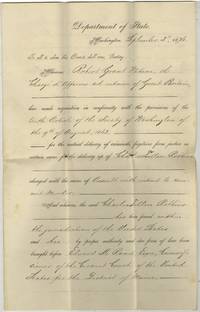
1874réf. BK0084Washington D.C.: Department of State 1874. Partly printed document completed in manuscript 2 pp. 16 ¾ x 10 ½ inches signed by Hamilton Fish as Secretary of State with embossed Department of State seal. Some small tears at folds otherwise near fine; very good plus overall. A Department of State extradition warrant arising from a violent episode aboard the British schooner Annie B and a subsequent dispute over whether the accused should be tried in Great Britain or Maine. Charles Tilton Robbins of Deer Isle boarded the vessel at Portland on May 22 1874 using the name "Dunham of St. Andrews" and taking passage for Saint John. According to the Maine Attorney General's contemporary account while the schooner was seven miles off Monhegan Light Robbins attacked the two men on deck with a revolver and then an iron bar mortally wounding mate Solomon Camp. Robbins escaped in the schooner's boat to Monhegan and then reached Rockland where he was arrested aboard the Deer Isle packet. Camp died at Rockland on May 28.1 Because the attack occurred aboard a British vessel on the high seas Great Britain claimed jurisdiction and requested Robbins's extradition under the tenth article of the Webster-Ashburton Treaty. U.S. Commissioner Edward M. Rand found the evidence sufficient to hold him pending action in Washington. In the present document Fish records that British chargé d'affaires Robert Grant Watson had made the required requisition and directs the United States Marshal for Maine or whoever had Robbins in custody "to surrender and deliver him up" to the British representative. The warrant appears to preserve a short-lived federal decision. Because Camp had died in Maine state authorities maintained that Maine itself had jurisdiction over the resulting murder. Robbins and his supporters appealed to Governor Nelson Dingley Jr. who intervened with Washington to prevent the extradition. The federal government subsequently declined to surrender Robbins and ordered him transferred to Maine authorities for trial. He was indicted in Knox County and brought to trial on September 29; after a twelve-day proceeding in which the defense was a general denial and insanity the jury found him not guilty by reason of insanity. Overall an interesting document from a notable nineteenth-century extradition dispute in which a single killing brought British maritime jurisdiction Maine criminal law and federal treaty obligations into direct conflict. 1 "In the County of Knox" Report of the Attorney General of the State of Maine. 1874 Sprague Owen & Nash 1875 5. . Department of State unknown
1874réf. BK0084Washington D.C.: Department of State 1874. Partly printed document completed in manuscript 2 pp. 16 ¾ x 10 ½ inches signed by Hamilton Fish as Secretary of State with embossed Department of State seal. Some small tears at folds otherwise near fine; very good plus overall. A Department of State extradition warrant arising from a violent episode aboard the British schooner Annie B and a subsequent dispute over whether the accused should be tried in Great Britain or Maine. Charles Tilton Robbins of Deer Isle boarded the vessel at Portland on May 22 1874 using the name "Dunham of St. Andrews" and taking passage for Saint John. According to the Maine Attorney General's contemporary account while the schooner was seven miles off Monhegan Light Robbins attacked the two men on deck with a revolver and then an iron bar mortally wounding mate Solomon Camp. Robbins escaped in the schooner's boat to Monhegan and then reached Rockland where he was arrested aboard the Deer Isle packet. Camp died at Rockland on May 28.1 Because the attack occurred aboard a British vessel on the high seas Great Britain claimed jurisdiction and requested Robbins's extradition under the tenth article of the Webster-Ashburton Treaty. U.S. Commissioner Edward M. Rand found the evidence sufficient to hold him pending action in Washington. In the present document Fish records that British chargé d'affaires Robert Grant Watson had made the required requisition and directs the United States Marshal for Maine or whoever had Robbins in custody "to surrender and deliver him up" to the British representative. The warrant appears to preserve a short-lived federal decision. Because Camp had died in Maine state authorities maintained that Maine itself had jurisdiction over the resulting murder. Robbins and his supporters appealed to Governor Nelson Dingley Jr. who intervened with Washington to prevent the extradition. The federal government subsequently declined to surrender Robbins and ordered him transferred to Maine authorities for trial. He was indicted in Knox County and brought to trial on September 29; after a twelve-day proceeding in which the defense was a general denial and insanity the jury found him not guilty by reason of insanity. Overall an interesting document from a notable nineteenth-century extradition dispute in which a single killing brought British maritime jurisdiction Maine criminal law and federal treaty obligations into direct conflict. 1 "In the County of Knox" Report of the Attorney General of the State of Maine. 1874 Sprague Owen & Nash 1875 5. . Department of State unknown books
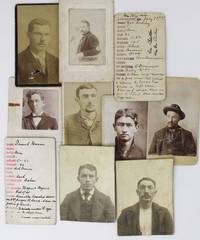
1899réf. 5150Kansas City Mo 1899. Very good. Ten carte-de-visite photographs 4 x 2.5 inches or slightly smaller on thick cardboard mounts four with partially-printed "rap sheets" on verso completed in manuscript. Occasional edge and surface wear as well as generally light dust-soiling. A nice group. A group of ten fabulous mugshot photographs or studio portraits featuring criminals in the last few years of the 1800s in Kansas City Missouri. Four of the photographs are particularly interesting for the personal and criminal history information recorded on their versos. These photographs are pre-printed with a list of fields to be filled out by the criminal or perhaps the jailer. The combination of fields varies slightly on three of the four cards but generally they all ask for similar information including name; aliases nationality age height weight eye color hair color complexion occupation or "Criminal Occupation" the pertinent crime place of arrest arresting officer date date of arrest and distinguishing marks or "Peculiarities of Build Features Scars Marks etc.". One of the mugshots is that of James Carrington Francis 1869-1892. At the bottom of his card is written: "Killed at Pleasanton KS for Pacific Ex Robbery Jan. 23 '92." Francis had indeed taken part in the robbery of the Frisco Express out of St. Louis on the night of November 30 1891. During the robbery two masked men boarded that train as it was leaving St. Louis. They remained in seclusion until they had traveled a few miles and then presented pistols to the heads of the engineer and fireman. They ordered them to stop at the point where two accomplices of the highwaymen were stationed. The engineer and fireman were then ordered from the cab and kept covered while the party proceeded to the express car where the robbers demanded admission but were refused by the messenger. The robbers then set off a stick of dynamite and blew in the side of the car seriously injuring the messenger. They then entered blew open the safe and after taking $10000 made their escape. The Pinkerton Detective Agency and Chief of Detectives Desmond of St. Louis investigated the case and gathered evidence which convinced them that the robbers were Marion Hedgepeth Dink Wilson Adelbert Slye and James Francis. The other three men whose photographs are supplemented with personal information include Frank Norris Patrick Raine and George Conley. Oddly enough the crimes of all four men are not stipulated on the present photographs. Norris was a baker by trade with a scar on the palm of his hand and a "knuckle knocked down" who was arrested on October 5 1895. Patrick Raine was a waiter with a forearm tattoo and "2 vax scars on left arm" arrested on January 24 1899. George Conley alias George Baker or George King was a brakeman arrested on July 12 1897. The remaining photographs do not include identifying information save for two with penciled names on the verso and one with a studio stamp from J.V. Dabbs in Fort Scott Kansas but were found with the previous four photographs and would likely reward further research into the Wild West criminal world of late-19th century Kansas. unknown
1899réf. 5150Kansas City Mo 1899. Very good. Ten carte-de-visite photographs 4 x 2.5 inches or slightly smaller on thick cardboard mounts four with partially-printed "rap sheets" on verso completed in manuscript. Occasional edge and surface wear as well as generally light dust-soiling. A nice group. A group of ten fabulous mugshot photographs or studio portraits featuring criminals in the last few years of the 1800s in Kansas City Missouri. Four of the photographs are particularly interesting for the personal and criminal history information recorded on their versos. These photographs are pre-printed with a list of fields to be filled out by the criminal or perhaps the jailer. The combination of fields varies slightly on three of the four cards but generally they all ask for similar information including name; aliases nationality age height weight eye color hair color complexion occupation or "Criminal Occupation" the pertinent crime place of arrest arresting officer date date of arrest and distinguishing marks or "Peculiarities of Build Features Scars Marks etc.". One of the mugshots is that of James Carrington Francis 1869-1892. At the bottom of his card is written: "Killed at Pleasanton KS for Pacific Ex Robbery Jan. 23 '92." Francis had indeed taken part in the robbery of the Frisco Express out of St. Louis on the night of November 30 1891. During the robbery two masked men boarded that train as it was leaving St. Louis. They remained in seclusion until they had traveled a few miles and then presented pistols to the heads of the engineer and fireman. They ordered them to stop at the point where two accomplices of the highwaymen were stationed. The engineer and fireman were then ordered from the cab and kept covered while the party proceeded to the express car where the robbers demanded admission but were refused by the messenger. The robbers then set off a stick of dynamite and blew in the side of the car seriously injuring the messenger. They then entered blew open the safe and after taking $10000 made their escape. The Pinkerton Detective Agency and Chief of Detectives Desmond of St. Louis investigated the case and gathered evidence which convinced them that the robbers were Marion Hedgepeth Dink Wilson Adelbert Slye and James Francis. The other three men whose photographs are supplemented with personal information include Frank Norris Patrick Raine and George Conley. Oddly enough the crimes of all four men are not stipulated on the present photographs. Norris was a baker by trade with a scar on the palm of his hand and a "knuckle knocked down" who was arrested on October 5 1895. Patrick Raine was a waiter with a forearm tattoo and "2 vax scars on left arm" arrested on January 24 1899. George Conley alias George Baker or George King was a brakeman arrested on July 12 1897. The remaining photographs do not include identifying information save for two with penciled names on the verso and one with a studio stamp from J.V. Dabbs in Fort Scott Kansas but were found with the previous four photographs and would likely reward further research into the Wild West criminal world of late-19th century Kansas. unknown books
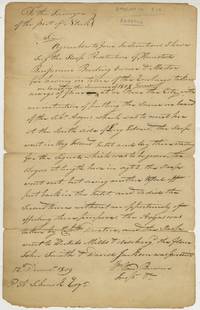
1809réf. BK0093No place 1809. Manuscript letter one page 8 x 12 ½ inches. Old folds with wear and separations at folds otherwise well preserved and legible. An interesting contemporary report on the enforcement of Jefferson's Embargo Act around New York and Long Island describing an elaborate attempt to transfer a cargo of flour at sea and recording the seizure of one of the vessels by Captain Stephen Decatur. Writing to Peter A. Schenck Surveyor of Customs for the Port of New York the author reports that "Agreeable to your Instructions" he had seized the sloop Resolution of Hempstead owned and commanded by Benjamin Burling. The seizure concerned events in June 1808 when the Resolution had taken on a cargo of flour "at or near the City" with the intention of transferring it to the schooner Argus off the south side of Long Island. The Resolution proceeded to Hog Island Inlet and waited there for a prearranged signal: "the Argus at length hove in sight the Sloop went out but seeing another vessel aft put back in the Inlet". A second attempt was likewise abandoned before the cargo could be transferred. The report then records the fate of the other vessel: "the Argus was taken by Capt. Decatur" while the Resolution returned and discharged its flour. John Smith and David Jackson are named as witnesses. The identification of "Capt. Decatur" as Stephen Decatur is supported by his documented service during this period. In the summer and fall of 1808 Decatur and the frigate Chesapeake were employed enforcing the embargo along the northeastern seaboard. The Navy Department instructed him that violations had become sufficiently serious that an active naval presence was required on the east coast.1 Contemporary records document Decatur making other embargo seizures that year including the Montezuma while later accounts record his capture of the Mount Vernon and John carrying provisions. The letter was written after the Embargo Act itself had expired in March 1809 but concerns an alleged violation committed while it was in force and appears to document the subsequent customs seizure of the Resolution. Its recipient Peter A. Schenck had served as Surveyor of Customs at New York since 1806 and was deeply involved in enforcing federal trade restrictions at the port. 1 Joe Mosier "Enforcing the Dambargo. The U.S. Navy Norfolk and the Embargo of 1807" The Daybook 12 no. 4 6-15. . unknown
1809réf. BK0093No place 1809. Manuscript letter one page 8 x 12 ½ inches. Old folds with wear and separations at folds otherwise well preserved and legible. An interesting contemporary report on the enforcement of Jefferson's Embargo Act around New York and Long Island describing an elaborate attempt to transfer a cargo of flour at sea and recording the seizure of one of the vessels by Captain Stephen Decatur. Writing to Peter A. Schenck Surveyor of Customs for the Port of New York the author reports that "Agreeable to your Instructions" he had seized the sloop Resolution of Hempstead owned and commanded by Benjamin Burling. The seizure concerned events in June 1808 when the Resolution had taken on a cargo of flour "at or near the City" with the intention of transferring it to the schooner Argus off the south side of Long Island. The Resolution proceeded to Hog Island Inlet and waited there for a prearranged signal: "the Argus at length hove in sight the Sloop went out but seeing another vessel aft put back in the Inlet". A second attempt was likewise abandoned before the cargo could be transferred. The report then records the fate of the other vessel: "the Argus was taken by Capt. Decatur" while the Resolution returned and discharged its flour. John Smith and David Jackson are named as witnesses. The identification of "Capt. Decatur" as Stephen Decatur is supported by his documented service during this period. In the summer and fall of 1808 Decatur and the frigate Chesapeake were employed enforcing the embargo along the northeastern seaboard. The Navy Department instructed him that violations had become sufficiently serious that an active naval presence was required on the east coast.1 Contemporary records document Decatur making other embargo seizures that year including the Montezuma while later accounts record his capture of the Mount Vernon and John carrying provisions. The letter was written after the Embargo Act itself had expired in March 1809 but concerns an alleged violation committed while it was in force and appears to document the subsequent customs seizure of the Resolution. Its recipient Peter A. Schenck had served as Surveyor of Customs at New York since 1806 and was deeply involved in enforcing federal trade restrictions at the port. 1 Joe Mosier "Enforcing the Dambargo. The U.S. Navy Norfolk and the Embargo of 1807" The Daybook 12 no. 4 6-15. . unknown books
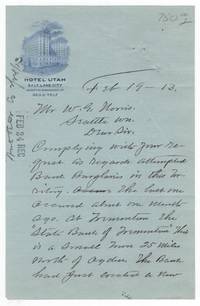
réf. 64479Handwritten letter on 4 pages measuring 5 1/2 x 8 1/2". With the letterhead "Hotel Utah Salt Lake City Under the Management of Geo. O. Relf." The letter is dated February 19 1913. The author writes: "Dear Sir "Complying with your request as regards attempted Bank Burglaries in this Territory. The last one occurred about one month ago. At Tremonton the “State Bank of Tremonton” This is a small town 25 miles north of Ogden. The bank had just located a new building and was ready to move in. They were using an old plate safe. But we sold them a new Manganese. The new safe was in the vault of the new bank while the old safe remained in the old building and vault. The bank had acknowledged they would move on Monday. On Sunday night the Burglers sic entered the old Bank and blew the old safe. But the Saturday evening previous the Cashier had transferred all the money to the new safe. So the yeggmen did not secure a cent and all the damage they did was to put the old safe out of use. The only other attempts I know of in the past six months was on a bank at Midvale Ut. and Murray Ut both small town south of Salt Lake about 15 and 25 miles. In both cases all they did was to punch the lock off the vault door. There was no attempt on either safe and the yeggs got nothing. "I presume you have heard of the First National at St. Anthony being entirely burned out as also the Commercial Bank at Burley Id. "Yours very truly " A letter with interesting content describing early twentieth century attempts at breaking open safes in small Utah towns which leave the yeggmen empty handed in the end. The letter is addressed to Mr. W. G. Norris of Seattle WA. William G. Norris was president of Norris Safe & Locke Co. which was a seller of safes. In 1904 the business occupied one of the first-floor storefronts of the Estabrook building at 1336 2nd Avenue. Perhaps Mr. Norris had queried the author of the letter as to how his safes were withstanding the occasional burglaries of the times. unknown
réf. 64479Handwritten letter on 4 pages measuring 5 1/2 x 8 1/2". With the letterhead "Hotel Utah Salt Lake City Under the Management of Geo. O. Relf." The letter is dated February 19 1913. The author writes: "Dear Sir "Complying with your request as regards attempted Bank Burglaries in this Territory. The last one occurred about one month ago. At Tremonton the “State Bank of Tremonton” This is a small town 25 miles north of Ogden. The bank had just located a new building and was ready to move in. They were using an old plate safe. But we sold them a new Manganese. The new safe was in the vault of the new bank while the old safe remained in the old building and vault. The bank had acknowledged they would move on Monday. On Sunday night the Burglers sic entered the old Bank and blew the old safe. But the Saturday evening previous the Cashier had transferred all the money to the new safe. So the yeggmen did not secure a cent and all the damage they did was to put the old safe out of use. The only other attempts I know of in the past six months was on a bank at Midvale Ut. and Murray Ut both small town south of Salt Lake about 15 and 25 miles. In both cases all they did was to punch the lock off the vault door. There was no attempt on either safe and the yeggs got nothing. "I presume you have heard of the First National at St. Anthony being entirely burned out as also the Commercial Bank at Burley Id. "Yours very truly " A letter with interesting content describing early twentieth century attempts at breaking open safes in small Utah towns which leave the yeggmen empty handed in the end. The letter is addressed to Mr. W. G. Norris of Seattle WA. William G. Norris was president of Norris Safe & Locke Co. which was a seller of safes. In 1904 the business occupied one of the first-floor storefronts of the Estabrook building at 1336 2nd Avenue. Perhaps Mr. Norris had queried the author of the letter as to how his safes were withstanding the occasional burglaries of the times. unknown books
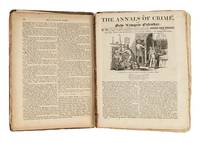
1833réf. 860791833. A Scarce and Short-Lived Crime Periodical from Late Georgian London Crime. Newgate Calendar. The Annals of Crime And Newgate Calendar. Vol. 1 Nos. 1-53 all published. London: Published every Saturday Morning for the Proprietor by Berger 1833-1834. 44 50-424 pp. Issue No. 6 incomplete but likely as-issued. Quarto 9-3/4" x 7-1/2"; 26 x 19 cm. Original plain publisher's boards text block edges untrimmed. Worn boards detached signatures loose first leaf rehinged onto front pastedown. Moderate toning to interior light browning in places chipping and edgewear to some leaves tears to leaf 2H4 pp. 239-240 with loss to text at upper left and lower right corners. Item housed in archival box. An interesting and scarce title. $750. A classic example of London's penny literature The Annals of Crime continues the tradition of Newgate calendars past and delivers florid accounts of treason murder robbery forgery piracy and many other crimes. Cheap and ubiquitous periodicals like this inspired and provided source material for Charles Dickens and many other novelists. The Annals was issued individually by number in parts of six numbers each and in a single bound volume. Based on the binding and condition the present copy is probably one of the single-volume issues; for this reason we believe the missing content from No. 6 is due to a contemporary error by the printer. Like all other issues in the volume it consists of 8 pp. but its account of the execution of Louis Mandrin is unfinished. We could not find a digital copy identical to ours for comparison. Issues of this short-lived periodical are scarce today. OCLC locates print copies at 6 institutions worldwide British Library Oxford SUNY-Binghamton University of California UCLA University of Minnesota. unknown
1833réf. 860791833. A Scarce and Short-Lived Crime Periodical from Late Georgian London Crime. Newgate Calendar. The Annals of Crime And Newgate Calendar. Vol. 1 Nos. 1-53 all published. London: Published every Saturday Morning for the Proprietor by Berger 1833-1834. 44 50-424 pp. Issue No. 6 incomplete but likely as-issued. Quarto 9-3/4" x 7-1/2"; 26 x 19 cm. Original plain publisher's boards text block edges untrimmed. Worn boards detached signatures loose first leaf rehinged onto front pastedown. Moderate toning to interior light browning in places chipping and edgewear to some leaves tears to leaf 2H4 pp. 239-240 with loss to text at upper left and lower right corners. Item housed in archival box. An interesting and scarce title. $750. A classic example of London's penny literature The Annals of Crime continues the tradition of Newgate calendars past and delivers florid accounts of treason murder robbery forgery piracy and many other crimes. Cheap and ubiquitous periodicals like this inspired and provided source material for Charles Dickens and many other novelists. The Annals was issued individually by number in parts of six numbers each and in a single bound volume. Based on the binding and condition the present copy is probably one of the single-volume issues; for this reason we believe the missing content from No. 6 is due to a contemporary error by the printer. Like all other issues in the volume it consists of 8 pp. but its account of the execution of Louis Mandrin is unfinished. We could not find a digital copy identical to ours for comparison. Issues of this short-lived periodical are scarce today. OCLC locates print copies at 6 institutions worldwide British Library Oxford SUNY-Binghamton University of California UCLA University of Minnesota. unknown books
1936If vintage true crime is your thing, you just hit the jackpot! 48 pages of fascinating cover-to-cover articles on sensational crimes of the day and related topics, all generously illustrated with quality black and white reproductions of photos. Features: Rehabilitation As I See It - by Richard E. Davis, Warden, Utah State Penitentiary; Inside Story of the Murder of Curtis W. Dobbins, brilliant young engineer of the RCA Victor Corporation, in the exclusive Camden suburb of Haddonfield; The Skull That Came Back To Life - the bones of Lillian White, murdered on Cheesecock Mountain near Haverstraw, New York, were used to reconstruct her identity and make possible a feverish manhunt; Sex Behind Bars - an expose of the ways of prison love and the unscrupulous "wolves" therein; The Most Wanted Man in Portland - Roy "Ted" Massey, alias Jack Henry, wanted for Hold-up and Murder Investigation; Rise and Fall of Racketeer Barons - Dossier of the Fabulous Volpe Brothers of Pittsburgh - they reached out for racketeer gold - and ruin; The Rape and Murder of pretty NYU student Helen Clevenger; What Happened to Vanished New York Supreme Court Judge Joseph Force Carter?; Sterilization - If legalized it could have prevented the heinous love racket killings of Harry F. Powers; Amazing photo of a portion of the throng of 20,000 souls who turned out to witness the hanging of 'Negro rapist' Rainey Bethea in Owensboro, KY; Brief write-ups (with small photos) of the murders of Japanese actress Neda Taka in Los Angeles, and Louise Trammell in Chicago; San Quentin Penitentiary Inmates caught operating a counterfeiting plant that circulated queer money from Canada to Mexico!; Modern Science in Crime Detection - fingerprints at the scene; Spicy color-illustrated back cover ad for the next issue features young lady being whipped; Somewhat above-average external soiling, otherwise unmarked with average wear. Binding intact. A sound copy of this outstanding vintage issue. Book
1969158 pages. Author wrote the manuscript for this work from memory in 1918 but it was not published until 1969. Dedicated it to "the thousands of innocent Armenian men, women and children of Ourfa, Turkey, who perished amid the horrors of the infamous genocide of 1915-18". Documents the experiences of a civil prisoner in Turkey during the Great War. In 1914 he was deported from Beirut to the interior of Turkey where he remained until his release in 1918. Average wear to clean and unmarked book. Binding sound. Above-average wear and soiling to dust jacket. A worthy copy of this important eye-witness account. Book