7 268 résultats
réf. DADAX184392272XNew unknown
1953réf. 012518Princeton New Jersey: Princeton University Press 1953. 226pp with fold-out chart. Previous owner name stamped at bottom of title page. Light edgewear to dj. Text clean. 1st Printing. Cloth. Very Good/Very Good. 8vo - over 7¾" - 9¾" tall. Princeton University Press Hardcover
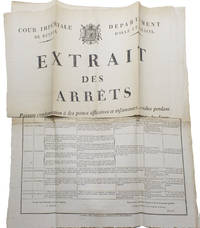
1813réf. 30782Rennes: Chez Cousin-Danelle Imprimeur de la Cour Impériale 1813. l sheet consisting of three leaves. 1 vols. FOLIO 20 x 46 inches. Broadside. Some marginal discoloration and creasing else very good. l sheet consisting of three leaves. 1 vols. FOLIO 20 x 46 inches. Lists the date of arrest the court identifies the criminal with age profession address a physical description crime and punishment citing the applicable laws next to them. Chez Cousin-Danelle, Imprimeur de la Cour Impériale unknown
1813réf. 30782Rennes: Chez Cousin-Danelle Imprimeur de la Cour Impériale 1813. l sheet consisting of three leaves. 1 vols. FOLIO 20 x 46 inches. Broadside. Some marginal discoloration and creasing else very good. l sheet consisting of three leaves. 1 vols. FOLIO 20 x 46 inches. Lists the date of arrest the court identifies the criminal with age profession address a physical description crime and punishment citing the applicable laws next to them. Chez Cousin-Danelle, Imprimeur de la Cour Impériale unknown books
1910réf. 86220New York: Funk & Wagnalls 1910. First edition. Octavo. Gray pictorial cloth stamped in black and silver inks on cover and spine; 379pp. 8 inserted leaves of plates halftones by Glenn O. Coleman. Trace of rubbing at spine ends and corners; scattered pencil marginalia with old erasure to front endpaper; still a tight square and attractive copy Very Good or better. Hapgood's uncommon chronicle of immigrant and underworld life on the Lower East Side of Manhattan a sequel of sorts to his classic The Spirit of the Ghetto. Hapgood a sometime anarchist and full-time free-lover was in the first wave of Greenwich Village bohemians; his celebratory accounts of Manhattan's seedier sections have long stood as scarce classics of New York writing. This a really brilliant copy; the book is very rarely seen thus. We have noted binding variants in gray cloth as here and green. Funk & Wagnalls unknown
1910réf. 86220New York: Funk & Wagnalls 1910. First edition. Octavo. Gray pictorial cloth stamped in black and silver inks on cover and spine; 379pp. 8 inserted leaves of plates halftones by Glenn O. Coleman. Trace of rubbing at spine ends and corners; scattered pencil marginalia with old erasure to front endpaper; still a tight square and attractive copy Very Good or better. Hapgood's uncommon chronicle of immigrant and underworld life on the Lower East Side of Manhattan a sequel of sorts to his classic The Spirit of the Ghetto. Hapgood a sometime anarchist and full-time free-lover was in the first wave of Greenwich Village bohemians; his celebratory accounts of Manhattan's seedier sections have long stood as scarce classics of New York writing. This a really brilliant copy; the book is very rarely seen thus. We have noted binding variants in gray cloth as here and green. Funk & Wagnalls unknown books
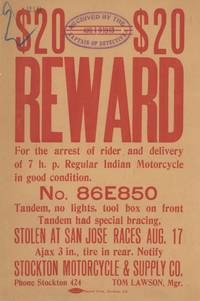
1913réf. List2840Stockton California 1913. Single 6 x 9 inch sheet. Marked with blue crayon at upper left corner otherwise near fine. A wanted poster offering $20 for the return of a stolen Indian motorcycle. Indian motorcycles were an early American motorcycle built by the Hendee Manufacturing Company in Springfield Massachusetts. This particular one was a tandem model stolen from a race ground in San Jose in August of 1913. Motorcycling was then a very new sport with the first motorcycling club the Federation of American Motorcyclists having been formed in New York City not ten years prior. unknown
1913réf. List2840Stockton California 1913. Single 6 x 9 inch sheet. Marked with blue crayon at upper left corner otherwise near fine. A wanted poster offering $20 for the return of a stolen Indian motorcycle. Indian motorcycles were an early American motorcycle built by the Hendee Manufacturing Company in Springfield Massachusetts. This particular one was a tandem model stolen from a race ground in San Jose in August of 1913. Motorcycling was then a very new sport with the first motorcycling club the Federation of American Motorcyclists having been formed in New York City not ten years prior. unknown books
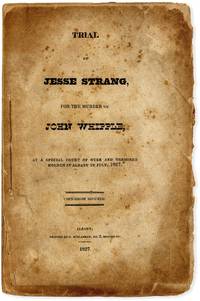
1827réf. 87802Albany: D. M'Glashan 1827. First and Only Edition. Octavo in 4's. 24cm. Stab bound pages with the title page serving as the front cover and no trace that the pamphlet was ever bound. 35pp. Some mild chipping to edges and extremities most notably the upper right corner toning and soiling to wraps; internally clean but uniformly toned with offsetting from the type throughout edges untrimmed luxuriously wide margins some traces of careless opening in places. Very good by dint of survival and solidity rather than beauty the paper is cheap and the pamphlet was printed to leverage opportunity rather than posterity. A notable and at the time highly controversial trial dealing with what was later referred to as "The Murder at Cherry Hill." The prominent New York Van Rensselaer family owned and lived at Cherry Hill Farm in Albany the daughter Elsie was married somewhat unhappily to John Whipple and fell for a younger man she met in a bar by the name of Jesse Strang. The couple fell in love Elsie expressed her deep unhappiness with Whipple; Strang masquerading under the name of Jesse Orton took on a job at the farm and began an affair with Elsie which was maintained by the house staff many of whom were enslaved people of color whose testimonies were heard at the trial passing notes between the two. Elsie chafing somewhat at having to endure her legal husband resolved that he must die to make way for Strang and they would run away together to Canada. The first plan was arsenic poisoning which failed. What Elsie lacked in poisoning ability she made up for with murderous intent and she purchased a rifle removed the ammunition from her now somewhat suspicious husband's gun and induced Strang who does not come across as the sharpest tool in the shed to shoot Whipple dead. Strang then attempted to fabricate an alibi which did not hold up and he was arrested. What followed was a widely publicised trial in which both defendants turned on each other Elsie's status as the daughter of prominent landowners was leveraged as protection from any serious punishment and Strang bore the brunt of the law. He had of course further doomed himself by attempting to plant evidence lying under several oaths and generally being one of the less gifted murderers of the early 19th century; he was hanged Elsie went home to Cherry Hill the Van Rensselaer's invested heavily in local collective amnesia and the rest of the US stared somewhat incredulously and gossiped over their breakfast grits. It was a carnival of awfulness that posed many questions about the societal rights and freedoms of women the privileges of wealth and the integrity of the judicial system. Fairly represented in institutions with 20 examples in US libraries but scarce in commerce and usually in later binding. D. M'Glashan unknown
1827réf. 87802Albany: D. M'Glashan 1827. First and Only Edition. Octavo in 4's. 24cm. Stab bound pages with the title page serving as the front cover and no trace that the pamphlet was ever bound. 35pp. Some mild chipping to edges and extremities most notably the upper right corner toning and soiling to wraps; internally clean but uniformly toned with offsetting from the type throughout edges untrimmed luxuriously wide margins some traces of careless opening in places. Very good by dint of survival and solidity rather than beauty the paper is cheap and the pamphlet was printed to leverage opportunity rather than posterity. A notable and at the time highly controversial trial dealing with what was later referred to as "The Murder at Cherry Hill." The prominent New York Van Rensselaer family owned and lived at Cherry Hill Farm in Albany the daughter Elsie was married somewhat unhappily to John Whipple and fell for a younger man she met in a bar by the name of Jesse Strang. The couple fell in love Elsie expressed her deep unhappiness with Whipple; Strang masquerading under the name of Jesse Orton took on a job at the farm and began an affair with Elsie which was maintained by the house staff many of whom were enslaved people of color whose testimonies were heard at the trial passing notes between the two. Elsie chafing somewhat at having to endure her legal husband resolved that he must die to make way for Strang and they would run away together to Canada. The first plan was arsenic poisoning which failed. What Elsie lacked in poisoning ability she made up for with murderous intent and she purchased a rifle removed the ammunition from her now somewhat suspicious husband's gun and induced Strang who does not come across as the sharpest tool in the shed to shoot Whipple dead. Strang then attempted to fabricate an alibi which did not hold up and he was arrested. What followed was a widely publicised trial in which both defendants turned on each other Elsie's status as the daughter of prominent landowners was leveraged as protection from any serious punishment and Strang bore the brunt of the law. He had of course further doomed himself by attempting to plant evidence lying under several oaths and generally being one of the less gifted murderers of the early 19th century; he was hanged Elsie went home to Cherry Hill the Van Rensselaer's invested heavily in local collective amnesia and the rest of the US stared somewhat incredulously and gossiped over their breakfast grits. It was a carnival of awfulness that posed many questions about the societal rights and freedoms of women the privileges of wealth and the integrity of the judicial system. Fairly represented in institutions with 20 examples in US libraries but scarce in commerce and usually in later binding. D. M'Glashan unknown books
réf. DADAX0131589547New unknown
réf. DADAX080397244XNew unknown
1955réf. 1402095Oklahoma City: Britten 1955. First Edition. Hardcover. Very Good. 1st printing. Pictorial cloth with image of the devil looming over Okla City and looking very pleased. 264pp. Illus. Index. Endpaper maps. "A revised and well-illustrated narrative of the capital city its politics and people portions of which were first published in the North Star as: Inside Oklahoma City." McRill was City Manager of OKC. A hard book to find with the devil's help or without. Minor wear to extremities; Vg. No dj as issued. 6-guns 1433. Britten hardcover
réf. 32697La Roulotte Paris 1950 In-8 ( 235 X 160 mm ), cartonnage ivoire, dos lisse janséniste. 56 pages de textes illustrés en marges des 80 dessins de tatouages par Jacques DELARUE et 64 planches illustrées de 80 photographies reproduites sur papier couché, dont 11 sont de Robert DOISNEAU, d'autres proviennent du Musée de l'Homme ou des collections Alexandre LACASSAGNE ( un des fondateurs de l'anthropologie criminelle ) et GRANGEVERSANNE. EDITION ORIGINALE sur papier d'édition. Jaquette absente, le dos a été habilement restauré, l'ouvrage est pur et les photographies très fraîches.
First edition, 8to (228 x 150mm), [2], iv, [2], 228pp., perforated stamp of the 'Hartford Medical Society Library' on title, errata slip pasted on the verso of the 'Contents' leaf, folding plate of an improved hand-crank mill for prison labour, modern boards, uncut, printed paper label on spine, a good copy. In his final years Hippisley turned to the question of prison discipline, and the study of the prevention and punishment of crime, publicly advocating the hand-crank instead of the treadmill. Goldsmith, 23921.
Single sheet printed on one side only (214 x 135 mm), printed black on white fragile paper, mounted on card, soiled and creased. From the London Times, February 25, 1828, page 3, Column 1 : "It is this week our painful duty to record one of the most cold-blooded murders that ever darkened the annals of crime, a deed which has spread a wider gloom and deeper horror than any event which has occurred in this neighbourhood within the remembrances of the eldest inhabitants." John Dyon was the second son of a wealthy landowner in Yorkshire, England near Doncaster. He lived a hard working, respectable and quiet life. He married the lovely Betty Conway and together they had 3 daughters, Elizabeth (from whom we descend), Mary and Matilda. Working closely with his father, he often gained favors and gifts from the older man. In 1826 and 1827 alone, it is recorded that he received 63 acres of land and 300 pounds sterling. His older brother, William also received many gifts from their father as a young man, but the money was mostly squandered and drunk, and eventually the gifts stopped coming. So William struggled and John thrived? and William stewed, and his resentment grew. William frequently ranted of his anger to his son, John, poisoning the younger man's mind against his uncle. On Saturday, the 16th of February, 1828, John Dyon attended the market in Doncaster (12 miles away) with a couple of friends as was his custom. On his return home that evening, when he dismounted his horse to open the gate to his property, he was assaulted, shot, and left for dead. His wife, concerned when he didn't arrive home at the time he should, sent a servant to look for him. The servant found John's horse standing near the gate, but did not see John lying a few feet away. They found him in the morning lying where he had bled out. Mr. E. B. Denison, Esq. and the local constable rode out from Doncaster immediately upon receiving the news Sunday morning and began their investigation. Mr. Denison, a student of the new forensic sciences, was pleased to find the murder scene offered an abundance of clues. It had rained on Saturday and the ground was quite moist, then the temperature dropped below freezing overnight, capturing the escape route of the assailants. Mr. Denison observed that there were two attackers; one smaller and lighter than the other. He noted that these persons were relatively wealthy because they possessed a pair boots with both a right and left foot. He also noted that the larger footprints had a distinctive toe-out gait. An inquest was called by the coroner. After the presentation of evidence, the jury delivered a verdict of "Willful murder by person or persons unknown". Many in the area knew of the ill will that William Dyon and his son held for William's brother, John Dyon. By Thursday of the following week, both were arrested. They provided alibis, insisting that they had been nowhere near the scene of the crime. The magistrate felt he had to let them go. After his release by the authorities, William went to a pub in Gainesborough, and bragged there that he had "humbugged" the local magistrate, apparently disclosing further details of the crime. His brags were soon brought to the attention of Mr. Denison and additional inquiries were made. A farmer who had previously worked for William, but was now in John's employ, admitted that he knew of William and young John's plan to kill John Dyon. He also said that he had hidden the gun at his home for a week prior to the murder, and that William had bribed him and threatened him to keep quiet about the plan. Soon, William and his son, John were arrested. The constable searched their homes and found the boots, a pair having both right and left feet, and the gun. During the trial, the farmer, John White, testified to everything he knew, including the fact that William had showed up the evening of the killing to pick up his gun. Several witnesses came forward to testify to the ill will that William and his son bore for the deceased. They also testified that William had a distinctive gait, walking with his toes pointed outward. William Dyon and John, his son, were hanged for their crime on April 4, 1828. William staunchly declared his innocence throughout, but his son confessed to all as they placed the noose around his neck. No other copy located.
Folio, xvi, 195, [1]pp., stitched as issued, orig. blue printed wrappers, spine lightly chipped. Important transportation Government Blue Book, predominantly relating to Western Australia.
12mo (150 x 85 mm) 37, [1]pp., several leaves mounted on stubs, new boards. Henry Sanderson, Adam Adie and Robert Bamford, were for murder, on Friday, March 22, 1822. Sanderson was out shooting pheasants, when he was apprehended by William Carr, gamekeeper to Sir Thomas Wollaston White. While wrestling with the gun Carr was shot, but he lived just long enough to identify his assailant. Adie and Bamford underwent the penalty of the law for the murder of John Timms, aged 17. The three, along with William Knight, were out on the town, after they decided to go poaching but only just got passed Trent Bridge before it began to rain. They then abandoned their plan and went to the Three Horse Shoes public house. Here they argued who was to pay for the drink consumed, Timms, having treated them all in the afternoon, refused to pay more than his share. On the way home the three robbed Timms of his watch and three shillings in silver. Knight then knocked him down, and Adie threw him over the battlements of the bridge into the river Trent. Adie and Bamford were executed after Bamford confessed, but Knight could not be identified, and was consequently acquitted. NOT found on JISC or OCLC.
réf. SONG1138491381Used: Good unknown
réf. DADAX0415644534New unknown
réf. DADAX0815360509New unknown
réf. SONG0815360509Used: Good unknown
1955réf. ZB393272National Council on Crime and Delinquency. 1955. volumes 1 3 6-7 9-12 14 16-18 20 25 27 29 1955-1983; complete volumes partly bound ex library; PRICE IS FOR THE LOT. - If you are reading this this item is actually physically in our stock and ready for shipment once ordered. We are not bookjackers. Buyer is responsible for any additional duties taxes or fees required by recipient's country. Photos available upon request. National Council on Crime and Delinquency. unknown
1904Binding slightly loose but not bad for its age. Some pages uncut; Darrow's autobiographical novel, a fictionalized account of his boyhood ; 12mo; 277 pages
réf. DADAX0195395085New unknown