236 risultati
rif. 68751Editeurs A. Rey et Cie / Masson et Cie - Tome XXVI - 26ème année - N° 212-213 - Août-septembre 1911 - Fondées en 1886 avec la collaboration du Dr. Albert Bournet, transformées en 1893 avec Gabriel Tarde et en 1904 avec Paul Dubuisson - Grand In-8 broché - 190 pages - Non massicoté (ouvrage jamais lu)
rif. 68752Editeurs A. Rey et Cie / Masson et Cie - Tome XXV - 25ème année - N° 197 - 15 mai 1911 - Fondées en 1886 avec la collaboration du Dr. Albert Bournet, transformées en 1893 avec Gabriel Tarde et en 1904 avec Paul Dubuisson - Grand In-8 broché - 79 pages - Non masicoté (ouvrage jamais lu)
rif. 68753Tome XXII - 22ème année - N° 159 - 15 mars 1907 - Fondées en 1886 avec la collaboration du Dr. Albert Bournet, transformées en 1893 avec Gabriel Tarde et en 1904 avec Paul Dubuisson - Editeurs A. Rey et Cie / Masson et Cie - Grand In-8 broché - 70 pages
2013rif. 687542013 Tome XX - 20ème année - N° 134 - 15 février 1905 - Fondées en 1886 avec la collaboration du Dr. Albert Bournet, transformées en 1893 avec Gabriel Tarde - Editeurs A. Storck et Cie, Lyon / Masson et Cie - Grand In-8 broché - 70 pages - Ouvrage non coupé (jamais lu)
1589rif. 688151589 Tome XV - 15ème année - N° 89 - 15 Septembre 1900 - Fondées en 1886, avec la collaboration du Dr. Albert Bournet - Editeurs A. Storck et Cie, Lyon / Masson et Cie - Grand In-8 broché - 112 pages - Ouvrage non coupé (jamais lu)
rif. 688171483 Tome XIV - 14ème année - N° 83 - 15 Septembre 1899 - Fondées en 1886 avec la collaboration du Dr. Albert Bournet - Editeurs A. Storck et Cie, Lyon / Masson et Cie - Grand In-8 broché - 126 pages - Ouvrage non coupé (jamais lu)
rif. 68820Tome XIII - 13ème année - N° 74 - 15 Mars 1898 - Fondées en 1886 avec la collaboration du Dr. Albert Bournet - Editeurs A. Storck et Cie, Lyon / Masson et Cie - Grand In-8 broché - 120 pages - Ouvrage non coupé (jamais lu)
1937rif. 135191Couverture souple. Chapitres détachés. 64 pages. 25 x 32 cm. Sans couverture.
2000rif. 29728Paris Presses De La Renaissance 2000 In-8 carré 253 pp
rif. DADAX0387799877New unknown
rif. DADAX0495807508New unknown
2012rif. LFA-126746853N° 203 - Décembre 2012-Janvier 2013 - 66 pages, format 215 x 280 mm, brochée, illustrée, bon état
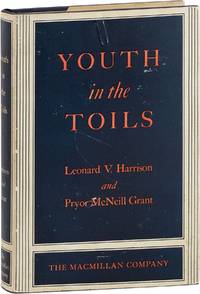
1938rif. 84958New York: Macmillan 1938. First Edition. First printing. Small octavo 19cm. Blue cloth titled in gilt on spine and front cover; dustjacket; xv167pp. Darkening to endpapers else a tight straight Near Fine copy. In the original dustwraper price-clipped rubbed on rear panel; Very Good. A study sponsored by the Delinquency Committee of the Boys Bureau of New York City of the rising problem of juvenile criminal offenders. The authors address the problem from both a criminological and sociological standpoint including many case studies. Uncommon in dustjacket. Macmillan unknown books
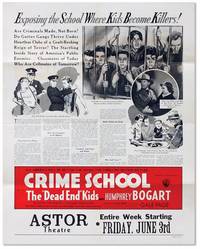
1938rif. 16826Los Angeles: Warner Brothers 1938. Lithograph in two colors 21" x 16-1/2" ca 54cm x 42cm. Vertical and horizontal fold lines; mild toning to paper on verso; Near Fine - Grade A/A-. Rare odd-size promotional broadside for the 1938 Warner Brothers exploitation drama "Crime School" starring Humphrey Bogart and the Dead End Kids. In addition to stills and renderings from the film the piece includes a full plot synopsis - something not included on any of the dozens of other promotional items for the film we have inspected. Apparently produced for the New York premier in 1938 at the Astor Theatre and likely produced not by the studio but the the theatre itself as part of its promotional campaign. Conceivably intended for distribution to the press but we posit that the piece was more likely created for mailing to schools and civic organizations who would no doubt be attracted to the film's "scared straight" approach to juvenile delinquency. Not seen at auction or in commerce. Warner Brothers unknown books
1938rif. 16826Los Angeles: Warner Brothers 1938. Lithograph in two colors 21" x 16-1/2" ca 54cm x 42cm. Vertical and horizontal fold lines; mild toning to paper on verso; Near Fine - Grade A/A-. Rare odd-size promotional broadside for the 1938 Warner Brothers exploitation drama "Crime School" starring Humphrey Bogart and the Dead End Kids. In addition to stills and renderings from the film the piece includes a full plot synopsis - something not included on any of the dozens of other promotional items for the film we have inspected. Apparently produced for the New York premier in 1938 at the Astor Theatre and likely produced not by the studio but the the theatre itself as part of its promotional campaign. Conceivably intended for distribution to the press but we posit that the piece was more likely created for mailing to schools and civic organizations who would no doubt be attracted to the film's "scared straight" approach to juvenile delinquency. Not seen at auction or in commerce. Warner Brothers unknown
1920rif. 5420London: Seeley Service & Co. Limited 1920. First Edition. Hardcover. Very Good. 8vo. Pp. 1-16 353 1. Frontis. photo. Illustrated with 37 black-and-white photos. With a line drawing of the penitentiary featuring two moats. Glossary of Indian words and terms. Index. Bound in green cloth with black rules on front cover black lettering stamped on spine. With stamp on fore and top edge "File Copy Not to be Taken Away." Several leaves unopened. With two contemporary Seeley promotional brochures slightly larger than a bookmark advertising recent titles one for the "Library of Romance" series and the other for three anthologies one compiled by A. T. Quiller-Couch. A stunning treatise on the British treatment of juvenile offenders in India. From the author of Juvenile Criminals. Coombes was warden of the Chingleput Reformatory in Madras. With draconian claptrap see photo of adolescent toes indicating a propensity for "thieving" the author disregards Hindu law and the post-Dickensian tendency toward reform over punishment. Coombes advocated "flogging and birching;" he probably enjoyed it. A handsome copy. Seeley, Service & Co. Limited hardcover
1938rif. 84958New York: Macmillan 1938. First Edition. First printing. Small octavo 19cm. Blue cloth titled in gilt on spine and front cover; dustjacket; xv167pp. Darkening to endpapers else a tight straight Near Fine copy. In the original dustwraper price-clipped rubbed on rear panel; Very Good. A study sponsored by the Delinquency Committee of the Boys Bureau of New York City of the rising problem of juvenile criminal offenders. The authors address the problem from both a criminological and sociological standpoint including many case studies. Uncommon in dustjacket. Macmillan unknown
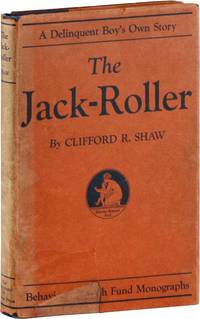
1930rif. 58580Chicago: University of Chicago Press 1930. First Edition. Octavo. Cloth boards; dustjacket; xiv 205pp; 2 folding maps. Fine copy of the book; in the original dustwrapper which has been heavily repaired on front and rear panels covering a ca. 1" x 2" loss and repairing a ca. 4" tear into the bottom margin; Good only. An appealing copy of this seminal study of juvenile delinquency in Chicago. Mostly written in the "first person" based on Shaw's interviews with "Stanley" his subject beginning with his destitute childhood and proceeding through homelessness pick-pocketing car-theft various correctional facilities etc. Includes a folding map "Home Addresses of 9245 Alleged Juvenile Delinquents Dealt With by the Juvenile Police Probation Officers During the Year 1926 - Ten to Seventeen Years of Age." An uncommon book in any condition; despite flaws to the jacket this remains a quite presentable copy. University of Chicago Press unknown books
1929rif. 35124New York: D. Appleton & Co 1929. Second American printing first published in London 1925; the first American printing also appeared that year. Octavo; blue cloth boards lettered in gilt on spine and front cover; dustjacket; xviii 1-619 2pp; 15 inserted leaves of photographic plates halftones; text illus. A tight Near Fine copy in the scarce dustwrapper lightly soiled overall with a few nicks to extremities Very Good to Near Fine. Very nice copy of this classic of juvenile criminal psychology. Burt achieved great eminence during his lifetime in 1946 becoming the first British psychologist to be knighted as a reward for his research. Burt's methodologies came into question after his death however and it is now widely believed he falsified much of his data particularly that relating to the inheritance of IQ. Nonetheless the current work remains compelling for both its wealth of detailed personal case studies of British delinquents and the numerous photographic portraits which though clearly staged portray genuine subjects and are classics in their genre. D. Appleton & Co unknown books
1930rif. 58580Chicago: University of Chicago Press 1930. First Edition. Octavo. Cloth boards; dustjacket; xiv 205pp; 2 folding maps. Fine copy of the book; in the original dustwrapper which has been heavily repaired on front and rear panels covering a ca. 1" x 2" loss and repairing a ca. 4" tear into the bottom margin; Good only. An appealing copy of this seminal study of juvenile delinquency in Chicago. Mostly written in the "first person" based on Shaw's interviews with "Stanley" his subject beginning with his destitute childhood and proceeding through homelessness pick-pocketing car-theft various correctional facilities etc. Includes a folding map "Home Addresses of 9245 Alleged Juvenile Delinquents Dealt With by the Juvenile Police Probation Officers During the Year 1926 - Ten to Seventeen Years of Age." An uncommon book in any condition; despite flaws to the jacket this remains a quite presentable copy. University of Chicago Press unknown
1929rif. 35124New York: D. Appleton & Co 1929. Second American printing first published in London 1925; the first American printing also appeared that year. Octavo; blue cloth boards lettered in gilt on spine and front cover; dustjacket; xviii 1-619 2pp; 15 inserted leaves of photographic plates halftones; text illus. A tight Near Fine copy in the scarce dustwrapper lightly soiled overall with a few nicks to extremities Very Good to Near Fine. Very nice copy of this classic of juvenile criminal psychology. Burt achieved great eminence during his lifetime in 1946 becoming the first British psychologist to be knighted as a reward for his research. Burt's methodologies came into question after his death however and it is now widely believed he falsified much of his data particularly that relating to the inheritance of IQ. Nonetheless the current work remains compelling for both its wealth of detailed personal case studies of British delinquents and the numerous photographic portraits which though clearly staged portray genuine subjects and are classics in their genre. D. Appleton & Co unknown
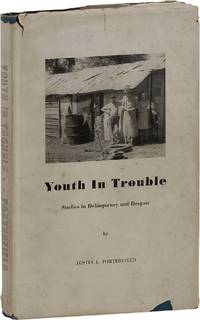
1946rif. 83975Fort Worth: Leo Potishman Foundation 1946. First Edition. Presentation lengthily inscribed: "To Edward Hopper / Assistant Superintendent of a work that is more than mere prevention of disaster in young peoples' lives - it is a program of building creative personalities - with the best wishes always" signed undated but apparently contemporary with publication. First printing. Octavo. Blue cloth hardcover titled in gilt; dustjacket; 136pp; included bibliography. Tight square copy in the original pictorial dustwrapper unclipped priced $1.50 on front flap slightly rubbed soiled and worn with small losses at margins; Good or better. Porterfield a pioneering sociologist at Texas Christian University seeks to demonstrate that juvenile criminal behavior is nearly always related to parental neglect or abuse and asserts that it is the responsibility of the community to provide a surrogate: ".the community is responsible for all youth whose parents fail them and for the training and improvement of oppoortunities of parents so that they can escape failure." from jacket copy. Includes three detailed case studies and a wealth of statistical data. This copy inscribed to an "Edward Hopper" presumably not the noted painter of this period at least we can find no evidence of Hopper's involvement in a program to rehabilitate troubled youth. Leo Potishman Foundation unknown books
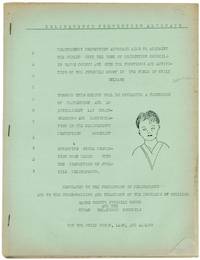
1936rif. 29958Detroit: Juvenile Court and the Human Relations Councils of Wayne County 1936. First Edition. Quarto 28cm. Side-stapled mimeographed self-wrappers; illus. Extremities a bit foxed and toned minor wear from handling else Very Good and sound. Monthly newsletter that "aims to acquaint the public with the work of prevention councils in Wayne County." Provides short pieces on treatment research and prevention; articles include "Forgiveness Is Not Condonation" "Boys Don't Want to Be Criminals" and "Lock Your Car." No holdings located in OCLC as of April 2024. Juvenile Court and the Human Relations Councils of Wayne County unknown books
1936rif. 29958Detroit: Juvenile Court and the Human Relations Councils of Wayne County 1936. First Edition. Quarto 28cm. Side-stapled mimeographed self-wrappers; illus. Extremities a bit foxed and toned minor wear from handling else Very Good and sound. Monthly newsletter that "aims to acquaint the public with the work of prevention councils in Wayne County." Provides short pieces on treatment research and prevention; articles include "Forgiveness Is Not Condonation" "Boys Don't Want to Be Criminals" and "Lock Your Car." No holdings located in OCLC as of April 2024. Juvenile Court and the Human Relations Councils of Wayne County unknown
1946rif. 83975Fort Worth: Leo Potishman Foundation 1946. First Edition. Presentation lengthily inscribed: "To Edward Hopper / Assistant Superintendent of a work that is more than mere prevention of disaster in young peoples' lives - it is a program of building creative personalities - with the best wishes always" signed undated but apparently contemporary with publication. First printing. Octavo. Blue cloth hardcover titled in gilt; dustjacket; 136pp; included bibliography. Tight square copy in the original pictorial dustwrapper unclipped priced $1.50 on front flap slightly rubbed soiled and worn with small losses at margins; Good or better. Porterfield a pioneering sociologist at Texas Christian University seeks to demonstrate that juvenile criminal behavior is nearly always related to parental neglect or abuse and asserts that it is the responsibility of the community to provide a surrogate: ".the community is responsible for all youth whose parents fail them and for the training and improvement of oppoortunities of parents so that they can escape failure." from jacket copy. Includes three detailed case studies and a wealth of statistical data. This copy inscribed to an "Edward Hopper" presumably not the noted painter of this period at least we can find no evidence of Hopper's involvement in a program to rehabilitate troubled youth. Leo Potishman Foundation unknown