KESSLER (Général)Livre Rare Book

19 résultats
1906réf. 62510Couverture rigide. Broché. 377 pages. Légèrement défraîchi
1906réf. 95721Couverture rigide. Broché. 377 pages.
réf. 19516bro- ché - 16x23.5 - 134pp - université libre de Bruxelles - études sur le XVIIIe siècle - volume hors serie 2 - éditions de l'université de Bruxelles - 1985
réf. 109896sd Edité par l'Information de l'Etat Français - Sans date (entre 1940 et 1944) - In-8, broché - 12 p. - Illustrations in et hors-texte en N&B
1934réf. 1160Paris, Grasset, 1934, in-12, br., 302 pp.
1941réf. 689Paris, Plon, 1941, in-12, br., 85 pp., couverture illustrée.
1935réf. 113416Paris, Les Nouvelles éditions Nationales 1935 In-12 18,5 x 12 cm. Broché, 252 pp., table des matières. Couverture poussiéreuse, intérieur correct.
1937réf. 113419Paris, Baudinière 1937 In-12 18,5 x 12 cm. Broché, auteurs & titre en noir & rouge sur le dos et le premier plat, 221 pp., table des matières, pièces annexes. Exemplaire en bon état.
1934réf. 126748Éditions Baudinière, s.d. [1934], in-12, 249 pp, annexes, broché, dos abîmé, couv. lég. salie consolidée par un film transparent autocollant, intérieur propre et frais, état correct. Rare
1941réf. 476Paris, Beauchesne, 1941, in-16, broché, 370 pp. ; précieux index des noms, couverture illustrée imprimée en rouge et noir.
1987réf. 89074Paris, éditions du Trident, La Librairie Française 1987 In-8 20,5 x 14,5 cm. Broché, couverture verte titre en noir sur le dos et le premier plat, X-152 pp. Bon exemplaire.
réf. 15511, Brussel, Fondsmercator, 2006, Bound, Relie, Nombre de pages: 160 Dimensions: 28 x 23 cm 200 illustrations.
1918réf. 106794Paris, La Renaissance française 1918 In-8 22 x 13,5 cm. Agrafé, 47 pp., table des matières. Exemplaire en bon état.
1904réf. 615Paris, Perrin et Cie, 1904, in-12, broché, VII-119 pp., couverture jaune paille.
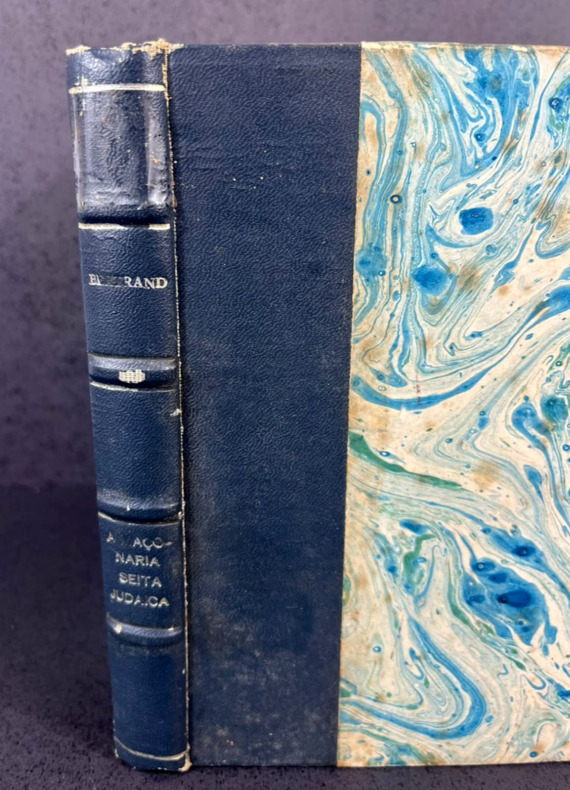
1938réf. 569São Paulo, Minerva, 1938. Com um prefácio sobre "A maçonaria e o Brasil" e um apêndice sobre "O Talmud e os judeus" do G. Barroso. Primeira edição em português brasileiro desse texto publicado em 1905 na França. In-12, 18 x 13 cm, (vii) 152 pp. Encadernação de meio tecido azul parecendo couro, papeis marmorizados azul claro, 4 nervos na lombada. Seções: O Estado no Estado, Internacionalismo maçônico, Ação anticristã, A kabala ortodoxa e farisaica, Sóbre a moral talmúdica, etc. Raro.
1829réf. 71749Utica: William Williams 1829. Fourth Edition No edition statement present. Leather Bound. Good. x; 2; 13-506; 1-55pp. With Appendix No. I and Appendix No II. Duodecimo 18 cm Original full leather with a red leather spine label mostly perished. Two frontispiece illustrations with small losses in the margins due to insect nibbling. Rough condition. Front board only hanging on by a couple of cords. Loss from leather at head of spine. Pages lightly foxed. Occasionally foxing is a bit more pronounced. Text block sturdy. Page 421 misnumbered "42". Walgren 3054. An early printing presumably the fourth edition. A work which reveals the inner workings of Freemasonry by David Bernard 1798-1876 a Baptist minister and Freemason from Utica NY. In addition Bernard's book also addresses certain controversies and criticisms surrounding Freemasonry in particular the controversial Morgan Affair. "Institutionalized Anti-Masonry began after the 1826 Morgan Affair. William Morgan a feisty fifty-two-year-old stonemason and recent immigrant to Batavia in western New York quarreled repeatedly with other Masons. He decided to get even with his adversaries by publishing a book Illustrations of Freemasonry that revealed the secrets of the first three degrees. This betrayal outraged other Masons and they appealed to Morgan to cease his 'madness' but he persisted. David C. Miller editor of the Batavia Republican Advocate agreed to publish and sell Morgans book. Some lodge members seized the page proofs and set fire to Millers printing establishment. On September 10 the head of the Masonic Lodge in Canandaigua brought charges of theft against Morgan which led to his arrest. On the twelfth Morgan was abducted from the Canandaigua jail by members of the fraternity and was never seen again. According to most sources he was taken west and drowned in the Niagara River. His exact fate has always remained a mystery. "News of Morgans abduction and alleged murder spread rapidly throughout western New York stirring up angry sentiment against Masonry and individual Masons. Hundreds of Masons repudiated their membership throwing the lodges into turmoil. By the fall of 1827 a new movement was in full swing with the name Anti-Masons. The movement gradually evolved from a mere moral crusade to a political faction through a series of town meetings and conventions. By years end Anti-Masons were publishing newspapers and pamphlets. Also by the end of 1827 many Masonic lodges in western New York were forced to shut down. The Anti-Masonic movement moved eastward through the center of the state on to New England and down to New Jersey Pennsylvania and Ohio." Citation: Bruce A. Van Orden "Anti-Masonic Partisan And Newspaper Editor" in We'll Sing and We'll Shout: The Life and Times of W. W. Phelps Religious Studies Center Brigham Young University; Salt Lake City: Deseret Book 2018 2130. William Williams unknown
1910réf. 111744Paris, Association antimaçonnique de France 1910 Fort in-8 22,5 x 14,5 cm. Broché, couverture jaune, titre en noir sur le dos et le premier plat, XXXII-760-166 pp. Couverture d’usage, plis de lecture au dos, intérieur propre.
1830réf. 21434Boston 1830. Broadside 7 3/4 x 13". Some old folds lightly foxed upper and lower margins Very Good. A rare broadside illustrating the anti-Masonic fervor of the times. Many prominent Americans opposed organizations whose secret rituals and oaths suggested fealty to a higher authority than the United States. Fueled by the alleged Morgan murder the movement took on a special vitality in Massachusetts with efforts to make Freemasonry a central political issue. John Quincy Adams was one of several heavyweights who assisted the fledgling Anti-Masonic Party. Here arguing "that the administration of Masonic oaths should be suppressed" the Memorial urges legislators "to investigate Freemasonry" and prohibit its secret rituals. An Act of the Legislature ought to require "a registry of the names and meetings of the members of such societies and the names of the persons and nature of the obligations assumed by those that may be hereafter admitted into such secret societies." Not located on OCLC or the AAS and Scottish Rite Masonic Library online sites as of August 2019. unknown books
1830réf. 21434Boston 1830. Broadside 7 3/4 x 13". Some old folds lightly foxed upper and lower margins Very Good. A rare broadside illustrating the anti-Masonic fervor of the times. Many prominent Americans opposed organizations whose secret rituals and oaths suggested fealty to a higher authority than the United States. Fueled by the alleged Morgan murder the movement took on a special vitality in Massachusetts with efforts to make Freemasonry a central political issue. John Quincy Adams was one of several heavyweights who assisted the fledgling Anti-Masonic Party. Here arguing "that the administration of Masonic oaths should be suppressed" the Memorial urges legislators "to investigate Freemasonry" and prohibit its secret rituals. An Act of the Legislature ought to require "a registry of the names and meetings of the members of such societies and the names of the persons and nature of the obligations assumed by those that may be hereafter admitted into such secret societies." Not located on OCLC or the AAS and Scottish Rite Masonic Library online sites as of July 2026. unknown