1 623 résultats
réf. 201802714Paris, Louis Conard , 1925 ; in-8, 367 pp., cartonnage de l'éditeur.
réf. 201413454Paris, Albin Michel, 1984 ; in-4, 406 pp., cartonnage de l'éditeur. Avec jaquette et boitage.
réf. 201311275Paris, Aux editions sun , 1958 ; in-4, 135 pp., cartonnage de l'éditeur. Avec jaquette.
réf. 201311196Paris, Editions alpina , 1942 ; in-8, 157 pp., br.
réf. 201212537Paris, Arthaud, 1957 ; in-8, 237 pp., br.
réf. 201212518Paris, Bordas, 1949 ; in-12, 128 pp., br.
réf. 201107679Paris, Editions alpina , 1942 ; in-8, 157 pp., broché, couverture illustr.
réf. 200701512London, Publische for the propiretor by Longman, Rees, Orme, Brown, Green, and Longmans, 1839 ; in-8, 256 pp., cartonnage d'éditeur coins émoussés (papier jaunie,qlq taches). WITH twenty highly finished engravings HEATH'S picturesque annual.(traces de mouillures anciennes en marge).
réf. 200619693Monaco, Les documents d'art - collection musées et monuments, 1948 ; in-4, 201 pp., cartonnage de l'éditeur (coins et coiffes ptes usures).
réf. 200615291Grenoble, Editions B. Arthaud, 1929 ; in-4, 150 pp., demi marocain à coins. Aquarelles de Camille Carlier-Vignal.
réf. 200614106Paris, Alpina, 1938 ; in-8, 64 pp., broché.
réf. 200612919Paris, Fernand nathan, 1948 ; in-8, 159 pp., cartonnage de l'éditeur.
réf. 200612823Paris, Fernant nathan, 1948 ; in-8 , 160 pp., cartonnage de l'éditeur.
réf. 200611588, Fernand nathan, 1948 ; in-8, 159 pp., cartonnage de l'éditeur.
réf. 55051P., Laurens, 1926, in 8° broché, 170 pages ; couverture rempliée.
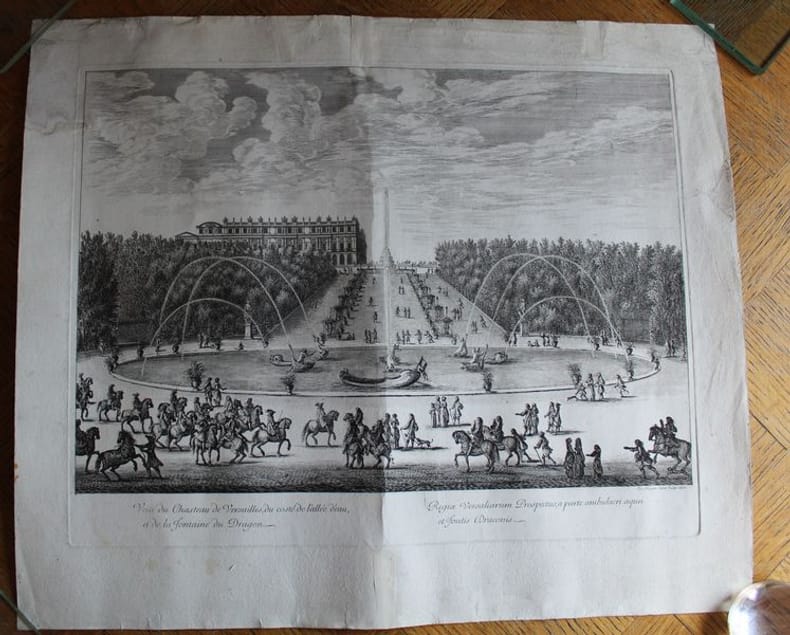
réf. 23510Isr. Silvestre del. Et sculp. 1676. Gravure à l'eau-forte au burin sur papier vergé épais, 485 x 585 mm., titre en bas à gauche. A droite, il y a la même inscription en latin. Quelques déchirures réparées aux marges, le motif de la gravure en bon état malgré une tache d'ancienne mouillure en haut à gauche.
2017réf. 4155Paris Château de Versailles - Gallimard 2017 In-4 (h. 30 cm.) 336 pp. couverture cartonnée, nombreuses illustrations.
1906réf. 34864New York: Dodd Mead & Company 1906. First Edition. Illustrated with 55 full-page plates in colour by René Binet. Royal 8vo publisher's original blue cloth the spine lettered in gilt and blocked in blind the upper cover lettered in gilt and elaborately blocked in blind top edge gilt. viii 384 pp. A very fine copy. FIRST EDITION IN ESPECIALLY FINE CONDITION. With beautiful colourplates throughout. After studying at Le Puy-en-Velay in Rodez and Clermont-Ferrand Pierre de Nolhac went to Paris in 1880 to undertake a literature degree at the Sorbonne and the École pratique des hautes études where he later became director of studies. A Member of the French School of Rome in 1882 he worked there on Italian humanism of the sixteenth century. In 1886 he was attached to the Museum in the Palace of Versailles and became curator in 1892 founding a chair of art history within the École du Louvre in 1910 then retiring to the Musée Jacquemart-André in 1920. He was elected a member of the Académie française in 1922. His activities in the museum of Versailles were crucial since they contributed greatly to modernisation and to restoring the collections including the furniture which had been dispersed during the French Revolution. He played a role in the preparations for the Treaty of Versailles which took place in the Palace in June 1919. He left a substantial body of work largely devoted to history especially to Renaissance humanism. During his stay at the French School of Rome 1882-1885 he discovered unpublished manuscripts of Petrarch in the Vatican library and the discovery helped advance knowledge about Petrarch. His monograph on Fulvio Orsini is still authoritative. He also devoted several books to Queen Marie-Antoinette at Versailles. His work as a poet was recognised in his own time notably by his friend the Italian poet Gabriele d'Annunzio. The central library of Versailles has many manuscripts of major works by de Nolhac including Erasmus and Italy Queen Marie Antoinette Nattier Louis XV and Marie Leszczynska. Dodd, Mead & Company hardcover
1906réf. 34865New York: Dodd Mead & Company 1906. First Edition. Illustrated with 55 full-page plates in colour by René Binet. Royal 8vo publisher's original blue cloth the spine lettered in gilt and blocked in blind the upper cover lettered in gilt and elaborately blocked in blind top edge gilt. viii 384 pp. A very fine copy. FIRST EDITION IN ESPECIALLY FINE CONDITION. With beautiful colourplates throughout. After studying at Le Puy-en-Velay in Rodez and Clermont-Ferrand Pierre de Nolhac went to Paris in 1880 to undertake a literature degree at the Sorbonne and the École pratique des hautes études where he later became director of studies. A Member of the French School of Rome in 1882 he worked there on Italian humanism of the sixteenth century. In 1886 he was attached to the Museum in the Palace of Versailles and became curator in 1892 founding a chair of art history within the École du Louvre in 1910 then retiring to the Musée Jacquemart-André in 1920. He was elected a member of the Académie française in 1922. His activities in the museum of Versailles were crucial since they contributed greatly to modernisation and to restoring the collections including the furniture which had been dispersed during the French Revolution. He played a role in the preparations for the Treaty of Versailles which took place in the Palace in June 1919. He left a substantial body of work largely devoted to history especially to Renaissance humanism. During his stay at the French School of Rome 1882-1885 he discovered unpublished manuscripts of Petrarch in the Vatican library and the discovery helped advance knowledge about Petrarch. His monograph on Fulvio Orsini is still authoritative. He also devoted several books to Queen Marie-Antoinette at Versailles. His work as a poet was recognised in his own time notably by his friend the Italian poet Gabriele d'Annunzio. The central library of Versailles has many manuscripts of major works by de Nolhac including Erasmus and Italy Queen Marie Antoinette Nattier Louis XV and Marie Leszczynska. Dodd, Mead & Company hardcover
1855réf. 22467Paris:: Au Bureau des Galeries Historiques ca. 1855. original black cloth with elaborate decoration in gold and colors a.e.g. Ownership signatures one dated 1855; light use to cloth; one corner bowed. 8vo. Numerous engraved plates and text illustrations. Au Bureau des Galeries Historiques, hardcover
Paris-Nice, Imprimatur, 1954. In-folio ; 176 pp -[10] ff n.ch. En feuilles, sous couverture rempliée et illustrée en rouge et noir, chemise et étui décoré (celui-ci avec légers défauts, frottements). Bel exemplaire orné de ving-six compositions originales en couleurs par Henry de Waroquier, (dont frontispice) gravées sur bois par Gérard Angiolini. P, une vignette de titre, 16 hors-texte et 8 dans le texte. Tirage limité à 267 exemplaires. Celui-ci l'un des 76 exemplaires nominatifs sur vélin d'Arches réservés à un groupe de Bibliophile, dédicacé par l'artiste, avec une suite de toutes les illustrations et la décomposition de l'un des hors-texte. Exemplaire enrichi DU DESSIN ORIGINAL DE LA COUVERTURE. Très belles et fortes illustrations de Waroquier. (prévoir des frais de port pour 7 kg).
1919réf. 49707Paris. 1919. Official French printing of the Treaty of Versailles a document of monumental importance in American and world history. The treaty made with Germany at the end of the First World War concluded a war of unrivalled devastation while sowing the seeds for the Second World War just twenty years on the horizon. The United States guided by Woodrow Wilson's vision played a central role in the crafting of the treaty. The U.S. Senate refused to ratify the treaty however based on the objection of several senators to the Covenant of the League of Nations which was included as Part I of the settlement thereby largely removing American influence and involvement from the international scene in the inter-war period. The Treaty of Versailles was a wide-ranging and ambitious document which sought not only to address the immediate postwar settlement but to punish Germany for its actions in starting and prosecuting the war attempted to remake the map of Europe and created a supra-national political organization the League of Nations. The Covenant of the League of Nations comprises the first part of the treaty. The next most famous part is that dealing with reparations which includes Article 231 the infamous "war guilt clause." By this article Germany accepted the responsibility of her and her allies "for causing all the loss and damage to which the Allied and Associated Governments and their nationals have been subjected as a consequence of the war imposed upon them by the aggression of Germany and her allies." The intent of the article was to affix legal and financial responsibility on Germany but it took on moral implications and was used by Hitler during his rise as an example of Allied perniciousness. Germany had to agree to pay reparations to the allies in the sum of 20000000000 gold marks the amount to be modified by a reparations commission in 1921. Germany also had to recognize the independence of Austria and agree not to compromise that independence in the future. Germany's borders were redrawn with Alsace-Lorraine being given to France West Prussia to Poland and other lands such as Danzig and the Saar Basin stripped away. She lost her overseas possessions the Rhineland was occupied and the German army was limited to one hundred thousand men and largely disarmed. Other provisions address issues of tariffs ports labor aerial navigation prisoners of war and more. As has been noted the many punitive measures of the Treaty of Versailles did much to fan the seeds of discontent in post-war Germany and to facilitate the rise of Hitler who publicly flaunted the provisions of the treaty throughout the 1930s. The refusal of the United States to ratify the treaty and participate in the League of Nations was a crucial part in the chain of events that led to the Second World War. A most important document here in an official French printing with the Protocol as a separate signature at the end. Folio. Original printed wrappers. Minor edge wear small nick on front cover. Very good. Untrimmed and unopened. In a cardboard chemise and slipcase. unknown
1919réf. 000014223Washington DC: Government Printing Office 1919. First edition. Hardcover. Very Good. 8vo. 3 4-192 pp. Bound in later green faux leather with gold lettering on the front board. Bound without the original wrappers. From the 66th Congress the 1st session document number 49. The concluding document of the First World War and according to some the catalyst for the Second World War. A small split to the front hinge. Government Printing Office hardcover
1919réf. 49707Paris. 1919. Official French printing of the Treaty of Versailles a document of monumental importance in American and world history. The treaty made with Germany at the end of the First World War concluded a war of unrivalled devastation while sowing the seeds for the Second World War just twenty years on the horizon. The United States guided by Woodrow Wilson's vision played a central role in the crafting of the treaty. The U.S. Senate refused to ratify the treaty however based on the objection of several senators to the Covenant of the League of Nations which was included as Part I of the settlement thereby largely removing American influence and involvement from the international scene in the inter-war period. The Treaty of Versailles was a wide-ranging and ambitious document which sought not only to address the immediate postwar settlement but to punish Germany for its actions in starting and prosecuting the war attempted to remake the map of Europe and created a supra-national political organization the League of Nations. The Covenant of the League of Nations comprises the first part of the treaty. The next most famous part is that dealing with reparations which includes Article 231 the infamous "war guilt clause." By this article Germany accepted the responsibility of her and her allies "for causing all the loss and damage to which the Allied and Associated Governments and their nationals have been subjected as a consequence of the war imposed upon them by the aggression of Germany and her allies." The intent of the article was to affix legal and financial responsibility on Germany but it took on moral implications and was used by Hitler during his rise as an example of Allied perniciousness. Germany had to agree to pay reparations to the allies in the sum of 20000000000 gold marks the amount to be modified by a reparations commission in 1921. Germany also had to recognize the independence of Austria and agree not to compromise that independence in the future. Germany's borders were redrawn with Alsace-Lorraine being given to France West Prussia to Poland and other lands such as Danzig and the Saar Basin stripped away. She lost her overseas possessions the Rhineland was occupied and the German army was limited to one hundred thousand men and largely disarmed. Other provisions address issues of tariffs ports labor aerial navigation prisoners of war and more. As has been noted the many punitive measures of the Treaty of Versailles did much to fan the seeds of discontent in post-war Germany and to facilitate the rise of Hitler who publicly flaunted the provisions of the treaty throughout the 1930s. The refusal of the United States to ratify the treaty and participate in the League of Nations was a crucial part in the chain of events that led to the Second World War. A most important document here in an official French printing with the Protocol as a separate signature at the end. Folio. Original printed wrappers. Minor edge wear small nick on front cover. Very good. Untrimmed and unopened. In a cardboard chemise and slipcase. unknown books
réf. 1129OFF7JI1Unknown Binding. Good. SIGNED with a brief inscription by the author: "To my dear SABBY whose sweet appreciation and tender encouragement were largely responsible for this little book. Devotedly DOLLY Bayka-Russell." . Very good hardcover first ed. 1st printing in fair unclipped color pictorial dustjacket. . No reader remainder or exlibrary marks. unknown