1.520 Ergebnisse
Best.-Nr. 226439La Haye, Jan Van Duren, Adriaan Moetjens, 1729 - 1731 5 tomes en deux forts vol. in-8, veau brun moucheté, dos à nerfs cloisonnés et fleuronnés, tranches mouchetées de rouge (reliure de l'époque).
1920Best.-Nr. 44411920 Les Temples Memphites et Thebains des Origines a la XVIIIe Dynastie. L'Architecture et la Decoration dans L'Ancienne Egypte. Editions Albert Morance. Paris. 1920. Hard cover portfolio with three cords, 20 ı" x 14 ı", 10 pp. in a unbound booklet and 80 loose plates with high quality monochromatic plates. In choice condition save for some tears to the spine. A large and heavy volume., In-folio en ff., chemise à lacets, dos toilé rouge, planches seules: 80/80 pl. d'ill. phot. légendées. SUPEREBE VOLUME DANS UN ETAT IMPECABLE
Best.-Nr. 97520A Paris, chez Duchesne, Libraire et chez Cailleau, Libraire,, 1763, 2 volumes in-12 de 165x95 mm environ, tome I : 1fb, 1 titre, xxiv-464 pages, 1fb, tome II : 1 titre, 518 pages,1fb, illustrations au t. II : 3 plans dépliants de Jérusalem, Ptolémaïde ou Acre, environs de Ptolemaïs ou dAcre), plein veau marbré cognac, dos à nerfs portant titres et tomaisons dorés, sur pièces en maroquin bordeaux, ornés de caissons à fleurons et motifs dorés, coupes dorées, gardes marbrées, tranches rouges. Coiffes arasées, coins et coupes émoussés, frottements sur les mors et nerfs, des rousseurs et petites mouillures dans les marges, déchirure p. 345-348 avec léger manque dans le coin de la p. 347-348, sinon bon état.
2017Best.-Nr. 2081502111908049National Library Publishing Company 2017. Soft Cover. Fine. The book is in fine condition. National Library Publishing Company paperback
2001Best.-Nr. 2091202133211546Peking Library Publishing House 2001. Soft Cover. Fine. Number of books: 4 books in total Peking Library Publishing House paperback
Best.-Nr. 2091202133213251Wen Zuiro N.A. Soft Cover. Fine. Number of books: 9 books in total Wen Zuiro paperback
2021Best.-Nr. 2081502111904825old books in shanghai 2021. Soft Cover. Fine. The book is in fine condition. old books in shanghai paperback
1924Very Good Turkish, Ottoman (1500-1928) Original autograph letter signed (ALS) by Ottoman princess 'Sükriye Serafeddin'. 17,5x14,5 cm. In Ottoman script (Turkish with Arabic letters). 1 p. [in four]. Bifolium. The letter starts with 'Huve' and it has 12 lines. She mentions a letter that was sent by this unnamed recipient to 'Serafeddin' who is probably from the Ottoman dynasty. Sükriye Sultan was an Ottoman princess, the daughter of the heir to the throne Sehzade Yusuf Izzeddin, son of Sultan Abdulaziz, and Leman Hanim. Sükriye Sultan was born on 24 February 1906 in Çamlica Palace. Her mother was Leman Hanim. She was the second child, and eldest daughter born to her father and the eldest child of her mother. She had two younger siblings, a brother, Sehzade Mehmed Nizameddin, two years younger than her, and a sister, Mihrisah Sultan, ten years younger than her. She was the granddaughter of Abdulaziz and Dürrünev Kadin.
1934Best.-Nr. 0302961934 University of Illinois Press Soft cover Very Good 1st Edition
Best.-Nr. 95502Les Editions J. Susse, 1944, 1 volume in-folio de 305x230 mm environ, xxx-227 pages, luxueuse reliure signée Lesage, plein maroquin bleu roi avec titres dorés sur dos lisse, gardes plein maroquin rouille, tranches dorées, sous emboîtage comprenant une chemise-étui rigide à demi reliure à bandes à recouvrement en maroquin bleu avec intérieur en basane havane portant titres dorés sur le dos, ensemble sous étui marbré avec ouverture en maroquin assorti et intérieur en basane havane, couverture et dos conservés. Exemplaire N° 584, un des 964 exemplaires sur Vélin de Rives, accompagné de 20 miniatures reproduites d'après le manuscrit 2810 de notre Nationale, exhumé tout exprès des profondeurs d'une cave ou l'avait enseveli la crainte des bombardements, tirées par les frères Draeger, Imprimeurs insignes, et une carte dépliante établie par A. T'SERSTEVENS, dessinée et coloriée par Sadi Dermndjieff, et réalisée par le maître-lithographe Pichon. Dos de la chemise-étui insolé, infimes frottements sur les angles de l'étui, petite déchirure dans la marge p. 151 sans manque de papier. Bon état pour le reste.
1747Best.-Nr. 2111902160200334Toto Bookstore Subundo Maekawa Rokuzaemon 1747. Soft Cover. Fine. Size: 26.7cmx17.8cm Number of books: 4 Toto Bookstore Subundo Maekawa Rokuzaemon paperback
1844Very Good Turkish, Ottoman (1500-1928) In contemporary cloth bdg. Roy. 8vo. (24 x 17 cm). In Ottoman script. 43, 59 p. Divan literature is described as "a certain tradition literature with its rules and boundaries" in the most general form. These rules and boundaries have enabled the formation of common expressions in religion and in Sufi intellection in particular and in poetry by the influence of Persian literature, and they have made it traditional in time. In this context, in classical Turkish poetry, whose male poets are predominant in quality and quantity, patriarchal rhetoric presents an outlook that its frame has been established by common tropes, metaphors, poetic themes and in short by similar imaginations and ideas. The divans of Lady Mihri (died after 1512), Lady Leyla (died in 1848) and Lady Seref (1809-1861) have different aesthetic understandings in that context. Laylâ Hanim was one of the few Turkish women poets who made a collection of her poems. Lived in Istanbul and died in 1848. Her family was close to the Ottoman Sultanate and Leylâ Hanim, witnessed the reign of Mahmud II (1808-1839) and Abdülmecid I (1839-1861). She is the daughter of Moralizâde Hâmid Efendi. Her mother Hadîce Hanim is the sister of Keçecizâde Izzet Molla, a notable bureucrat and poet of the times. She has three brothers, Atâullah Mehmed Efendi, Nurullah Mehmed Efendi and Hâlid Efendi, who died at a young age. She had financial problems after her father's death and she expressed those in her poems. Some of her poems in the divan mention that her father and brother Hâlid Efendi have lived in Bursa for a while. She is educated by Keçecizâde Izzet Molla, she is quick-witted. She experienced a short marriage, which lasted about a week; after the divorce she devoted herself to poetry. Her grave is in Galata Mevlevîhanesi. Following books include information of her life, characteristics and poetry: Fatin Tezkiresi (363), Ahmet Rif'at's Lugat-i Târîhiyye ve Cogrâfiyye (154), Tuhfe-i Nâ'ilî (895), Sicill-i Osmânî (93), Bursali Mehmet Tahir's Osmanli Müellifleri (406), Haci Begzâde Ahmet Muhtar's Sâir Hanimlarimiz (51-2), Mehmed Zihnî Efendi's Mesâhir'ün-Nisâ (195), and Semseddin Sâmî's Kâmusü'l-A'lâm (4060). These resources indicate that Leylâ Hanim is from a noble family and the links of the family to the high cadres of Ottoman bureaucracy and their intellectual property have left traces in her poetry. AH 1299 = AD 1882. Fourth Edition. (Source: All poetry). OCLC 163633996.; Özege 4177 / 2. First Bulaq Edition. Litho. Rare.
2018Best.-Nr. 2081502111907741Shanghai Ancient Book Publishing House 2018. Soft Cover. Fine. Number of pages: 1908 pages Size: 16 open Soft Cover Shanghai Ancient Book Publishing House paperback
Best.-Nr. DADAX0882293680New unknown
1938Fair French Modern full brown leather, gilt lettering of title on front board. Heavily water stained, and some chippings on extremities of some pages. A fair copy. 4to. (27 x 20 cm). In French. 63 p. The very rare autographed copy of this lecture given in Lebanon on January 20, 1937, at the Youth Center, by Ostrorog after his serving in China as Assistant High Commissioner, a French diplomat from a noble Polish family, who had served as Assistant High Commissioner in China and Syria in the 1930s. Signed and inscribed by Ostrorog as "Par Mahid, Avec autre au mille amitié, Damas, 1938". On the eve of the Second Sino-Japanese War (1937-1945) between the Chinese and the Empire of Japan which is often regarded as the beginning of World War II in Asia, French ex-Assistant High Commissioner in China Ostrorog gave a lecture about Chinese power and policy. Some titles from book: "La Chine.; Le monde au temps de Confucius.; Humanisme Confuceen.; Opposition de l'humanisme Chinois a la morale idealiste de l'occident.; Facteur grammatical.; Universalite des caracteres.; Facteur geographique.; Facteur moral.; La republique des philosophes.; Reaction de Huang Ti au 3me siecle avant notre ere.; Evolution historique dans le cadre de l'unite.; Isolement.; Arrivee des Europeens au XVIme siecle les marchands et les missionnaires.; La querelle des rites condamnation des Jesuites.; Eclat du couchant Kien Lung.; Lettre de Kien Lung a Georges III.; Guerre de l'Opium.; Qeuvre des missions en Chine.; Tseu-hi et Abdul-Hamid.; Le Japon.; Propagande de Moscou.; Succes du mouvement nationaliste.; Intervention Japonaise en Mandchourie.; L'Unite Chinoise menacee.; La Grande pitie.; L'avenir de la Chine.". From the last chapter: "In our contract, the Chinese until now have taken only the faults and vices of Western civilizations. There is, however, something else to choose from and perhaps the time is near when the Chinese will understand it. Whether they are few in number, fifty, forty, ten, or five only, that will suffice. And on that day, with the power of assimilation which has always characterized it, China will integrate, in a way, all the foreign contributions of a moral or cultural order, to rebuild its unity, to resume the continuity of his story, and rediscover his genius." Only two copies in OCLC: 42804470. Signed and inscribed by Stanislas Ostrorog.
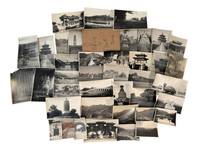
1910Best.-Nr. 235921910. Peking and North China travel photo archive circa 1912 to 1918 documenting the former imperial capital during the turbulent opening years of the Republic of China when centuries of Qing imperial rule had only recently ended and Beijing remained the political and cultural heart of northern China. The photographs record a landscape where imperial monuments Buddhist temples ancient roads and rural villages continued to define daily life despite the collapse of the dynasty in 1912. Produced during the era that followed the Xinhai Revolution and preceded the consolidation of the warlord period the archive preserves a city and surrounding countryside poised between imperial tradition and an uncertain republican future. Photo archive of 40 original silver gelatin photographs ranging from approximately 2 × 3 inches to 4 × 6 inches Peking Beijing and North China circa 1912 to 1918. The photographs depict the Temple of Heaven the Summer Palace Pei Hai Beihai Park the Forbidden City and its surrounding walls the White Dagoba at Miaoying Temple monumental ceremonial gateways pagodas temple courtyards the Great Wall north of Peking the Western Hills stone bridges lakes canals and mountain landscapes. Other photographs show Buddhist monks walking through temple precincts camel caravans crossing rocky valleys mule carts on country roads grazing livestock village architecture and rural agricultural scenes beyond the capital. Contemporary manuscript captions identify numerous locations including "The Great Wall of China" "Temple of Heaven Peking" "Pei Hai Grounds Peking" "Bridge over stream between Jade Fountain & Summer Palace" "The 3rd Green Golf at Paomachang Peking" "Western Hills near Peking" "Camel Drive at the Great Wall Nankow Pass north of Peking" and "Temple in the Western Hills near Peking Golden Roof." One inscription notes that several views "were taken by the younger Miss Dunne last summer" preserving a small but meaningful record of the archive's contemporary provenance. This photo archive belong to one of the most consequential transitions in modern Chinese history. The Qing dynasty collapsed in 1912 after more than two and a half centuries of rule ending the imperial system that had governed China since 221 BCE. Although the Republic of China replaced the monarchy Beijing remained filled with imperial architecture ceremonial spaces and religious institutions whose daily rhythms changed only gradually. The Forbidden City was still occupied by the abdicated emperor Puyi until 1924 Buddhist monasteries continued to function throughout the Western Hills and camel caravans remained an essential means of transporting goods across northern China's mountain passes. Foreign travelers could still move through monuments that only a generation earlier had been closely associated with imperial authority while political power increasingly shifted among competing republican governments and regional military leaders during the emerging Warlord Era. Rather than emphasizing political upheaval directly the archive records the remarkable continuity of Beijing's monumental landscape and traditional patterns of travel religion and commerce immediately after the fall of the last Chinese dynasty. Light surface wear occasional corner creasing and scattered silvering consistent with age; manuscript identifications on many versos. Overall in very good condition. A concentrated visual record of Peking and North China at the moment imperial China gave way to the Republic preserving both the enduring ceremonial landscape of the Qing capital and the traditional life that continued beneath profound political change. unknown
1910Best.-Nr. 235921910. Peking and North China travel photo archive circa 1912 to 1918 documenting the former imperial capital during the turbulent opening years of the Republic of China when centuries of Qing imperial rule had only recently ended and Beijing remained the political and cultural heart of northern China. The photographs record a landscape where imperial monuments Buddhist temples ancient roads and rural villages continued to define daily life despite the collapse of the dynasty in 1912. Produced during the era that followed the Xinhai Revolution and preceded the consolidation of the warlord period the archive preserves a city and surrounding countryside poised between imperial tradition and an uncertain republican future. Photo archive of 40 original silver gelatin photographs ranging from approximately 2 × 3 inches to 4 × 6 inches Peking Beijing and North China circa 1912 to 1918. The photographs depict the Temple of Heaven the Summer Palace Pei Hai Beihai Park the Forbidden City and its surrounding walls the White Dagoba at Miaoying Temple monumental ceremonial gateways pagodas temple courtyards the Great Wall north of Peking the Western Hills stone bridges lakes canals and mountain landscapes. Other photographs show Buddhist monks walking through temple precincts camel caravans crossing rocky valleys mule carts on country roads grazing livestock village architecture and rural agricultural scenes beyond the capital. Contemporary manuscript captions identify numerous locations including "The Great Wall of China" "Temple of Heaven Peking" "Pei Hai Grounds Peking" "Bridge over stream between Jade Fountain & Summer Palace" "The 3rd Green Golf at Paomachang Peking" "Western Hills near Peking" "Camel Drive at the Great Wall Nankow Pass north of Peking" and "Temple in the Western Hills near Peking Golden Roof." One inscription notes that several views "were taken by the younger Miss Dunne last summer" preserving a small but meaningful record of the archive's contemporary provenance. This photo archive belong to one of the most consequential transitions in modern Chinese history. The Qing dynasty collapsed in 1912 after more than two and a half centuries of rule ending the imperial system that had governed China since 221 BCE. Although the Republic of China replaced the monarchy Beijing remained filled with imperial architecture ceremonial spaces and religious institutions whose daily rhythms changed only gradually. The Forbidden City was still occupied by the abdicated emperor Puyi until 1924 Buddhist monasteries continued to function throughout the Western Hills and camel caravans remained an essential means of transporting goods across northern China's mountain passes. Foreign travelers could still move through monuments that only a generation earlier had been closely associated with imperial authority while political power increasingly shifted among competing republican governments and regional military leaders during the emerging Warlord Era. Rather than emphasizing political upheaval directly the archive records the remarkable continuity of Beijing's monumental landscape and traditional patterns of travel religion and commerce immediately after the fall of the last Chinese dynasty. Light surface wear occasional corner creasing and scattered silvering consistent with age; manuscript identifications on many versos. Overall in very good condition. A concentrated visual record of Peking and North China at the moment imperial China gave way to the Republic preserving both the enduring ceremonial landscape of the Qing capital and the traditional life that continued beneath profound political change. unknown books
Best.-Nr. 49596Section historique du Maroc.Ernest Leroux.1922. et Geuthner,1954.4 vols.in-4 demi-reliés Dont la Bibliographie et l'Index Alphabétique des Tomes de I à V.Documents.BE.QQues piqûres sans gravité.Manquent les Tomes IV,V et VI.
Best.-Nr. 2091202133209320Macao New Book Office N.A. Soft Cover. Fine. Number of books: 4 books in total Macao New Book Office paperback
1962Best.-Nr. 2091202133202844Chinese book office 1962. Soft Cover. Fine. Number of books: 5 books in total Chinese book office paperback
1870Best.-Nr. 055223Kostantiniyye Constantinople - Istanbul: Matbaa-yi Âmire. AH 1287 1870. 1st Edition . Hardcover. Very Good. 8vo - over 7¾ - 9¾" tall. Contemporary cloth bdg. marbled boards. Cr. 8vo. 19 x 14 cm. In Ottoman script Old Turkish with Arabic letters. 2 130 p. Exceedingly rare first edition of the most comprehensive biographical book of the Crimean Khans and Khanate including 44 biographies starting from the founder of the khanate Hadji Geray 1397-1466 each khan period has been handled separately including narrations of the wars with Tsarist Russia and other important events. In the beginning the genealogy of the Crimean khans dating back to Genghis Khan is also given. In the book the dates of the expeditions of these rulers of Crimea their reigns and wars were tried to be determined meticulously. Some important events are mentioned albeit briefly like the Fire of Moscow occurred on May 24 1571 when the Crimean and Ottoman armies led by the khan of Crimea Devlet I Giray bypassed the Serpukhov defensive fortifications on the Oka River crossed the Ugra River and rounded the flank of the 60000-man Russian army. The last biography in the work was the author's father and Baht Geray Han d. 1801. Özege 6373.; TBTK 12314. Matbaa-yi Âmire., [AH 1287] hardcover
1895Best.-Nr. 2091202133206193Not Available 1895. Soft Cover. Fine. Number of books: 16 books in total Not Available paperback
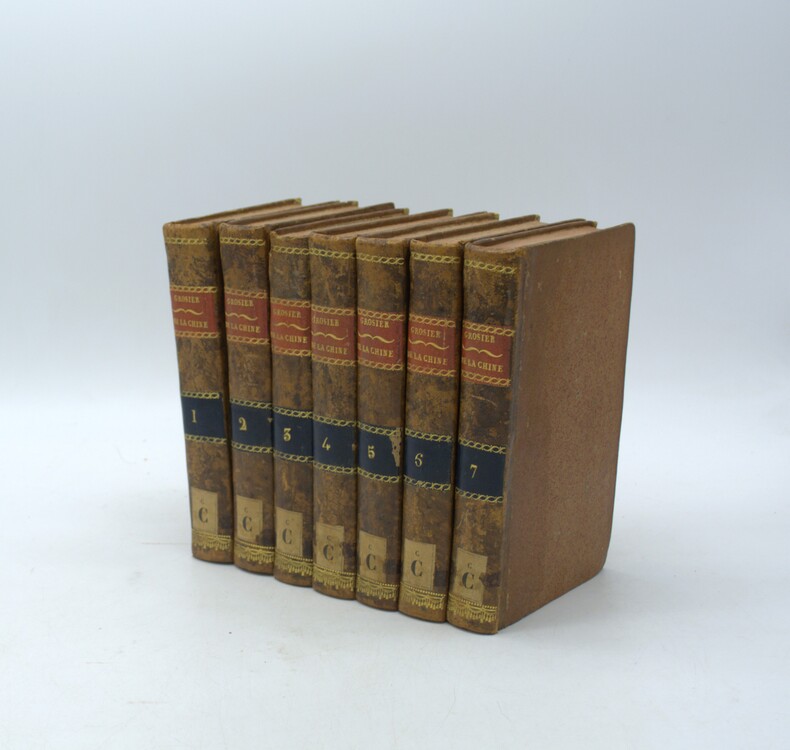
1818Best.-Nr. PHO-2140Paris, chez Pillet, 1818-1820. 7 vol. in-8, demi-basane époque, dos lisse avec pièces d’auteur et titre cerise et tomaison noire, tranches mouchetées, étiquette de bibliothèque en pied, quelques frottements et épidermures aux dos, petit accroc (tome 3)
2000New New English Original bdg. Dust wrapper. Folio. (43 x 30 cm). In Persian and English. [i-xxxvii] pp. text in English, [8], 264 p. text in Persian, richly illustrated. After a large historical background, the presented book has old views, city plans and maps of Iranian cities including Russian, Iranian, Arabian and Western cartographers in the Qajar dynasty (1794-1925). A very comprehensive large and heavy book on Iran in the 19th century cartographic material.
1940Very Good English Original color photograph, hand-colored. 4to. (26 x 20 cm). A portrait. Signed and inscribed as 'To my dear uncle and mother, Fatma Sultana, New York, August 1940'. Sabia Sultan was born on 2 April 1894 in her father's palace in Ortaköy. Her mother was Nazikeda Kadin, daughter of Hasan Marshan and Fatma Horecan Aredba. She was the third daughter born to her father and mother. She had two sisters, Fenire Sultan, six years elder than her, and Ulviye Sultan, one year elder than her. When her father asecended the throne in 1918, Sabiha was still unmarried, but had several admirers. Those who knew her always said that she was not like the other women of the Ottoman family. "Sabiha Sultan was different", said the Turkish poet Yahya Kemal. Her first suiter is thought to be Rauf Orbay. He was followed by Mahmud Kemal Pasha. Another was Fuad Bey of the Babanzade clan. Captain Safvet Arikan, Lieutinant Suphi Bey from Damascus were other suitors, but none of them were accepted. Her betrothal to Ahmad Shah Qajar, the last ruling member of the Qajar dynasty and Mustafa Kemal Atatürk was forfeited in favor of her second cousin Sehzade Ömer Faruk thus missing her chance of becoming the first "First Lady" of the nascent Turkish Republic. Sabiha and Sehzade Ömer Faruk, the son of Abdulmejid II, the last Caliph of the Ottoman Caliphate and Sehsuvar Hanim, were in love with each other. When Abdulmejid asked Sabiha's hand in marriage for his son, Mehmed flatly refused as there was no such thing as a marriage between cousins. Sehsuvar Hanim, the prince's mother called on Nazikeda, and succeeded in convincing her. The marriage took place on 5 December 1919, in the pavilion of the sacred relics, Topkapi Palace. The marriage was performed by Seyhülislam Hayrizade Ibrahim Efendi. Sabiha Sultan's deputy was Baskatip Ali Fuad Bey, and Ömer Faruk's deputy was Ömer Yaver Pasha. The wedding reception took place four months later on 29 April 1920 at the Yildiz Palace. The couple were given the Nisantasi Palace as their residence. Fatma Neslisah Osmanoglu was a granddaughter of the last Ottoman Caliph Abdulmejid II and his first wife, Sehsuvar Hanim and granddaughter of the last Ottoman Sultan Mehmed VI and his first wife, Nazikeda Kadin. She was the daughter of Sehzade Ömer Faruk (1898-1969/1971) and his first wife and cousin Sabiha Sultan (1894-1971). Extremely rare.