1507 risultati
2015New Persian Paperback. Roy. 8vo. (24 x 17 cm). Text in Persian with a bilingual title in English and Persian on cover. 598 p., portrait and ills. The religions of ancient Iran.= Adyân va mazâhib dar Îrân bâstân.
1967Lower corners bumped. Scholar's bookplate to inner cover (G. P. Goold). Foxing/dustsoiling to top of textblock. DJ has a bit of browning. ; Papyrologica Coloniensia Vol. III; 294 pages
2010The Poison King describes a life brimming with spectacle and excitement. Claiming Alexander the Great and Darius of Persia as ancestors, Mithradates inherited a wealthy Black Sea kingdom at age fourteen after his mother poisoned his father. He fled into exile and returned in triumph to become a ruler of superb intelligence and fierce ambition. Hailed as a savior by his followers and feared as a second Hannibal by his enemies, he envisioned a grand Eastern empire to rival Rome. After massacring eighty thousand Roman citizens in 88 BC, he seized Greece and modern-day Turkey. Fighting some of the most spectacular battles in ancient history, he dragged Rome into a long round of wars and threatened to invade Italy itself. His uncanny ability to elude capture and surge back after devastating losses unnerved the Romans, while his mastery of poisons allowed him to foil assassination attempts and eliminate rivals. ; 448 pages
2010Very minor shelfwear. ; The Poison King describes a life brimming with spectacle and excitement. Claiming Alexander the Great and Darius of Persia as ancestors, Mithradates inherited a wealthy Black Sea kingdom at age fourteen after his mother poisoned his father. He fled into exile and returned in triumph to become a ruler of superb intelligence and fierce ambition. Hailed as a savior by his followers and feared as a second Hannibal by his enemies, he envisioned a grand Eastern empire to rival Rome. After massacring eighty thousand Roman citizens in 88 BC, he seized Greece and modern-day Turkey. Fighting some of the most spectacular battles in ancient history, he dragged Rome into a long round of wars and threatened to invade Italy itself. His uncanny ability to elude capture and surge back after devastating losses unnerved the Romans, while his mastery of poisons allowed him to foil assassination attempts and eliminate rivals. ; 448 pages
1998rif. 2091502135307409Kyukoshoin 1998. Soft Cover. Fine. Volume: 1 Kyukoshoin paperback
Fine English Paperback. Pbo. 4to. (33 x 24 cm). In English and Turkish. [40] p., color and b/w ills. and musical scores. The musicians of the Ottoman dynasty.= Müzisyen Osmanogullari. Photos by Sami Güner.
1896pp. xxxii, 245, (2) [Publisher's catalogue] + Frontis and folding plates. XLib. Tall 8vo. Original purple cloth boards, spine crudely taped. Hardbound. Worn copy. Scarce. ISLAM BOX 1
1967xvi + 212pp. + 11 plates out-of-text, 26cm., in the series "Studies in Kushana genealogy and chronology" vol.1 & "Calcutta Sanskrit College Research Series", cloth (bit stained), dustwrapper (some use), text G, X71382
1967rif. X71382Calcutta, The Principal, Sanskrit College 1967 xvi + 212pp. + 11 plates out-of-text, 26cm., in the series "Studies in Kushana genealogy and chronology" vol.1 & "Calcutta Sanskrit College Research Series", cloth (bit stained), dustwrapper (some use), text G, X71382
1985No marks or inscriptions. A very clean very tight copy with unmarked black cloth boards and minor bump to lower front corner. Dust jacket not price clipped or marked or torn or creased with a few tiny nicks to edges and corners. 565pp. The saga of America's Kennedy dynasty. Illustrated.
2011New Persian Paperback. Roy. 8vo. (24 x 17 cm). Text in Persian with bilingual title in English and Persian on cover. [6], 222 p., 1 folded map, b/w and color ills. The Iran's history of political, social, economical and cultural changes in the Samanid's period.= Târîkh-i tahavvulât-i siyâsî, ijtimâ'î, iqtisâdî va farhangî Irân dar dawrah-'i Sâmâniyân.
1985rif. 950704Chicago: Ares Publishers, 1985. XXI; 409 S., zahlr. Abb. Broschiert.
2016New Persian Paperback. Roy. 8vo. (24 x 17 cm). Text in Persian with bilingual title in English and Persian on cover. 512 p., maps. The history of Iran in Qajar dynasty: The era of Aqa Mohammad Khan.= Târîkh-i Irân dar dawrah-'i Qâjârâyah: 'Asr-i Âqâ Muhammad Khân.
2016New Persian Paperback. Roy. 8vo. (24 x 17 cm). Text in Persian with bilingual title in English and Persian on cover. [8], 312 p. The history of Dialamites in Iran (Local governments, Ziarids, Buyids).= Daylamiyân dar gustarah-'i târîkh-i Irân: Hukûmat'hâ-yi mah?allî, Âl-i Ziyâr, A?l-i Bûyah.
2003rif. 2083002115706015Chinese book office 2003. Soft Cover. Fine. Size: 21cm Number of books: 6 Chinese book office paperback
1995rif. 1186611London ; New York : Viking., 1995. XXIX, 384 S. : 50 Abb., Kt. ; 24 cm Originalhardcover mit Schutzumschlag / with dust jacket.
rif. 50283E.J. Brill, Leiden, Holland, 1967
2007rif. ART5753MPaperback, 240 pages, published by British Museum Press in 2007, very good conditions.
rif. 8987Lexington, KY, Forgotten Books, 2011 (Reprinted Edition). 1 volume, in-4, 367 pp., softcover, with frontispiece of President Li Yuan-Hung, enriched with 28 black and white illustrations, stamp on front page, in excellent condition.
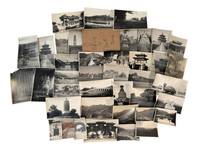
1910rif. 235921910. Peking and North China travel photo archive circa 1912 to 1918 documenting the former imperial capital during the turbulent opening years of the Republic of China when centuries of Qing imperial rule had only recently ended and Beijing remained the political and cultural heart of northern China. The photographs record a landscape where imperial monuments Buddhist temples ancient roads and rural villages continued to define daily life despite the collapse of the dynasty in 1912. Produced during the era that followed the Xinhai Revolution and preceded the consolidation of the warlord period the archive preserves a city and surrounding countryside poised between imperial tradition and an uncertain republican future. Photo archive of 40 original silver gelatin photographs ranging from approximately 2 × 3 inches to 4 × 6 inches Peking Beijing and North China circa 1912 to 1918. The photographs depict the Temple of Heaven the Summer Palace Pei Hai Beihai Park the Forbidden City and its surrounding walls the White Dagoba at Miaoying Temple monumental ceremonial gateways pagodas temple courtyards the Great Wall north of Peking the Western Hills stone bridges lakes canals and mountain landscapes. Other photographs show Buddhist monks walking through temple precincts camel caravans crossing rocky valleys mule carts on country roads grazing livestock village architecture and rural agricultural scenes beyond the capital. Contemporary manuscript captions identify numerous locations including "The Great Wall of China" "Temple of Heaven Peking" "Pei Hai Grounds Peking" "Bridge over stream between Jade Fountain & Summer Palace" "The 3rd Green Golf at Paomachang Peking" "Western Hills near Peking" "Camel Drive at the Great Wall Nankow Pass north of Peking" and "Temple in the Western Hills near Peking Golden Roof." One inscription notes that several views "were taken by the younger Miss Dunne last summer" preserving a small but meaningful record of the archive's contemporary provenance. This photo archive belong to one of the most consequential transitions in modern Chinese history. The Qing dynasty collapsed in 1912 after more than two and a half centuries of rule ending the imperial system that had governed China since 221 BCE. Although the Republic of China replaced the monarchy Beijing remained filled with imperial architecture ceremonial spaces and religious institutions whose daily rhythms changed only gradually. The Forbidden City was still occupied by the abdicated emperor Puyi until 1924 Buddhist monasteries continued to function throughout the Western Hills and camel caravans remained an essential means of transporting goods across northern China's mountain passes. Foreign travelers could still move through monuments that only a generation earlier had been closely associated with imperial authority while political power increasingly shifted among competing republican governments and regional military leaders during the emerging Warlord Era. Rather than emphasizing political upheaval directly the archive records the remarkable continuity of Beijing's monumental landscape and traditional patterns of travel religion and commerce immediately after the fall of the last Chinese dynasty. Light surface wear occasional corner creasing and scattered silvering consistent with age; manuscript identifications on many versos. Overall in very good condition. A concentrated visual record of Peking and North China at the moment imperial China gave way to the Republic preserving both the enduring ceremonial landscape of the Qing capital and the traditional life that continued beneath profound political change. unknown books
1910rif. 235921910. Peking and North China travel photo archive circa 1912 to 1918 documenting the former imperial capital during the turbulent opening years of the Republic of China when centuries of Qing imperial rule had only recently ended and Beijing remained the political and cultural heart of northern China. The photographs record a landscape where imperial monuments Buddhist temples ancient roads and rural villages continued to define daily life despite the collapse of the dynasty in 1912. Produced during the era that followed the Xinhai Revolution and preceded the consolidation of the warlord period the archive preserves a city and surrounding countryside poised between imperial tradition and an uncertain republican future. Photo archive of 40 original silver gelatin photographs ranging from approximately 2 × 3 inches to 4 × 6 inches Peking Beijing and North China circa 1912 to 1918. The photographs depict the Temple of Heaven the Summer Palace Pei Hai Beihai Park the Forbidden City and its surrounding walls the White Dagoba at Miaoying Temple monumental ceremonial gateways pagodas temple courtyards the Great Wall north of Peking the Western Hills stone bridges lakes canals and mountain landscapes. Other photographs show Buddhist monks walking through temple precincts camel caravans crossing rocky valleys mule carts on country roads grazing livestock village architecture and rural agricultural scenes beyond the capital. Contemporary manuscript captions identify numerous locations including "The Great Wall of China" "Temple of Heaven Peking" "Pei Hai Grounds Peking" "Bridge over stream between Jade Fountain & Summer Palace" "The 3rd Green Golf at Paomachang Peking" "Western Hills near Peking" "Camel Drive at the Great Wall Nankow Pass north of Peking" and "Temple in the Western Hills near Peking Golden Roof." One inscription notes that several views "were taken by the younger Miss Dunne last summer" preserving a small but meaningful record of the archive's contemporary provenance. This photo archive belong to one of the most consequential transitions in modern Chinese history. The Qing dynasty collapsed in 1912 after more than two and a half centuries of rule ending the imperial system that had governed China since 221 BCE. Although the Republic of China replaced the monarchy Beijing remained filled with imperial architecture ceremonial spaces and religious institutions whose daily rhythms changed only gradually. The Forbidden City was still occupied by the abdicated emperor Puyi until 1924 Buddhist monasteries continued to function throughout the Western Hills and camel caravans remained an essential means of transporting goods across northern China's mountain passes. Foreign travelers could still move through monuments that only a generation earlier had been closely associated with imperial authority while political power increasingly shifted among competing republican governments and regional military leaders during the emerging Warlord Era. Rather than emphasizing political upheaval directly the archive records the remarkable continuity of Beijing's monumental landscape and traditional patterns of travel religion and commerce immediately after the fall of the last Chinese dynasty. Light surface wear occasional corner creasing and scattered silvering consistent with age; manuscript identifications on many versos. Overall in very good condition. A concentrated visual record of Peking and North China at the moment imperial China gave way to the Republic preserving both the enduring ceremonial landscape of the Qing capital and the traditional life that continued beneath profound political change. unknown
1887rif. 62521ABLondon. Smith, Elder and Co. 1887. 469 S., englischsprachig. Or.-Leinen. guter, altersgemäßer Zustand., Besitzereintr. a. Titel., Ecken etw. bestoßen., Riss im ob. drittel d. Buchrückens., Buchdeckel u. Kanten leicht berieben.
1979190 p., illus. Examination of the Mongol invasion which began in 1241. Hardcover Very good condition good
1991rif. 2082702114905878Mingde Publishing Company 1991. Soft Cover. Fine. Number of pages: 338p Size: 22cm Mingde Publishing Company paperback
1998rif. 2092902141208401old books in shanghai 1998. Soft Cover. Fine. Volume: 1 old books in shanghai paperback