1919 risultati
rif. DADAX0367014564New unknown
rif. DADAX0415302676New unknown
rif. DADAX0415240697New unknown
rif. DADAX0198757964New unknown
rif. DADAX1543810705New unknown
1867rif. BK0168Philadelphia: J. B. Chandler Printer 1867. 116 pp. 8vo. Original printed wrappers. Ex-library with small Massachusetts State Library stamp to title page; otherwise near fine. Very good. A late defense of the Pennsylvania system of prison discipline written as the model developed at Eastern State Penitentiary was increasingly becoming an exception among American prisons. The system kept inmates separated from one another both at work and at rest in contrast to the Auburn system which brought prisoners together for silent congregate labor during the day. Eastern State maintained the separate system from its opening in 1829 into the 1870s despite sustained criticism of its effects and lessened ability to keep prisoners separate in the first place due to overcrowding.1 Published as a defense of the Pennsylvania system of separate confinement the pamphlet appeared after the model associated with Eastern State Penitentiary had already been the subject of decades of criticism in the United States and abroad. The work is generally attributed to Richard Vaux son of the prominent Philadelphia prison reformer Roberts Vaux and himself a longtime advocate of the Pennsylvania system. By the time this edition appeared in 1867 separate confinement had lost ground nationally to the Auburn system of congregate labor making the pamphlet a late statement in defense of a model of incarceration closely identified with Philadelphia and Eastern State Penitentiary. 1 Ashley Theresa Rubin Institutionalizing the Pennsylvania System: Organizational Exceptionalism Administrative Support and Eastern State Penitentiary 1829-1875 PhD diss. University of California Berkeley 2013. . J. B. Chandler, Printer unknown

rif. DADAX0367224526New unknown
rif. DADAX0199595011New unknown
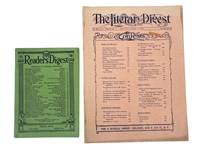
1904rif. 237201904. Two American digest periodicals documenting changes in national public discourse from the Progressive Era through the Great Depression. The earlier issue contains prominent contemporary coverage of the Statesboro Georgia lynching of 1904 reproducing reactions from newspapers across the country and condemning the burning and killing of two Black men by a white mob after the courts had already imposed sentences. The Literary Digest. New York: Funk & Wagnalls Company August 27 1904. Vol. XXIX No. 9 Whole No. 749. Together with The Reader's Digest. Pleasantville New York: The Reader's Digest Association May 1932. Eleventh Year Vol. 21 No. 121. Two illustrated periodicals. The Literary Digest complete in original printed wrappers; the Reader's Digest in original green printed wrappers. The Literary Digest treats the Statesboro lynching as a national disgrace assembling condemnations of the white mob that seized two Black prisoners from lawful custody and burned them alive after their convictions. Its opposition to mob violence is forceful for a mainstream national periodical but the journalism is not racially radical: it condemns lynching chiefly as a collapse of law civilization and public order while reproducing racialized language paternalistic assumptions and comparisons with "Darkest Africa" that reveal the limits of white Progressive reform discourse. The article documents how anti-lynching sentiment could coexist with the racial hierarchies embedded in early twentieth-century American journalism. Other contents also address the Russo-Japanese War Theodore Roosevelt's "Big Stick" politics immigration early automobile culture religion scientific racism and political caricature preserving the mixture of reform journalism racial ideology international reporting and editorial debate that shaped mass-circulation American periodicals at the beginning of the twentieth century. The May 1932 issue captures an American reading public attempting to understand economic collapse mass unemployment and the instability of modern life during the darkest years of the Great Depression. Its condensed articles move from Arthur Pound's courtroom account of bankrupt workers shopkeepers and failed speculators to proposals for canceling international war debts arguments over housing and advertising and criticism of the press's exploitation of the Lindbergh kidnapping. Reports on Japan's campaign in Manchuria cancer research industrial materials telecommunications and labor-saving inventions place domestic economic crisis beside the geopolitical and technological transformations reshaping the interwar world. The two issues document national and international crises into accessible commentary for a broad readership moving from the racial violence imperial politics and reform debates of 1904 to the economic collapse mass media consumer culture and geopolitical instability of 1932. Both remain stapled without annotations or other markings. Completely legible and in overall very good condition with only minor discoloration and scattered creasing or handling use. unknown
rif. DADAX0415238684New unknown
rif. DADAX0415227925New unknown
rif. DADAX0415236096New unknown
rif. DADAX0415240956New unknown
rif. DADAX0199260419New unknown
rif. SONG0387257098Used: Good unknown
rif. DADAX1847200796New unknown
1888rif. 41415New York: Commissions Verlag von Hermann Rosenthal & Co 1888. hardback. 1st edition. Original Cloth. 8vo 88 pages 17 cm. In German with scattered Hebrew. Singerman 3624. Title translates as "The Proverbs of Solomon as true to the Text as Possible in Rhyme." The Book of Proverbs "Mishli Shlomoh" or Solomon's Proverbs is a book in the third section of the Hebrew Bible Ketuvim. Written by King Solomon it discusses values moral behavior the meaning of human life and ethical conduct. Louis Naumurg 1813-1902 "went to America after 1848 and was elected cantor of Reform Congregation Keneseth Israel at Philadelphia Pa. which position he held from 1850 to 1860. In 1865 he was chosen minister of Congregation Rodeph Shalom Pittsburg Pa. During his earlier years in America Naumburg acted as teacher and reader in the synagogue of the Congregation Keneseth Israel of Philadelphia. He prepared a metrical version in German of the Book of Proverbs" this work Cyrus Adler & Josiah Cohen in JE. Naumburg's biography appears in the American Hebrew March 1902. SUBJECTS: Bible. Proverbs -- Paraphrases German. OCLC: 10245073. OCLC-Worldcat lists 7 copies worldwide NYPL JTS Duke Penn Brown Columbia Boston Public None beyond the American East Coast. All Edges Gilt. Spine and endpapers replaced some light staining about Very Good Condition. B AMR-57-21-BRKK-lxe. New York: Commissions Verlag von Hermann Rosenthal & Co unknown
1820rif. 55414London: John Fairburn 1820. First Edition. First printing. Octavo in fours 22cm. In nineteenth-century half brown calf with marbled paper over boards seven double gilt rules to spine with blind ornament in compartments titled in gilt on brown leather spine label all edges sprinkled brown; plain endpapers; iv 480pp. 1944 pencil ownership inscription to rear endpaper. A straight sound copy with minor general wear to boards paper lightly scuffed edges rubbed internally largely clean with one or two pencil marks and small spots of foxing: Very Good. A key text of early nineteenth-century English parliamentary reformers: "a massive compendium of all the abuses electoral ecclesiastical legal" that they "sought to abolish." The book "passed through edition after edition continually augmented with new arguments new reports of abuses and new statistics. . . its emphasis on the need to have practical as well as equitable representation lies at the root of parliamentary democracy" Printing and the Mind of Man p.180. Previously published in installments in 1819; this is the first book edition. PMM296. GOLDSMITHS 23071. KRESS C.638. John Fairburn unknown
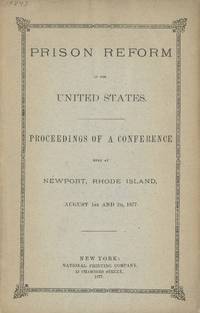
1877rif. BK0163New York: National Printing Company 1877. 8vo 56 pp. Original printed wrappers. "Compliments of Dr. Wines" slip affixed to title page. Near fine with a small tear to front wrapper at seam. Proceedings of an important national conference on prison reform organized around a program prepared by Enoch Cobb Wines the leading American prison reformer of the period. Wines had served as secretary of the New York Prison Association and was instrumental in organizing the landmark National Congress on Penitentiary and Reformatory Discipline at Cincinnati in 1870. The Newport conference met seven years later to formulate a practical system of penal institutions and policies that could be recommended to state legislatures. Much of the pamphlet is devoted to the conference's "Outline Draft of a System of Preventive Reformatory and Penitentiary Institutions and Discipline" which attempted to address criminal justice as a single system extending from childhood through incarceration. Its recommendations begin with compulsory education and institutions for neglected and delinquent children and proceed through reform schools houses of detention women's prisons county jails and state penitentiaries. The conference was particularly severe in its judgment of the existing jail system: "The county jails of the United States numbering about two thousand are with few exceptions schools of vice nurseries of crime and feeders of the penitentiaries. Their construction and management are alike bad; indeed the former is so radically defective as to render any good administration of them impossible." The conference occurred during a period when many of Wines's ideas were beginning to find practical application most notably at Elmira under Zebulon Brockway. Its recommendations ranged from compulsory education and separate institutions for juveniles and women to trained prison officers productive labor improved sanitation and greater state oversight. The "Compliments of Dr. Wines" slip gives this copy a nice association with the man chiefly responsible for both the conference and the program it produced. . National Printing Company unknown
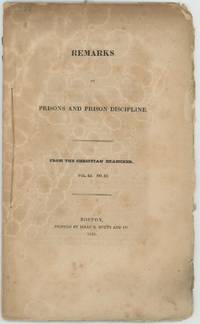
1826rif. BK0167Boston: Isaac R. Butts and Co 1826. 35 pp. 8vo. Original printed wrappers sewn. Wrappers toned and mottled with some edge wear; contents toned. Very good. An early American prison reform pamphlet attributed to Lewis Tappan by Sabin and by Tappan biographer Bertram Wyatt-Brown. Originally appearing in the Christian Examiner it was published separately in 1826 just as the penitentiary was becoming one of the central experiments of antebellum social reform. The essay describes the new system of discipline then being developed at Auburn and other American prisons: prisoners confined separately at night brought together for labor during the day under enforced silence and subjected to regular religious instruction. The arrangement was intended to prevent prisons from becoming schools of crime while replacing indiscriminate punishment with an organized program of labor surveillance and moral reform. The Boston Prison Discipline Society founded the previous year became the principal national advocate of this Auburn system and issued its first annual report in 1826. Its program called for separate cells productive employment religious and common-school instruction and the separation of youthful offenders from adults and habitual offenders.1 Tappan was still a Boston merchant when the pamphlet appeared several years before he became one of the founders of both the New York and American Anti-Slavery Societies in 1833 and later a leading organizer of the defense of the Amistad captives.2 1 Prison Discipline Society Boston Mass. records CC 1 Simmons College Archives Boston MA USA. 2 Lewis Tappan Papers Manuscript Division Library of Congress Washington D.C. https://hdl.loc.gov/loc.mss/eadmss.ms010139. . Isaac R. Butts and Co unknown
rif. SONG0367314924Used: Good unknown
rif. 65933. pp. 337-392 AND 617-670. Both disbound from annual volumes the overall stitching retained in excellent condition. For the TWO titles. unknown
rif. SONG1107081203Used: Good unknown
rif. DADAX0877220832New unknown
rif. DADAX0198208286New unknown