52 résultats
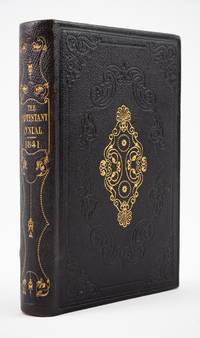
1840réf. ST20302-02London: Francis Baisler 1840. FIRST EDITION. 195 x 130 mm. 7 3/4 x 5". xi 1 307 1 4 pp. Publisher's black pebbled morocco covers elaborately decorated in blind with gilt centerpieces smooth spine decorated in gilt all edges gilt gutter between the end of the text and the ads at the back expertly reinforced. With 10 engraved plates including the frontispiece and engraved title. Dedication page with contemporary ink ownership inscription of Wm. C. Drysdale. Noticeable discoloration to pastedowns and flyleaves from binding adhesive plates negligibly foxed otherwise especially clean and fresh internally with only the most trivial of imperfections; the exceptionally clean binding showing virtually no signs of use. This collection of essays and verse promoting Protestant thought and values comes in a beautifully preserved Victorian publisher's binding. The editor of this work Charlotte Elizabeth Tonna 1790-1846 was an evangelical Protestant social reformer particularly devoted to exposing poor factory conditions and improving the welfare of women and the poor. Writing under the name Charlotte Elizabeth she made "contributions to social reform literature and her use of the 'Christian Lady's Magazine' as a forum to influence politics through her female readers mark her as a significant nineteenth-century figure especially for other women social reform writers such as Harriet Beecher Stowe . . . and Elizabeth Gaskell." DNB Of particular note in our volume is an essay by Charlotte Elizabeth discussing the figure of Katherine Parr sixth wife of Henry VIII as a model of Protestantism and womanhood. Francis Baisler unknown books
2002réf. 11263Washington DC: Brookings Institution Press 2002. First Edition. Illustrated Paperback. Near fine. Report of the National Commission on Federal Election Reform signed by President Jimmy Carter. This report was produced by Brookings Institution with co-chairs being: Jimmy Carter Gerald R. Ford Lloyd N. Cutler and Robert H. Michel. Octavo vii 358pp. Illustrated paperback title on cover and spine. This copy appears unread. Signed by President Jimmy Carter on the half title with a full signature. In the wake of the 2000 presidential election a commission was established to look at the integrity of voting systems around the United States. The commission proposed improvements to federal state and local voting systems. The recommendations resulted in landmark legislation called the Help America Vote Act signed by President George W. Bush in 2002. Brookings Institution Press paperback books
1871réf. 229841871. Parliament House of Commons. Report from the Select Committee on Protection of Infant Life 1871 documents the development of state intervention into infant care mortality and childcare practices in industrial Britain establishing a foundational record in the history of child welfare law and public health regulation. Produced in response to widespread concern over infant deaths associated with "baby farming" the report supports research into nineteenth-century social reform gender and labor history and the emergence of legal frameworks governing child protection. Its findings informed subsequent legislation including the Infant Life Protection Act of 1872 and later reforms expanding state oversight of childcare marking a significant shift toward recognizing infant welfare as a matter of public responsibility rather than private domestic concern. Parliament House of Commons. Report from the Select Committee on Protection of Infant Life; together with the Proceedings of the Committee Minutes of Evidence Appendix and Index. London: Ordered by the House of Commons to be Printed 20 July 1871. First edition. The volume records proceedings of a parliamentary inquiry directed "to inquire as to the best means of preventing the destruction of the lives of infants put out to nurse for hire by their parents." Contents include formal committee findings extensive Minutes of Evidence and appended statistical and documentary material. Testimony from surgeons coroners medical editors and local officials details infant mortality rates across London Lancashire Yorkshire and Scottish industrial centers. Witnesses describe systems of paid infant care including lump-sum "adoption" payments and weekly nursing arrangements that enabled maternal wage labor alongside accounts of infants transferred "generally immediately after birth" to low-cost nursing establishments. The report analyzes financial structures secrecy in lying-in houses and disparities in care tied to poverty and illegitimacy. Discussions within the proceedings reveal tensions between criminal law enforcement Poor Law administration and emerging public health authorities while tabulated data and narrative testimony together document patterns of neglect mortality and institutional response. The material documents the system of early child welfare regulation through parliamentary inquiry medical testimony and statistical evidence revealing how infant care practices were scrutinized categorized and brought under state oversight and providing primary-source evidence for the study of legal intervention in family life the expansion of public health governance and the consolidation of parens patriae authority. Issued at a time of accelerating industrialization and urban poverty the report demonstrates how gendered labor economic precarity and unregulated childcare markets contributed to infant mortality and prompted legislative reform. Large octavo; single volume; contemporary red cloth with black spine label lettered in gilt. Light rubbing minor surface wear and small spots to binding with edge wear; internally light toning and scattered marginal wear; text clean and fully readable. Overall condition: Very good. unknown books
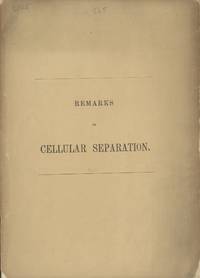
1861réf. BK0164Philadelphia: Publication Committee of the Philadelphia Society for Alleviating the Miseries of Public Prisons 1861. 112 pp. 8vo. Original printed wrappers. Wrappers frayed along spine otherwise near fine internally; very good overall. A defense of the Pennsylvania system of prison discipline advocating the separation of prisoners as a means of moral reform rather than punishment alone. The work was read by appointment before the American Association for the Improvement of Penal and Reformatory Institutions at its annual meeting in New York on November 29 1860 and published the following year by the Philadelphia Society for Alleviating the Miseries of Public Prisons. Foulke was one of Philadelphia's leading nineteenth-century prison reformers and a prominent defender of the system associated with Eastern State Penitentiary in which prisoners were housed separately. By 1860 the practice had become the subject of sustained criticism in the United States and Europe particularly over the psychological effects of prolonged isolation. Foulke takes up those objections at length arguing that cellular separation had been confused with punitive solitary confinement and presenting it instead as a carefully supervised regime intended to encourage reflection and rehabilitation. Foulke engages with Charles Dickens's celebrated attack on the Pennsylvania system after his 1842 visit to Eastern State Penitentiary reproducing and responding to Dickens's account. Published at a time when American penal institutions were becoming an international subject of study and controversy Remarks provides a substantial contemporary statement of the case for one of the country's most influential-and eventually most disputed-experiments in incarceration. . Publication Committee of the Philadelphia Society for Alleviating the Miseries of Public Prisons unknown books
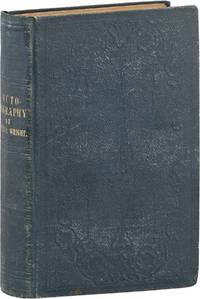
1849réf. 86600Boston: Bela Marsh 1849. First Edition. First printing. Octavo 18.5cm. Publisher's green embossed cloth titled in gilt; pale salmon endpapers; 414pp; mezzotint portrait frontispiece. A quite attractive copy just lightly rubbed to boards with a few scattered spots of foxing to text; solidly Very Good overall and somewhat uncommon thus. A significant if entirely idiosyncratic work in the annals of American radical reform as much a philosophical treatise as an autobiography. American pacifist freethinker feminist and abolitionist Henry Clarke Wright 1797-1870 though little remembered was among the most interesting radical voices of the mid-19th century a defrocked Presbyterian minister who in his adopted role as a "Christian reformer" preached against all established religions and adopted a thoroughly stridently contrarian voice in nearly every field of social reform he touched which was practically all of them. His views opposing established government put him directly in the line of such individualist anarchists as Lysander Spooner and Benjamin Tucker while his opposition to slavery was so uncompromising that he was ejected from the American Antislavery Society in 1837. He remained closely associated with most of the New England radical abolitionist community however especially with William Lloyd Garrison with whom he frequently collaborated. Like most of Wright's commercially-issued works this one was published by the Boston radical publisher Bela Marsh known for disseminating works by fellow abolitionists and freethinkers during the antebellum period. 86600. Bela Marsh unknown books
1883réf. 727291883. London 1883. London 1883. The "Annual Blister" of Victorian Law: A Scarce 1883 Reformist Tract on the Deceased Wife's Sister Controversy Marriage Law Reform Association. A Summary of the Chief Arguments For and Against Marriage With A Deceased Wife's Sister. London: Marriage Law Reform Association 1883. 15 1 pp. Octavo 8-1/4" x 5-1/2". Stab-stitched pamphlet in self wrappers. Light toning negligible edgewear light foxing in a few places. $350. Third and final edition. A scarce reformist tract representing one of the most protracted legal and social battles of the Victorian era. The Marriage Law Reform Association was established in 1851 to overturn Lord Lyndhurst's Marriage Act of 1835 which codified the prohibition of marriage between a widower and his sister-in-law. This restriction was rooted in the theological "one flesh" doctrine of affinity which legally equated a wife's sister with a blood sister. The controversy often dubbed the "annual blister" due to its near-yearly debate in Parliament highlighted a sharp class divide; while the wealthy could travel abroad to marry the working classes-who relied on sisters-in-law for domestic stability-were forced into "legalized concubinage." The debate permeated Victorian culture appearing in works ranging from Gilbert and Sullivan's Iolanthe to the novels of Dinah Craik. This edition captures the height of the Association's campaign which eventually succeeded with the passage of the Deceased Wife's Sister's Marriage Act in 1907. Sweet & Maxwell A Legal Bibliography of the British Commonwealth of Nations Vol. 2 p. 224. unknown books
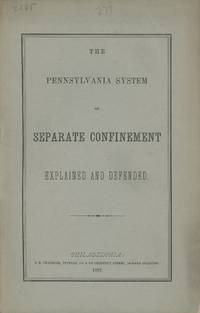
1867réf. BK0168Philadelphia: J. B. Chandler Printer 1867. 116 pp. 8vo. Original printed wrappers. Ex-library with small Massachusetts State Library stamp to title page; otherwise near fine. Very good. A late defense of the Pennsylvania system of prison discipline written as the model developed at Eastern State Penitentiary was increasingly becoming an exception among American prisons. The system kept inmates separated from one another both at work and at rest in contrast to the Auburn system which brought prisoners together for silent congregate labor during the day. Eastern State maintained the separate system from its opening in 1829 into the 1870s despite sustained criticism of its effects and lessened ability to keep prisoners separate in the first place due to overcrowding.1 Published as a defense of the Pennsylvania system of separate confinement the pamphlet appeared after the model associated with Eastern State Penitentiary had already been the subject of decades of criticism in the United States and abroad. The work is generally attributed to Richard Vaux son of the prominent Philadelphia prison reformer Roberts Vaux and himself a longtime advocate of the Pennsylvania system. By the time this edition appeared in 1867 separate confinement had lost ground nationally to the Auburn system of congregate labor making the pamphlet a late statement in defense of a model of incarceration closely identified with Philadelphia and Eastern State Penitentiary. 1 Ashley Theresa Rubin Institutionalizing the Pennsylvania System: Organizational Exceptionalism Administrative Support and Eastern State Penitentiary 1829-1875 PhD diss. University of California Berkeley 2013. . J. B. Chandler, Printer unknown books
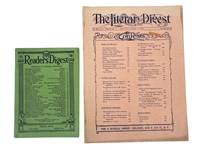
1904réf. 237201904. Two American digest periodicals documenting changes in national public discourse from the Progressive Era through the Great Depression. The earlier issue contains prominent contemporary coverage of the Statesboro Georgia lynching of 1904 reproducing reactions from newspapers across the country and condemning the burning and killing of two Black men by a white mob after the courts had already imposed sentences. The Literary Digest. New York: Funk & Wagnalls Company August 27 1904. Vol. XXIX No. 9 Whole No. 749. Together with The Reader's Digest. Pleasantville New York: The Reader's Digest Association May 1932. Eleventh Year Vol. 21 No. 121. Two illustrated periodicals. The Literary Digest complete in original printed wrappers; the Reader's Digest in original green printed wrappers. The Literary Digest treats the Statesboro lynching as a national disgrace assembling condemnations of the white mob that seized two Black prisoners from lawful custody and burned them alive after their convictions. Its opposition to mob violence is forceful for a mainstream national periodical but the journalism is not racially radical: it condemns lynching chiefly as a collapse of law civilization and public order while reproducing racialized language paternalistic assumptions and comparisons with "Darkest Africa" that reveal the limits of white Progressive reform discourse. The article documents how anti-lynching sentiment could coexist with the racial hierarchies embedded in early twentieth-century American journalism. Other contents also address the Russo-Japanese War Theodore Roosevelt's "Big Stick" politics immigration early automobile culture religion scientific racism and political caricature preserving the mixture of reform journalism racial ideology international reporting and editorial debate that shaped mass-circulation American periodicals at the beginning of the twentieth century. The May 1932 issue captures an American reading public attempting to understand economic collapse mass unemployment and the instability of modern life during the darkest years of the Great Depression. Its condensed articles move from Arthur Pound's courtroom account of bankrupt workers shopkeepers and failed speculators to proposals for canceling international war debts arguments over housing and advertising and criticism of the press's exploitation of the Lindbergh kidnapping. Reports on Japan's campaign in Manchuria cancer research industrial materials telecommunications and labor-saving inventions place domestic economic crisis beside the geopolitical and technological transformations reshaping the interwar world. The two issues document national and international crises into accessible commentary for a broad readership moving from the racial violence imperial politics and reform debates of 1904 to the economic collapse mass media consumer culture and geopolitical instability of 1932. Both remain stapled without annotations or other markings. Completely legible and in overall very good condition with only minor discoloration and scattered creasing or handling use. unknown books
1820réf. 55414London: John Fairburn 1820. First Edition. First printing. Octavo in fours 22cm. In nineteenth-century half brown calf with marbled paper over boards seven double gilt rules to spine with blind ornament in compartments titled in gilt on brown leather spine label all edges sprinkled brown; plain endpapers; iv 480pp. 1944 pencil ownership inscription to rear endpaper. A straight sound copy with minor general wear to boards paper lightly scuffed edges rubbed internally largely clean with one or two pencil marks and small spots of foxing: Very Good. A key text of early nineteenth-century English parliamentary reformers: "a massive compendium of all the abuses electoral ecclesiastical legal" that they "sought to abolish." The book "passed through edition after edition continually augmented with new arguments new reports of abuses and new statistics. . . its emphasis on the need to have practical as well as equitable representation lies at the root of parliamentary democracy" Printing and the Mind of Man p.180. Previously published in installments in 1819; this is the first book edition. PMM296. GOLDSMITHS 23071. KRESS C.638. John Fairburn unknown books
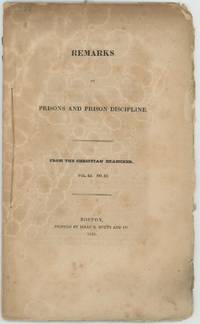
1826réf. BK0167Boston: Isaac R. Butts and Co 1826. 35 pp. 8vo. Original printed wrappers sewn. Wrappers toned and mottled with some edge wear; contents toned. Very good. An early American prison reform pamphlet attributed to Lewis Tappan by Sabin and by Tappan biographer Bertram Wyatt-Brown. Originally appearing in the Christian Examiner it was published separately in 1826 just as the penitentiary was becoming one of the central experiments of antebellum social reform. The essay describes the new system of discipline then being developed at Auburn and other American prisons: prisoners confined separately at night brought together for labor during the day under enforced silence and subjected to regular religious instruction. The arrangement was intended to prevent prisons from becoming schools of crime while replacing indiscriminate punishment with an organized program of labor surveillance and moral reform. The Boston Prison Discipline Society founded the previous year became the principal national advocate of this Auburn system and issued its first annual report in 1826. Its program called for separate cells productive employment religious and common-school instruction and the separation of youthful offenders from adults and habitual offenders.1 Tappan was still a Boston merchant when the pamphlet appeared several years before he became one of the founders of both the New York and American Anti-Slavery Societies in 1833 and later a leading organizer of the defense of the Amistad captives.2 1 Prison Discipline Society Boston Mass. records CC 1 Simmons College Archives Boston MA USA. 2 Lewis Tappan Papers Manuscript Division Library of Congress Washington D.C. https://hdl.loc.gov/loc.mss/eadmss.ms010139. . Isaac R. Butts and Co unknown books
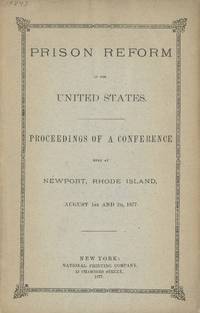
1877réf. BK0163New York: National Printing Company 1877. 8vo 56 pp. Original printed wrappers. "Compliments of Dr. Wines" slip affixed to title page. Near fine with a small tear to front wrapper at seam. Proceedings of an important national conference on prison reform organized around a program prepared by Enoch Cobb Wines the leading American prison reformer of the period. Wines had served as secretary of the New York Prison Association and was instrumental in organizing the landmark National Congress on Penitentiary and Reformatory Discipline at Cincinnati in 1870. The Newport conference met seven years later to formulate a practical system of penal institutions and policies that could be recommended to state legislatures. Much of the pamphlet is devoted to the conference's "Outline Draft of a System of Preventive Reformatory and Penitentiary Institutions and Discipline" which attempted to address criminal justice as a single system extending from childhood through incarceration. Its recommendations begin with compulsory education and institutions for neglected and delinquent children and proceed through reform schools houses of detention women's prisons county jails and state penitentiaries. The conference was particularly severe in its judgment of the existing jail system: "The county jails of the United States numbering about two thousand are with few exceptions schools of vice nurseries of crime and feeders of the penitentiaries. Their construction and management are alike bad; indeed the former is so radically defective as to render any good administration of them impossible." The conference occurred during a period when many of Wines's ideas were beginning to find practical application most notably at Elmira under Zebulon Brockway. Its recommendations ranged from compulsory education and separate institutions for juveniles and women to trained prison officers productive labor improved sanitation and greater state oversight. The "Compliments of Dr. Wines" slip gives this copy a nice association with the man chiefly responsible for both the conference and the program it produced. . National Printing Company unknown books
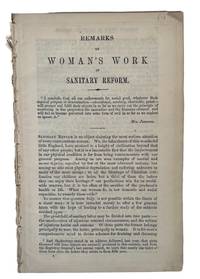
1858réf. 197991858. Powers Susan Rugeley. Remarks on Woman's Work in Sanitary Reform is a circa 1859 pamphlet documenting Victorian women's public health work through the system of sanitary reform revealing how women's domestic educational and visiting labor was framed as essential to national health. Addressed to mothers educators tract distributors and visitors of schools cottages and workhouses the text asks "What can woman do in her domestic and social capacities to remedy these evils" and answers by assigning women authority over household health infant care education and habits. The pamphlet supports research into women's employment Victorian public health sanitary reform feminist social thought and the expansion of women's public roles through reform labor. Powers Susan Rugeley. Remarks on Woman's Work in Sanitary Reform. London: Tweedie circa 1859. 20 pages. 8vo. The pamphlet divides sanitary labor into "the amelioration of injurious external circumstances" and "the reform of injurious habits and customs" identifying the former principally with men and the latter principally with women. Powers argues "It is for woman in her functions of mother housewife and teacher" to change infant management domestic economy education and the habits of women and adds that "It is for her to teach and apply the laws of health in her own provinces where man cannot act." Susan Rugeley Powers was the first secretary of the Ladies' Sanitary Association an organization founded to educate working-class communities on public health; the pamphlet was also connected to the English Woman's Journal and the wider Langham Place reform milieu. The pamphlet demonstrates the process by which sanitary reform converted gendered domestic expertise into organized public health labor giving women a socially sanctioned role in health education before broader access to professional employment. Contemporary holdings appear limited: a dealer record notes four WorldCat copies and three COPAC copies while a University of Wisconsin catalog record identifies a later microfilm version associated with the English Woman's Journal. Slight chipping at binding; pages held together; minor wear. Overall very good. A focused Victorian women's reform pamphlet linking public health domestic authority and early arguments for women's socially necessary work. unknown books
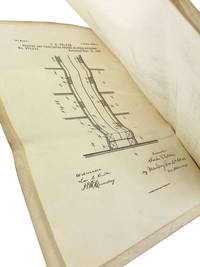
1887réf. 21386Washington: H. Peters 1887. Very Good. Washington: H. Peters 1887. Folio 30.5cm.; ribbon-bound engraved self-wrappers wax-sealed and accomplished in manuscript; 8ll. of photo-engraved plans printed on versos only followed by 3pp. text printed in double columns on rectos only. Previous mail folds extremities a bit chipped and toned ribbons slightly frayed else Very Good internally clean and sound. Signed by Acting Secretary of State D.L. Hawkins and Commissioner of Patents Burton J. Hall. Detailed patent application submitted by the Superintendent of the Chicago Bridewell Prison on September 13 1887. Charles E. Felton ca. 1832-1909 was the prison's longest serving overseer having held the position from its opening in 1872 until his retirement in 1890. Formerly a printer in Buffalo New York Felton entered the field of prison administration through the usual political platforms though he assumed his position in Chicago not through the usual channels but based on his previous experience serving as director of the Erie PA correctional facility. A Democrat and avid duck hunter with a rather unfocussed eye on the mayoralty of Chicago Felton was especially interested in enforcing labor in his prisons as a means of reducing costs and galvanizing individual reformation a position he clung to even past his retirement. The present patent submitted with steel manufacturer Herbert B. Streeter 1833-1919 offered substantial air circulation improvements for prisons "or other structures where the tiers of cells or dormitories have an open hall or corridor without separation by floors or otherwise." Previously the Chicago House of Corrections had just one small ventilating flue leaving the air "absolutely foul and poisonous." The plans depicted here show two foul air flues and one steam-coil heating device per cell as well as additional open air gratings for increased circulation. Though it is unclear whether the patent was ever approved Felton in an address delivered before the Prison Congress four years later complained that the increase in crime rates could be blamed in part on "the comfortable quarters" offered prospective convicted criminals. Also to blame "the present views of the public and acts of legislatures as to systems of prison labor and its ease to the prisoner.the quality of food; their the prisoners' easy access to visitation and the readiness with which a sympathetic public accepts as true the complaints of the prisoners" "Inter Ocean" newspaper October 14 1891. This patent submitted to improve the comfortable prison cells Felton so bemoaned an important document for students and historians of prison reform architecture and engineering. H. Peters unknown books
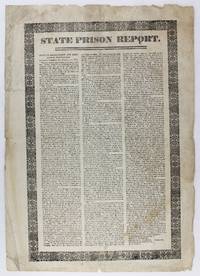
1834réf. 3806Providence 1834. Good plus. Broadside 15 x 10.5 inches printed in three columns within an ornamental border. Old folds short splits along some folds a few small chips moderate dust-soiling and foxing. Untrimmed. A rare broadside disseminating a report from a five-man committee of the General Assembly of Rhode Island recommending penal code reform and the establishment of a state prison in the Ocean State in 1834. The beginning of the report expounds upon the inconsistency of the various legal punishments meted out in county jails. The committee then evaluates different methods of imprisonment in New York Pennsylvania Connecticut and other states concluding as follows: "On the whole the committee are in favor and recommend to the General Assembly the erection of a State penitentiary on the principle of solitary confinement at labor with instruction in labor in morals and religion." The committee hoped this prison reform would "relieve the State from the future support of convicts and may produce a moral reformation in those who may be subjected to its operation." We could locate just one copy of this broadside in OCLC at Brown. unknown books
1972réf. 232591972. Prison and IncarcerationSocial activism Prison reform organizing conference broadside. Attica and San Quentin prison organizing stand at the center of this January 1972 Berkeley conference broadside which opens with a Brecht quote "Slave who is it that shall free you.all of us or none" and declares that "no one in America today is more a slave than the inmates in American prisons." The text ties prison struggle to "class and racial oppression" names the murders at Attica and San Quentin and frames the prison system as a site of beatings drugs "behavior modification" and brain surgery schemes. The conference was held just a few months after the 1971 Attica uprising during which prisoners revolted against inhumane treatment and racial discrimination in a violent struggle that left 39 dead. The conference roster grounds the prison rights moment Bay Area Black liberation featuring figures including Afeni Shakur Fay Stender and former Soledad Prison chief psychiatrist Frank Rundle. "Slave Who Is It Shall Free You . . . All of Us or None." The Struggle Inside. Prison Action Conference. Berkeley 1972. Single-sheet broadside 8.5 x 11 inches for a prison action conference scheduled for January 28-30 in Pauley Ballroom UC Berkeley printed on both sides. Recto features two halftone prison photographs and a dense typed manifesto arguing that prisoner demands had moved "from traditional demands for food and shelter to demands for civil and religious rights and finally to a general challenge to the prison system and the society which fosters it." It announces the conference as "a forum for self education and exploration of potential action to assist the prison movement" with key speakers Afeni Shakur a defendant in the Panther 21 trial Fay Stender a Berkeley attorney with years of prison movement experience and Frank Rundle former chief psychiatrist at Soledad Prison. Verso gives the full three-day program: Friday evening remarks by Stender and Shakur; Saturday sessions on "Medical Repression in Prisons" "Adult Authority and Indeterminate Sentencing" "Economics of Prisons" "Juvenile Reformatories and Detention" and "Prisoners Demands"; and Sunday sessions on "Women in Prison" "Defense of Political Prisoners" "Military Prisons" "Prison-Community Communications" "Prisoners Organizations" "County Jails and Pre-trial Detention" plus a closing "Panel Discussion on Racism." The broadside illustrates the actions and intentions of the Berkeley prison movement at a time when prison rebellion legal defense anti-racist analysis and ex-prisoner testimony were being brought before public audiences in the aftermath of the Attica Uprising. Afeni Shakur's appearance links the handbill to the political world of the Black Panther movement while the inclusion of sessions on women in prison political prisoners juvenile detention county jails and medical repression demonstrate the intersectional goals of the movement and the broadening of post-Attica activism from outrage over one massacre to a larger indictment of prison administration and criminal punishment. Some light staining; otherwise very good condition. A Bay Area prison movement piece that preserves both the rhetoric and the working program of organizing against U.S. imprisonment in the immediate aftermath of the 1971 Attica Uprising. unknown books
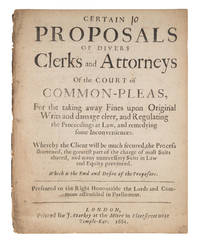
1661réf. 724361661. A Scarce Restoration-Era Pamphlet Proposing Reforms to Court Procedure Law Reform. Great Britain. Certain Proposals of Divers Clerks and Attorneys of the Court of Common-Pleas For the Taking Away Fines upon Original Writs and Damage Cleer And Regulating the Proceedings at Law And Remedying Some Inconveniences. Whereby the Client Will be Much Secured The Process Shortened The Greatest Part of the Charge of Most Suits Abated And Many Unnecessary Suits in Law and Equity Prevented. Which is the End and Desire of the Proposers. Presented to the Right Honourable the Lords and Commons Assembled in Parliament. London: Printed for J. Starkey at the Mitre in Fleetstreet near Temple-Bar 1661. vi 8 pp. Quarto 7" x 5-1/2". Disbound stab-stitched pamphlet. Moderate toning soiling to exterior light browning to margins "10" in early hand to head of title page. $450. Only edition. Produced by a "divers" group of "clerks and attorneys of the Court of Common-Pleas" this pamphlet suggests ways to reform pleading and procedure and reduce the number of lawsuits in the civil and equity courts. This is a scarce title. OCLC locates 6 copies 4 in law libraries Harvard Library of Congress San Francisco Law Library Yale. English Short-Title Catalogue R35481. unknown books
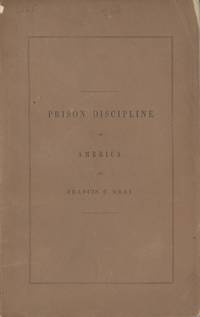
réf. BK0166Boston: Charles C. Little and James Brown 1847. 203 pp. 8vo. Original printed wrappers. Near Fine. An important contemporary attack on the Pennsylvania system of prison discipline and its use of prolonged cellular separation published during a heated national and international debate over the treatment of prisoners. Gray had served as vice-president of the Boston Prison Discipline Society and for several years chaired the board of directors of the Massachusetts State Prison. The book appeared amid the bitter 1846-47 controversy within the Boston Prison Discipline Society after Charles Sumner challenged the organization's longstanding hostility toward the Pennsylvania system. Sumner's intervention drew attention in Europe and correspondence from Alexis de Tocqueville; Gray answered from the opposing side with the present work. A later account specifically identified Prison Discipline in America as the principal American response taking a stand against the Pennsylvania system.1 Gray's argument rests heavily on comparative evidence from American prisons including statistics from the Massachusetts State Prison at Charlestown and Eastern State Penitentiary at Philadelphia. He regarded the higher rates of insanity and mortality under constant separation as evidence against the system concluding that it tended to "enfeeble the body and the mind." His observations became an enduring part of the literature on solitary confinement and continue to be cited in modern medical and legal discussions of its psychological effects. A particularly nice copy in near fine condition in the original wraps. 1 "RIVAL SYSTEMS OF PRISON DISCIPLINE. Speech before the Boston Prison Discipline Society at the Tremont Temple June 18 1847" in Charles Sumner. His Complete Works Lee and Shepard 1900 digitized by Project Gutenberg accessed October 8 2026 https://www.gutenberg.org/cache/epub/45473/pg45473-images.html. . Charles C. Little and James Brown unknown books
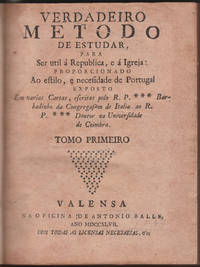
1747réf. 65Valensa Actually Lisbon: Antonio Balle Unknown 1747 Actually 1751. Second Edition. Contemporary calf; rebacked; spine laid down; hinges reinforced. Fair copy; overall browning; headlines on several leaves are gouged out affecting page numbers. Library release stamp on the verso of the first title page. 4to. I: 12 12 - 264 ; II: 4 12 - 243244 pp. A scarce and according to Palau important tract in the development and introduction of modern pedagogical concepts into Spain. The first edition of 1746 was seized and destroyed. The second edition was clandestinely printed see Martins Livros clandestinos . A revolutionary book in opposing the Jesuits and with very interesting comments on the teaching of the sciences medicine jurisprudence literary aesthetics and the education of women. The book generated a considerable polemical literature. Palau citing the first # 360777. Antonio Balle [Unknown] unknown books
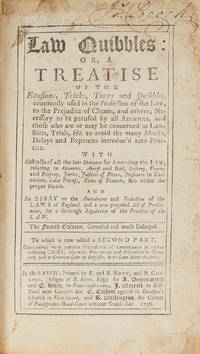
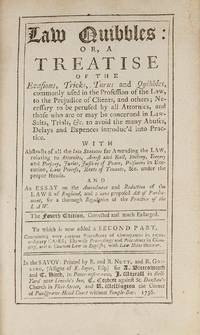
1736réf. 856711736. London 1736. Fourth & final edition. London 1736. Fourth & final edition. A Reform-Oriented Layman's Guide to Law's "Evasions Tricks Turns and Quibbles" Legal Criticism. Law Reform. Great Britain. Law Quibbles: Or A Treatise of the Evasions Tricks Turns and Quibbles Commonly Used in the Profession of the Law To the Prejudice of Clients And Others; Necessary to be Perused by All Attornies And Those Who Are or May be Concerned in Law Suits Trials &c. To Avoid the Many Abuses Delays and Expences Introduc'd into Practice. With Abstracts of All the Late Statutes for Amending the Law Relating to Attornies Arrest and Bail Bribery Forgery and Perjury Juries Justices of Peace Prisoners in Execution Law Process Rents of Tenants &c. Under the Proper Heads. And an Essay on the Amendment and Reduction of the Laws of England And a New Proposed Act of Parliament For a Thorough Regulation of the Practice of the Law. Corrected and much Enlarged. To Which is Now Added a Second part Containing Every Curious Precedents of Conveyances in Extraordinary Cases; Likewise Proceedings and Precedents in Chancery And at Common Law in English; With Law-Notes Thereon. London: Printed by E. and R. Nutt and R. Gosling 1736. viii 132 135 13 72 pp. An Essay on the Amendment and Reduction of the Laws of England bound at rear text complete. Octavo 8" x 4-1/2"; 20.2 x 11.5 cm. Modern quarter calf over marbled boards lettering piece to spine endpapers renewed. Some fading to spine negligible light shelfwear to extremities. Moderate toning to interior occasional light foxing light soiling in a few places light edgewear to first and last several leaves first four leaves reinforced at edges on verso reinforcement just touching text on one page without loss early owner signature of James Pocock to head of title page. A good copy. $650. Fourth and final edition substantially expanded. First issued in 1724 Law Quibbles occupies a distinctive place in the history of English legal literature as a hybrid work combining satire procedural commentary statutory digest practical precedent book and reform tract. The first part presents an alphabetical exposition of procedural stratagems tactical evasions and professional "mysteries" attributed to legal practitioners. Framed for both attorneys and lay litigants it documents contemporary perceptions of delay expense and pr. unknown books
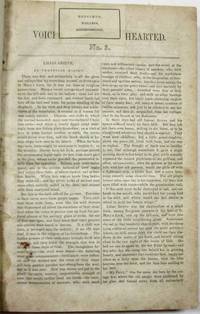
1846réf. 39101Philadelphia 1846. 16 of 18 issues lacking 1 and 2 bound together in contemporary three-quarter calf with marbled boards. Pages numbered 33-288. Some leaves browned. General title page is absent; a small bookplate "Bodichon Scalands Robertsbridge" covers the caption title of No. 3. This is the bookplate of Barbara Leigh Smith Bodichon notable British artist feminist writer and women's rights activist who founded the first women's college at the University of Cambridge. Bound in contemporary quarter calf rubbed and marbled paper over boards. Occasional text browning. Except as noted Very Good. This periodical is a literary anthology of American and British reformist prose and poetry with significant anti-slavery contributions. The authors included John Greenleaf Whittier James Russell Lowell Ralph Waldo Emerson Nathaniel Hawthorne Henry Longfellow John Pierpont Lydia Maria Child Harriet Martineau Lydia Sigourney Alfred Lord Tennyson Elizabeth Barrett and William Lloyd Garrison who wrote three poems for the journal one while imprisoned for libel of a merchant he had accused of illegal slave trading. The anti-slavery pieces are not only poetic most famous being Whittier's "Branded Hand" but also include his essay on the "Slave Market at Washington" Child on the "Economy of Slavery" the "Declaration of Sentiments of the American Anti-Slavery Society" and principles of the 1838 "Peace Convention" organized by Garrison. LCP 10848. AI 46-7277 6. Not in Lomazow or Mott. unknown books
réf. 57805Original illuminated document on parchment; hand-lettered in italic with gilt illuminations at upper left and right margins; signed beneath work by the calligrapher "E. von E." unidentified. With original signatures of 71 board members and staff of the Henry Street Settlement. Mild soil at margins; Near Fine. A handsome hand-lettered tribute to outgoing President of the Board of the Henry Street Settlement Newbold Morris. Morris 1902-1966 was an important figure in Henry Street history assuming the board presidency soon after the reorganization of the Settlement under Director Helen Hall in 1944. Morris also played a prominent role in New York City planning and politics during the Robert Moses era; he was among the more prominent members of the New York Planning Commission; was President of the City Council from 1938 to 1945 and an unsuccessful candidate for Mayor in 1945 and 1949. Later in 1961 Morris achieved some notoriety as the City Parks Commissioner when he rejected the permits of hundreds of folk musicians who had been performing in Washington Square Park sparking the so-called "Beatnik Riot" one of the opening salvos of Sixties countercultural activism. The document is undated but expresses appeciation for Morris's "completion of a decade of service" placing it in the vicinity of 1954-5. Beneath the calligraphic portion the document has been signed by seventy-one individuals including fellow board-members staff and residents. These include a host of prominent mid-century New York figures beginning with Hall herself and including the prominent civic leader Nicholas Kelley; choreographer Alwin Nikolais; economist Mary Keyserling; painter Jack Levine; long-time Henry Street youth worker Ralph Tefferteller and many others. A unique and visually attractive artifact marking the mid-century apex of one of the most successful and long-lived social welfare projects in New York. unknown books
1736réf. 857121736. London 1736. Fourth & final edition. London 1736. Fourth & final edition. A Spirited Call for Reform: A Layman's Guide to Law's "Evasions Tricks Turns and Quibbles" Legal Criticism. Law Reform. Great Britain. Law Quibbles: Or A Treatise of the Evasions Tricks Turns and Quibbles Commonly Used in the Profession of the Law To the Prejudice of Clients And Others; Necessary to be Perused by All Attornies And Those Who Are or May be Concerned in Law Suits Trials &c. To Avoid the Many Abuses Delays and Expences Introduc'd into Practice. With Abstracts of All the Late Statutes for Amending the Law Relating to Attornies Arrest and Bail Bribery Forgery and Perjury Juries Justices of Peace Prisoners in Execution Law Process Rents of Tenants &c. Under the Proper Heads. And an Essay on the Amendment and Reduction of the Laws of England And a New Proposed Act of Parliament For a Thorough Regulation of the Practice of the Law. Corrected and much Enlarged. To Which is Now Added a Second part Containing Every Curious Precedents of Conveyances in Extraordinary Cases; Likewise Proceedings and Precedents in Chancery And at Common Law in English; With Law-Notes Thereon. London: Printed by E. and R. Nutt and R. Gosling 1736. viii 72 132 135 13 pp. With an index and advertisement leaf. Collated and complete. Octavo 7-3/4" x 4-1/2"; 19.6 x 11.8 cm. Contemporary calf blind rules to boards blind fillets along joints raised bands and lettering piece to spine gilt tooling to board edges. Moderate rubbing to boards light wear to extremities joints starting at head chip to center of lettering piece spine ends lightly abraded small vertical surface crack to spine hinges cracked. Light toning to interior crack in text block between pp. 78 & 79 all leaves secure occasional small faint dampstains at page edges. Early owner signature of Thomas Winter dated 1781 to front pastedown. A good sound copy of a scarce and engaging title. $750. Fourth and final edition significantly expanded. First published in 1724 Law Quibbles is a lively and sharply critical guide to the procedural artifices and technical maneuvers of the English legal profession. Designed for the lay reader as much as the practitioner it functions both as a satirical expose and as a practical survival manual for navigating 18th-century litigation. The first part presents an alphabetical "dic. unknown books
1724réf. 753321724. Rare Eighteenth-Century English Tract on Law Reform Law Reform. Great Britain. An Essay on the Amendment And Reduction Of the Laws of England. For the Ease of the Subject The Advancement of Justice And Regulating the Profession of the Law. London: Printed by E. and R. Nutt And R. Gosling Assigns of Edward Sayer Esq; for Tho. Corbett 1724. iv 63 1 pp. Octavo 7-1/2" x 4-3/4". Stab-stitched pamphlet bound into recent quarter calf over marbled boards blind fillets running parallel to joints gilt fillets and contrasting calf lettering piece to spine. Moderate toning to interior faint dampstaining and some wear to fore-edges of final three leaves. $850. Only edition as a separate work. Also issued as the second part of Law Quibbles 1st ed. 1724 this work is a substantial proposal to reform English law and the English legal profession. Clearly the work of an informed and responsible author it influenced the work of the Society of Gentlemen Practisers a professional society for attorneys and solicitors in England and Wales established in 1739. All editions of Law Quibbles are scarce; An Essay is rare. OCLC locates 2 copies Franklin and Marshall College Staatsbibliothek zu Berlin; the ESTC locates 1 California State Library Sutro Library. English Short-Title Catalogue ESTC N30349. unknown books
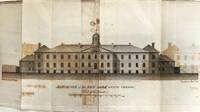
1801réf. 5570New York: I Collins 1801. First Edition. Somewhat later full sheep. Very good; some flaking to the spine of the binding; some offsetting to the plates; otherwise a bright fresh copy. 8vo 4 5 - 94 95 - 109 are erroneously numbered 83 - 97pp. 2 large folding plates a floor plan and elevation and 2 folding tables included in the pagination. Eddy was a Quaker merchant and reformer who had spent time in prison during the Revolution because of his Tory sympathies. He had befriended Philip Schuyler the father-in-law of Alexander Hamilton and hosted a visit of his to Philadelphia to inspect the Walnut Street Jail in 1796. This visit was the impetus for the first penal reform in New York State. Eddy was thus launched upon a career. In 1801 he published the book offered here that is a description of a new prison. The actual design was the work of the Mangin brothers see DAB who are best known for the design of New York City Hall. Eddy's report however contains all of his stipulations for the building and its appointments as well as a detailed summary of how the inmates were to be treated menu lists clothing etc. A most important book: the first native American work on prisons written by the country's first prison director. S & S #431; King Am. Philanthropy # 817; Sabin #21816; see Lewis for citations to Eddy. I Collins unknown books
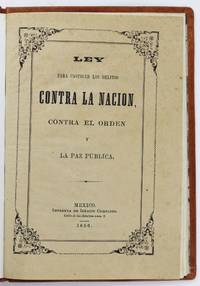
1856réf. 4036Mexico City: Imprenta de Ignacio Cumplido 1856. Still very good. 17pp. Original printed wrappers bound into full calf front board gilt lettered. Some toning and scattered light foxing. This law was promulgated at the end of 1856 by the new liberal government of Mexico following its ascendancy in the mid-1850s and preceded the reform Constitution of 1857 by two months. Its statutes defined "crimes against the independence and security of the nation" including various forms of treason rebellion and foreign military service or assistance and made them punishable by death. The law anticipated conservative resistance and revolt against the new policies of the liberal faction that aimed to strip power and influence from the church and traditional aristocracy of the country. Their efforts indeed led to full-scale civil war in 1858 and the second French intervention in the early 1860s. OCLC locates a small handful of institutional copies and we locate just one in available sales records. Scarce and in attractive original wrappers. Imprenta de Ignacio Cumplido unknown books