2.158 Ergebnisse
Best.-Nr. DADAX0195146999New unknown
Best.-Nr. DADAX0367096366New unknown
Best.-Nr. DADAX0367345625New unknown
Best.-Nr. DADAX0415778220New unknown
Best.-Nr. DADAX0367345307New unknown
Best.-Nr. DADAX0415302757New unknown
Best.-Nr. DADAX0415325404New unknown
Best.-Nr. DADAX0367444356New unknown
Best.-Nr. DADAX0367561468New unknown
Best.-Nr. DADAX0415159725New unknown
Best.-Nr. DADAX0415816831New unknown
Best.-Nr. DADAX0415958032New unknown
Best.-Nr. DADAX0415558646New unknown
Best.-Nr. DADAX041543663XNew unknown
194132 pages. Features: Cover photos of Churchill and Viscount Halifax approaching battleship 'King George V'; Excellent two-page illustration of sappers throwing a box-girder bridge with nose union across an enemy tank trap; Photo of Carl J. Hambro with M. Carton De Wiart; Photo of King Haakon with Polish President M. Raczkiewicz; One-page photo of General Wavell with Maj.-Gen. O'Connor outside doomed Bardia; Eight pages of fantastic photos of the fall of Bardia - first views; Magnificant centrefold photo of Britain's latest and greatest battleship, H.M.S. 'King George V'; Eight photos of patriot Abyssinians training for battle against Italian tyrants; Six photos of Greek heroism in arctic cold - latest pictures from Albania; Two pages of photos of Wendell Willkie, supporter of the aid for Britain policy, at work; Photos of personalities of the week include General De Gaulle, Count Ciano, Marshal Griziani, Count Csaky, Commander Roger Bureau, P.D. Willeringhaus, John Oxenham, Daniel Hopkin, L.F. Sinclair, and David Lloyd George at his wife's funeral; Five photos of the Chinese military which stands undaunted after four years' heroic resistance; Four photos of Chiang Kai-Shek and his wife, plus a photo of her Pekinese dog; Photo of amazing Italian 'Land Yacht' (captured from Commander Gatti) presented to Britain as a symbol of the resistance by the Belgian Congo; and more. Staples disintegrated. Unmarked with above-average wear. A worthy vintage copy of this important wartime issue. Book
194060 pages. Features: *Beautiful* colour ad for International Harvester's Diesel TracTractors inside front cover; The Dionne Quints are featured in an ad for Remington noiseless portable typewriters; Bush Job (fiction); The Wartime Prices Board - photo and article; Beverley Baxter comments on Finland's resistance against Bolshevism and the Imperial Russian forces; "Miz Perkins" (fiction); Canada's Fighting Forces - Part 4 - Soldiers of French Canada - article with photos; Blizzard Honeymoon (fiction); Solver of Air Riddles - The story of Wallace Rupert Turnbull, a Canadian who invented the controllable pitch propeller - article with photos; Wings of Hazard (fiction, part 4 of 5); Dodge car ad; An argument to scrap the Alaska Highway project; Ford V-8 colour ad; Dodge Truck ad; Plymouth ad; Fargo Truck ad; Nice colour photo ad for Oldsmobile; Hockey player Gordie Drillon is featured in an Alka-Seltzer ad along with Syl Apps, Red Horner and Billy Taylor; Humorous Lifebuoy soap ad used the B.O. (body odour) scare to promote sales; Hinds hand cream ad featuring "Honey" the beauty advisor; Nice photo ad for Heinz spaghetti follows the product from farm to plate; Colour photo ad for the 1940 Studebaker Champion inside back cover; Nice Coke ad on back cover shows man in suit checking his pocket watch while eating lunch. Moderate wear. Unmarked. A sound copy. Magazine
1900Best.-Nr. 10656Paris, Imprimerie Nationale, 1900 ; in-8, broché ; (4), 439 pp., 12 planches hors-texte dépliantes.
Best.-Nr. 890655 textes reliés en 1 seul volume, demi-basane, reliure en mauvais état mais structure solide, des rousseurs sur les pages. Carillian-Goeury et Vor Dalmont, 1845, 118 p., 1 planche dépliante / Bachelier, 1852, 103 p., / Mallet-Bachelier, 1858, 104 p., 1 planche dépliante / Carilian-Goeury et Vor Dalmont, 1846, 72 p., 3 planches dépliantes / Carillian-Goeury et Vor Dalmont, 1850, 46 p., 3 planches dépliantes.
1950Best.-Nr. 17581950 Paris, La Hune - Editions de Minuit, 1950. 48 x 33 cm, grand in-folio, 72 ff. n. ch. comportant 33 lithographies en noir hors texte, en feuilles sous couverture blanche imprimée, chemise de demi-toile noire titrée en blanc et étui de l'éditeur.
Best.-Nr. 40531New York Editions de la Maison Française, s.d. [1941] 1 vol. broché brochure in-4 de (2) + 49 feuillets dactylographiés au recto sous couverture brune muette. Rare version dactylographiée dont il est difficile de déterminer si elle précède ou suit l'édition imprimée en 1941 par les Editions de la Maison Française à New York. On sait que ce texte célèbre, où Jacques Maritain analyse les causes de la défaite française de 1940, commença de circuler dans les milieux francophiles américains sous cette forme dactylographiée. Et c'est également ainsi qu'elle fut reproduite en France et en Suisse, l'édition réalisée en novembre 1942 par les Editions de Minuit n'ayant été pour ainsi dire pas diffusée. Notre exemplaire porte le cachet d'une collection privée à Genève. La B.N.F. possède un autre specimen de dactylographie, mais de 48 feuillets.
Best.-Nr. 21683Paris, Éditions de Minuit, 1944. In-8, 59 pp., broché, couverture originale imprimée (petites taches et rousseurs).
Best.-Nr. DADAX0415942152New unknown
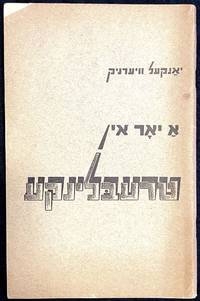
1944Best.-Nr. 43339Nyu-York: Farlag 1944. 1st American Edition. Paper Wrappers 8vo 61 pages. Includes illustrations. 22 cm. In Yiddish. Title translates as "A Year in Treblinka." Translation of Rok w Treblince. Jankiel Yankel Yaakov or Jacob Wiernik 1889-1972 was a "Polish-Jewish Holocaust survivor who was an influential figure in the Treblinka extermination camp resistance. He had been forced to work as a Sonderkommando slave worker there where an estimated 700000-900000 people mostly Jews were murdered. After his escape during the uprising of 2 August 1943 Wiernik reached Warsaw and joined the resistance. He also wrote a clandestine account of the camp's operation A Year in Treblinka which was copied and translated for printing in London and the US in English and Yiddish. Following World War II Wiernik testified at Ludwig Fischer's trial in 1947. He left Poland emigrating first to Sweden and then to the new state of Israel. In 1961 he testified at Adolf Eichmann's trial in Jerusalem. He returned to Poland in 1964 to attend the opening of the Treblinka Memorial. Wiernik died in Israel in 1972 at the age of 83. On his arrival at Treblinka aboard the Holocaust train from Warsaw Wiernik was selected to work as a Sonderkommando; otherwise he would have been immediately gassed and killed that day. Wiernik's first job with the Sonderkommando required him to drag corpses from the gas chambers to mass graves. He was traumatized by his experiences and later wrote in his book: 'It often happened that an arm or a leg fell off when we tied straps around them in order to drag the bodies away.' He remembered the horrors of the enormous pyres where '10000 to 12000 corpses were cremated at one time.' He was also encouraged by occasional scenes of brave resistance. In chapter 8 he describes seeing a naked woman escape the clutches of the guards and leap over a three-metre high barbed wire fence unscathed. When accosted by a Ukrainian guard Trawniki on the other side she wrestled his machine gun out of his grasp killed the guard and shot another guard before being killed herself. When the SS recognized that Wiernik was a professional carpenter they put him to work constructing various camp structures including additional gas chambers. Given his skills Wiernik was not subjected to the same treatment as others and no longer had to handle dead bodies. He attributed his survival to being able to build structures needed in the camp. Given the shortage of skilled construction workers accustomed to the killing process Wiernik moved between the two divisions of the camp frequently. As a result he became an important contact between the camp zones when the revolt was being planned. Wiernik escaped Treblinka during the revolt of the prisoners on 'a sizzling hot day' of August 2 1943. A shot fired into the air signaled that the revolt was on. Wiernik wrote that he 'grabbed some guns' and after spotting an opportunity to make a break for the woods an axe. A camp guard in pursuit shot Wiernik with a pistol but the bullet did not penetrate his skin. Wiernik said he turned around and killed his pursuer with the axe. Wiernik continued to Warsaw hiding in a freight train. Wiernik assumed the name of Jan Smarzynski. He made contact with members of the Jewish underground working in the 'Aryan' part of Warsaw. They realized he was a valuable eyewitness of the extermination process in Treblinka. He was persuaded in late 1943 to write A Year in Treblinka in spite of his initial reluctance Wiernik had little education and was not a skilled writer. He took part in the 1944 Warsaw Uprising fighting in the Armia Ludowa. After the end of World War II Wiernik initially remained in Poland in 1947 he testified in the trial of Ludwig Fischer. He emigrated to Sweden and afterwards to the newly founded state of Israel. There in the 1950s Wiernik built a model of the Treblinka camp. It is displayed in the Ghetto Fighters' House museum in Israel. In 1961 Wiernik testified in the Eichmann trial in Israel. Jankiel Wiernik published Rok w Treblince A Year in Treblinka in 1944 as a clandestine booklet. It was printed through the efforts of the Jewish National Committee Zydowski Komitet Narodowy ZKN Bund underground organizations of the remnants of Polish Jews and the Polish Council to Aid Jews Zegota by means of an underground printer organized by Ferdynand Arczynski. The circulation was estimated by Wladyslaw Bartoszewski as 2000 copies. It was sent through Polish underground channels to London and translated into English and Yiddish. It was also printed in the US by American representatives of the General Jewish Workers Union of Poland ie. this copy. The book recounts his experiences in the Treblinka extermination camp between 1942 and 1943" Wikipedia. SUBJECTS: Holocaust Jewish 1939-1945 -- Poland. Jews -- Poland -- Biography. OCLC: 12246244. Some toning touch or corner wear to covers otherwise Very Good Condition. Nice copy of this very important contemporary account of Treblinka. B HOLO2-50-20A-XXLE-IMMBBE@-'gg. Nyu-York: Farlag unknown
Best.-Nr. DADAX047171576XNew unknown