5,596 results
1985ref. 017799Westfield New Jersey: Privately Published 1985. INSCRIBED / SIGNED by the AUTHOR on the first white page. Very Good condition. NOT a library discard. Pages are crisp and clean. NO underlining. NO highlighting. NO margin notes. Autobiography of a Jewish woman that focuses mostly on her girlhood in Hitler's Germany. Illustrated with full page drawings by S. Bonstein one of which depicts "the hiding place" - a crawl space behind a brick wall concealed by a stack of "collapsible" shelves. Spiral bound black plastic comb with printed tan paper covers under clear plastic sheets front and rear. INSCRIBED / SIGNED by the AUTHOR. 1st ed No additional printings listed. Oversize Softcover. Very Good condition/No jacket as issued. Illus. by Bonstein S. drawings. 146 leaves. Privately Published Paperback
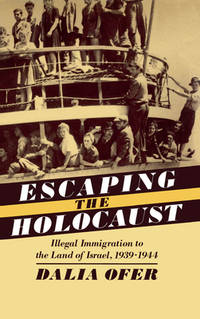
1990ref. 017866New York & London: Oxford University Press 1990. Fine condition in a Near Fine dust jacket. NO chips. NO tears. NO fading. Bright shiny clean square and tight. Sharp corners. NOT a library discard. NO owner's name or bookplate. NO remainder mark. Fresh and crisp -- probably never read. NO underlining. NO highlighting. NO margin notes. 1990 First printing with complete number row 135798642 on the copyright page. Photo illustrated. List of chapter notes. Bibliography. Index. Bound in the original pale yellow boards with a maroon spine stamped in shiny gold. From the dust jacket: "Illegal Jewish immigration to Palestine prior to the founding of the State of Israel forms one of the most fascinating chapters in the history of Zionism and modern Jewish history. Bringing Jews from Europe to Palestine by land and by sea in defiance of restrictive British immigration policies was partly an undertaking of national rescue and partly a calculated strategy of political brinksmanship. In ESCAPE FROM THE HOLOCAUST sic Dalia Ofer examines various rescue and illegal immigration efforts organized by the Palestinian Jewish community in both the beginning and latter phases of the war. Making exhaustive use of archival sources Ofer provides invaluable insight into the struggles of the immigrants the activists and supporters of the movement the logistical obstacles and the political forces working to halt or exploit the flow of refugees." . First Printing of the First Edition. Hardcover. Fine condition/Near Fine dust jacket. 8vo. xiii 408pp. Oxford University Press Hardcover
1984ref. 017851Oaktree Books 1984. INSCRIBED / SIGNED by Leon Mayer. Very Good condition. Illustrated with photos and several full page drawings. Introduction by Dr. Hyman S. Frank. Account of a young Holocaust survivor from Galicia Poland during the Nazi era. English language edition. From the front matter: "The dramatic story of how Leon Mayer and his mother and younger brother survived the Nazi terror first appeared in a series of columns by Dr. Hyman S. Frank in The Jewish Press. This book is a compilation of those articles." Bound in the original gilt-stamped black cloth. INSCRIBED / SIGNED by Leon Mayer. 1st ed No additional printings listed. Hardcover. Very Good condition/No jacket probably as issued. ix 70pp. Oaktree Books Hardcover
1962ref. 017845New York / Jerusalem: Yad Washem Martyrs' and Heroes' Memorial Authority / YIVO Institute for Jewish Research 1962. Very Good condition. NOT a library discard. NO underlining. NO highlighting. NO margin notes. Text is in Hebrew Yiddish and English. Foreword translated from the Hebrew by Jacob Robinson. ON THE BIBLIOGRAPHY OF THE JEWISH CATASTROPHE translated from the Yiddish by Leibush Lehrer. Introduction translated from the Yiddish by Joseph Gar. Joint Documentary Projects Bibliographical Series No. 3. Bound in the original gilt-stamped black cloth. 7.75" wide by 10.75" tall 19.5 cm x 27.5 cm. First Edition in English. Hardcover. Very Good condition/No jacket. xxxi 330pp. Yad Washem Martyrs' and Heroes' Memorial Authority / YIVO Institute for Jewish Research Hardcover
1961ref. 017862New York: The William-Frederick Press 1961. INSCRIBED / SIGNED and dated December 7 1962 by the AUTHOR on the front free endpaper. Fine condition in a Good dust jacket. The jacket is sunned at the spine and edges lightly frayed/rubbed at its corners and spine ends. Not price clipped $3.50. The book itself is bright clean square and tight with sharp corners. NOT a library discard. NO underlining. NO highlighting. NO margin notes. 1961 First Edition. Illustrated with 4 pages of photos. Bound in the original gilt-stamped black cloth. Complete with dust jacket. INSCRIBED / SIGNED by the AUTHOR. First Edition. Hardcover. Fine condition/Good dust jacket. 8vo. vi 97pp. 4 pages of photos. The William-Frederick Press Hardcover
1975ref. 017914New York: Pageant - Poseidon Press Ltd. 1975. Very Good condition. Slight browning to the endpapers probably offset from binder's glue. 1975. First Edition. Sharp corners. NOT a library discard. No owner's name or bookplate. No underlining. No highlighting. No margin notes. Bound in the original gilt-stamped black cloth. First Edition. Hardcover. Very Good condition/No jacket. x 204pp. Great Packaging Fast Shipping. Pageant - Poseidon Press Ltd. Hardcover
1989ref. 017918New York: Grove Weidenfeld 1989. INSCRIBED / SIGNED by Simon Wiesenthal on the front free endpaper. A beautiful copy of the First U.S. printing. Fine condition in a Fine dust jacket. NO chips. NO tears. NO creases. NO fading. NOT price clipped $22.50. Protected by a removable Brodart clear-plastic sleeve. Bright shiny clean square and tight. Sharp corners. NOT a library discard. NO remainder mark. Pages are clean and crisp. NO underlining. NO highlighting. NO margin notes. First U.S. printing 1989 with "First American edition" so stated and complete number row 10 987654321 on the copyright page. Illustrated with 16 pages of photos. Translated from the German by Ewald Osers. Laid in is a copy of Wiesenthal's 2005 obituary. From the publisher: "Since the end of World War II Wiesenthal has dedicated his life to bringing Nazis to justice. In this book he describes his activities the men such as Eichmann and Mengele he has pursued the Nazi escape organization Odessa but also some of the heroism that the horrors produced. The book asks questions about the function of punishment and the possibility of rehabilitation in such extreme cases of criminality. He shows that many of the most sadistic persecutors of the Nazi regime found it all too easy to merge into normal society and assume a cloak of decency. Wiesenthal's aim has been to expose to the fullest possible extent the hypocritical sham of this normalization which he believes incubates the anti-semitism of which the Nazi regime was the most barbaric manifestation." Index. Bound in the original brown boards with a brown cloth spine stamped in shiny copper. Complete with dust jacket. . INSCRIBED / SIGNED by Simon Wiesenthal. First American edition so stated. Hardcover. Fine condition/Fine dust jacket. 8vo. xi 372pp. 16 pages of photos. Grove Weidenfeld Hardcover
1978ref. 018398Washington D. C.: University Press of America 1978. Very Good condition. Sharp corners. Flat spine. NO creases. NOT a library discard. NO owner's name or bookplate. Pages are clean and crisp. NO underlining. NO highlighting. NO margin notes. Translated from the Polish with an introduction and notes by E. P. Kulawiec. 8 full page illustrations. This is the first edition in English of the Warsaw Ghetto diary written from May to August 1942 by Janusz Korczak 1878-1942 who was a Polish doctor author of over 20 books and head of an orphanage caring for some two hundred children. Korczak declined repeated offers of rescue choosing instead to remain with the children. He was exterminated in August 1942 at Treblinka. Bound in the original green wraps stamped in black. First Edition in English. Softcover. Very Good condition. xviii 12 129pp. Great Packaging Fast Shipping. University Press of America Paperback
1986ref. 002136Brooklyn New York: Mesorah Publications Ltd. 1986. 6" wide by 9" tall. Trade paperback. Fine condition. No underlining. No highlighting. No margin notes. No owner's name or bookplate. Bright clean square tight and unmarked. Flat spine. No creases. Illustrated throughout with photos and facsimiles of document and newspapers. Bibliography. Index. A volume in the ArtScroll History Series. From the rear cover: "This is the incredible story of Rabbi Chaim Michael Dov Weissmandl the legendary leader who -- under the nose of the Gestapo -- nearly succeeded in saving over a million Jews Weissmandl was the world's most courageous innovative audacious imaginative and charismatic rescue activist from 1941-1945. He negotiated with Eichmann's apparatus appealed to an anti-Semitic bishop escaped from an Auschwitz death train sent the first map of Auschwitz to the West initiated the negotiations that led to Eichmann's offer to spare at least 1000000 Jews - for a price that was never paid." Tells who blocked his telegrams to the Free World. Keywords: Jewish Holocaust. WWII. WW2. Nazi Germany. Third Reich. . Second printing. Softcover. Original pictorial wraps. 288pp. . Mesorah Publications, Ltd. Paperback
1990ref. 005975Detroit Michigan: Wayne State University Press 1990. Brand new in perfect condition. 5.5" wide by 8.25" tall. Bright shiny clean square and tight. Sharp corners. No store stamp owner's name or bookplate. Flat spine. No creases. Pages are fresh crisp and unmarked. "TOUCHING EVIL is about the Holocaust but there are no living Jews in it only the shadows of dead ones." From the rear cover: "'Using the Eichmann trial as nexus Rosen has created a suspenseful novel of the horrible era when the trains were chugging into Belsen and Auschwitz.' - Newsday." Originally published in 1969 this 1990 edition features a new foreword by the author in which she briefly traces the background of the novel. . 1st Wayne State ed. with new foreword. Trade Paperback. New. Illus. by Krzewinski Mary cover art. vii 269pp. Great Packaging Fast Shipping. Wayne State University Press Paperback
2025ref. BIBSD0160335612025. Full Leather Bound. NEW. Size: 22.22x 29.21 cms A Unique Premium Leather-Bound book for elite readers/collectors of old rare books. An Original Leather is being used for binding this book with Golden Leaf Printing and designing on Spine front and Back of the book with edge gilding. WE HAVE MULTIPLE OPTIONS IN COLOR OF LEATHER RED GREEN BLUE MAGENTA TAN PURPLE DEEP BROWN BLACK AND WITH DIFFERENT COLOR LABELS. YOU MAY CHOOSE ANY COLOR OF YOUR CHOICE AND MAIL US. This service is chargeable. Original edition was published in 1897 and this unique edition is Reprinted in 2025 with the help of original edition. Black & white printing on high quality natural shade paper with sewing binding for longer life professionally processed without changing its contents. As these are old books we processed each page manually on computer and make them readable. We give our best to give you the best book but in some cases we have to adjust few pages which are blur or missing or black spots. If it is multi volume set then it is only single volume. We hope that you understand these issues in these old treasure. This is an important book for the readers who want to know more about our old treasure. Our dedicated team is trying to bring these rare books back to the shelves. We are also giving service of printing the hard-to-find books which are not listed in our store. Hope you will like it and give your comments and suggestions. Lang: - Hebrew Pages 202. Product Disclaimer: Please be aware that because leather is a natural material slight discoloration or change in texture may be visible. FOLIO EDITION Size 12x19 Inches IS ALSO AVAILABLE ON REQUEST. Please Note:- 4Text Cut hardcover
2012ref. C000038932Pittsburgh PA: The Holocaust Center of the United Jewish Federation of Pittsburgh 2012. Hardcover. Very Good /very good . Oblong 8vo black cloth in dust jacket. Illustrated in color and b&w. Mild shelfwear to book and unclipped jacket with contents clean bright and unmarked. Scarce. The Holocaust Center of the United Jewish Federation of Pittsburgh hardcover
2012ref. C000038931Pittsburgh PA: The Holocaust Center of the United Jewish Federation of Pittsburgh 2012. Hardcover. Very Good/very good . Oblong 8vo black cloth in dust jacket. Illustrated in color and b&w. Book is VG- with light rubbing and discoloration to front and rear boards. Contents clean bright and unmarked. Minimal shelfwear to unclipped jacket. Scarce. The Holocaust Center of the United Jewish Federation of Pittsburgh hardcover
ref. 0845731262New. hardcover. New. Satisfaction Guaranteed or your money back. hardcover
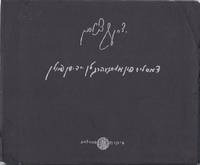
1963ref. 43253New York: YKUF 1963. Paperback. Original Wrappers. 12mo. 79 pages. 17 cm. In Yiddish. Includes introduction by Miriam Novitch as well as "Vi Yitshak Katsnelson hat geshribn zayne klog-lider" also by Miriam Novitsh on pages 15-16. “Song of the Murdered Jewish People" by Itzhak Katzenelson 1885–1944 a leading Hebrew and Yiddish poet. ”Katzenelson’s world fell apart when in August 1942 his wife Hanna and two younger sons Ben-Tsiyon and Binyamin were deported to Treblinka. From then on his literary creativity was piercingly shaped by lamentations over the loss of his family. Nonetheless with his oldest son Tsevi he found the strength to join the Jewish Fighting Organization and took part in the first uprising of January 1943. After the ghetto was destroyed in April and May 1943 he escaped to the Aryan section of Warsaw and obtained a Honduran identity document. Nevertheless he was sent to a German detention camp for foreign subjects in Vittel France. He was imprisoned there until April 1944 and devoted most of his time to writing. Two important works were produced during that period: Pinkas Vitel The Vittel Diary a Hebrew composition that uses the language of an incensed diarist and reconstructs the days of terror in Warsaw during the mass deportations; and Dos lid fun oysgehargetn yidishn folk The Poem about the Murdered Jewish People a pathos-filled Yiddish poem that laments the destruction of the Jewish people and of the poet himself who has been become bitterly angry with humankind and God. These two works are among the boldest and most lofty literary expressions to emerge from the Holocaust.… All of Katzenelson’s works from his Vittel period were either buried in hiding places or were given to people he trusted; consequently they were saved and published shortly after the end of the war. In the middle of April 1944 Katzenelson and his son Tsevi were sent to the Drancy transit camp and from there one month later to Auschwitz where they were murdered. In 1950 the Ghetto Fighters kibbutz built a museum and an institute for research about the Holocaust that bear Yitshak Katzenelson’s name” YIVO Encyclopedia. Subjects: Holocaust Jewish 1939-1945 -- Poetry. OCLC: 28824340. Some stains on covers Good Condition. B HOLO2-97-33A-XX-ELABCC. New York: YKUF paperback
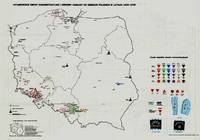
1979ref. 41929Warszawa Warsaw: Pan´stw. Wydawn. Naukowe 1979. 1st Edition. Original black printed portfolio 8vo. Portfolio of seven large folding maps on on 4 sheets of heavy paper 3 are double sided 1 is singled sided. Primarily black and white with some color. Text in Polish. Title translates to “Nazi camps in Poland 1939 - 1945. An Encyclopaedic Reference Book: Maps." Collection of 7 maps each 84 cm x 60 cm 33 x 24 inches produced by Jan Laskowski at the Main Commission for the Investigation of Nazi Crimes in Poland. The maps comprise Volume II of the work; Volume I is a heavily illustrated 676-page book of the same title which we offer separately. The Seven maps all present are: - Map 1 Single Sided: Hitlerowskie obozy na ziemiach polskich w latach 1939 - 1945. “Nazi camps in Poland in the years 1939 - 1945”. Showing: concentration and extermination camps sub-camps of concentration camps extermination centers POW camps more important sub-camps working divisions commandos and temporary POW camps penal labor camps major labor camps prisons transit camps & ghettos. - Map 2A: Getta na ziemiach polskich w okresie okupacji hitlerowskiej w latach 1939 - 1945 “Ghettos in Poland during the Nazi occupation in 1939 - 1945”. - Map 2B: Hitlerowskie obozy przejsciowe na ziemiach polskich w latach 1939 - 1945 “Nazi transit camps in Poland in 1939-1945”. - Map 3A: Hitlerowskie wiezienia i areszty na ziemiach polskich w latach 1939 - 1945 “Nazi prisons and arrests in Poland in 1939 - 1945”. - Map 3B: Hitlerowskie obozy pracy na ziemiach polskich w latach 1939 - 1945 “Nazi labor camps in Poland in the years 1939 - 1945”. - Map 4A: Hitlerowskie obozy jenieckie na ziemiach polskich w latach 1939 - 1945 “Nazi POW camps in Poland in 1939 - 1945”. - Map 4B: Hitlerowskie obozy koncentracyjne i osrodki zaglady na ziemiach polskich w latach 1939 - 1945 “Nazi concentration camps and extermination centers in Poland in 1939 - 1945”. Maps 2A & 2B have been described as a “Terrifying pair of maps showing the locations of German POW and internment camps in Poland during World War II highlighting the widespread locations of these establishments. In some parts of the map the information becomes so dense that three inset maps are shown. This map was designed by Jan Laskowski and printed in 1979 as part of a work on the Nazi extermination machine produced by PWN Warsaw a state-owned research-focused publishing house in Poland. The map on the front is particularly interesting for its depiction of symbols used to classify internees in German camps. The uppermost of these depictions shows the combinations that can be made for different types of prisoners of different levels of importance. The armbands that would have been worn by these prisoners is shown as well as the prison uniforms. Other details are also shown. The map lists hundreds of sites run by Nazi operators throughout the country. These include concentration camps death camps transitional camps and ghettos. The map is divided according to Poland's voivodeships with a key in the lower left. Names of cities too long to spell are also provided in the lower left. This map was produced during a point in Poland's history during which it was actively revisiting the period during the Second World War. Leading social scientists devoted their time to trying to gather all the living as well as the recorded history of the events of the Holocaust and related atrocities before this information vanished. Leading these efforts particularly during the 1960s and 1970s was the Glówna Komisja Scigania Zbrodni przeciwko Narodowi Polskiemu known as the Chief Commission for the Prosecution of Crimes against the Polish Nation. They were active in publishing maps both for domestic educational purposes and for international remembrance and diplomatic efforts regarding the Holocaust. Jan Laskowski was a leading cartographer who produced a number of maps in this field. These maps were produced as part of a series of maps that purported to combine to form an atlas of all of Hitler's crimes in Poland. Many of the large wall maps produced during this period could only show a fraction of the crimes or only the atrocities committed in one region. Thus a series of maps was needed to show all the points necessary which this present work contributes to. Polish Reinterpretations of the Holocaust: Studying the effects of German occupation in Poland is a delicate subject. While it is certain that Poland suffered at least as badly as any other European nation during the Second World War reinterpretations of the Holocaust in the country have also been used to satisfy nationalistic tendencies. It has become evident to Western observers in the last several years that there is a strong nationalist movement in Poland that seeks to place blame for the Holocaust solely on the shoulders of non-Polish actors a movement originally fostered under Soviet rule. This movement has gone so far as to limit freedom of speech criminalizing with a three-year sentence the suggestion that Poland or its citizens in any form participated in the murders committed by Nazis. As such the term ‘Polish concentration camps’ has been deemed unacceptable with the government-approved term being ‘concentration camps on Polish territory.’ All lines of evidence show that this map 2A & 2B was produced using the most accurate and impartial historical sources. The language on the map is simple naming only ‘Hitler's Atrocities’ and there is no evidence of a clear anti-German bias. However it is impossible to separate this map one of the most important productions of the remembrance movement during this period from the social situation in which it was produced. Maps like these can easily be converted into propaganda instruments and today's Polish leaders most of whom grew up during Soviet occupation will have formed their understanding of the Holocaust through maps like these. Soviet Censorship: While the content of the map appears to have been produced free from bias the map still had to go through Soviet censorship. Mentioning prisoner of war camps in which primarily Soviet troops were interned would have been a prerequisite condition upon which the publication of the map rested. Further the lack of mention of any Soviet killings or camps requires no explanation….The map unlike many later maps makes no differentiation between the populations who suffered at the various camps. This represents the Soviet agenda that all nations suffered fought and won equally which sought to limit divisions in this post-identity state” Ruderman 2022. SUBJECTS: World War 1939-1945 -- Prisoners and prisons German. -- Concentration camps -- Poland. Guerre mondiale 1939-1945 -- Prisonniers et prisons des Allemands. -- Camps d'internement -- Pologne. Obozy koncentracyjne -- Polska -- 1900-1945. OCLC: 830885973. Light shelf wear to portfolio as expected. All maps in pristine condition with normal folds as issued. Very Good Condition. Complete and dramatic BR5 holo2-147-19-'cc. Warszawa (Warsaw): Pan´stw. Wydawn. Naukowe unknown
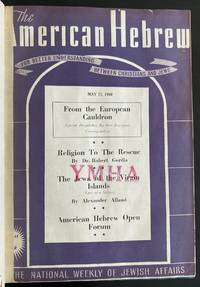
1940ref. 40003New York N. Y. : American Hebrew 1940. Hardcover. 1st edition. 4to. Period Cloth 4to Approximately 20 pages each issue approximately 520 pages total. Issues were published weekly. Holocaust-era American weekly Jewish magazine. “From the time of its founding The American Hebrew covered many topics of intense Jewish interest internationally” wikipedia. This set of magazines contain articles showing reform Jewish perspectives on WWII and the Holocaust including material about Jewish refugees “Behind the War” “Relationship Between Religion and Democracy “War Propaganda in England and Germany” as well as more mundane topics such as an essay we noted titled “Resort Guide: Another List of Ideal Vacation Spots Selected for American Hebrew Readers.” SUBJECTS: Jewish newspapers. -- United States. OCLC: 1479954. Many copies have a YMHA stamp on cover of magazine. Cloth cover has staining and dampstains pages are not affected. Spine says “American Hebrew 147 May-Nov. 1940”. Magazines in Very Good Condition. B HOLO2-140-11-X-'mmecc. New York, N. Y. : American Hebrew hardcover
1948ref. 29513New York; YKUF 1948. Paperback. Original Wrappers. 12mo. 79 pages. 17 cm. Undated edition. In Yiddish. Includes introduction by Miriam Novitch as well as "Vi Yitshak Katsnelson hat geshribn zayne klog-lider" also by Miriam Novitsh on pages 15-16. “Song of the Murdered Jewish People" by Itzhak Katzenelson 1885–1944 a Hebrew and Yiddish poet. ”Katzenelson’s world fell apart when in August 1942 his wife Hanna and two younger sons Ben-Tsiyon and Binyamin were deported to Treblinka. From then on his literary creativity was piercingly shaped by lamentations over the loss of his family. Nonetheless with his oldest son Tsevi he found the strength to join the Jewish Fighting Organization and took part in the first uprising of January 1943. After the ghetto was destroyed in April and May 1943 he escaped to the Aryan section of Warsaw and obtained a Honduran identity document. Nevertheless he was sent to a German detention camp for foreign subjects in Vittel France. He was imprisoned there until April 1944 and devoted most of his time to writing. Two important works were produced during that period: Pinkas Vitel The Vittel Diary a Hebrew composition that uses the language of an incensed diarist and reconstructs the days of terror in Warsaw during the mass deportations; and Dos lid fun oysgehargetn yidishn folk The Poem about the Murdered Jewish People a pathos-filled Yiddish poem that laments the destruction of the Jewish people and of the poet himself who has been become bitterly angry with humankind and God. These two works are among the boldest and most lofty literary expressions to emerge from the Holocaust.… All of Katzenelson’s works from his Vittel period were either buried in hiding places or were given to people he trusted; consequently they were saved and published shortly after the end of the war. In the middle of April 1944 Katzenelson and his son Tsevi were sent to the Drancy transit camp and from there one month later to Auschwitz where they were murdered. In 1950 the Ghetto Fighters kibbutz built a museum and an institute for research about the Holocaust that bear Yitshak Katzenelson’s name” YIVO Encyclopedia. Subjects: Holocaust Jewish 1939-1945 -- Poetry. OCLC: 12260367. Half Dollar size chip to cover no text loss institutional stamp on title page taped spine otherwise Good Condition. BK5 B HOLO2-97-33-XX-ELABCC. New York; YKUF paperback
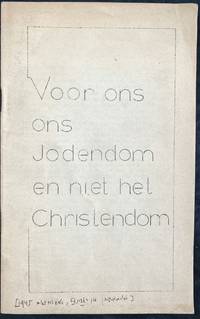
1930ref. 25194Amsterdam: Selecta 1930. Softcover 24 pages 22 cm. In Dutch. “For us Judaism—and not Christianity. ” Jewish response to attempts at conversion just prior to the Holocaust. Chief Rabbi Justus Tal 1881-1954 was "From 1918 until the outbreak of World War II.Chief Rabbi of Utrecht. During the war he was hidden from the Nazis by a Protestant clergyman. Afterwards he assumed the post in Amsterdam and was elected president of the Dutch Conference of Chief Rabbis" JTA 1954. OCLC: 64304774. OCLC lists 14 copies worldwide only 3 in the US HUC Harvard YIVO none south or west of Ohio. Light wear. Handwritten note on bottom of cover notes "edited by Chief Rabbinate of Netherlands Amsterdam 1945.” Good condition. B Holo2-162-37XXXCC-'. Amsterdam: Selecta unknown
2007ref. 012681Tielt: Nieuw Amsterdam / Lannoo 2007. Omnibus uitgave boek met stofomslag in goede staat. 471 862 pagina's. Oorspronkelijke titels: "Nazi-Germany and the Jews; Volume 1 The Years of Persecution 1933-1939 ; Volume 2 The Years of Extermination - Nazi Germany and the Jews 1939-1945. 1ste / 1st. Cardboard / Karton. Good / Goed/Good / Goed. A5. Nieuw Amsterdam / Lannoo hardcover
ref. 0889467145New. hardcover. New. Satisfaction Guaranteed or your money back. hardcover
1947ref. 298232New York: Machmadim Art Editions 1947. Hardcover. Very Good. Folio in gray cloth with original brown paper dustjacket. Book of fantastic charcoal illustrations with accompanying Yiddish melodies on staves Machmadim Art Editions hardcover
ref. 0815635532.Ghardcover. Good. Access codes and supplements are not guaranteed with used items. May be an ex-library book. hardcover
ref. 9997678281.Ghardcover. Good. Access codes and supplements are not guaranteed with used items. May be an ex-library book. hardcover
ref. 69182New York: Raw Books & Graphics 1986. Very Good. Slim folio 36 cm Saddle-stitched illustrated wraps. Wraps lightly rubbed. Moderate soiling to rear wraps of numbers 1 and 3. Volume 1 Number 1 Fall 1980. "Two-Fisted Painters" by Art Spiegelman booklet. Volume 1 Number 3. 1981. "Maus Chapter Two The Honeymoon" booklet. Volume 1 Number 4. 1982. Vinyl record "Reagan speaks for himself" detached and laid in. "Maus Chapter Three Prisoner of War" booklet. Volume 1 Number 5. 1983. Couple by Art Spiegelman. "Maus Chapter Four The Noose Tightens" booklet. Stapled in a little loosely. Volume 1 Number 6. 1984. "Maus Chapter Five Mouse Tales" booklet. Volume 1 Number 7. 1985. "Maus Chapter Six Mouse Trap" booklet. "Red Flowers" booklet by Yoshiharu Tsuge. Deliberately issued by the publisher with a torn front wrap. Volume 1 Number 8. 1986. Jimbo by Gary Panter. "Maus Chapter Seven Mauschwitz" booklet. The first number along with six other issues of RAW Magazine Volume 1. Number 2 is not present. A very colorful and bold comics and graphics anthology edited by Art Spiegelman and Françoise Mouly a husband and wife team which highlighted artists from around the world and was published in the United States from 1980 to 1991. In addition to the work of Spiegelman and Mouly RAW featured cutting-edge comic artists such as Robert Crumb Gary Panter Charles Burns Kim Deitch Sue Coe Jerry Moriarty Richard Sala and Ever Meulen among many others. In these issues of RAW one will find Gary Panter's best-known comic protagonist "Jimbo" a burly punk and existential adventurer as well as "The Voice of Walking Flesh" by Charles Burns "Love's Savage Fury" by Mark Newgarden and a centerfold by Ever Meulen captioned "Use the Mood of the Past to Rewire Your Brain for the Future." Of significant importance is the fact that Art Spiegelman's seminal graphic work "Maus: A Survivor's Tale" made it's first appearance in this magazine chapters 2-7 are present here as stapled-in booklets. Spiegelman's unrivaled Holocaust narrative "Maus" was awarded the 1992 Pulitzer Prize it was the first graphic novel to win the Pulitzer Prize and he was the first-ever cartoonist to receive the prestigious Edward MacDowell Medal a medal awarded annually since 1960 to artists who have made an outstanding contribution to American culture. A nearly consecutive run of volume 1 of this trailblazing magazine with original serialized chapters of "Maus." "The Graphix Magazine for Your Bomb Shelter's Coffee Table." Number 4 front cover caption. Raw Books & Graphics unknown