[holocaust]ABAA

11 Ergebnisse
1975Best.-Nr. 162863Villejuif: the municipality 1975. 241p. b&w photo section mostly archived period images first edition green oilcloth boards gilt titling a bit rubbed long ink inscription signed by a resident of Villejuif a very good copy. Laid in find a color brochure of the antifacist museum consisting of six 4x8 inch panels showing exhibits. --Caveat emptor: volume is very faintly musty. Aka Vassieux-en-Vercors. "A la occasion du cinquantieme anniversaire de la Municipalite Communiste de Villejuif." Marchais was at writing the secretary-general of the French Communist Party. the municipality unknown books
1998Best.-Nr. 39147Boston: Little Brown 1998. First edition second printing. 4to pp. 254. Notes chronology reading list index. Illustrated with photographs maps facsimiles. Almost as new. Little Brown unknown books
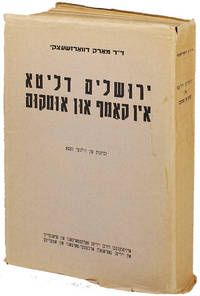
1948Best.-Nr. 16623Paris: L'Union Populaire Juive en France 1948. First Edition. Octavo. Printed paper wrappers; 515pp; illus some folding; facs. Includes bibliography. Text entirely in Yiddish. Text slightly tanned but a tight clean copy overall VG or better in the original wrappers. First-hand account of atrocities in the Vilnius ghetto by a survivor; extensively documented including facsimiles of original documents and photographic evidence of Nazi atrocities. Uncommon especially in this state of preservation. L'Union Populaire Juive en France unknown books
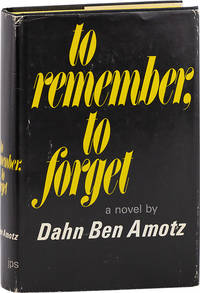
1973Best.-Nr. 62864Philadelphia: Jewish Publication Society of America 1973. First American and first English language edition. Octavo. Cloth hardcover; dustjacket; yellow top-stain; 399pp. Tight straight fine copy with top-stain vivid and unfaded. In the original dustwrapper unclipped priced $6.95 on front flap lightly rubbed at extremities VG. Ben-Amotz's semi-autobiographical first novel a landmark portrayal of a Polish Holocaust survivor who re-invents himself as a true sabra in postwar Israel. Ben-Amotz would go on to a popular and somewhat controverisal career as a fiction-writer journalist and media personality. Originally published in Hebrew as "Lizkor lishcoah" Tel-Aviv 1968 the English-language translation is by Zeva Shapiro. Surprisingly uncommon especially in nice condition. Jewish Publication Society of America unknown books
Best.-Nr. 73DS. Haifa. A partly printed document signed "Olga Polok" regarding moving funds from her bank fund just four days after the start of World War II: "I. have conferred general authority upon Olga Polak whose signature please find below to administer - as he may think fit - all funds or securities now or in future lying for my our account with yourselves or with any other offices of the Hollandsche Bank Unie N.V. or with any one of their correspondents; to dispose of same to receive the countervalue of all securities moneys deposits bills cheques and promissory notes telegraphic and letter-payments. to give discharge for same to give all kinds of instructions and to sign as my our mandatory receipts. It is hereby expressly stipulated that I we waive the right to notarial notices in connection with any matter arising out of these presents. ". The document has a few light toning patches and is in fine condition overall. An unusual Holocaust-era document. unknown books
1938Best.-Nr. liliOctavo paper boards 22 x 15 cm viii 132 pages; backstrip chipped paper toned and a little brittle with torn title page and occasional chipping decent condition overall. Half-tone photos throughout. A very evocative guide book to "Jewish excursions" in Frankfurt and Hessen dedicated to "My wife Bertha Lilienthal née Fuchs. My hiking companion on rocky roads." The preface is dated almost exactly a year before Kristallnacht. The author was the chief cantor at the main synagogue in Wiesbaden. He and his wife fled to Amsterdam in June 1939. He was transported to Theresienstadt in 1943 and murdered in October 1944. His wife's exact fate is unknown. J. Kauffmann, Jüdischer Buchverlag hardcover books
1945Best.-Nr. 47189Krakow: Spóldzielnia Wydawnicza "Czytelnik" Czytelnik Publishing Cooperative 1945. First edition. Softcover. g to von-. Octavo 8 1/4 x 6". 93pp. 13 leaves of double sided photographic plates interleaved and unpaginated. Illustrated tan red and black wrappers with black lettering on the front cover. Photographic b/w frontispiece. Spóldzielnia Wydawnicza "Czytelnik." Possibly an earlier publication on lower quality paper compare to a slightly smaller publication by the "Library of the Union of Polish Patriots in the USSR" Biblioteczka Zwiazku Patriotów Polskich w ZSRR with the same text in different layout. That publication issued on higher quality paper and with twenty-eight photogravures three more than in this publication with twelve photographs appearing in both publications though in lesser quality here. Court Proceedings of the Polish-Soviet Special Criminal Court established in Lublin in August 1944 in order to investigate the crimes committed by the Germans in the Majdanek extermination camp. Despite the importance of this document it must be mentioned that the Commission made erroneous assumptions regarding the duration of the camp and the number of people killed at Majdanek. The Publishing cooperative "Czytelnik" was established behind Soviet front lines in 1944. It became the first post-World War II. publisher in Poland. The total numbers of the victims is still controversial: In this report 1.5 million victims of different nationalities were counted however according to the latest researches there were 79000 victims 59000 of whom were Jews See: Kranz T.: "Bookkeeping of Death and Prisoner Mortality at Majdanek." pp. 81-110. In: Silberklang D. Ed.: Yad Vashem Studies. Vol. 35:1. Jerusalem 2007. Illustrated with 25 pages of b/w photographic reproductions including a frontispiece on 13 double-sided interleaved plates altogether thirty-two photographs depicting members of the Commission Nazi guards now prisoners who used to run the camp and survivors alike testifying before the Commission. Also includes views of the actual concentration camp piles of suitcases Zyklon B poison gas pellets gas chambers ovens and survivors amid corpses. Wrappers with some chipping rubbing creasing and/or closed tears to extremities. Small stain on the back cover and side edge of book block. Verso of frontispiece with a vertical crease. Some pages throughout with some light age toning or small water spots. Overall text and images clear and vibrant. Wrappers in good interior in very good- condition overall. One of two editions of this work published in Moscow and Krakow in 1945. It is not certain which was released first. Each has different wrappers size pagination and publishers. Spóldzielnia Wydawnicza "Czytelnik" (Czytelnik Publishing Cooperative) unknown books
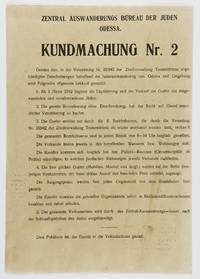
1942Best.-Nr. 51752Odessa: Zentral Auswanderungs Büreau 1942. Original document. Loose leaf. Very good condition. Quarto. Original loose leaf with black lettering. Announcement based on ordinance no. 35/942 of the civil government of Transnistria relating to the emigration of Jews in Odessa and surrounding areas. The text printed biligually in German and Ukrainian is organized into five statements. The annoucement concerns the liquidation and sale of goods of emigrated or vanished Jews beginning on March 1 1942 with the whole population without limitations given the right to buy these items based on oral agreements. Furthermore the announcement regulates details and procedures of the sale and at the end announces that after the sale proceeds will by handed to the Jews by the Central Emigration Office. "The rapid development of Odessa began after the Russian conquest 1789. Its Jewish population also grew quickly and in the late nineteenth and early twentieth centuries it was the most important Jewish literary community after Warsaw. In 1926 there were 153194 Jews in Odessa 36.4 percent of the total population and by 1939 their numbers reached 180000." Encyclopedia of the Holocaust Vol. 3 page 1080. When Romanians and Germans laid siege to the city on August 5 1941 many Jews in Odessa managed to leave and eighty to ninety thousand Jews remained in the city. Odessa fell on October 16 and the German Einsatzkommando 11b and the Romanian intelligence service immediately slaughtered over eight thousand residents mainly Jews and Odessa was established as the capital of the Transnistria region. On October 22 the Romanian military headquarters were blown up killing sixty-six officers and the military governor. In reprisal the Romanian ruler Ion Antonescu ordered devastating retaliation including the arrest of one member of each Jewish family. By October 1941 some 40000 Jews were assembled in the ghetto of the nearby city of Slobodka and their valuables confiscated. Deportations of some 20000 Jews began in January of 1942. When Odessa was liberated on April 10 1944 authorities reported that about 99000 Jews had been killed. Odessa again became an important Jewish center with 102000 Jews living there according to a 1959 census. Considering the context of "Kundmachung Nr. 2 the Odessa massacre of October 22-24 1941 and the murder of Jews living between the rivers Dniester and Bug during the Romanian and German occupation this succinct notice including its misspellings and mistakes in the German language is a chilling mirror image of the attitude shown by the occupying powers towards the Jews. Approximately 30000 Jews were killed in Odessa and more than 100000 in Transnistria. The text is printed in German on one side and Ukrainian on the verso. Minor wear and smudging. Protected in modern mylar. Zentral Auswanderungs Büreau unknown books
Best.-Nr. 69182New York: Raw Books & Graphics 1986. Very Good. Slim folio 36 cm Saddle-stitched illustrated wraps. Wraps lightly rubbed. Moderate soiling to rear wraps of numbers 1 and 3. Volume 1 Number 1 Fall 1980. "Two-Fisted Painters" by Art Spiegelman booklet. Volume 1 Number 3. 1981. "Maus Chapter Two The Honeymoon" booklet. Volume 1 Number 4. 1982. Vinyl record "Reagan speaks for himself" detached and laid in. "Maus Chapter Three Prisoner of War" booklet. Volume 1 Number 5. 1983. Couple by Art Spiegelman. "Maus Chapter Four The Noose Tightens" booklet. Stapled in a little loosely. Volume 1 Number 6. 1984. "Maus Chapter Five Mouse Tales" booklet. Volume 1 Number 7. 1985. "Maus Chapter Six Mouse Trap" booklet. "Red Flowers" booklet by Yoshiharu Tsuge. Deliberately issued by the publisher with a torn front wrap. Volume 1 Number 8. 1986. Jimbo by Gary Panter. "Maus Chapter Seven Mauschwitz" booklet. The first number along with six other issues of RAW Magazine Volume 1. Number 2 is not present. A very colorful and bold comics and graphics anthology edited by Art Spiegelman and Françoise Mouly a husband and wife team which highlighted artists from around the world and was published in the United States from 1980 to 1991. In addition to the work of Spiegelman and Mouly RAW featured cutting-edge comic artists such as Robert Crumb Gary Panter Charles Burns Kim Deitch Sue Coe Jerry Moriarty Richard Sala and Ever Meulen among many others. In these issues of RAW one will find Gary Panter's best-known comic protagonist "Jimbo" a burly punk and existential adventurer as well as "The Voice of Walking Flesh" by Charles Burns "Love's Savage Fury" by Mark Newgarden and a centerfold by Ever Meulen captioned "Use the Mood of the Past to Rewire Your Brain for the Future." Of significant importance is the fact that Art Spiegelman's seminal graphic work "Maus: A Survivor's Tale" made it's first appearance in this magazine chapters 2-7 are present here as stapled-in booklets. Spiegelman's unrivaled Holocaust narrative "Maus" was awarded the 1992 Pulitzer Prize it was the first graphic novel to win the Pulitzer Prize and he was the first-ever cartoonist to receive the prestigious Edward MacDowell Medal a medal awarded annually since 1960 to artists who have made an outstanding contribution to American culture. A nearly consecutive run of volume 1 of this trailblazing magazine with original serialized chapters of "Maus." "The Graphix Magazine for Your Bomb Shelter's Coffee Table." Number 4 front cover caption. Raw Books & Graphics unknown books
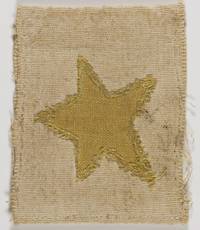
1943Best.-Nr. 53630Tunisia 1943. Nearly Fine. Five-pointed yellow cloth star sewn onto plain beige cloth 7.3 by 9 cm. Yellow dye somewhat faded else in fine state of preservation. Specimen of the yellow star imposed on the Jewish population of Tunisia in March 1943 as a mark of the slave laboror. Tunisia was the only Islamic country to come under Nazi rule at first indirectly through the Vichy regime in France between 1940 and its liberation by Allied forces on May 7 1943. In response to the Allied invasion of Algeria and Morocco German and Italian forces invaded Tunisia on November 9 1942. By the end of November the Germans took the first anti-Jewish move by arresting four of the community leaders including Moïse Borgel the president of the Jewish congregation. "In addition to the governor-general's sympathetic attitude -- and in some degree to the pro-Jewish attitude of Bey Sidi Mohammed al-Mounsaf -- the Italians also in practice interfered with the application of the anti-Jewish laws" E.H. The dignitaries were released after a week following the intervention of the mayor of Tunis and the Italian consul. Because of objections by the Italians the edict to wear the star does not appear to have been generally enforced with rigor and was only formally imposed in two cities Sfax and Tunis. While 5000 Jews had originally been put on forced labor in thirty locations and camps along the front line "at the time of the collapse and surrenter in early May 1943 only sixteen hundred Jews were employed on forced labor" E.H. Given the relatively small labor force and the lack of zeal in imposing the anti-Jewish ordinances it is clear why so few of these yellow badges have survived. References: I. Gutman ed. Encyclopedia of the Holocaust vol. 4 pp. 1521-23. unknown books
1946Best.-Nr. 349981946. First Edition. JUDAICA HOLOCAUST SURVIVORS. Unser Welt Our World. Partial nearly complete run from 1946 Number 1 through 1951 Number 2. Munich and Paris: 1946-51. Folio earlier numbers 1946 Number 1 through 1948 Number 18 bound in half black cloth and boards; remaining numbers 1948 Number 19 through 1951 Number 2 unbound folded once as issued. $7500.Scarce nearly complete run of the earliest issues of the Zionist newspaper Unser Welt Our World the National Weekly for Jewry in Europe published in Munich just after World War II and the Holocaust.Unser Welt was a Zionist-oriented publication with a deep respect for the Revisionist wing of the Zionist movement with editorial offices in Munich and Paris. Initially for the first two numbers the newspaper was called Hamdina ""The State""; this collection contains both Numbers 1 and 2 of Hamdina all published under that name along with Number 1 of the newly titled Unser Welt all from 1946. By the late 1940s however Unser Welt's circulation reached several European nations besides Germany namely Switzerland France Austria Belgium Sweden and Italy and its sub-title proclaimed it to be the ""National Weekly for Jewry in Europe."" The very fact that Unser Welt sought to be the publication of European Jewry spoke volumes about a conscious decision of a number of Jews to remain in the continent where two-thirds of their brethren had been murdered. This collection includes from 1946 both Numbers 1 and 2 of Hamdina then of Unser Welt Numbers 1 5 8-15 18 20-21 23-30; from 1947 Numbers 31 33-45a 48-82; from 1948 Numbers 1-18 all of which are bound together in one folio volume. The collection also gathers from 1948 Numbers 19-49 51-62 65-69; from 1949 Numbers 3-13 15-17 20-30 35-42 44/45-46 49; from 1950 Numbers 1-50; and from 1951 Number 2. These are all unbound folded once as issued. Text in Yiddish with photographic and line illustrations. A few minor closed tears and mild edge-wear to unbound numbers. Exceptionally good condition. Scarce. hardcover books