5 266 résultats
1919Original Wraps. Single Leaf Folio, double sided [2] pages. 36 x 28 cm. Only edition. Double sided fundraising poster and typewritten letter; typewritten address to Rabbi Joshua Bloch of Lake Charles, Louisiana, requesting the name of the chairman for the campaign committee from his city. Reverse side contains printed fundraising tally accounting sheet poster demonstrating the funds already raised, and the funds remaining to be raised from campaign committees in (appx 190) towns and cities across the United States. 'March 16th-22nd, Campaign Week', 'March 23rd-29th, Meeting of the Central Conference American Rabbis in Cincinnati', 'May 20-21-22 XXVI Council of the Union of American Hebrew Congregations in Boston'. Subjects: Wise Centenary - Union of American Hebrew Congregations Fundraising Campaign 1919. Ephemera - Union of American Hebrew Congregations. None on OCLC. Previously folded in thirds and in half, line creases still remain; otherwise clean and fresh. Very good condition. (AMR-46-7A)
1950Original red cloth boards with later blue spine and gold lettering. 4to. Unpaginated [ca 200 pages]; 38cm. Written in Hebrew and Aramaic. Title translates to Tractate Kiddushin from the Babylonian Talmud. Includes intricately illustrated title page with luxurious royal pillared structure with urns and lion statues. Tractate Kiddushin focuses on marriage law. The Vaad Hatzalah was an organization to rescue Jews in Europe from the Holocaust. It was founded in November 1939 by the Union of Orthodox Rabbis of the United States and Canada (Wikipedia, 2016) . After the war, Vaad Hatzalah published special editions of important Jewish and rabbinic texts for the survivors living in the DP camps in Germany. Some editions, like this one, were printed in New York, where supplies and prototypes of Jewish texts were more readily available. SUBJECT(S) : Talmud, Rabbinic literature, Holocaust survivors, DP camps. OCLC lists no holdings worldwide. Spine rebacked. Dampstaining, markings, and rubbing that affects text on Original boards. Significant edgewear. Library stamps, bookplate, and markings. Pencil and pen markings that minimally affect text. Slight browning to pages. Good condition. Rare edition, much more scarce than the more common Munich publications. (Holo2-134-13)
19471st edition. Original printed paper wrappers, 20 pages. 1st serially issued volume of the detailed Dutch Red Cross report on deportation of Dutch Jews to Auschwitz via Westerbork; special attention to when & what train. Wiener Library (Wolff) I: 1659. Includes errata Slip. An important and rare early document. Very light wear, pages starting to brown, Very Good Condition (Holo2-141-41)
19472nd Revised Edition. Original printed paper wrappers. 8vo, 16 pages. Dutch Red Cross report to help account for the missing--lists name by name who was sent when on which trains from Westerbork to Sobibor. Early, rare and very important. Wiener Library (Wolff) I:1824. Very light wear, pages starting to brown, Very Good Condition (holo2-141-39)
19361st edition, original wrappers, 8vo. 31 pages, charts throughout. In Spanish. Title translates to The Jewish Population in the Argentine Republic. Holocaust-era lecture delivered on October 23, 1935 by Simon Weill. Pages 25-31 are charts Resumen General de la Poblacion Israelita en la Republica Argentina Ano 1934. The US Holocaust Memorial Museum in Washington notes of Argentina during the war, "Argentina, which had admitted 79,000 Jewish immigrants between 1918 and 1933, officially admitted 24,000 between 1933 and 1943. Another 20,000 Jews entered Argentina illegally, crossing the border from neighboring countries." SUBJECT(S): Jews -- Argentina -- Statistics. Population. OCLC: 33237945, OCLC lists 8 copies worldwide. Spine repair, some pencil marks on cover. Internally very good, Good Condition Overall. (HOLO2-141-15-ABBCCIII-'+).
1943Original Wraps. 8vo. 19 pages. 22 cm. First edition. Some Hebrew throughout. Torah va'avodah library, no. 2. Dedicated to Moshe Zvi Weinstock. Contains a discussion of the holiday, with poems, selections from the Bible, Midrash, and Talmud detailing Chamishah Asar Bi'Shevat (Jewish arbor day celebrated on the fifteenth of Shevat) . The mother of the Jew is Eretz Israel. The heart of every Jewish child is tied to his holy motherland [ ] And when this day comes, the fifteenth of Shevat, the day on which the yemot Ha'Geshamim, the period of heavy rainfall is over in Eretz Israel, and the sap begins to rise in its trees, awaking them to a new spring and new life - pg 5. Bachad was a religious Zionist youth movement in pre-war Germany called Brit Chalutzim Datiim which shortened its name to its initial letters Bachad. Its members prepared themselves for Aliya. A group of them came over to England among the refugees who were permitted to enter this country in the years immediately before the war. They were accommodated in a castle in Wales [Gwrych Castle] and set up Hachshara centres in Bromsgrove and other places, as well as a Merkaz Limmud in Manchester to which members came from the Hachsharah centres for periods of three or six months for intensive Jewish studies. Later on a farm was bought at Thaxted in Essex which became not only a model Hachsharah centre but very quickly a successful agricultural venture which at one time won first prize for having the best milk yielding cow in Essex! (bauk, 2013) . Subjects: Tu bi-Shevat. OCLC lists 8 copies. Wraps previously folded, light soiling to outer margins, internally clean and fresh. Very good condition. (SPEC-40-14)
1973Advanced Uncorrected Proof. 8vo. 173 pages ; 22 cm. A rare advanced proof of Wiesels 1974 Play, which was performed on Broadway in 1976 and later made into a full-length movie. As a marketing tool, publishers provide free copies of new book titles to booksellers, stores, PR people, journalists and even celebrities.
1938Original Wraps. 8vo. 65, XI pages. 24 cm. With color fold out chart. Report of the Central Executive of the Ort-Union submitted to the 4th Conference held in Paris in Aug. 24-26, 1937. Detailied report covering the years of 1930-1936, with collage illustrated pages dividing sections, that of the Organization of ORT, Vocational Education Assistance to Artisans, Agriculture, Industrialisation. The constructive work undertaken by the ORT is mostly confined to Eastern Europe in this report, with the majority of activity being conducted in Lithuania, the Soviet Union, Poland, and Romania (with reports on Birobidjan and France as well) . Includes large fold out chart displaying the Geographical Distribution of the Activities of the ORT-Union in 1937, with 11 pages of charts detailing the training and assistance by country (in this period the ORT still maintained an office in Berlin, and was able to have a dayschool for juveniles in locksmithing and engineering, and plumbing and gas workshops for adults, however, the total number of Berlin Jews was 114) . Subjects: World ORT Union - History. Politique internationale. Juifs. 1919-1939. OCLC lists 7 copies (British Libr, Nanterre, Natl Biblio France, Harvard, Tel Aviv, Univ Biblio Hamburg, Deutsche ZentralBiblio) , only 1 in the US. Light wear to edges, very fresh. Very good + condition. (HOLO2-105-37)
1941Original wraps. 4to. 4 pages. 28 cm. First edition. Typewritten Report. Report on the newly founded ORT Technical School in Buenoes Aires, a carefully planned establishment for putting the Argentine-Jewish population on the level of productive industrial work, contributing to the industrial development of the Argentine Republic, and offering a source of pride on the part of the Jews of Argentina. Outlines the courses that have been established (courses for adolescents; courses for Adults) , equipment of the school, the staff, registration and conditions for admission, documents required for admission, reprint of articles on the ORT school printed in El Mundo, April 9th, and El Mundo Israelita (which describes the beneficial aspects of the training not only for the Argentine Jewish community, but also for newly arrived refugees) ; includes reprint of a letter of congratulation from Dr. Enrique Dickmann, member of parliament. Subjects: World ORT Union. ORT (Argentina) . ORT Training Buenos Aires. None listed on OCLC. Scarce. Light edge wear, otherwise fresh and clean. Good + condition. (HOLO2-113-29)
1947Paper Wrappers, 8vo, 29 pages 21 cm. In Polish. A bibliography listing 184 works in Polish published in 1947 or earlier dealing with German atrocities in Poland during WW II. "Tydzien ziem odzyskanych. " SUBJECT (S) : Poland -- History -- Bibliography. OCLC lists 6 copies worldwide (Hoover, Columbia, School of Slavonic & E. European Studies, UCL,Polish Union Cat, Herder Inst) , only 2 in the US. Slight browning to covers, otherwise Very Good Condition. Scarece and important. (H2-1-15)
1941Original Wraps. 8vo. 31 pages. 21 cm. First separate edition. Founder's Day address, Hebrew Union College, March 29, 1941. Reprinted from the Synagogue, Sept. And Oct. 1941. Essay on Wise's life and thought to serve as a comparison between the ideals and times of the nineteenth century (equalitarianism, freedom, the fight against anti-semitism) and the horrors in Germany today. With long reflections on the relationship of Wise to Zionism, Judaism, and America. The author, George Zepin, was born in Russia in 1878. In 1900 he was ordained as a rabbi at Hebrew Union College. From 1917-1941 Zepin was secretary of the Union of American Hebrew Congregations. Subjects: Reform Judaism - United States. Reform Judaism. Wise, Isaac Mayer, 1819-1900. OCLC Number: 5664579. OCLC lists 9 copies. Light soiling and wear to wraps, otherwise clean and fresh. Good + condition. (AMR-46-6)
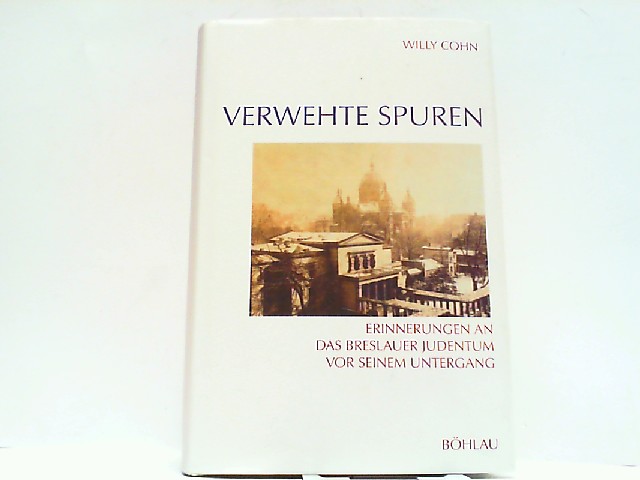
1995réf. 166724Köln, Böhlau Verlag, 1995.
1963IN HEBREW AND YIDDISH. Contains photos in b&w. 220x275 mm. Gilt hardcover. Cover stained and slightly bumped. Pages yellowing. Else in good condition.
1948réf. 2115Film Holocaust Jakubowska Wanda Director. Ostatni etap The Last Stage. Warsaw: PWZG 1948. Oblong sheet folded to create 6 panels measuring 8 x 5 3/4 inches 200 x 145 mm when folded. Program for Ostatni etap The Last Stage a film directed by Auschwitz survivor Wanda Jakubowska 1907-1998. This pioneering work was the first to portray the Auschwitz-Birkenau concentration and death camp. Part of the movie was filmed at Auschwitz and Jakubowska employed Auschwitz survivors to work on the film. The program features black-and-white stills from the film a list of cast members and an essay in Polish. This was undoubtedly Jakubowska's most acclaimed film. She was an ardent communist and made some largely forgettable agitprop pieces after The Last Stage. SCARCE. CONDITION: Several nicks and tears vertical fold throughout some soiling and toning to the pages which appear to be cheap newsprint. About Very Good. PWZG books
1945réf. 107068BBO. O., Dr. u. J. (Berlin ?, American War Information Unit, 1945). 4°. [16] Bl. (inkl. Umschlag) mit 45 Abb. OBr. [9 Warenabbildungen]
1989réf. 017918New York: Grove Weidenfeld 1989. INSCRIBED / SIGNED by Simon Wiesenthal on the front free endpaper. A beautiful copy of the First U.S. printing. Fine condition in a Fine dust jacket. NO chips. NO tears. NO creases. NO fading. NOT price clipped $22.50. Protected by a removable Brodart clear-plastic sleeve. Bright shiny clean square and tight. Sharp corners. NOT a library discard. NO remainder mark. Pages are clean and crisp. NO underlining. NO highlighting. NO margin notes. First U.S. printing 1989 with "First American edition" so stated and complete number row 10 987654321 on the copyright page. Illustrated with 16 pages of photos. Translated from the German by Ewald Osers. Laid in is a copy of Wiesenthal's 2005 obituary. From the publisher: "Since the end of World War II Wiesenthal has dedicated his life to bringing Nazis to justice. In this book he describes his activities the men such as Eichmann and Mengele he has pursued the Nazi escape organization Odessa but also some of the heroism that the horrors produced. The book asks questions about the function of punishment and the possibility of rehabilitation in such extreme cases of criminality. He shows that many of the most sadistic persecutors of the Nazi regime found it all too easy to merge into normal society and assume a cloak of decency. Wiesenthal's aim has been to expose to the fullest possible extent the hypocritical sham of this normalization which he believes incubates the anti-semitism of which the Nazi regime was the most barbaric manifestation." Index. Bound in the original brown boards with a brown cloth spine stamped in shiny copper. Complete with dust jacket. . INSCRIBED / SIGNED by Simon Wiesenthal. First American edition so stated. Hardcover. Fine condition/Fine dust jacket. 8vo. xi 372pp. 16 pages of photos. Grove Weidenfeld Hardcover
2002BRAND NEW. Royal Octavo. Pp. 298. With photographs, facsimiles, tables. Notes, bibliography, index. Hardcover, bound in the original publisher's pictorial boards. A brand new copy. ~ First edition. A well documented study of a rather neglected chapter of Nazi history, the medical killing centre at the Provincial Sanatorium and Nursing Facility in Bedburg-Hau.
1998réf. 220622Urj Press November 1998. Paper Back. Like New. Urj Press unknown
1948Original Illustrated wrappers, 4to. 28 cm. Ceased in 1951. In Yiddish with English Rear Cover. Title from masthead. Includes music, poetry, fiction, journalism and, of course, many photos, photo-mantages, and artwork. SUBJECT (S) : Jews -- Periodicals. OCLC lists 6 holdings that potentially include these issues. Light wear, Very Good Condition. (period-1-6)
19451st edition. Original printed paper wrappers, small 8vo, 50 pages, 21 cm. In Polish. An early (1945!) post-war assortment of eye-witness reportsand documentation of the Warsaw Ghetto Uprising of 1943, 2 years earlier. Table of contents on the last leaf, listing out all 22 essays, some of which are reprinted here for the first time from diaries and newspapers. Also reproduces to flyers honoring the ghetto and a photo of yizkor services to those who perished there. "Between July 22 and September 12, 1942, the German authorities deported or murdered around 300,000 Jews in the Warsaw ghetto. SS and police units deported 265,000 Jews to the Treblinka killing center and 11,580 to forced-labor camps. The Germans and their auxiliaries murdered more than 10,000 Jews in the Warsaw ghetto during the deportation operations. The German authorities granted only 35,000 Jews permission to remain in the ghetto, while more than 20,000 Jews remained in the ghetto in hiding. For the at least 55,000-60,000 Jews remaining in the Warsaw ghetto, deportation seemed inevitable. In response to the deportations, on July 28, 1942, several Jewish underground organizations created an armed self-defense unit known as the Jewish Combat Organization (Zydowska Organizacja Bojowa; ZOB). Rough estimates put the size of the ZOB at its formation at around 200 members. The Revisionist Party (right-wing Zionists known as the Betar) formed another resistance organization, the Jewish Military Union (Zydowski Zwiazek Wojskowy; ZZW). Although initially there was tension between the ZOB and the ZZW, both groups decided to work together to oppose German attempts to destroy the ghetto. At the time of the uprising, the ZOB had about 500 fighters in its ranks and the ZZW had about 250. While efforts to establish contact with the Polish military underground movement (Armia Krajowa, or Home Army) did not succeed during the summer of 1942, the ZOB established contact with the Home Army in October, and obtained a small number of weapons, mostly pistols and explosives, from Home Army contacts. In October 1942, SS chief Heinrich Himmler ordered the liquidation of the Warsaw ghetto and deportation of its able-bodied residents to forced labor camps in the Lublin District of the Generalgouvernement. In accordance with this order, German SS and police units tried to resume mass deportations of Jews from Warsaw on January 18, 1943. A group of Jewish fighters, armed with pistols, infiltrated a column of Jews being forced to the Umschlagplatz (transfer point) and, at a prearranged signal, broke ranks and fought their German escorts. Most of these Jewish fighters died in the battle, but the attack sufficiently disoriented the Germans to allow the Jews arranged in columns at the Umschlagplatz a chance to disperse. After seizing 5,000-6,500 ghetto residents to be deported, the Germans suspended further deportations on January 21. Encouraged by the apparent success of the resistance, which they believed may have halted deportations, members of the ghetto population began to construct subterranean bunkers and shelters in preparation for an uprising should the Germans attempt a final deportation of all remaining Jews in the reduced ghetto. The German forces intended to begin the operation to liquidate the Warsaw ghetto on April 19, 1943, the eve of Passover. When SS and police units entered the ghetto that morning, the streets were deserted. Nearly all of the residents of the ghetto had gone into hiding places or bunkers. The renewal of deportations was the signal for an armed uprising within the ghetto. ZOB commander Mordecai Anielewicz commanded the Jewish fighters in the Warsaw ghetto uprising. Armed with pistols, grenades (many of them homemade), and a few automatic weapons and rifles, the ZOB fighters stunned the Germans and their auxiliaries on the first day of fighting, forcing the German forces to retreat outside the ghetto wall....Though German forces broke the organized military resistance within days of the beginning of the uprising, individuals and small groups hid or fought the Germans for almost a month....The Warsaw ghetto uprising was the largest, symbolically most important Jewish uprising, and the first urban uprising, in German-occupied Europe. The resistance in Warsaw inspired other uprisings in ghettos (e.g., Bialystok and Minsk) and killing centers (Treblinka and Sobibor)" (USHMM 2018).Subjects: Warsaw (Poland) --History--Warsaw Ghetto Uprising, 1943. Beautiful Polish commemorative bookplate from the early post-war years, touch of wear to crown of spine, some toning, Very Good condition, a very nice copy. (H-13-1-EU)
19791st edition, original wrappers, 8vo. 31+[1] pages. The International Scientific Session under the heading The Child In the Years of The Second World War was held in Warsaw on 26th-28th of April 1979. It was organized on the occasion of the International Year of the Child by the Main Commission for the Investigation of Nazi Crimes in Poland and by the Council for the Protection of Monuments of Combat and Martyrdom. The subject of the session were Nazi crimes committed on children and youth, the struggle of nations to save children and youth from their biological extermination, demoralization, denationalization and depravation by the Nazi occupant and also the participation of youth in the combat against Nazism in the years of the Second World War, 1939-1945 . The session coincided with the 40th anniversary of the Third Reichs aggression on Poland which initiated the Second World War, and with the 34th anniversary of the victory over Nazi Germany. It was, therefore, an occasion to reflect on what was fascizm and where it led to. (from introduction) SUBJECT(S) : World War, 1939-1945 -- Children -- Poland. Atrocities. Corp Author(s) : Rada Ochrony Pomników Walki I Meczenstwa (Poland) ; Glówna Komisja Badania Zbrodni Niemieckich w Polsce. OCLC: 34502040, OCLC lists 4 copies worldwide: (National Library of Poland, Bib Narodowa, US Holocaust Memorial Museum, University of S Florida Library, and Niod Instituut Voor Oorlogs) . Upper right corner of cover and pages is slightly bent, light wear on cover, else Very Good Condition. Scarce. (HOLO2-140-4-U)
1941Postcard from Hadassah Reinhard in Tel Aviv to Gerhard Reinhard in Gurs Concentration Camp, dated June 14, 1941. Over 163 words, in period-script German, in ink. Beginning Dear Grandfather, and wishing the recipient a happy 75th birthday, Hadassah writes, I pray to God that you can soon come to me in good health . From Granny and everyone in Poland and Siberia we hear absolutely nothing . The picture is not good . Your youngest grandchild, Hadassah. Gurs was a major internment camp in France, near Oloron-Sainte-Marie and 80 kilometers from the Spanish border. Established in 1939 to absorb Republican refugees from Spain, Gurs served later as a concentration camp for Jews from France and refugees from other countries. While under the administration of Vichy France (1940-1942) most non-Jewish prisoners were released and approximately 2000 Jews were permitted to emigrate. In 1941 Gurs held some 15, 000 prisoners. The camp was controlled by the Germans from 1942 to 1944, during which time several thousand inmates were deported to extermination camps in Poland. An unknown number succeeded in escaping and reaching Spain or hiding in Southern France. Gurs was liberated in the summer of 1944. No stamp or postmark, presume originally delivered in envelope. Few incoming postcards into Gurs survived. Usual stains and wear, 4 faint slices into paper, Good- Condition. (holo2-131-38)
1st Edition. Original Wrappers. 8vo. Tri-Fold Holocaust-era Pamphlet with 5 pages ; 24 cm. The Undersigned Rabbis Are: Philip S. Bernstein, Barnett R. Brickner, Israel Goldstein, James G. Heller, Mordecai M. Kaplan, B. L. Levinthal, Israel H. Levinthal, Louis M. Levitsky, Joshua Loth Liebman, Joseph H. Lookstein, Jacob R. Marcus, Abraham A. Neuman, Louis I. Newman, David de Sola Pool, Abba Hillel Silver, Milton Steinberg, and Stephen S. Wise. We, the undersigned Rabbis, they write, of all elements of American Jewish religious life, have noted with concern a statement by ninety of our colleagues in which they repudiate Zionism on the ground that it is inconsistent with Jewish religious and moral doctrine. This statement misrepresents Zionism and misinterprets historic Jewish religious teaching OCLC lists no holdings worldwide. Front wrapper is mostly loose. 4th and 5th page are torn with a few words affected. Otherwise in good condition. Very rare. (zion-10-57)
19481st edition. Original paper wrappers. 4to, 44 pages. "For presentation to the Second International Conference of the International Bar Association, The Hague, Netherlands, August 16-21, 1948, as part of the Symposium: ‘Restoration of the Law and Property Rights After World War II. '" (from cover) "The actions and policies of the United States Government with respect to the restoration of property rights of foreign nationals after World War II must be considered in the light of the unprecedented and all embracing freezing controls over foreign-owned property imposed by the United States long prior to its entry into the war. " (from introduction) . Alk testified before congress as part of debate over War Claims and Enemy Property Legislation. Not listed on OCLC. Sunning and light wear to cover, and very slight staining of a few pages, else clean copy. Very Good Condition Overall. Appears to be exceedingly rare. (HOLO2-159-15)
1941Original wraps. 4to. 11 pages. 28 cm. First edition. Typewritten Report, by Engineer M. M. Belogousky, Collaborator of the Training Section, Secretary to the Technical Council of the Central Board of World ORT Union. Report on the ORT Schools and Training Courses in France, from the period 1933-39 (training German Jewish Refugees after the advent of Hitler) , with details of the type of courses, those involved, and a schematic outline of the courses given in this period; from the period 1939-1940, when France entered the war, the demand for skilled workers in the 'national defense' industries, the change in situation of refugees and foreign workers, cooperation with MAT-FORD Manufactory (the French Ford) and an exchange of training materials for graduates, inauguration of courses in Lyons at the time of the German invasion, the evacuation of Paris; the period 1940-1941, from the period of the 'French National Revolution' after the armistice with Germany and the imposition of strict requirements on ORT schools, the need for new facilities outside Paris, etc. , the work accomplished since October 1940, with new facilities opened in various towns and cities, the courses offered are listed; immediate difficulties of movement between towns is noted in detail, the granting of three 'circulating cards' permitting unrestricted movement across towns between facitlities for three engineers (Frenkel, Belogousky, Melamed) ; the establishment of ORT courses for people interned in concentration camps (camp Gurs, Argeles, Brens) , the difficulties ensuing, ORT's accomplished release of 150 boys from the camps who are learning a trade at the ORT boarding school in the Pyrenees; last sections of report titled: Constructive Help to Single Refugees, The Management and the Financing of Schools, The Kinds of Program of Studies, Study-Plan, the Pupil's Staff. Subjects: World ORT Union. Jewish refugees - Employment France. Refugees France 1933-1941. OCLC lists one copy (NYPL) . Light wear to edges, lightly aged, otherwise clean and fresh. Very good condition. (HOLO2-113-28)